3.2.13 – THE FLICK. In the last five years, Annie Baker has distinguished herself among young playwrights by zeroing in on the minute particulars of mundane lives and mining them for drama with a richness that bears comparison to Beckett (with whom she shares a reverence for silence) and Chekhov (whose Uncle Vanya she adapted for a production at Soho Rep that was one of last year’s best). The settings are unpromising. Circle Mirror Transformation took place entirely within the confines of a small-town community drama workshop in Vermont. The Aliens happened on the back porch employees’ smoking deck of a restaurant in the same town, next to the dumpster. Baker’s latest, The Flick (at Playwrights Horizons through April 7), depicts a decrepit, barely populated movie theater in Bumfuck, Connecticut, one of the last in the country to project celluloid rather than digital films. Two of the three main characters – black teenage movie nerd Avery (Aaron Clifton Moten) and head usher Sam (the mesmerizing Matthew Maher) — spend the better part of three hours sweeping popcorn off the floor (the set designed by David Zinn immaculately recreates, let’s stay, one of the dingy theaters at the Quad) and pining for the projectionist, a girl in her twenties named Rose with long hair dyed washed-out green (Louisa Krause). Beautifully staged by Baker’s frequent collaborator Sam Gold, the production takes its perverse, pokey time telling this story, and plenty of people bailed at intermission, but I was riveted the whole time and by the end felt like I had witnessed these characters’ entire lives. There were one or two moments I didn’t quite buy, but they didn’t take away from my respect and enjoyment of the endless movie gab, Zinn’s dowdy costumes, and Jane Cox’s lighting, which tells its own story.

Incidentally, the Playwrights Horizons website offers a bunch of cool additional info on the play: an interview with the playwright, an interview with Matt Maher, and a fascinating video about the set and props for the show, revealing how they keep the debris that the usher sweep up looking like “first-run trash” and how they avoid attracting mice (shellack the popcorn). If you “follow” Playwrights Horizons on SoundCloud, you can listen to podcasts of interviews with a whole slew of playwrights and other artists who’ve worked at the theater in the last five years — very cool.
3.8.13 – KINKY BOOTS. Based on the 2005 British movie about a family shoe factory saved from bankruptcy by reinventing itself as manufacturer of fetishy footwear for fierce drag queens, the musical Kinky Boots marks Cyndi Lauper’s debut as a Broadway composer, with book by Harvey Fierstein, directed and choreographed by Jerry Mitchell. With that creative team, it should be the most fun show on Broadway this season, right? I’m bummed to announce that it is not. The first act held my interest, even though the only song that really stood out was “The History of Wrong Guys,” the first trace of certified Cyndi Lauper-ism in the score, sung by the delightful Annaleigh Ashford. At intermission, Andy admitted that he had a headache from trying to love the show and failing. The second act fell apart – the creators didn’t trust the story on its own terms so ladled on a lot of sentimental preaching about what makes a man a man and accepting people for who they are. Two back-to-back Big Numbers stop the show dead in its tracks – super-earnest “The Soul of a Man,” sung by Stark Sands (a good actor but surprisingly bland as the factory owner), and what shockingly was staged to look like this show’s version of “And I’m Telling You I’m Not Going,” as performed by a drag queen at a nursing home, at the end of which said drag queen makes a bathetic speech to the audience, confessing abjectly “I am…a man.” Except for that mawkish scene, Billy Porter as Lola had the audience eating out of his hand – he’s a great performer and it’s nice to see him polishing up his Broadway star. We saw the show about halfway through previews. Undoubtedly there will be changes. Enough to make the show really fly? Much as I admire Jerry Mitchell as a fun pop choreographer who came up the ranks as a dancer himself, as a director he’s no Tommy Tune or Michael Bennett, or not yet anyway. I suspect a stronger directorial hand was needed to help shape this material.
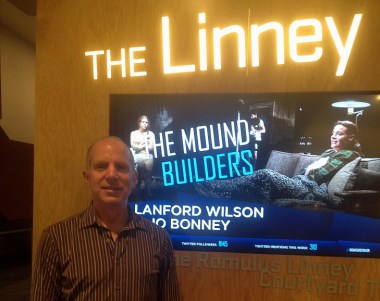
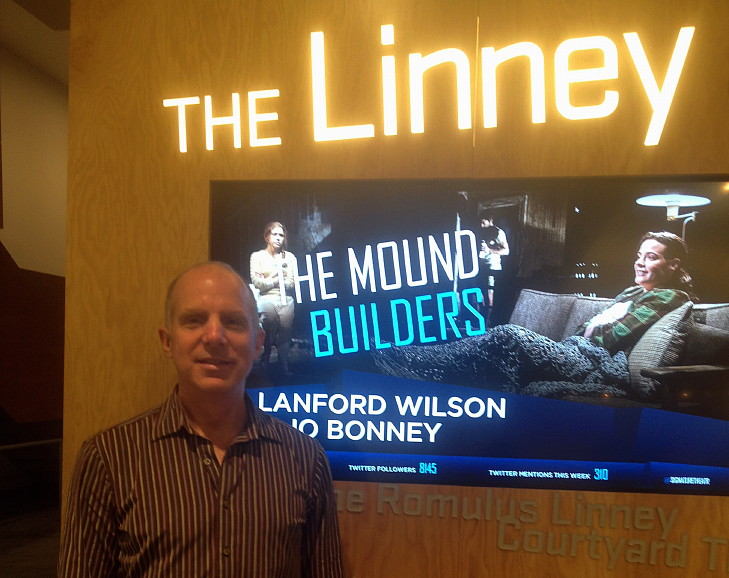
3.10.13 – THE MOUND BUILDERS is one of Lanford Wilson’s rarely performed plays. I’d never seen it, and I’m grateful to Signature Theater for programming it. Wilson was a master at creating complicated group narratives, partly the legacy of his intimate collaboration with the exceptional acting ensemble of Circle Repertory Company. Intelligent, energetic, highly skilled naturalistic actors like Tanya Berezin, Jonathan Hogan, Trish Hawkins, Joyce Reehling, Amy Wright, and William Hurt gave Wilson state-of-the art tools to work with in dramatizing the light and shadows of human beings. The Mound Builders won him an Obie Award when it premiered in 1975, and when I interviewed him for Rolling Stone he told me it was his favorite among all his plays. The story revolves around a group of hotshot archaeologists unearthing a Native American burial ground in southern Illinois on a site whose prospects for commercial development have the local residents dreaming of life-changing windfalls. Characters who are academics and writers give Wilson license to unleash the dense, smart dialogue he does best, and each of them has a distinct world-view and a personality strong enough so that the audience is constantly being thrown off-guard and having to reconsider where the story is going. Chekhov’s The Cherry Orchard unmistakably lurks in the background but Wilson gives the theme of class conflict a particularly American spin, with plenty of ambisexual juice below and above the surface. I thought Jo Bonney did a fine job staging The Mound Builders for Signature and coaxing good performances especially from Danielle Skraastad, Will Rogers, and Zachary Booth, whom I didn’t even recognize as one of the stars of Ira Sachs’ film Keep the Lights On until Tom pointed it out to me at intermission.
3.13.13 – LIZA MINNELLI & ALAN CUMMING at Town Hall. Daniel Nardicio, a nightlife entrepreneur who specializes in underwear parties, produced a concert on Fire Island last summer pairing Liza Minnelli and Alan Cummings that was a big hit, so he booked Town Hall for a two-night return engagement. ‘Twas quite a scene. There were one or two homosexuals in the audience. As for the show: he was absolutely charming, and she was a wreck, hobbling around with an injured ankle and gasping for breath, none of which staunched the tidal wave of Liza Love pouring from the audience. After they did a medley from Chicago (“Nowadays” and “Class”), she toddled offstage and he did his act, the high points of which included: Adele’s “Someone Like You” (mashed up with Lady Gaga’s “On the Edge of Glory” and Katy Perry’s “Fireworks”), “Falling Slowly” from Once, an Elvis Costello song mashed up with Stephen Sondheim’s “Losing My Mind,” and a medley from Hedwig and the Angry Inch (“Wicked Little Town/Wig in a Box”). He’s handsome and sexy and graceful and utterly endearing. As a storyteller, he’s the world’s best talk-show guest, dishy and revealing and funny. Recalling their triumph last summer, he said, “Liza Minnelli in Cherry Grove…it was like a papal visit. If you can imagine the Catholic Church filled with homosexuals…Don’t cry for me, Argentina!” Without pause for intermission, Liza came out and sang her greatest hits, one after another: “New York, New York,” “Maybe This Time,” “The World Goes Round,” even “Liza with a Z,” which ought to be retired by now. Her voice is shot; she doesn’t bother to even reach for the big notes. I found it hard to watch her, with her strange twitchy body habitus. But I’ll never forget how great she was on film in Cabaret and New York, New York.










 another eye opens