THEATER
5.22.13 My dear friend Misha Berson, a dedicated theater scholar who reviews theater for the Seattle Times, visits New York twice a year and always takes me as her guest to a couple of shows. I got lucky this time – both shows we saw together were terrific. Pippin is not a musical I harbor any great love for. I saw and reviewed the post-Broadway national tour when it arrived in Boston in 1979, but it left no impression on me one way or the other. The current revival has gotten pretty sensational reviews and word-of-mouth. Still, I kept my expectations low and it turned out to be much better than I would have thought possible. I’ve not loved Diane Paulus’s productions of The Donkey Show, Hair, or Porgy and Bess (though I did admire her Laura Nyro jukebox musical, Eli’s Comin’ at the Vineyard Theater) but I thought she did an excellent job staging Pippin. Her central good idea was to hire a Canadian circus company, Les 7 doigts de la main, to create an entirely new and different form of “Magic To Do” than the passel of sexy dancers with which Bob Fosse dressed up the original Broadway production.

The circus performers are fantastic, as are Scott Pask’s circus tent set and Kenneth Posner’s lighting. And the leads are surprising, quirky, and satisfying. At first I thought Matthew James Thomas (whom I liked in Spider-Man Turn Off the Dark) was too bland in the title role until I realized that the journey of the play is one of a callow young man moving toward maturity and individuation. Patina Miller (who made a splash in Sister Act) is an intriguing, spiky Narrator – Misha found her “scary,” and indeed at the end when she’s cleared the stage of everyone but Pippin, his wife, and their child, I thought she looked like she was going to eat them. Again, not an unreasonable interpretation of the role. Charlotte D’Amboise and Terrence Mann (married in real life) inhabit their vaudevillean roles like the troupers they are. But the performance that has put this production on the map is Andrea Martin as Pippin’s grandmother. In all my years of theatergoing, I have never seen a performer get a standing ovation in the middle of the first act – Martin does, and she deserves it and the Tony Award that she will undoubtedly walk away with on June 9.
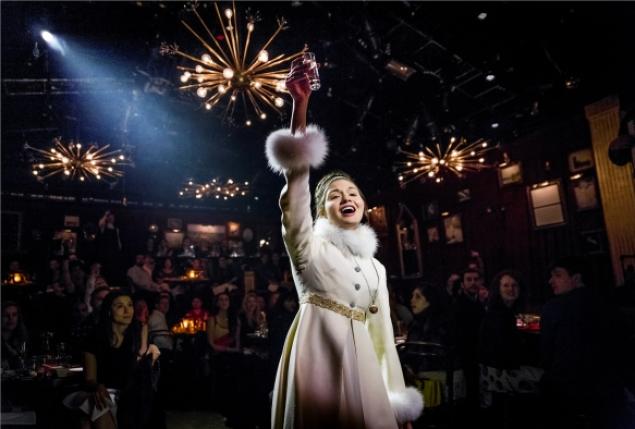
5.24.13 From the glowing reviews it received for its initial limited run last fall, I suspected that I would dig Natasha, Pierre, and the Great Comet of 1812 – but then I thought that about Murder Ballad, which left me cold. (Misha, on the other hand, liked Murder Ballad much more than I did, almost certainly because she sat in conventional seating rather than having to wheel around in her onstage cabaret seat all night long, as I did.) Natasha, Pierre is another immersive theatrical experience – the audience sits at cabaret tables and is served dinner and free vodka shots while the show takes place all around them – performed at a special pop-up temporary space you enter on West 13th Street directly under the High Line. It’s cleverly conceived, designed, and staged on the caliber of Sleep No More (and as expensive), and its ambitions are not modest – it’s an adaptation of a chunk of Tolstoy’s War and Peace with an expertly devised text, luscious score, superbly contemporary orchestrations, and leading performance (as Pierre) by Dave Malloy.

Julliard-training Philippa Soo, as Natasha (above), torn between two lovers, is sensationally good – a real star-in-the-making along the lines of Kelli O’Hara and Lea Michele. It’s a rich, intellectually demanding, quietly profound theatrical event – so much so that the eating and drinking distracted me a lot. High praises to director Rachel Chavkin – she and Malloy deservedly took home Obie Awards for their work – as well as to Paloma Young’s luxurious costumes and Matt Hubbs’s engulfing sound design. This show apparently can only run in this space through September 1, and tickets are going to be gone soon. Worth the investment – you’ll remember it long after you’ve forgotten even good Broadway musicals conventionally staged.
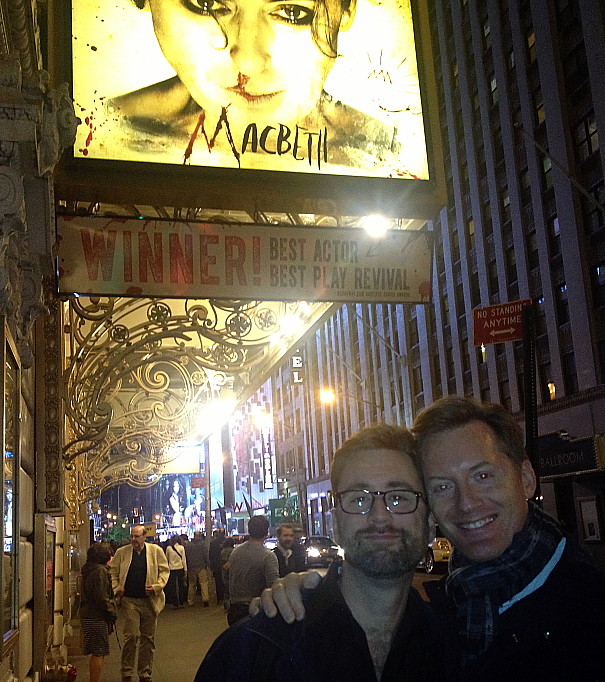
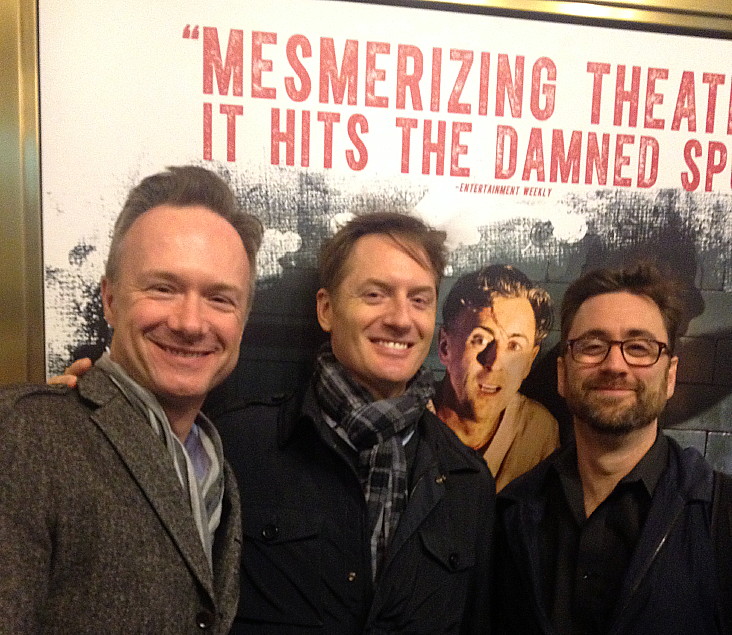
5.25.13 Weeks ago, perhaps high on seeing Alan Cumming dazzle Town Hall in concert with Liza Minnelli, I talked Andy and his college buddy Terry into buying tickets to see Cumming’s conceptual one-man performance of Macbeth. Some good omens: it was staged by John Tiffany, whose stagings of Once and The Black Watch were impeccable; and theater-savvy friends who saw early previews found it compelling to hear the text of The Scottish Play spoken by An Actual Scotsman. After the fact, I remembered that I didn’t care much for Cumming and Tiffany’s previous collaboration on The Bacchae, seen at the Lincoln Center Festival a few years ago.

This show takes place in a mental institution – it opens with Cumming’s character being examined and relieved of his personal belongings by a crisp, kind female doctor and a kind, burly male nurse. As the other two start to leave the room, Cumming says, “When shall we three meet again…?” and then proceeds to enact a truncated version of Shakespeare’s tragedy, playing all the roles. Nothing new is churned up from doing the play this way, nor do we understand something coherent about the character of the mental patient. All we’re left with, really, is a different way of doing one of Shakespeare’s most (over)familiar plays. And a show in which we witness Cumming’s considerable physical agility without his tremendous comic ability is a bit of a waste. The show felt of a piece with Fiona Shaw’s antic, arid performance art rendition of Colm Toibin’s The Testament of Mary.
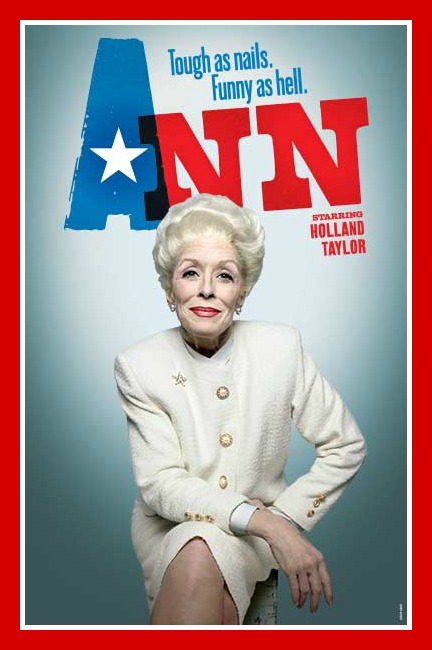
5.26.13 I felt very torn about seeing Ann, the living portrait of former Texas governor Ann Richards written and performed by Holland Taylor at Lincoln Center’s Vivian Beaumont Theater. I didn’t think the play would be very good; I’m allergic to one-person bio-dramas. Yet several people I trust liked it very much (although I think my friend Dave’s experience of the show got skewed somewhat by sitting behind Bill and Hillary Clinton, who were with Meryl Streep and Gabby Giffords and her astronaut husband). It was on TDF, and my friends Tom and Melissa were game for going, so what the hell, we went, and I found that I liked it much more than I expected I would.
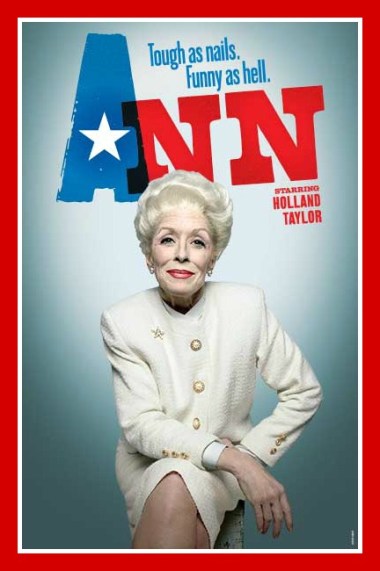
It’s a beguiling performance eerily true to a remarkable woman whose forthrightness and willingness to speak bluntly and truthfully to power made her a hero to many people, including me. (And my mother, who transferred her voter registration from Colorado to Texas just to vote for Richards for governor. Another family connection – Richards grew up in Lakeview, the pitiful lake-free suburb of Waco where we spent five years living in a trailer park while my father was stationed at nearby James Connolly Air Force Base.) The show goes on too long and insists on covering every scrap and tittle of Richards’s life, before and after her one-term governorship. But the middle section is a bravura set piece to match the second act of Lily Tomlin’s The Search for Signs of Intelligent Life in the Universe. Richards is sitting at her desk signing a pile of documents while fielding a relentless succession of phone calls – employees she yells at, reporters she coos to, children she cajoles – and calling out instructions to her offstage secretary. It’s a pretty good stylized condensation of a day in the life of a charismatic high-powered elected official.
FILM
On a break from theatergoing, Mr. David Zinn and I took in Noah Baumbach’s Frances Ha, the new black and white film by the maker of The Squid and the Whale, co-written with Greta Gerwig (his girlfriend), who plays the title role. The film is quirky – always an admirable trait in my book – telling its story in tiny fleet snippets frequently chopped off in such a way as to subvert conventional pleasures. And the story itself undertakes an unreliable-narrator gambit familiar in fiction but hard to pull off in a movie.
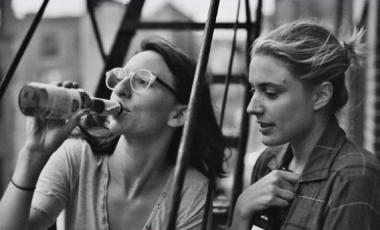
The narrative revolves around Frances’s friendship with high school chum Sophie (played by Mickey Sumner, daughter of Sting) but by the end you can’t really tell whether the friendship has grown distant and sour or whether it was a figment of Frances’ imagination all along. Gerwig plays an impetuous, bumbly underachieving twentysomething surrounded by rich kids with more social savvy. Her performance is not meant to be charming, and it’s not – it’s lumpy and awkward. The inevitable comparison, to Lena Dunham’s Girls, does not favor Frances Ha. It’s like a movie centered on the listless house cleaner Aimee Mann plays on Portlandia. Only in beautiful and admirably dark black and white. With Adam Driver in a key role.
MUSIC
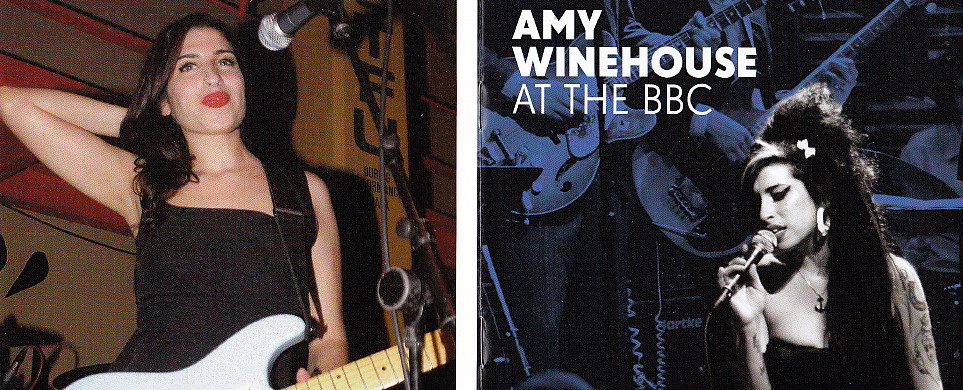
For my birthday, someone gave me a copy of the wonderful two-disc Amy Winehouse at the BBC. Disc 1 is a CD containing previously unreleased live recordings of songs from her first two albums; disc 2 is a DVD of a film called The Day She Came to Dingle, documenting Winehouse’s appearance at Other Voices, a festival held in a tiny hall in seaside Ireland. It’s an incredible document – thrilling, shocking, heartbreaking. She performs six songs from Back to Black, which hadn’t yet been released, backed only by a guitar and electric bass – in other words, without the sensational sonic environment and classic horn-heavy R&B arrangements by Mark Ronson.

In a backstage interview, Winehouse talks about the evolution of her musical taste: from Kylie and Madonna, to hip-hop (Salt ‘n’ Pepa) and jazz (Sarah Vaughan, Thelonious Monk), and only recently to gospel (Mahalia Jackson) and early ‘60s girl groups (the Shangri-Las). The film interpolates archival footage of the people she mentions (including some British acts I’d never heard of – Carleen Anderson and Soweto Kinch). It’s naked and as riveting as any live performance video you’ve ever seen. It was shot five years before she died. She was 22.














 another eye opens