Performance Diary: Neil Gaiman and Amanda Palmer at Town Hall and GRASSES OF A THOUSAND COLOURS

November 27, 2013

gaiman palmer
11.23.13 –
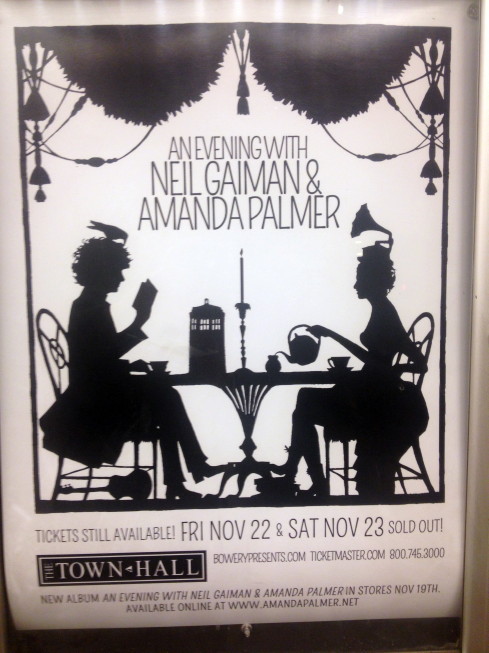
Andy is a huge fan of writer Neil Gaiman and singer-songwriter Amanda Palmer, so he bought tickets for their double-bill at Town Hall as soon as they went on sale. The two met when Palmer, formerly half of the Dresden Dolls, asked him to write material for her solo album Who Killed Amanda Palmer? Before long, they were a pair and are now married. In this charming, chatty, intimate concert, we heard a little about their courtship. Early on, in a conversation about the dearth of contemporary torch songs, Gaiman announced that he’d written one called “I Google You.” He sang it for her, twice, and a few days later she sent him a link to a YouTube video of her singing it in concert in San Francisco. For the Town Hall gig, they opened the evening singing a duet on “Making Whoopee,” paving the way for considerably more singing from Gaiman than I expected (and less reading of his work than I would have liked). He’s a Brit and characteristically modest; she’s an American, more brash and with, let’s say, a bigger personality. Weirdly, she often reminds me of my friend, the San Francisco-based performance artist Keith Hennessy (weirder still, I think it’s the powerful legs). Saturday night also happened to coincide with the premiere of the 50th anniversary broadcast of Doctor Who, the long-running British TV show for which Gaiman has contributed a few episodes, so there was a fair amount of fanboy-geekery running between the stage and the audience. The inevitable special guests included Aussie burlesque chanteuse Meow Meow backed by Lance Horne (on loan from La Soiree downtown) and Arthur Darvill, who plays a minor character on Doctor Who and ran over after finishing his show as the lead in Once.

11.25.13 – I can’t pretend I understand what Wally Shawn’s play Grasses of a Thousand Colours is about. When I flew to London to see the world premiere at the Royal Court, I managed a pretty succinct summary of the play in my Performance Diary:
grasses-of-a-thousand-colors-86857
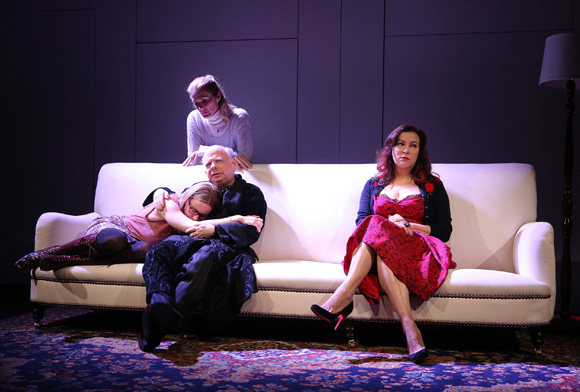
It’s a big, long, crazy, intense three-act fantasia about a famous scientist overwhelmingly fixated on his penis and his relationships with three different women (his wife, his mistress, and his girlfriend, named for three shades of red: Cerise, Robin, and Rose) and a mysterious shape-shifting cat named Blanche who may be the shamanic double of Cerise and/or possibly God. It’s set in some apocalyptic near-future when some initially successful experiments with increasing the world’s food supply have gone dreadfully wrong. And the stories that Ben and his playmates tell – addressing the audience directly, as is usually the case in Shawn’s plays – teem with images of animals. Eating and fucking. Dick and Pussy. Humans and animals. Andre Gregory’s staging unfolds on a simple stationary set – a long white sofa and two standing lamps – and it interpolates strange little bursts of film that surrealistically mangle the sense of time and place. Wally himself plays the main character, known as Ben or the memoirist, who says things like, “When I was a boy, parents never masturbated in front of their children. In fact, children never masturbated in front of their parents! And God knows children would never make out with their parents or fuck them, ever, because that would have been seen as utterly shocking…So, you see,  for me, the way things are now still seems astonishing – I mean, the fact that people talk about their penises and vaginas in public, at dinner parties, in magazines, and newspapers. I can’t get over it. Ha ha ha!”…
whitecat1
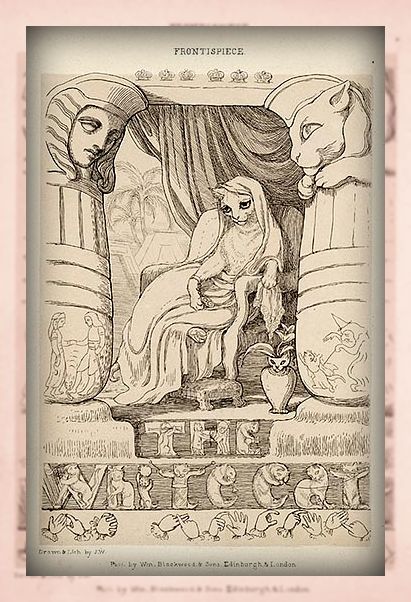
In an endnote to the published text, Shawn mentions that certain elements from the play derive from a 17th century story by Madame D’Aulnoy called “The White Cat.” I don’t know that story, but I will look it up as I continue thinking about this strange strange play, which is a bizarre combination of fairy tale, fever dream, and The Story of O. It’s quite unlike any other play I’ve seen before, except that it bears a distinct family resemblance to other wild, linguistically pungent, sexually transgressive, disturbing and disorienting Wally Shawn plays (Our Late Night, Marie and Bruce, The Music Teacher, The Designated Mourner).

Besides Wally in the central role, the London cast included Miranda Richardson as Cerise, Jennifer Tilly as Robin, and Emily Cass McDonnell as Rose. Seeing it again at the Public Theater, with Julie Hagerty in the Miranda Richardson role, I found that I had no particular advantage the second time around, nor did I find it especially enjoyable to sit through again. (I was somewhat affected by sitting next to Andy, who is a game theatergoer in general but found the play an ordeal.) I admired Andre Gregory’s production less than I did the first time around – for one thing, Jennifer Tilly’s performance has coarsened over time to a one-note bray.  I had mixed feelings about Julie Hagerty, who was definitely wispier than Miranda Richardson. I enjoyed most the freaky dream-like film sequences in which she appeared as “Blanche,” although my strongest takeaway is her deliver of the line, “Last night, as I was urinating on him…”

Clearly there are layers and layers of mischief going on throughout the production, signaled by tiny gestures of sound and movement – every time Ben (the main character) takes a sip of the green potion on his lecturer’s podium, his energy immediately shifts, never predictably. As I explained to Andy and my friends Melissa and Maribel, as we walked to dinner at Noho Star afterwards, my best guess about  the play is that it represents a particular literary phenomenon – Shawn, an excellent brainy and theatrically savvy playwright, has given himself the challenge to follow his imagination, his psyche, his dreams in creating a work that relentlessly and categorically defies the viewer’s attempt to interpret it as any kind of coherent narrative reducible to meaning. Like the craziest, scariest fables and fairy tales ever written, it is a story that exists in relation only to itself.

Oh, one major difference in the production at the Public Theater was that instead of a second intermission, after two and a half hours, we got a five-minute pause, during which an insane array of snacks was handed out in the foyer adjacent to the Shiva Theater – a paper cup containing 5 almonds, a hard-boiled egg, a Lindt chocolate ball, and a silver cup containing a swallow of cranberry juice – served by a chubby whiskered lad wearing a cat mask.


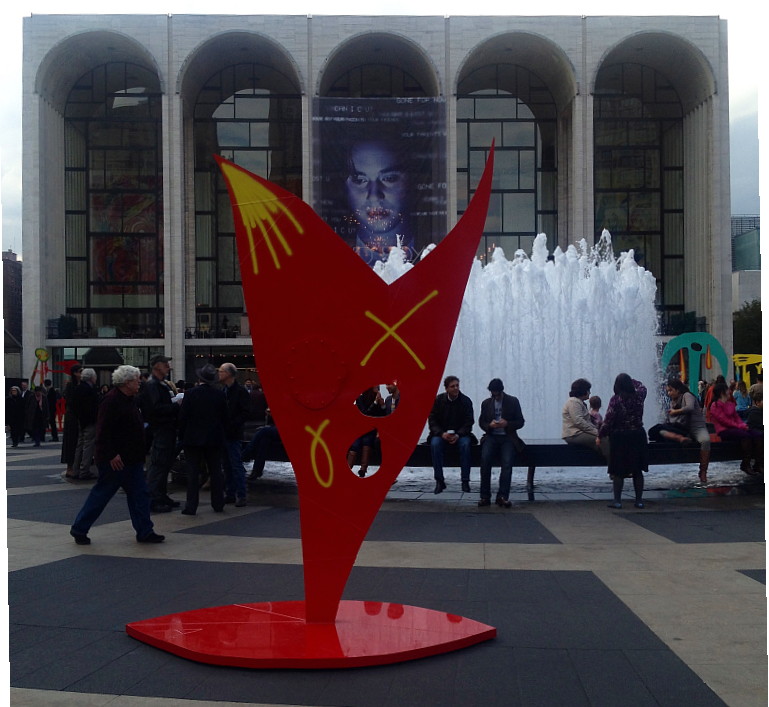
Photo diary: November in NYC miscellany

November 25, 2013

(click to enlarge photos)

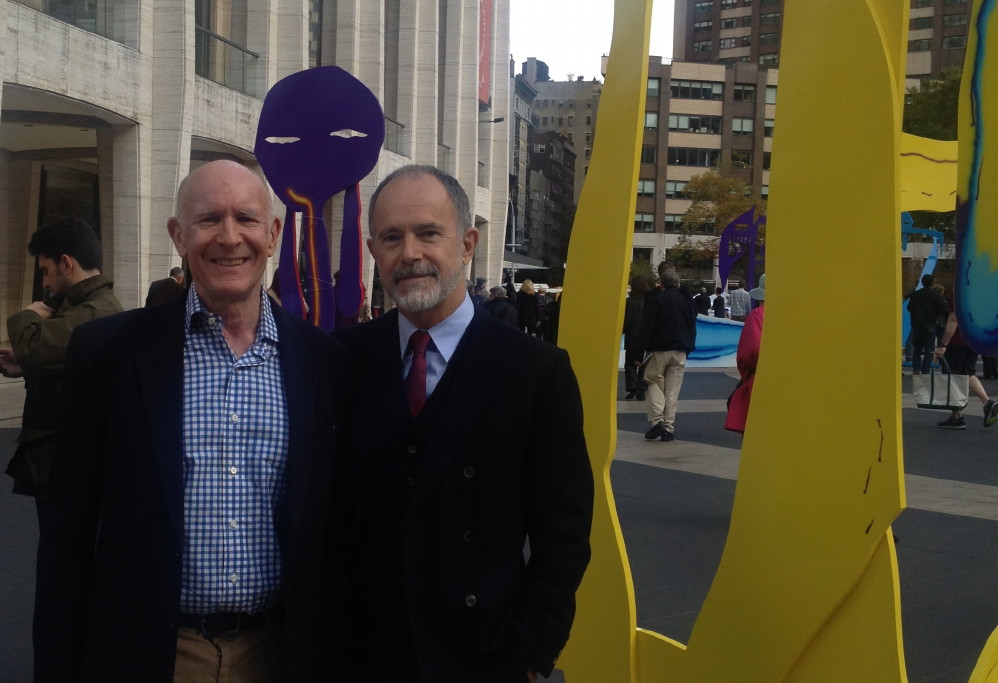
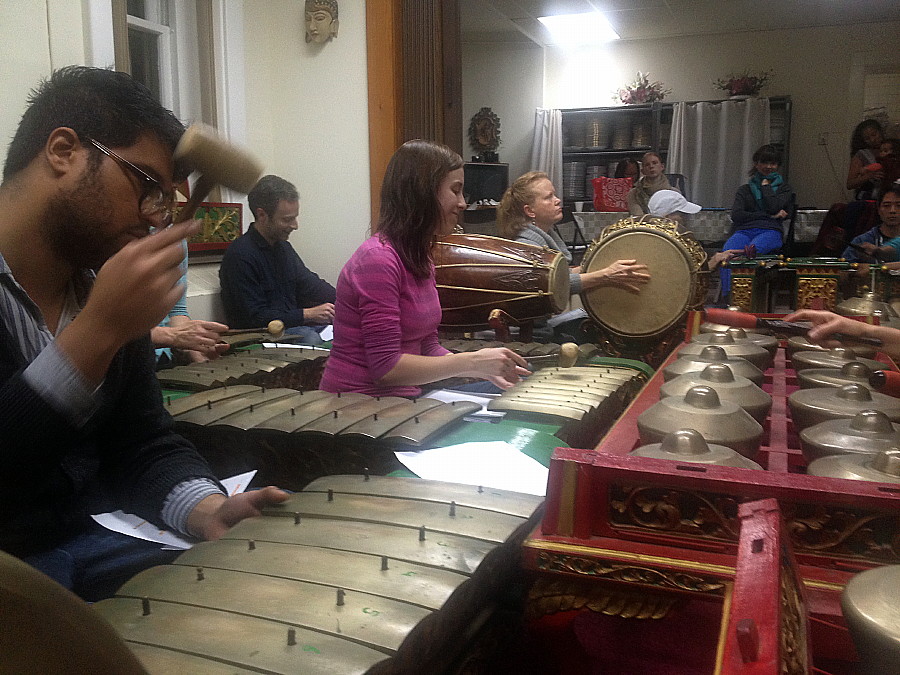
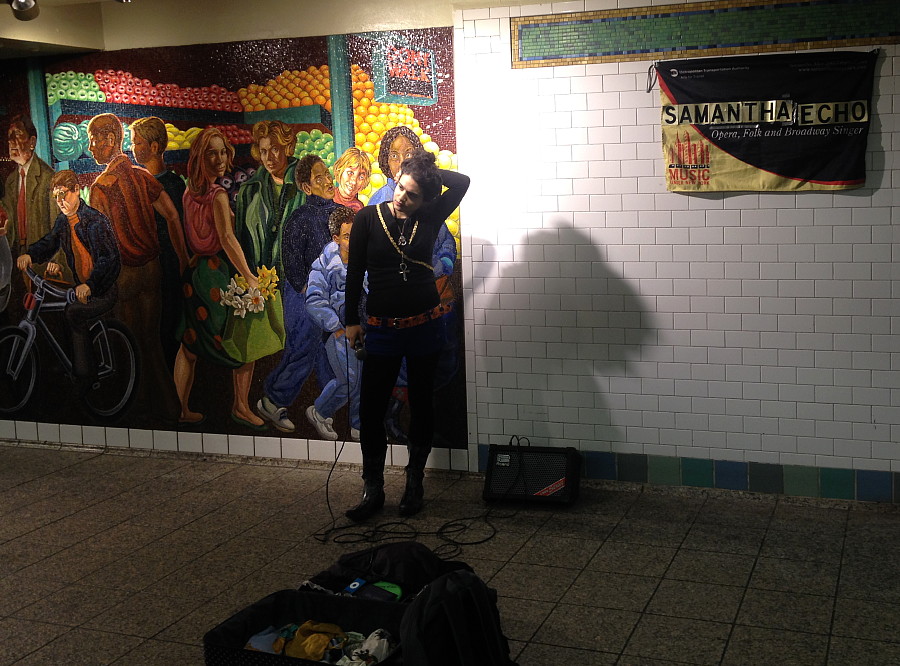
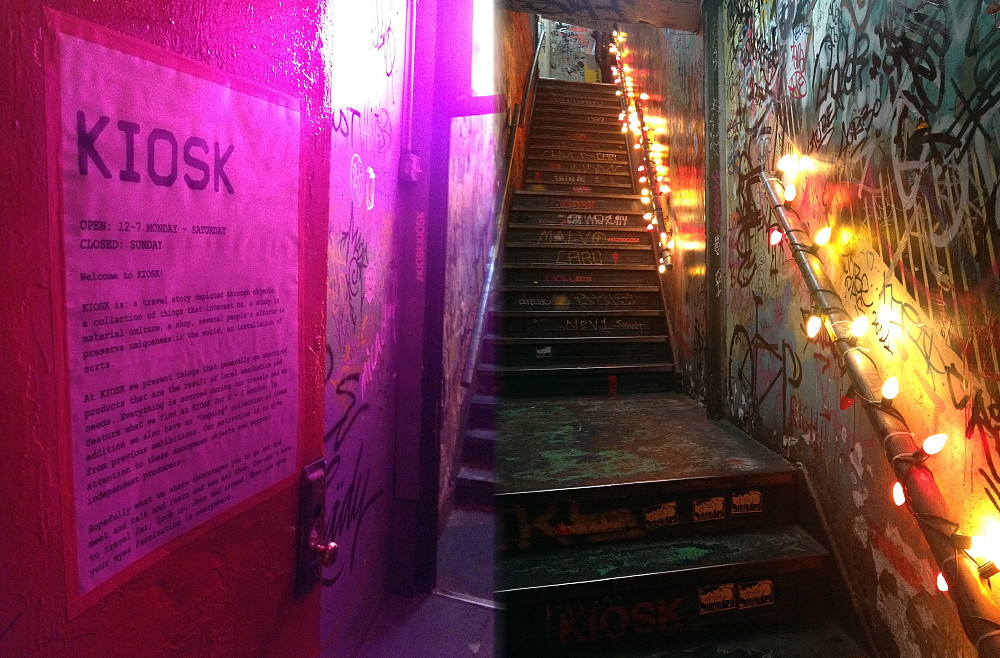
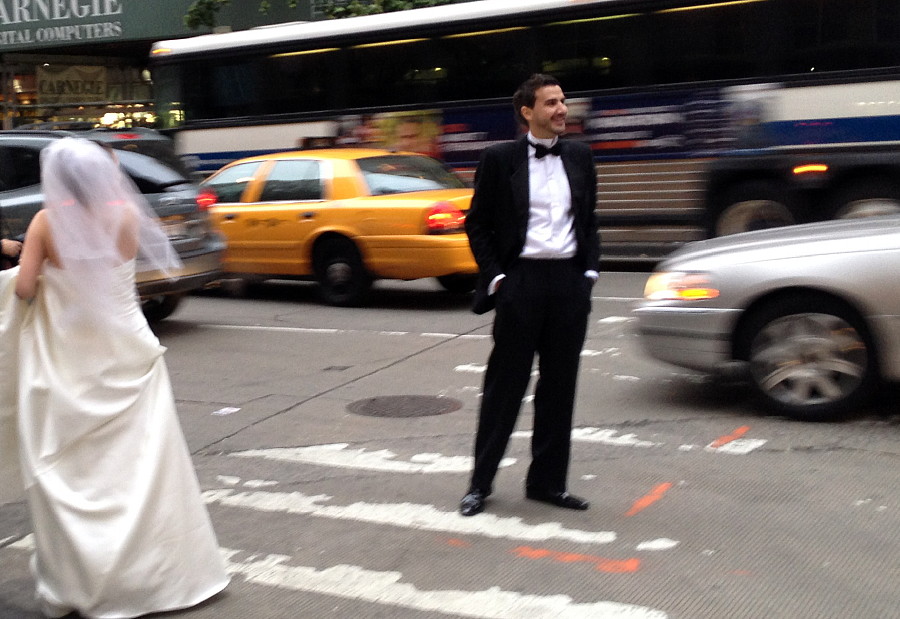
10-27 zamzam water10-20 new pants11-2 aaron curry sculpture with opera house11-2 aaron curry sculpture with chinese boy11-2 chinese girl11-2 stephen don lincoln center11-3 sunset on madison ave11-17 cloisters11-17 gamelan rehearsal11-17 ouotfit11-17 sugar pumpkins11-17 busker11-17 kiosk stitch11-17 groom in traffic


Playlist: iPod shuffle, 11/21/13

November 22, 2013

“Skullcrusher Mountain,” Jonathan Coulton (one of the all-time great psychotic love songs)
“I’ll Never Say Goodbye,” Barbra Streisand
“It Won’t Bring Her Back,” Jimmy Webb
“Bottom Feeder,” Amanda Palmer Featuring the Grand Theft Orchestra
“I Just Wanted You to Get Old,” Nataly Dawn
“A Sentence of Sorts in Kongsvinger,” Of Montreal
“10,” Loudon Wainwright III
“Kabhi Kabhi Mere Dil Mein Khayal Aata,” Lata Mangeshkar & Mukesh
“Who Can I Turn To,” Tony Bennett & Queen Latifah
“The Girl from Back Then (Riton Remix),” Kings of Convenience
“Magic,” Ben Folds Presents University A Cappella
“He Miss Road,” Fela Kuti
“Another Thought (See Through Love),” Arthur Russell
“Honey,” Eyrkah Badu
“Kid A,” Punch Brothers
“Another Country,” Cassandra Wilson
“More Love,” Smokey Robinson & the Miracles
“Beautiful Love,” Helen Merrill
“Queen Elvis,” Robyn Hitchcock
“Pastorale,” Gabriel Faure
“Question & Answer,” Violet OCR
“Don’t Ask (Final Fantasy Remix),” Grizzly Bear
“Swoon,” Chemical Brothers
“Call Your Girlfriend,” Robyn
“Darkness,” Leonard Cohen
“Goatpath,” Ferron
“No Moon,” Iron & Wine
“Under My Thumb,” Rolling Stones
“Vaporize,” Broken Bells


Quote of the day: WRITING

November 22, 2013

WRITING

Everything that needs to be said has already been said. But since no one was listening, everything must be said again.

Andre Gide

gide1


Performance Diary: TWO BOYS, GENTLEMAN’S GUIDE, FUN HOME, 40-PART MOTET, and LITTLE MISS SUNSHINE

November 19, 2013

11-2 sh alvaro 2 boys
November 2 –
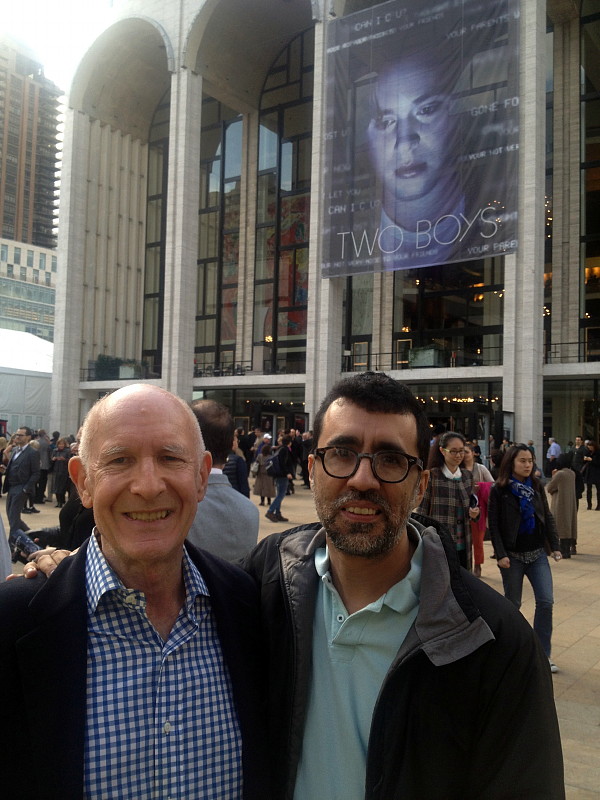
I went with Stephen and Alvaro (above) to see Two Boys at the Metropolitan Opera. For me, the artistic merit in the production had less to do with Nico Muhly’s passable, unmemorable score than with Craig Lucas’s libretto. Based on a true story, the opera depicts the tragic consequences of an online friendship between a 13-year old, Jake, and a 16-year-old, Brian. Much of their interaction takes place in a chat room (the year is 2001 – nowadays chat rooms are passé but it’s interesting to have this technology captured in art). Lucas is a prolific playwright, I’m a big fan of his work, and I could immediately see that Lucas was returning to territory he’s mined before in his play (and film) The Dying Gaul, in which cyberspace becomes an eerie version of Orpheus’s underworld – a man finds his dead lover cruising him online. The chatroom dialogue between Jake and Brian (and other characters who get pulled into the action), misspellings and shorthand intact, shows up in the sung text but also on video screens in Bartlett Sher’s production and, at the Met, in titles on the back of the chair in front of you.

two boys
I loved how Lucas made theatrical poetry out of this language. It made me think of Gertrude Stein’s operas. I wish Nico Muhly’s score was as tuneful as Virgil Thomson’s. His vocal writing is lyrical, and his choral passages have a pleasant wash, but there’s nothing especially distinctive about his compositional voice. He’s getting a lot of attention and opportunity because of his youth (he’s 32) but he’s yet to create music that grabs me. Still, at the curtain call, I found myself unexpectedly moved to see a young living composer taking bows at the end of a piece that the Metropolitan Opera commissioned – must be quite a thrill for him.

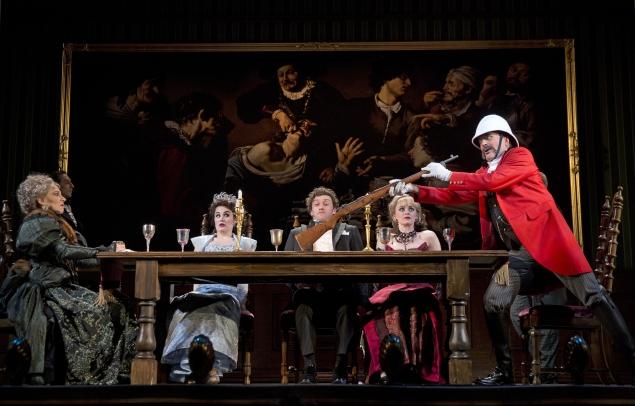
11.16.13 – A weekend full of musicals, beginning with A Gentleman’s Guide to Love and Murder, a lavish and stylish exercise in pure fun. The Broadway debut of the journeyman team Robert L. Freeman (book and lyrics) and Steven Lutvak (music and lyrics), the show adapts to the stage the novel that inspired the 1949 film Kind Hearts and Coronets. Handsome but penniless striver Monty Navarro (Bryce Pinkham) discovers belatedly that he is descended from the rich and famous D’Ysquith clan. Determined to ascend to the family’s aristocratic title (Earl of Highhurst), he sets out to dispatch the eight individuals who stand in his way. All eight victims are played by the excellent Jefferson Mays (Tony Award winner for I Am My Own Wife), in the show-off role(s) legendarily played in the movie by Alec Guinness.

gentleman18f-1-web
From the acclaim it received when it previously played in Hartford, I’d gotten the impression that the show revolved around Mays’ tour de force performance, but I was wrong. The show has a large cast full of excellent performers, and while Mays (above far right) gets to do all sorts of dazzling and daffy quick-changes, he is equally matched as leading man by Pinkham (above center, a crucial member of Alex Timbers’ teams for Bloody Bloody Andrew Jackson and the musical of Love’s Labour’s Lost last summer in Central Park). Lisa O’Hare (above in pink) and Lauren Worsham (above in white) are terrific as the women Monty courts; Joanne Glushak (above far left) is a riot as the current earl’s squabbling spouse. Beautifully designed from top to bottom, cleverly staged by Darko Tresnjak, superbly orchestrated by the great Jonathan Tunick, and entertaining as hell. Still, I left the theater with my heart untouched and my intellect unfed.

The same evening, I went back to the Public Theater to see Fun Home for the second time and liked it even better than I did the first time. In the interim I’d sat down and re-read Alison Bechdel’s original graphic memoir, which both deepened my understanding of the characters (especially the author and her father) and increased my appreciation for how creatively and ruthlessly the creators of the musical worked to turn it into a musical. I was much more aware this time of the understated importance to the story of the father’s mental illness. And where it bothered me the first time that the adult cartoonist Alison (Beth Malone) spends a lot of stage time standing around watching the younger versions of herself, it didn’t bother me at all this time. Every single performance has gotten sharper and stronger.

fun home diner
Each of the three Alisons gets a major aria. “Ring of Keys,” a song about a nine-year-old nascent lesbian (sung by Small Alison, the adorable Sydney Lucas, above left) spotting her first bull-dyke, is one for the ages, a moment that instantly enters gay-theater history.

             With your swagger and your bearing

            And the just-right clothes you’re wearing

            Your short hair and your dungarees

            And your lace-up boots and your keys

            Your ring of keys…

Of all the people in this luncheonette

            Why am I the only one who sees you’re beautiful…

            I mean, handsome?

Medium Alison’s big number, sung with brave awkwardness by Alexandra Socha, is “Changing My Major” (from English to Joan — sex with Joan, minor in kissing Joan). And once again, I wept helplessly during “Telephone Wire,” the climactic song in which adult Alison pours out her desperate and unsuccessful clamoring for her father (a seriously impressive performance by Michael Cerveris, above right) to see her as a complete person, including her sexuality. I loved tracking the T-shirts that designer David Zinn gives to the three ages of Alison, and I appreciated how director Sam Gold let many awkward dramatic moments stay awkward. Kudos once more to Lisa Kron (book and intensely smart, characterful lyrics) and Jeanine Tesori (composer extraordinaire) – also choreographer Danny Mefford and lighting designer Ben Stanton.

11.17.13 – I tagged along as a posse of Andy’s choir-geek friends made an expedition to The Cloisters to experience Janet Cardiff’s sound installation “The Forty Part Motet” – an eleven-minute composition by 16th century composer Thomas Tallis recorded in 2000 by the Salisbury Cathedral Choir.

40 part motet
One voice comes out of each of 40 standing speakers arranged in an oval around the beautiful Fuentidueña Chapel – I thought of it as an invisible flash mob. The room was pretty crowded on a rainy Sunday afternoon, but it was one of those great New York interactive museum experiences, like lying on the floor of the Guggenheim’s rotunda looking up at the James Turrell light show.

11-17 fuentiduena chapel ceiling crop
The late twelfth-century apse of the chapel has been transported intact from the church of San Martín at Fuentidueña, near Segovia, Spain, on permanent loan from the Spanish Government. The art includes a striking Christ-on-the-cross and what looks for all the world like Tweedledee and Tweedledum proffering freshly baked pies (above).

11-17 unicorn in captivity
While we were at the Cloisters, we had a look at the famous room of Unicorn Tapesties and some of the other curiosities on display. I’d never seen a tableau like this one described as “Christ in Limbo.”

11-17 christ in limbo
And it’s always fascinating to encounter these images of LBJ (the little baby Jesus) with strangely adult facial expressions. This one seems to be saying, “Bitch, get these animals out of my face.”
11-17 lbj in stable
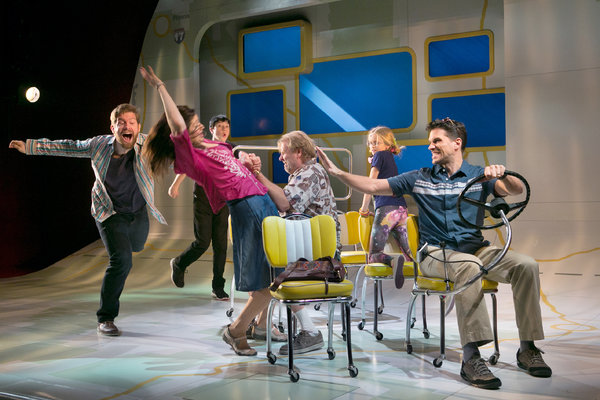
In the evening, my friend Misha Berson took me along to James Lapine and William Finn’s musical adaptation of Little Miss Sunshine, the feel-good dysfunctional family hit indie film. You can totally see why everyone would think that the guys who wrote March of the Falsettos and what everyone calls The Spelling Bee Musical would be perfect to make a musical out of this story. Yes, there are precocious children and furniture on wheels and quippy gay guys and a long-suffering wife (that would be Stephanie J. Block, very good). I wasn’t a fan of the movie – I thought all the characters were implausible cutesy stick figures. Lapine and Finn gave it their all, but they’re still stuck with mediocre source material.

little miss sunshine
The musical is superbly, unpredictably cast – in the Steve Carell role, Rory O’Malley is an appealingly pudgy Jesse Tyler Ferguson type; I find Will Swenson charmless, which isn’t bad for the self-absorbed dad; I’ve always been a big fan of David Rasche, who couldn’t be more unlike the movie’s Alan Arkin; and all the nasty little girls are great, including Hannah Nordberg’s Olive. The wittiest thing about the show is Beowulf Boritt’s set, which snakes up from the floor onto the ceiling.