Cultural weekend! Friday night, Andy and I met friends for dinner at The Smith in the East Village in honor of a recently departed college chum. It was Hallo-weekend and the streets were full of costumed revelers. We were most amused to see a couple dressed as tourist (him in I ❤️ NY t-shirt) and the Statue of Liberty.
Saturday – beautiful day, up to 80 degrees. We took part in the Gays Against Guns action in response to the mass shootings in Lewiston, ME. I had a Google Hangout conversation with Alastair Curtis, a young theater artist in London who’s just discovered the work of Harry Kondoleon and wanted to talk to me in preparation for a reading he’s doing of Christmas on Mars. In the evening, Andy and I were back in the East Village to see Helen., the SuperGeographics production of Caitlin George’s play directed by Violeta Picayo. In the lobby we chatted a little with producer Anne Hamburger (whose En Garde Arts brought the show to La Mama), Linda Chapman, Chay Yew (looking very buff), and two young artists Anne is cultivating. I enjoyed the play, a dense, poetic, cheeky, queer/feminist riff on Greek mythology that reminded me of Young Jean Lee’s Lear the way it played fast and loose with familiar stories. In this version, Helen and her twin sister (!) Klaitemnestra and their sibling Timandra operate under the supervision of Elis, god of discord. This restless Helen isn’t waiting around to be abducted from her husband – she’s got wanderlust and knows how to use it. Picayo’s excellent production – light, fun, funny – made extensive use of quirky props (crowns, marbles, a barbecue) and almost continuous underscoring (by the great sound designer Darron L. West) with terrific performances, especially by charismatic Constance Strickland as Eris and Lanxing Fu as Helen (below center, with Grace Bernardo as Klaitemnestra and Melissa Coleman-Reed as Timandra).
Sunday afternoon we saw Sabbath’s Theater, Philip Roth’s late novel adapted for the stage by John Turturro with Ariel Levy. I never read the novel but the promotional material and the advance feature in the New York Times built up my expectations for a sexier/ filthier event than the New Group production turned out to be. But I guess for some (straight?) people any reference to masturbation comes off as racy rather than (as Roth has always demonstrated) a typical feature of most people’s sex lives. For all its lustiness, the play is primarily a melancholy contemplation of loss, desire, and death as the title character Sabbath (played by the brave, inventively comic, ever-watchable Turturro, below), a former puppeteer brought down by arthritis and a sex-with-student scandal, recalls the lovers, friends, and relatives he’s lost and considers joining them by throwing himself out the window of his high-rise apartment or walking naked into the sea. Jason Kravits and the great Elizabeth Marvel have fun playing all the other characters with distinctly different costumes, voices, and body habitus. Jo Bonney’s production struck me as tame, and in contrast to Helen., the sound score (by Mikaal Sulaiman) came off as intrusive and annoying at times rather than evocative or scene-setting. I pointed out to Andy that the fine-print trigger warning in the program (“This production contains nudity, sexual situations, strong and graphic language, and discussion of suicide.”) could apply to virtually every show at the New Group.
photo by Jeenah Moon for the New York Times
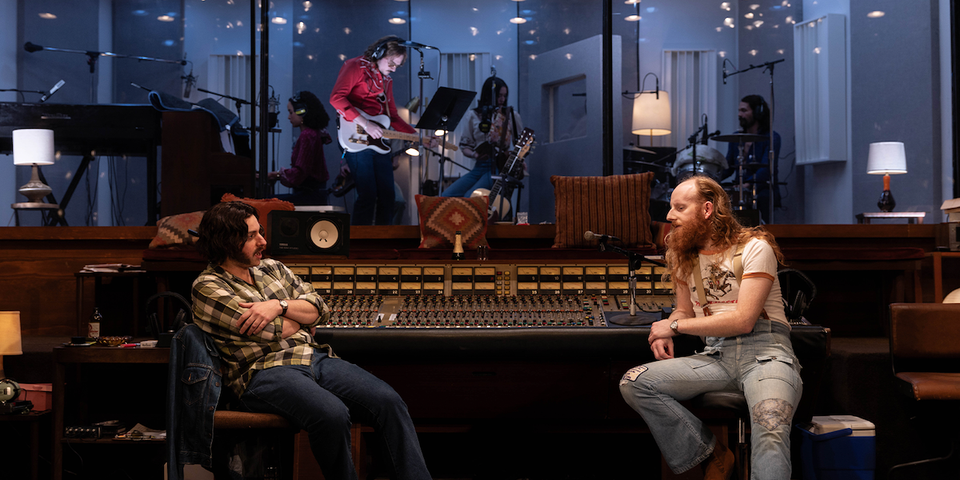
I loved Rob Weinert-Kendt’s succinct summary: “If Robert Altman directed a Chekhov play about a 1970s rock band struggling to perfect their next album, it might look (and sound) something like David Adjmi’s STEREOPHONIC.” I saw the play a couple of weeks ago and it’s stuck with me like few plays I’ve seen in recent years. A three-hour play can seem a little daunting these days, but Daniel Aukin’s production at Playwrights Horizons casts a spell. When I try to name the unusually evocative atmosphere to myself, I keep coming back to Fassbinder – the intense attention to tiny increments of human behavior, the honesty about intertwined love and depravity, artists at work, extraordinary design on every level, occasional longeurs but that being part of the astonishing success of capturing life in its complexity. Pop music was my first love, and I related to the play’s deep immersion in rock music culture much the same as Todd London did in his terrific essay on the PH website. (There you can also read commentary by David Byrne, who happened to be in the audience for the performance I attended; my friends and I noted how remarkably friendly and chatty Byrne was with the people sitting around him. One member of my posse is a hardcore Fleetwood Mac nerd and regaled us at intermission and afterwards with all of his observations about the Easter eggs hidden throughout the play – for instance, that Lindsay Buckingham has a brother who’s an Olympic swimmer, like the LB character in the play. And he knew exactly which Steve Nicks song was deemed too long to be included on Rumours.) The set designed by David Zinn manages to look completely natural and lived-in while being actually insanely meticulous in its creation of an artificial environment that works as an additional character in the play. Ditto the impossibly intricate sound design by Ryan Rumery. The performers are uniformly excellent, all playing their own instruments on ingenious original songs by Will Butler of the Arcade Fire. But what impressed me most of all is how the playwright, the director, and Tom Pecinka, the actor who plays Peter (the Lindsay Buckingham stand-in), collaborated to create the most nuanced and compassionate portrait of a perfectionist I’ve seen in any medium.
Under the modest guise of an evening’s entertainment, Nightclub Cantata is a radical reconsideration of the musical theater form. The production, which originated at the Lenox Arts Center and won a 1977 Obie Award at New York’s Village Gate, compresses into 75 minutes a cross-cultural musical/emotional experience so stimulating and adventurous it reduces the average Broadway musical to a McDonald’s jingle.
As the title suggests, Nightclub Cantata is a hybrid of cabaret revue and classical recital, encompassing, among other things, a 1950s doo-wop number and a Sylvia Plath poem, a ridiculous takeoff on daredevil acrobatics and a terrifying reminiscence of Auschwitz. In other words – those of Elizabeth Swados, who conceived, composed, and directed the show – ”it combines the seriousness of a cantata with the frivolousness of a nightclub.” On the whole, it is the virtuosic Swados who provides the seriousness (not to be confused with solemnity) and the exuberant young company that contributes the flashy fun, but neither of these elements hints at the emotional depth of Cantata.
Early on the choral cry goes up: “I want to know this world!” And in its own way each of the 21 selections reiterates that desire. The words – some written by Swados, most by assorted 20th century poets – describe looking inward or outward for love, support, identity, knowledge. Verse by the Turkish poet Nazim Hikmet opens and closes the show with fierce affirmations of life (“Even though you fear death, you do not believe in it”), but this is not Up with People. The last hurrah is arrived at only after a zigzag journey full of tensions, struggles and epiphanies, expressed in the words of Plath, Muriel Rukeyser, Delmore Schwartz, Pablo Neruda, Carson McCullers, Frank O’Hara and others.
The poetry alone covers a vast terrain, but Swados’s eclectic score, which is far more than accompaniment, plays an active, often aggressive role, supplying irony, subtext, extra emphasis, cross-associations. She draws on natural sounds (bird calls, animal cries) and ethnic modes (Indian, Greek, Caribbean, tribal drum codes) as well as on familiar rock, blues and vaudeville forms to create a composite of musical fragments against which words or sounds are sung, chanted or delivered in unorthodox ways. The elements of Swados’s music, scored for piano, bass, and acoustic guitar, are not new, but their combination in Nightclub Cantata has few precedents, and Jacques Brel is not one of them.
Swados’s conceptual approach incessantly integrates words, music, and movement. A prime example is her treatment of Delmore Schwartz’s “In Dreams Begin Responsibilities,” Cantata’s longest and most ambitious segment. Sing-speaking the words and accenting them with simple but evocative gestures, the cast dramatizes Schwartz’s surreal short story: a young man dreams he is in a movie theater watching a silent film about his parents’ courtship. The tricky problem of maintaining a tight dramatic focus while skipping through various levels of reality is solved largely by Swados’s musical manipulations. The recitation begins in counterpoint to a steady rhythmic accompaniment, which switches to syncopation, then takes off into ricky-ticky silent-movie piano music, boogie-woogie, and finally a waltz. The music and text continually diverge and recombine without transition, preparation, or apparent logic, except that the result always seems appropriate to the moment.
The whole of Nightclub Cantata is like this: a barrage of images, musical patterns, visual embellishments and emotional disclosures. In her directorial debut, Swados has made staging choices as effective and as varied as hr material. She doubles up actors for a split-screen effect, scatters them around the theater at various levels, drives the show at a brisk pace. Sometimes, indeed, it’s too brisk; insights speed by unheard, unabsorbed. The lack of breathing space is uncomfortable at first – one wishes for the luxury of a long, lush melody or some restful repetition. Cantata requires concentration, for Swados is intent on making every detail count, on staying “in the dramatic moment” – a phrase she often uses in discussing her music, and a perfect description of the point where Nightclub Cantata’s words, music, and actors converge.
At 26, Elizabeth Swados has already established a formidable reputation on the basis of her collaborations with Rumanian director Andrei Serban. His experimental stagings of Greek tragedies (Medea, Electra, Trojan Women, and Agamemnon) have relied heavily on Swados’s knowledge of non-verbal communication and ethnic musics to recreate the power of ancient drama. When the collaboration began, Swados was a 19-year-old undergraduate at Bennington College, where her all-American pop, folk, and classical background had been eclipsed by a passion for ethnic music.
“Something in that music really moved me,” she recalls. “There was something dramatic in it that we didn’t have in our music.” Asked to score a Grotowski-style production of Everyman at Bennington, Swados created a sensation by incorporating the Indian and Polynesian music she was studying at the time. The success of Everyman led to an introduction to Ellen Stewart, founder of La Mama, New York’s experimental theater complex, and she in turn brought Swados to Serban.
“I felt like what Serban was trying to do with Greek was just what I had been looking for,” Swados says. “I was very willing to just learn and do what I was told, because I had access to a whole lot of strange music and I knew how to apply it to theatrical situations by some intuition. And that combination was good for what he wanted.” The 1972 Medea (which earned her an Obie) began a fruitful five-year period during which she collaborated with Serban on the tragedies, wrote incidental music for his productions of The Good Woman of Setzuan and The Cherry Orchard, toured Europe with several Serban productions, and traveled through Europe and Africa with Peter Brook’s Center for International Theater. She absorbed the work of these two major avant-garde directors and soaked up the music and language of various cultures.
In contrast to all this, Nightclub Cantata was “a rebellion,” Swados says. “It was a combination of paying respect to everything that I’ve learned from Brook and Serban, but it was also saying, ‘Enough of these classics! Let’s do something about people now.’ My whole sensibility has been based on non-verbal communication and ancient languages, and I don’t deny the absolute value of that, but I had to do something more political, more contemporary, something that relates on a more overt level.”
One wonders how the creator of such an uncommon musical entertainment relates to traditional Broadway fare. “I love it if it’s good. I can’t stand it if it’s bad. Literally, I get – you don’t want to print this, but I get diarrhea if I go to a musical that’s bad. I get so angry that head doesn’t register it – my stomach does and I have to leave and go shit my guts out. Because it’s more bad information going into the human system that’s already been poisoned beyond belief. There’s so much in American musical theater that’s just schlock that gets across as art because somebody can whip out an easy tune or has a cute psychological insight into sex or drugs or something modern like that. And they rip people off, because people see it and think, ‘Oh, I’m enlightened.’ There’s this kind of easy psychology that gets sent back and forth between audience and performer, and everybody gets away with nothing and nobody learns anything.”
Swados’s resistance to “easy” music-making is also the source of her main limitation, one to which she readily admits. “I haven’t found a way to compose something with an extremely rich melody, a tune. I think it’s very important because it soothes people, but I always prefer a kind of percussive performance of things. I think because I’m young, I’m angry-ish, I’m a little nervous, my music tends to be overly energetic sometimes. I’ve just sort of snobbed myself out, and I’m working on that. The next project I’m doing is with kids – 16, 17, 18 – and I hope I’ll unsnob myself. I’ll be using whatever music they like: salsa, punk rock, whatever.”
ADDITIONAL INTERVIEW:
What kind of music did you study and write when you were a kid?
I wrote calypso music, for some strange reason, and horror-movie music. We had piano, and when I was 12 I got a guitar. My family listened to Kurt Weill and Frank Sinatra, Harry Belafonte, and my mother loved this group called the Eloise Trio, which she played all the time. She’s flippo about Barbra Streisand. It wasn’t until I got to college that I got into ethnic music. There was something dramatic in it that we didn’t have in our music. Our pop singers seem to be emotionally rather vapid, and I wasn’t really moved. So I got really excited when I went to Africa and heard all this Arabic music with all these complexities.
I went to Bennington for three years, but they’re very supportive of students who have good things to do. They gave me a grant to go down to West Virginia to live with a family and explore the mining situation. Then I wanted to go to Wesleyan and study Indian music, because they had an ethnic music program, and Bennington gave me credit for that. When I went to La Mama and started living in New York half the time, they gave me credit. I didn’t ever really finish there, but they gave me a degree. There was a time after the Kent State massacre that I felt very absurd being in Vermont. I felt the guilt of all middle-class children at that time. But I was already aligned with non-violence. I wrote to Pete Seeger, and he invited me to come work on his sloop, and Bennington let me go. In some way my life has been graced by very understanding, supportive people, because what they’ve gotten in return has been a lot of hard work. I have a gift, you know. But I’ve also been lucky, because there are lots of people who have gifts who don’t get the breaks I have.
How did you get involved with La Mama?
There was a Grotowski teacher at Bennington, a Belgian guy, and I was taking acting at the time. He was doing all these headstands and shoulder-stands and back-stands and nose-stands, inner leaps, and physically, I couldn’t do it. It was killing me. So I said to him, “I would still like to work with you, but I don’t want to do this anymore.” He said, “Why don’t you write music for my play?” He was doing Everyman, and that was really the beginning of it, because I was studying the South Indian vina, so I put that in the show and this thing called a kinjura – sort of an Indian tambourine – and kalimbas, things that were very unusual for 1971, and he was very excited that I was applying this strange music to Western theater. His next stop after Bennington was La Mama, and he took me along and introduced me to Ellen Stewart. She “beeped” on me, as she calls it, and she said I would be one of her babies and supported me for five straight years. She introduced me to Andrei Serban and just made me alive.
With Serban, it just worked automatically. There was no conflict of territories at the time, until I got older and more ornery. I was 19 when we met, and I was very willing to just learn and do what I was told.
The whole idea of what a musical is is something that really fascinates me. You go to Brazil during Carnival – that’s the kind of musical event that really fascinates me. And like in Africa, they dance our stories and stuff like that. People here have begun to pick up on that kind of thing, like the Bread and Puppet Theater. I’m also interested in how to use a song for storytelling and humor. I’m interested in redefining the conventions of musical comedy, although I don’t really know what those are.
You believe in God, right? I believe that there’s an intelligence, a spiritual power that I don’t understand. I call it God because I don’t know what else to call this great spiritual power. It gives me strength. I’ve also had amazing times alone in nature when for a moment you forget you’re human. Your humanness goes away, and you’re part of that natural world. It’s the most amazing and wonderful and beautiful feeling.
How do you square things like environmental degradation and war with a belief in that overriding intelligence? Traditional faith will have you believe in a loving God, and when I look at what’s happening on the planet, I think if there is a God like that, is he playing with us? Are we living in some great experiment? How can you believe in a loving God when you see the horrors that are perpetrated against nature, against animals, against each other? I sometimes think it is like an experiment which has culminated in this strange, confused creature that is human beings, and we seem to be lost. Who are we? What are we? Why are we here? I don’t know what the meaning of life is. The meaning of my life is to give people hope because without hope you give up.
–Jane Goodall, interviewed by David Marchese in the New York Times Magazine
You understood the dangers of American policing, the criminalization of Black, native, and brown people, 50 years ago. Your activism and your scholarship has always been inclusive of class and race and gender and sexuality. It seems we’re at a critical mass where a majority of people are finally able to hear and to understand the concepts that you’ve been talking about for decades. Is that satisfying or exhausting after all this time?
I don’t think about it as an experience that I’m having as an individual. I think about it as a collective experience, because I would not have made those arguments or engaged in those kinds of activisms if there were not other people doing it. One of the things that some of us said over and over again is that we’re doing this work. Don’t expect to receive public credit for it. It’s not to be acknowledged that we do this work. We do this work because we want to change the world. If we don’t do the work continuously and passionately, even as it appears as if no one is listening, if we don’t help to create the conditions of possibility for change, then a moment like this will arrive and we can do nothing about it. As Bobby Seale said, we will not be able to “seize the time.” This is a perfect example of our being able to seize this moment and turn it into something that’s radical and transformative.
One of the things that you’ve talked about that I hold on to is about diversity and inclusion. In many industries, especially the entertainment industry where I work, those are buzzwords. But I see them in the way that you taught me during our conversation for13th.These are reform tactics, not change tactics. The diversity and inclusion office of the studio, of the university, of whatever organization, is not the quick fix.
Absolutely. Virtually every institution seized upon that term, “diversity.” And I always ask, “Well, where is justice here?” Are you simply going to ask those who have been marginalized or subjugated to come inside of the institution and participate in the same process that led precisely to their marginalization? Diversity and inclusion without substantive change, without radical change, accomplishes nothing.
“Justice” is the key word. How do we begin to transform the institutions themselves? How do we change this society? We don’t want to be participants in the exploitation of capitalism. We don’t want to be participants in the marginalization of immigrants. And so there has to be a way to think about the connection among all of these issues and how we can begin to imagine a very different kind of society. That is what “defund the police” means. That is what “abolish the police” means….
We haven’t been talking a lot about that period of Occupy. I think that when we look at how social movements develop, Occupy gave us new vocabularies. We began to talk about the 1 percent and the 99 percent. And I think that has something to do with the protests today. We should be very explicit about the fact that global capitalism is in large part responsible for mass incarceration and the prison industrial complex, as it is responsible for the migrations that are happening around the world. Immigrants are forced to leave their homelands because the system of global capitalism has made it impossible to live human lives. That is why they come to the U.S., that is why they come to Europe, seeking better lives.
It can be easy to believe pain has a monopoly on profundity, that we access truth or salvation through suffering, from the story of Christ’s crucifixion to the mundane ravages of our own daily lives. But perhaps the Western obsession with Turkish baths, in all its fantasizing and fetishizing, has been in part an attempt to claim pleasure as something more than indulgence, more like a mode of survival. Pain claims so much of us; why not give pleasure its due when we can?
Visiting the hammams of Istanbul was like taking a rigorous course in pleasure itself, a syllabus committed to exploring the granular texture of bodily enjoyment, and to proving that pleasure holds its own pathways to meaning, that it might matter most at precisely those moments when it seems most out of place. Life finds unexpected ways to make this argument. In line at the grocery store a few weeks after I returned from Istanbul, just a few days before lockdown, with my own cart full of diapers and Pedialyte, I admired the cart of the elderly woman standing in front of me. It held nothing but cookies and beer. Her cart seemed to be telling me, You’ll need those diapers, but that’s not all you’ll need. She had so many years of living under her belt. I bet she knew a fair amount about pleasure, and also about endurance — how each permits the other, and how impossible they are to separate.
Pleasure demands presence. It invites you to inhabit your body more fully; no part of you is held at remove. For centuries, the Turkish bath has embodied the seductive prospect of seeing other people’s bodies not simply physically exposed but also psychically exposed, caught inside the particular vulnerability of enjoyment. There can be a radical honesty to pleasure, a profound nakedness in surrendering fully to unguarded, un-self-conscious states of enjoyment. It’s harder to hide or dissimulate when you’re enjoying yourself.




 another eye opens