Robert Brustein, who just passed away at the age of 96, was one of the titans of American theater in the 20th century: producer, critic, mentor, public intellectual, playwright and adaptor, educator. I studied with him only from afar, but I learned something very important from him — to assess artists and institutions by the body of their work, not on the basis of hits and flops. I interviewed him a few times for major publications (the New York Times, the Village Voice, American Theatre) and made many pilgrimages to Boston to see shows at the American Repertory Theater. I felt respected by him, which meant a lot to me as a young journalist and theater critic. I just posted the text from my 1987 American Theatre cover story — check it out here.
Sad to hear of the death of Treat Williams at 71, from a motorcycle accident in Vermont. I interviewed him in 1986 for Caught in the Act: New York Actors Face to Face, a collaboration with Susan Shacter, who took the most beautiful and sexy portrait of this guy that I’ve ever seen. (A print of it hangs in my hallway art gallery.) When I met him, his hair was just starting to grow out after he shaved his head to play Ernest Hemingway for a movie that never happened. The first thing he did when I arrived for the interview was invite me to run my hand over his buzzcut, which did indeed feel very soft and lovely and, you know, flirtatious all at the same time.
I don’t mind if I’m not being taken advantage of, if they’re really unsure. Nothing’s handed to you. The only things that come easily are the things you’ve already shown you’re capable of doing. In life, you have to struggle to get what you want.
But there are other uses for auditions besides seeing if you’re right for the role. The reason you have so many meetings on a movie is often just to see if you’re emotionally compatible with the director. After all, you’ll be working together five or six months, up to fourteen hours a day.
How do you determine if you’re compatible?
First you see their work. Then you meet them. If you go to dinner with someone you’ve never met, and he starts slapping you on the back and calling you “baby,” something’s wrong. You’re interested in their approach to the work. You’re interested in the unspoken – Is he clearheaded? Is he abusive? Is he a drunk? Will he let me take chances? Will he let me use my sense of humor? Will he force me to play the character the way he sees it? Does he have a discerning eye, or will he edit out the good stuff? Does he know what kind of movie he wants to make, or is he just making a movie? None of those things are talked about, but they’re all going on.
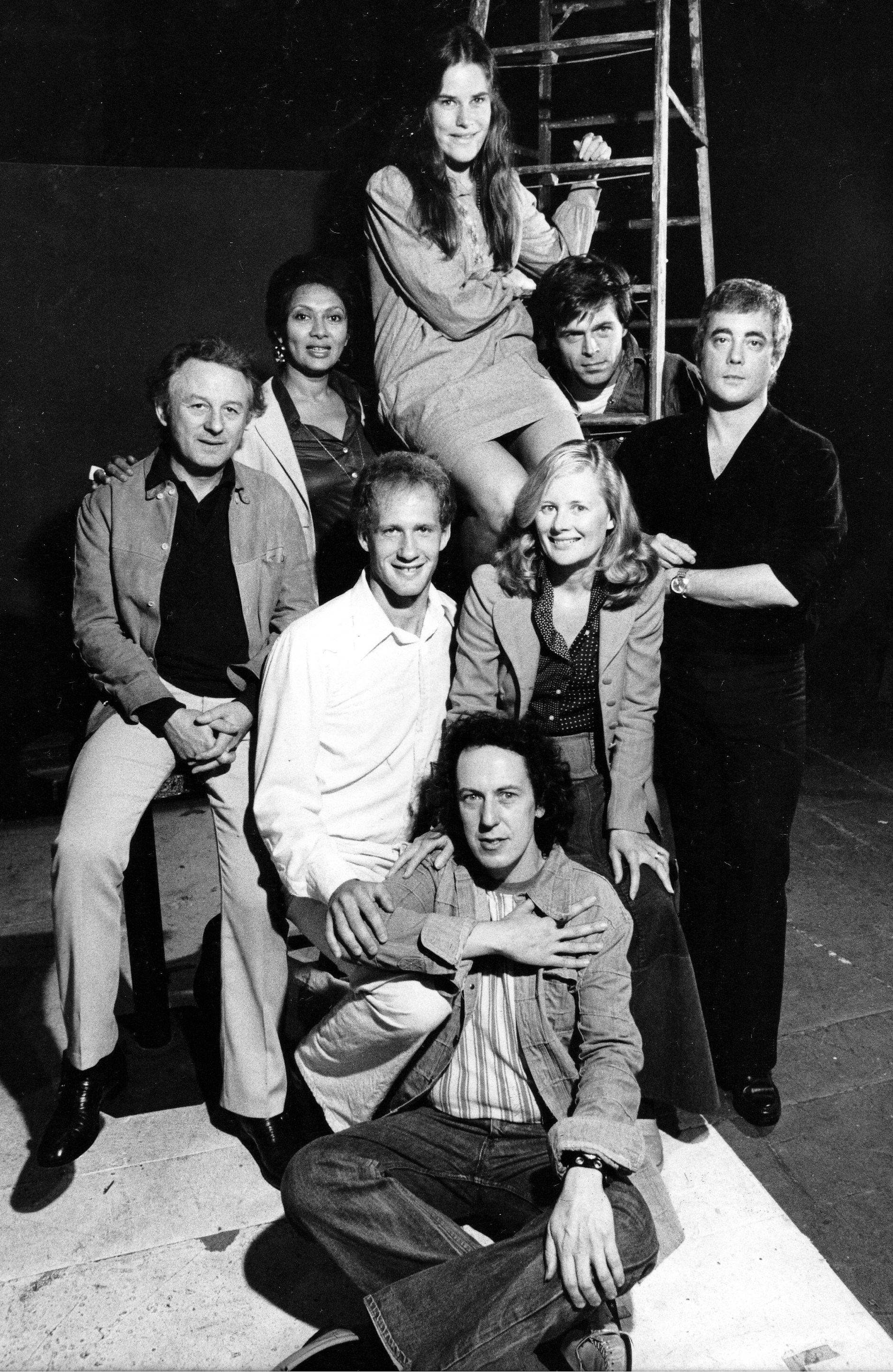
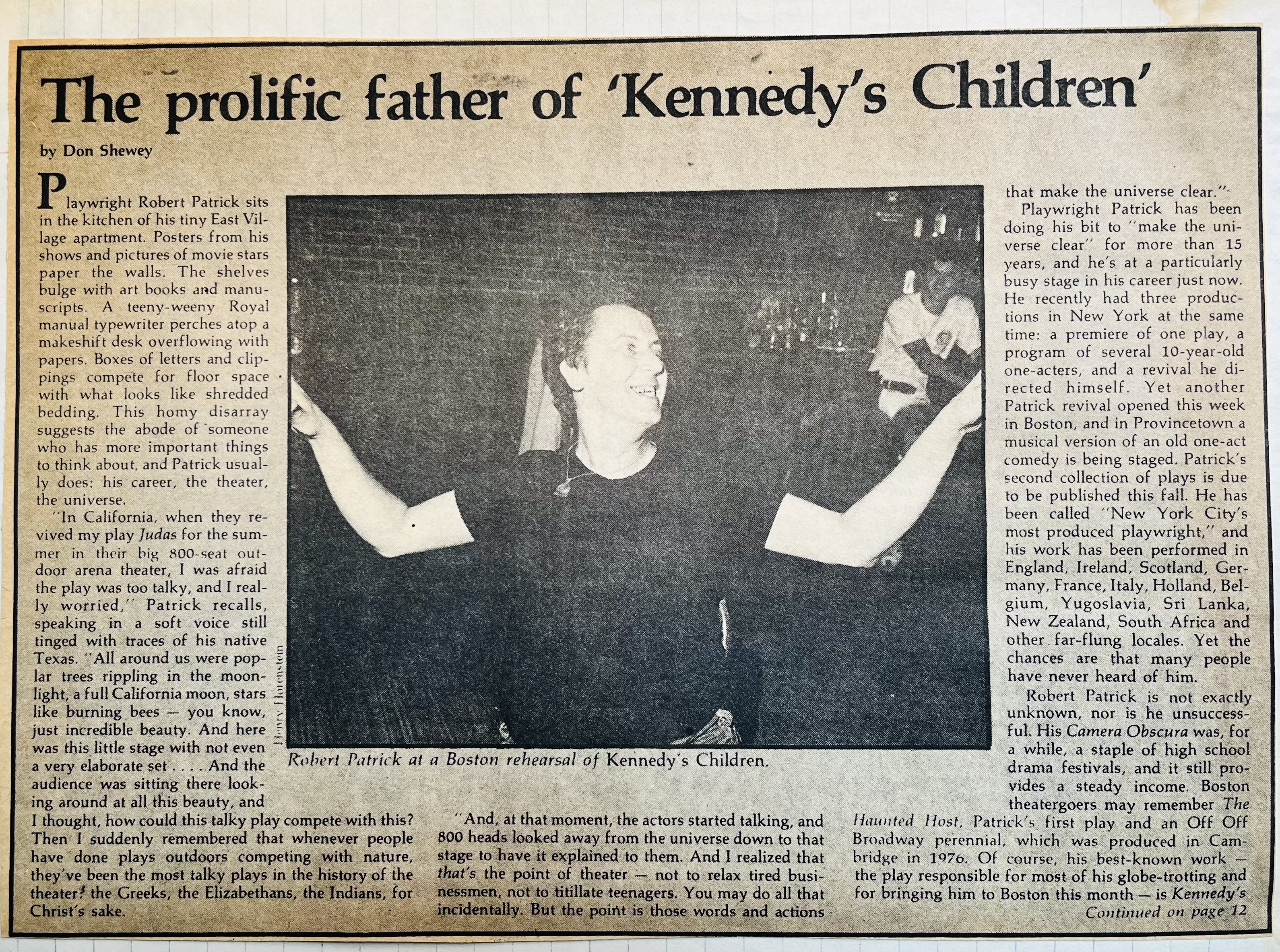
The gay theater pioneer Robert Patrick had a huge impact on me as a young journalist. He was one of the prolific early contributors to Off Off Broadway, but weirdly I first encountered his work at the time of his one and only Broadway production, a wonderful play called Kennedy’s Children, which I saw in its pre-Broadway tryout at the Wilbur Theater in Boston in 1975. (See photo below of the playwright with his cast, which included some legendary performers: Shirley Knight, Barbara Montgomery, Kaiulani Lee.) The following year, someone mounted a revival of his very first play, The Haunted Host, at the equivalent of an Off-Broadway theater in Boston, starring the force of nature that is Harvey Fierstein. That show blew my mind. I got to know Bob a little and saw and admired many of his plays, including Judas, T-Shirts, and My Cup Ranneth Over. He was an unforgettable character who left a big imprint on the gay theater worlds in New York, Los Angeles, and beyond.
Playwright Robert Patrick sits in the kitchen of his tiny East Village apartment. Posters from his shows and pictures of movie stars paper the walls. The shelves bulge with art books and manuscripts. A teeny-weeny Royal manual typewriter perches atop a makeshift desk overflowing with papers. Boxes of letters and clippings compete for floor space with what looks like shredded bedding. This homey disarray suggests the abode of someone who has more important things to think about, and Patrick usually does: his career, the theater, the universe.
“In California, when they revived my play Judas for the summer in their big 800-seat outdoor arena theater, I was afraid the play was too talky, and I really worried,” Patrick recalls, speaking in a soft voice still tinged with traces of his native Texas. “All around us were poplar trees rippling in the moonlight, a full California moon, stars like burning bees — you know, just incredible beauty. And here was this little stage with not even a very elaborate set…And the audience was sitting there looking around at all this beauty, and I thought, how could this talky play compete with this? Then I suddenly remembered that whenever people have done plays outdoors competing with nature, they’ve been the most talky plays in the history of the theater: the Greeks, the Elizabethans, the Indians, for Christ’s sake.
“And, at that moment, the actors started talking, and 800 heads looked away from the universe down to that stage to have it explained to them. and I realized that that’s the point of theater — not to relax tired businessmen, not to titillate teenagers. You may do all that incidentally. But the point is those words and actions that make the universe clear.”
When I interviewed him for this article, we covered a multitude of topics. He did like to talk! I got more material than I could possibly use, but there are a few passages I think are worth sharing — the equivalent of DVD extras.
On Judas: “I wrote the play in one night. I then read books for five years to understand the play. And out of 500 books, for 10 books I would get only one line, but that was all right, it clarified one scene. History, history of religion books, history of history books, Bibles, Korans, Confucius, Tao, Madame Blavatsky, theosophy, Chariots of the Gods, Worlds in Collision, African Genesis, and a million tracts, pamphlets, secret societies, crazy magazines on man, myth and magic, anything anyone handed me on the street. Eventually everything related to it. That’s what happens when you’re really researching. It wasn’t til the very last screaming raving draft of the play that the words finally came into Pilate’s mouth at one time: ‘You may think that a young man’s only concerns are sex and food, sleep and sports, but you are wrong, wrong. A young man’s main concern is morality. A young man wants to be good, to make good. That is why young men are so obsessed with authority, with testing it or protesting. They want someone to show them or tell them how to be or not to be good.’ The point being that people want morality, that morality is a stronger urge than sex, country, race, love, food. People will die to feel they’re doing right. They’ll kill. Convince someone that something is good and he will die trying to do it.”
On the future: “It’s pretty inevitable that we’re in for immense regimentation. But what will happen in our heads? Will the very idea of freedom have any meaning? This is the first age in the history of the world when people have even considered the possibility of freedom or the importance of the individual or the value of the intellect. We’re in the pioneering time as far as the existence of the importance of the individual mind and soul are concerned. And it may be the last. The whole experiment may have failed. The whole renaissance may have been proved to be a very unworkable idea. As more and more people survive and live, it may be absolutely impossible for them to have any individuality. It may be too grating. Too many people go too crazy for us to doubt it. It may be we’re evolving toward termite people – good, solid, unthinking functionaries. The overall sketches of totalitarianism have been made; it works pretty well. All you have to do now is make people love it or take away from them the idea that they need to love anything.
“On the whole I don’t think they’re going to want much thought in the decades to come. As I say, things work pretty well, the machines make enough food for people, etc. etc. I don’t think people want thought beyond that. They want the novelty of art, but even that they’re willing to surrender; after adolescence, they’re content to lull themselves to sleep with slight variations on the TV. Thought is the enemy of the state; and ‘the state’ is the same no matter what it’s called. I don’t like thinking all that, but it seems to be the logical next step unless there’s a war or something that wipes out so many millions of people that a lot of creative thinking is needed. But we certainly do live in an interesting time. A time of collapse like this is fascinating for an artist because when a thing collapses you see its most intimate structure. By the time America collapses, we will see whether the rot is really at the roots or whether it’s some corruption that’s crept into the American idea that’s made everything go wrong.”
On gay life in 1979: “Anyone who spends any time in the gay section of New York comes out of it saying, ‘This can’t go on.’ Not even morally. One reason I live in such isolation in New York is that the alternative, if I were to run around with the people I know – and I know thousands – would be to spend all my time as drugged and drunk as I could financially and physically afford to get every night and be discoing or fucking in backroom bars until I staggered home and got dressed to go to a job. That is how they live. They do not even see the possibility of any other kind of life. And the suggestion that they might be able to lead another kind of life is met with jeering cynicism. I mean, that cannot go on. People will be dying in those bars, if they are not already, from the amount of drugs those people are taking, the amount of sexual exertion. I have no close friends in New York because I’ve stepped out of the drug-and-drink cycle. Almost everyone I know lives for drugs and drink. People keep telling me there’s another world. I don’t know about it. I don’t meet anyone from it.”
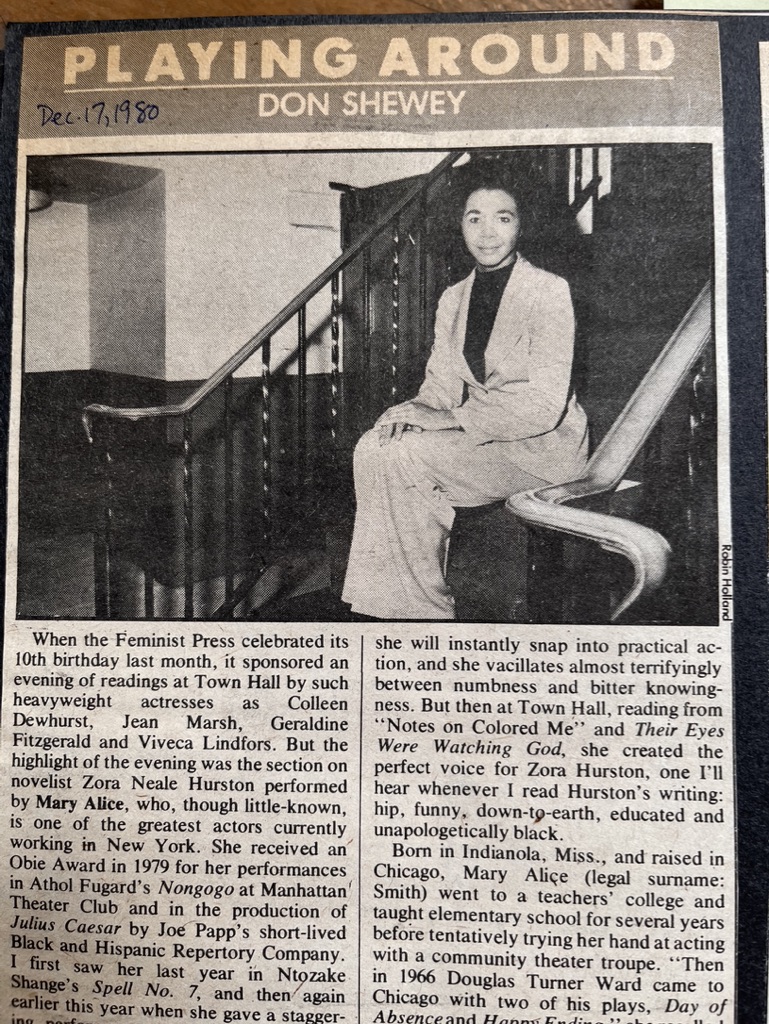
I always considered Mary Alice, who died on Wednesday July 27 at the age of somewhere in her eighties, to be one of the great American actors of our time. And I already thought that when I interviewed her for the Soho News in 1980, my first year in New York. That was before she appeared on Broadway opposite James Earl Jones in August Wilson’s Fences (for which they both won Tony Awards) and opposite Gloria Foster in Emily Mann’s adaptation of Having Our Say, the best-selling oral history about civil rights pioneers Bessie and Sadie Delany. I will never forget her scorching performance at Shakespeare in the Park as Queen Margaret to Denzel Washington’s Richard III.
I’m reprinting here my entire Soho News column about her because I love the thoughtfulness and confidence with which she talked about her work as an actor.
*
When the Feminist Press celebrated its 10th birthday last month, it sponsored an evening of readings at Town Hall by such heavyweight actresses as Colleen Dewhurst, Jean Marsh, Geraldine Fitzgerald and Viveca Lindfors. But the highlight of the evening was the section on novelist Zora Neale Hurston performed by Mary Alice, who, though little-known, is one of the greatest actors currently working in New York. She received an Obie Award in 1979 for her performances in Athol Fugard’s Nongogo at Manhattan Theater Club and in the production of Julius Caesar by Joe Papp’s short-lived Black and Hispanic Repertory Company. I first saw her last year in Ntozake Shange’s Spell #7 and then again earlier this year when she gave a staggering performance of Judy Grahn’s long poem A Woman Is Talking To Death in a gay poetry reading at the Public. In both, her work was so intense it was literally frightening; with an apparent abundance of power in reserve, she seemed like a human bomb that could go off any minute.
An extraordinarily mercurial actor, Mary Alice has a lined, weary face that in repose suggests the blank mask of a dullard or stoic but can suddenly, unpredictably soften into reckless ebullience or tighten in profound rage. Her voice can slide from the most elegant of dictions to a streetwise slur, from a high and happy croon to a slow, penetrating snarl, in nothing flat. Even in as crude a play as Charles Fuller’s Zooman and the Sign at the Negro Ensemble Company, in which she currently plays the mother of a 12-year-old girl slain by a stray bullet from a gang fight, she projects astonishing complexity. Seemingly paralyzed with grief, she will instantly snap into practical action, and she vacillates almost terrifyingly between numbness and bitter knowingness. But then at Town Hall, reading from “Notes on Colored Me” and Their Eyes Were Watching God, she created the perfect voice for Zora Hurston, one I’ll hear whenever I read Hurston’s writing: hip, funny, down-to-earth, educated and unapologetically black.
Born in Indianola, Miss., and raised in Chicago, Mary Alice (legal surname: Smith) went to a teachers’ college and taught elementary school for several years before tentatively trying her hand at acting with a community theater troupe. “Then in 1966 Douglas Turner Ward came to Chicago with two of his plays, Day of Absence and Happy Ending,” she recalled when we met recently in her Manhattan Plaza apartment. “Actor’s Equity in Chicago required that they hire at least one local actor. They wanted a woman, because they needed someone to do the laundry. So I was hired to do two or three small roles in both plays and to do the laundry. That’s how I met Doug, and he told me he was forming the Negro Ensemble Company and if I ever came to New York to contact him, which I did the following July. I wasn’t in the original company, but he did put me in Lloyd Richards’ acting class, and that’s where I really learned about acting. Lloyd Richards and Uta Hagen are the two teachers I’ve learned a lot from. Around October of that year, I got my first Off-Broadway play, Cynthia Belgrave’s production of two Wole Soyinka plays, The Trouser Brother Jero and The Strong Breed. I joined Equity in January of ’68, and that’s how I started this career.”
That career has taken her from Broadway (No Place To Be Somebody) to Australia (For Colored Girls), from film to television, from Grape Nuts commercials to teaching drama in Brooklyn’s High School Redirection program. Actually, she’s done only one film (Sparkle), and she would gladly interrupt her busy schedule of stage acting to do more movies; she find film work particularly valuable in improving her acting technique. When did you get good? I asked. “I’ve always been a very good actor. I won’t be modest; I’ve always been very good. I’ve gotten better in the last two years. I’ve done my best work. It’s been…clear.” She pulled her face into a thoughtful moue and adjusted the turban covering her tightly braided hair. “After I got the Obie, I brought it home and looked at it and tried to determine what it meant to me – not their giving it to me, but the work I had done to get it. It was around that time that I realized that I was an actor. This is, mind you, after about 12 years of acting professionally. But until then I don’t think I ever thought about why I was acting. It had something to do with ambition, with career, with being a star, and all that. But I didn’t realize until last year that for the last 13 years acting has been the best way for Mary Alice to express Mary Alice. Before that, it was teaching. When I knew that, I finally was able to appreciate the quality of my work, instead of needing approval from other people. After that, my work took on another meaning for me.”
You might know Lenny Von Dohlen from Twin Peaks or the movie Electric Dreams. When Susan Shacter and I collaborated on creating the book Caught In The Act: New York Actors Face to Face, Lenny was still very young (26) and I don’t think I had seen him in anything onstage or in film. But Susan was a big fan, and when I met him for the interview he turned out to be a real sweetie pie, smart and funny and thoughtful and soulful. Also from Texas, like me. I was sad to learn that he died at his home in Los Angeles this week after a long illness, at the age of 63. I just posted Susan’s portrait and my interview from the book on my writing archive here.



 another eye opens