Archive for the 'quote of the day' Category

Quote of the day: MERMAID

August 12, 2010

MERMAID

“The Straightforward Mermaid”

The straightforward mermaid starts every sentence with “Look . . . ” This comes from being raised in a sea full of hooks. She wants to get points 1, 2, and 3 across, doesn’t want to disappear like a river into the ocean. When she’s feeling despairing, she goes to eddies at the mouth of the river and tries to comb the water apart with her fingers. The straightforward mermaid has already said to five sailors, “Look, I don’t think this is going to work,” before sinking like a sullen stone. She’s supposed to teach Rock Impersonation to the younger mermaids, but every beach field trip devolves into them trying to find shells to match their tail scales. They really love braiding. “Look,” says the straightforward mermaid. “Your high ponytails make you look like fountains, not rocks.” Sometimes she feels like a third gender—preferring primary colors to pastels, the radio to singing. At least she’s all mermaid: never gets tired of swimming, hates the thought of socks.

— Matthea Harvey

Quote of the day: MEDITATION

August 9, 2010

MEDITATION

I’ve found that the basic practice of “small moments, many times” is my life-preserver in busy times.  It’s not easy to find time to sit regularly when I’m zipping around the country, but I’ve worked hard to “come back” faster and more frequently to the non-seeking, non-desiring mind; to the mind settled in itself and not leaping outside for amusement or validation; to, perhaps, some inkling of the nondual truth.  It can be as simple as an exhale, or a relaxation of the body leading to a resting of the mind.  It’s not a particularly special or exotic feeling I’m after in these moments — just a settling-back into what’s already there.  Although I am thankful for each time it works!

— Jay Michaelson

I’ve found that the basic practice of “small moments, many times” is my life-preserver in busy times.  It’s not easy to find time to sit regularly when I’m zipping around the country, but I’ve worked hard to “come back” faster and more frequently to the non-seeking, non-desiring mind; to the mind settled in itself and not leaping outside for amusement or validation; to, perhaps, some inkling of the nondual truth.  It can be as simple as an exhale, or a relaxation of the body leading to a resting of the mind.  It’s not a particularly special or exotic feeling I’m after in these moments — just a settling-back into what’s already there.  Although I am thankful for each time it works!

Quote of the day: ADDICTIONS

August 3, 2010

ADDICTIONS

Our ability to pursue our dreams can be damaged by four addictions: 1. an addiction to what other people think of us; 2. an addiction to creating melodrama in a misguided quest for excitement; 3. an addiction to believing we’re imprisoned by what happened in the past; and 4. an addiction to negative thoughts that fill us with anxiety.

— success coach Tom Ferry

Quote of the day: MUSIC

August 1, 2010

MUSIC

The musicians took the stage. The singer was wearing a dull green sari. She must have been sixty, was grand-looking, stern, hefty. She supervised the tuning of the tempura, sipped water without letting the bottle touch her lips, and waited….

Within minutes of starting to sing, she was transformed. It was like hearing a girl, dark-haired and lovely as the gopis Krishna had spied on from is tree-top hideaway. I had no idea what she was singing about, could not even tell when the words stopped being words and became just syllables, gliding sound. Her hands reached into the air above her as if the notes were growing there and, as long as they were picked endlessly, over and over, would always be there. Music people talk about perfect pitch, but what her voice made me think of was perfect posture: hair as long and straight as a supple back; bare feet moving so lightly they scarcely touched the ground. Her voice promised absolute devotion; but then the note was stretched further still, beyond this, until you wondered what you would have to do to be worthy of such devotion, such love. You would have to be that note, not the object of devotion, but the devotee. Her voice slid and swooped. It was like those perfect moments in life, moments when what you hope for most is fulfilled and, by being fulfilled, changed – changed, in this instance, into sound: when, in a public place, you glimpse the person you most want to see and there is nothing surprising about it; the pattern in the random, when accident slides into destiny. A note was stretched out as long as possible and then a little longer; it continued, somewhere, long after it was capable of being heard. It is still there, even now.

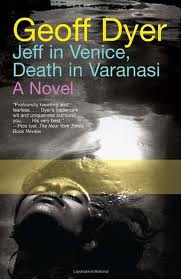
— Geoff Dyer, Jeff in Venice, Death in Varanasi

Quote of the day: GIBBERISH

July 24, 2010

GIBBERISH

Eurovision English [is] an exquisite tongue, spoken nowhere else, which raises the poetry of heartfelt but absolute nonsense to a level of which Lewis Carroll could only have dreamed. The Swedes are predictably fluent in this (“Your breasts are like swallows a-nesting,” they sang in 1973), and the Finns, too, should be hailed as early masters, with their faintly trouble back-to-back efforts from the mid-seventies, “Old Man Fiddle” and “Pump-pump,” but the habit continued to flourish even during those periods when the home-language ruling was in place, as cunning lyricists broke the embargo by smuggling random expostulations into their titles and choruses. Hence such gems as Austria’s “Boom Boom Boomerang,” from 1977 (not to be confused with Denmark’s “Boom Boom,” of the following year), Portugal’s “Bem-bom,” from 1982, and Sweden’s “Diggi-loo Diggi-ley,” which won in 1984. The next year’s contenders, spurred by such bravado, responded with “Magic, Oh Magic” (Italy) and “Piano Piano” (Switzerland). Not that the host national relinquished the crown without a fight, as anyone who watched Kikki Danielson can attest. Her song was called “Bra Vibrationer.” It was, regrettably, in Swedish.

By and large, philologists date the golden age of gibberish from the collapse of the Communist bloc. This brought a surge of fresh, unjaded contestants into the fray, hitherto unexposed to the watching world and avid to make their mark. (Of the thirty-nine contenders this year, eighteen did not exist as independent entities when the contest was first held.) I tried to interview Alyosha, who was in Oslo to sing “Sweet People,” for Ukraine, and hit a wall. She could learn English phonetically, and howl it convincingly into a wind machine, but speaking it one-on-one was another matter. Run your eye down the first semifinal of 2008, and you find what Donald Rumsfield used to call Old Europe being gate-crashed, in style, by Ukraine (“Shady Lady”), Latvia “(Wolves of the Sea”), Lithuania (“Nomads in the Night”), Bulgaria (“DJ, Take Me Away”), and Belarus (the ambitious “Hasta La Vista”). How could veterans like Turkey (“Deli”) or Switzerland (“Era Stupendo”) compare with that? My overriding concern, of course, was that 2010 would mark a hiatus of calm and common sense in this ritual massacre of the English language. I needn’t have worried. From the moment that Aisha took to the stage, for Latvia, in the first semifinal, with a hostage-to-fortune special called “What For?,” I settled down to enjoy a vintage year:

I’ve asked my Uncle Joe

But he can’t speak

Why does the wind still blow?

And blood still leaks?

So many questions now

With no reply

What for do people live until they die?

That is a good question. And even better was Aisha’s answer:

Only Mr. God knows why

(But) His phone today is out of range.

— Anthony Lane, writing in the New Yorker about the Eurovision Song Contest