GUNS
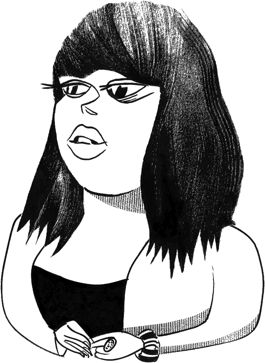
 A New Jersey driver who had previously seen the Red Hook housing projects only while passing by on an elevated span of the Brooklyn-Queens Expressway got off the highway the other day, parked, walked into the projects, and met up with Shaina Harrison, a young woman whose job is helping to prevent gun violence among kids in New York City. Harrison is twenty-six years old and has lived in the Red Hook projects all her life. Watching her approach, the Jersey driver wondered if that could really be she. She wore a necklace of big gold-colored links, a pumpkin-orange top, striped drawstring trousers, and cream-colored pumps with gold tips. She is five feet eleven inches tall. Her long, wavy hair, black streaked with cinnamon highlights, fell to below her shoulders.
“Don’t ask me about my hair,” she said, joining the Jersey driver on a playground bench. “My hair is this way today, and it will be completely different tomorrow. You’ve never been to Red Hook before? I love it here. For the rest of my life, I am never going to leave. The apartment I live in used to be my grandmother’s. Her name was Myrtee Harrison and she came up from North Carolina in 1942, when she was thirteen, and started cleaning offices and apartments. When I was ten, she got temporary custody of me and my younger sister, Ashley. My grandmother was part Blackfoot Indian and never let you forget it. When she had to fill out a form, she would put ‘Native American,’ or ‘Other.’ I would joke, ‘Gramma, we’re black! Why can’t we just be black? I don’t want to be more minority than I am already!’
“Gramma died in this apartment, with just me and my sister there,” Harrison went on. “I was eighteen and Ashley was fourteen. After the funeral, we didn’t know what to do, so we just stayed. I had a full scholarship to go to Bowling Green University, in Ohio. But I decided I had to stay here and raise my little sister. I went to John Jay College of Criminal Justice instead.”
Harrison led the Jersey driver on a stroll around the neighborhood. Almost everybody—kids, old ladies pushing walkers, guys drinking beer on benches—said hello to her. “People don’t shoot here as much as they used to,” she said. “I remember when it was so bad you’d hear gunshots and not even run. It was, like, ‘Oh, who is that shooting now?’ Like the bullets belonged to individual people and had names. Everybody knew what a gunshot sounded like and what a firecracker sounded like. Kids of seven and eight years old could tell you the difference right away—and that’s crazy. But Red Hook has gotten better. We even have our own IKEAnow! I haven’t heard a gunshot around here in nine or ten months.”
She and the Jersey driver came to the corner of Mill and Henry Streets, at the projects’ northern border. “This is where Ronald D. was shot,” Harrison said. “There was a corner store here, and one night a guy in front of it started shooting at someone else, and Ronald D.—Ronald D. Williams was his name—happened to be in between, and he was shot and killed. Ronald D. was a funny, chubby kid who was not the type of person you might think would probably get shot. That was the saddest shooting.”
On another day, Harrison wore business attire—paisley blouse, brown pleated skirt—as she sat at a conference table in the offices of her employer, New Yorkers Against Gun Violence, in Chinatown. This time, her hairdo consisted of extra-large Chaka Khan-style curls, extending horizontally on either side of her face.
She held up her nails, polished in a peach-pink shade. “See my nails? The person who does my nails has to have a license to do nails. You have to have a license to cut hair, a license to be a plumber. I went to buy a goldfish and the pet-store person wanted proof that I owned a fish tank before he would sell me a goldfish. Many people do not know how easy it can be to purchase a gun without a license. I teach after-school classes in high schools and middle schools, and sometimes I show the kids pictures of gun shows and I ask them, ‘Who do you see in this picture that looks like you? The guns are coming to your community from places where almost nobody looks like you, and you are using these guns to kill each other.’
“If I ask a room of kids at a high school in Crown Heights if they could get a gun if they wanted to, every hand goes up. These kids can get a gun more easily than a MetroCard. There are guns nobody owns, guns you can borrow—community guns.
“The reason kids pick up guns is that they are powerless. I try to let them understand how they can have power. We draw maps of their neighborhoods and figure out who their representatives are. The first time I ask who represents them in the government, they always shout, ‘Obama!’ I try to show them there are dozens and dozens of other people between them and him.
“People sometimes ask them what they want to be when they grow up. Don’t ask that! Ask what they want to be right now! I want to help them find that out—how they can have some direction and some power, without it coming from a gun.”
— Ian Frazier, The New Yorker, Talk of the Town, September 30, 2013


 another eye opens