PUBLIC NUDITY
“Because of the weather, we don’t have proper plazas in the Italian or French style,” the writer Magnus Sveinn Helgason explained to me. “Beer was banned in Iceland until 1989, so we don’t have the pub tradition of England or Ireland.” The pool is Iceland’s social space: where families meet neighbors, where newcomers first receive welcome, where rivals can’t avoid one another. It can be hard for reserved Icelanders, who “don’t typically talk to their neighbors in the store or in the street,” to forge connections, Mayor Dagur told me. “In the hot tub, you must interact. There’s nothing else to do.”
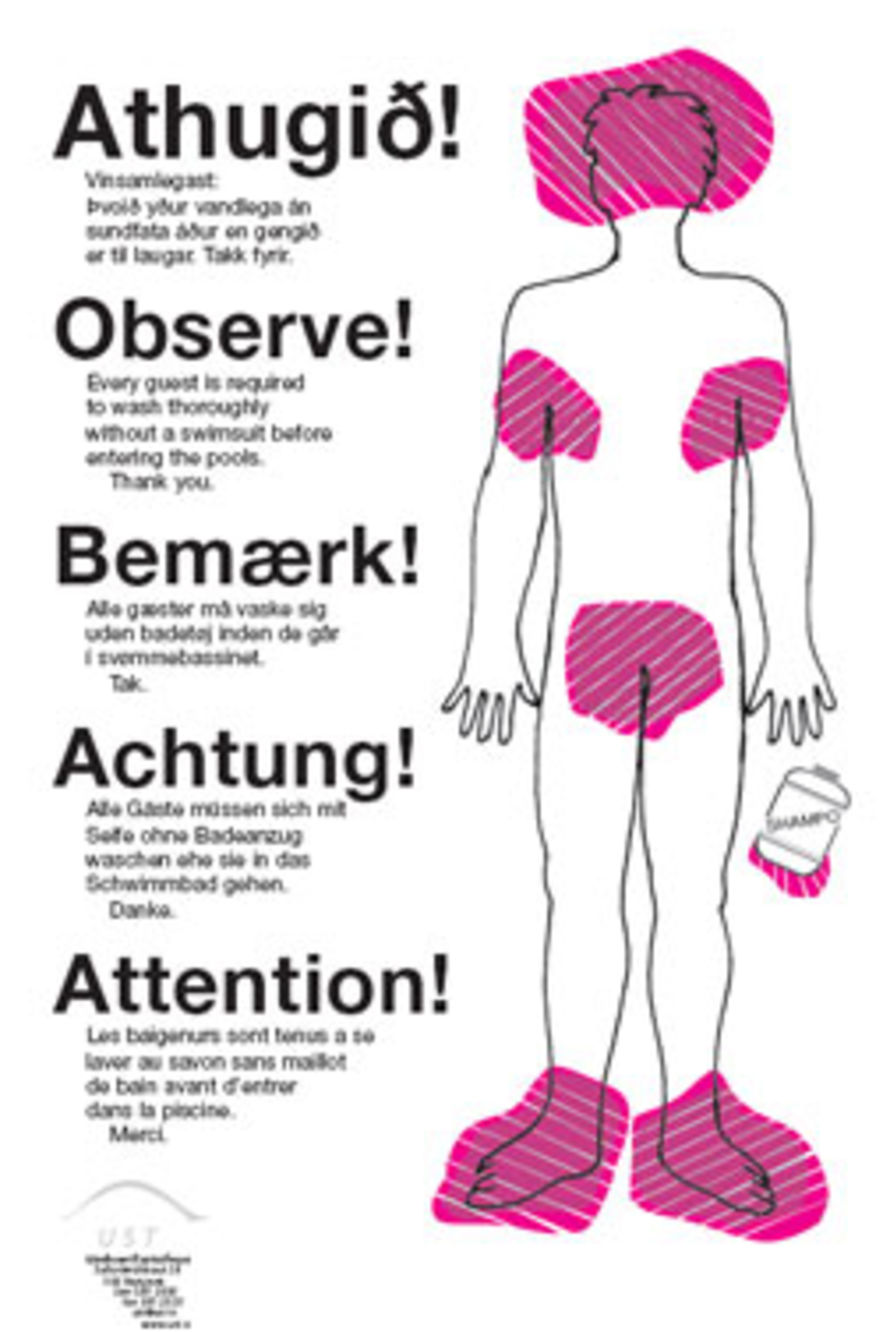
Not only must you interact; you must do so in a state of quite literal exposure. Most Icelanders have a story about taking visitors, often American, to the pools and then seeing them balk in horror at the strict requirement to strip naked, shower and scrub their bodies with soap from head to toe. Men’s and women’s locker rooms feature posters highlighting all the regions you must lather assiduously: head, armpits, undercarriage, feet. Icelanders are very serious about these rules, which are necessary because the pools are only lightly chlorinated; tourists and shy teenagers are often scolded by pool wardens for insufficient showering. The practice was even the subject of a popular sketch on the comedy show “Fostbraedur,” in which a zealous warden scrubs down a reluctant pool visitor himself.
That one of the buck-naked bystanders in that viral video, Jon Gnarr, was later elected mayor of Reykjavik demonstrates that Icelanders are quite un-self-conscious about nudity in the service of pool cleanliness. This was made most clear to me, perhaps, in a dressing room in the town Isafjordur, where a chatty liquor-store manager named Snorri Grimsson told me a long story about the time a beautiful Australian girl asked him to go to the pool but then revealed that she doesn’t shower before swimming. He mugged a look of comic horror, then brought home the kicker: “It was a very difficult decision. Thankfully, the pool was closed!” I could tell this bit killed with his fellow Icelanders, but my own appreciation of it was somewhat impeded by Snorri’s delivery of it in the nude, his left foot on the sink, stretching like a ballet dancer at the barre.
“It’s wonderful,” an actress named Salome Gunnarsdottir told me in the pool one evening. “Growing up here, we see all kinds of real women’s bodies. Sixty-five-year-olds, middle-aged, pregnant women. Not just people in magazines or on TV.” Her friends, all in their 20s and pregaming for a Saturday night out in the bars, nodded enthusiastically. “Especially pregnant women,” Helga Gunnhildursdottir agreed. “You can see: Oh yes, she really got quite big.”
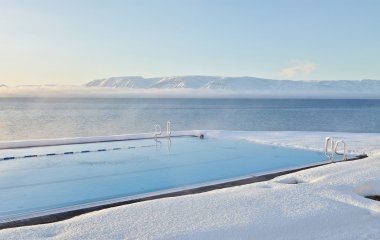
The pool in Hofsos, an old trading port on the northern coast. Credit Massimo Vitali for The Ny Times
“It’s so important,” Salome said earnestly. “You get used to breasts and vaginas!”
As a journalist, I will never forget the uniquely Icelandic experience of shaking hands with handsome Mayor Dagur and then, just minutes later, interviewing him as we each bared all. (In the tradition of politician interviews everywhere, an aide lurked nearby, in a manner I would call unobtrusive but for the fact that he was also naked.) I admit I found this disconcerting at first, but eventually there was something comforting about seeing all those other chests and butts and guts — which for the most part belonged to normal human-being bodies, not sculpted masterpieces. And that comfort extends out into the pool proper, where you might be covered — only a little, in my case — but are still on display.
But near-nudity, by encouraging a slight remove from others, also allows the visitor to focus, in a profound and unfamiliar way, on his own body, on its responses and needs. Despite its being a social hub, the pool also cultivates inwardness. Results of a questionnaire distributed by Valdimar’s research team suggested that women in particular go to the pool to seek solitude. According to women I talked to, most everyone respects the posture of aquatic reverie — head tilted back against the pool wall, eyes closed, mouth smiling a tiny smile of satisfaction — that you adopt when you come to the pool wanting to be left alone.
Sigurlaug Dagsdottir, a graduate student researching the pools, speculated that the sundlaugs’ social utility in Icelandic communities derives in part from the intimacy of the physical experience: In the pool, she said, you can “take off the five layers of clothing that usually separate you from everyone else.” As such, the pools are a great leveler: Council members in Reykjavik make a point to circulate among the city’s sundlaugs, where they often take good-natured grief from their constituents. The filmmaker Jon Karl Helgason, who is shooting a documentary about Iceland’s pools, said, “When people are in the swimming pool, it doesn’t matter if you are a doctor or a taxi driver.” His girlfriend, Fridgerdur Gudmundsdottir, added, “Everyone is dressed the same.”
–Dan Kois, “Iceland’s Water Cure,” New York Times
 Donald Trump, it is worth stating, is married to an immigrant [Melania Trump, nee Melanija Knauss]…Trump’s mother was an immigrant, too, from Scotland; his first wife was born Ivana Zelníčková, in Zlín, Czechoslovakia. If he’s as concerned as he says he is by all the “people that are from all over and they’re killers and rapists and they’re coming into this country,” he might consider building a wall around his pants.

 another eye opens