Archive for the 'quote of the day' Category

Quote of the day: DESIRE

January 23, 2010

There is more to desire than just suffering. There is a yearning in desire that is as spiritual as it is sensual. Even when it degenerates into addiction, there is something salvageable from the original impulse that can only be described as sacred. Something in the person wants to be free, and it seeks its freedom any way it can.

As the well-known contemporary Indian teacher Sri Nisargadatta, famous for sitting on a crowded street corner selling inexpensive bidis, or Indian cigarettes, once commented, “The problem is not desire. It’s that your desires are too small.” The left-handed path means opening to desire so that it becomes more than just a craving for whatever the culture has conditioned us to want. Desire is a teacher: when we immerse ourselves in it without guilt, shame, or clinging, it can show us something special about our own minds that allows us to embrace life fully.

– Mark Epstein, from “In Defense of Desire,” Tricycle, Spring 2005

Quote of the day: CONFRONTING RACISM

January 22, 2010

I am a white Baptist male living in Georgia, and I’ve found that the best way for white people to fight racism is to put other whites on the defensive when they make racist comments. For years I felt uncomfortable whenever someone made a remark like “You’re not sending your kids to public school with those children, are you?” Now I just ask, “What do you mean?”

Here’s an example: Last year I was watching a college basketball game when a man said to me, “I used to love basketball before they stole it from us.”

“What do you mean?” I asked.

“You know.”

“No, what are you talking about?”

“You know what I mean.”

“No, explain it to me.”

“Forget about it.”

Suddenly he felt uncomfortable instead of me.

— Bob Herndon


Quote of the day: HAITI

January 19, 2010

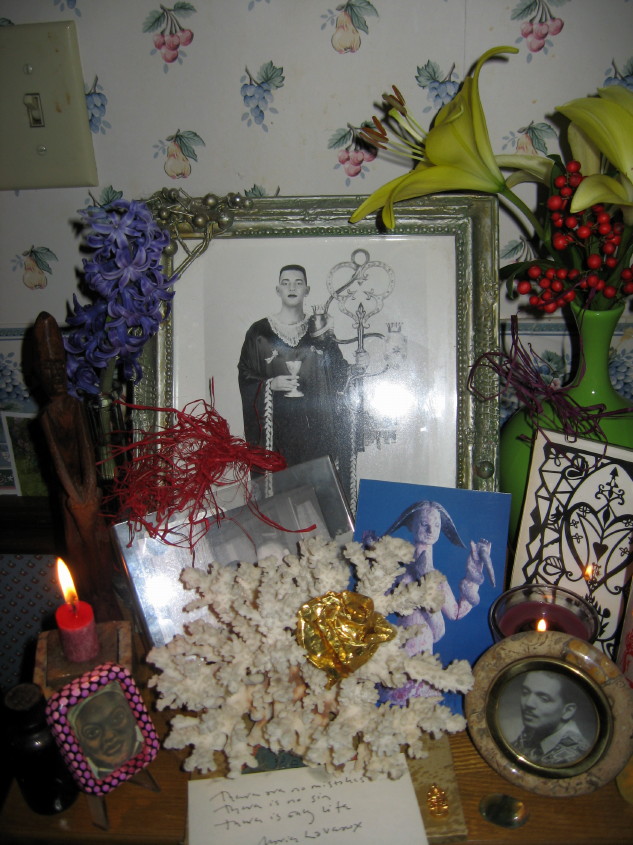
On the occasion of Martin Luther King Day, Atlanta-based poet Franklin Abbott channels his friend and lover, the late Assoto Saint (pictured below):

Black is the Color

I go to Troublesome to mourn and weep . . .
— Scottish folk song popular in Appalachia

for Haiti
for Yves Lubin/Assotto Saint
beloved
your mother
has broken
her back
your father
died in your quiver
long before
you joined him
you beloved poet
Yves/Assotto
beyond time
whisper prayers
Rumi-like
a flute in the wind of my ear:
help my people
and the midnight art
of our magic
will set you
free


Quote of the day: BODY

January 11, 2010

i like my body when it is with your
body. It is so quite a new thing.
Muscles better and nerves more.
i like your body. i like what it does,
i like its hows. i like to feel the spine
of your body and its bones, and the trembling
-firm-smooth ness and which I will
again and again and again
kiss, i like kissing this and that of you,
i like, slowly stroking the, shocking fuzz
of your electric fur, and what-is-it comes
over parting flesh…And eyes big love-crumbs,

and possibly i like the thrill
of under me you quite so new

— e.e. cummings

Quote of the day: WRITING

January 9, 2010

WRITING

On January 8, 1981, when Chilean-born Isabel Allende was living in Venezuela and working as a school administrator and freelance journalist, she got a phone call that her beloved grandfather, at 99 years old, was dying. She started writing him a letter, and that letter turned into her very first novel, The House of the Spirits. She said, “It was such a lucky book from the very beginning, that I kept that lucky date to start.”

January 8 is a sacred day for her, and she treats it in a ceremonial, ritualistic way. She gets up early this morning and goes alone to her office, where she lights candles “for the spirits and the muses.” She surrounds herself with fresh flowers and incense, and she meditates.

She sits down at the computer, turns it on, and begins to write. She says: “I try to write the first sentence in a state of trance, as if somebody else was writing it through me. That first sentence usually determines the whole book. It’s a door that opens into an unknown territory that I have to explore with my characters. And slowly as I write, the story seems to unfold itself, in spite of me.”

She said, “When I start I am in a total limbo. I don’t have any idea where the story is going or what is going to happen or why I am writing it.” She doesn’t use an outline, and she doesn’t talk to anybody about what she’s writing. She doesn’t look back at what she’s written until she’s completed a whole first draft — which she then prints out, reads for the first time, and goes about the task of revising, where she really focuses on heightening and perfecting tension in the story and the tone and rhythm of the language.

She said that she take notes all the time and carries a notebook in her purse so that she can jot down interesting things she sees or hears. She clips articles out of newspapers, and when people tell her a story, she writes down that story. And then, when she is in the beginning stages of working on a book, she looks through all these things that she’s collected and finds inspiration in them.

She writes in a room alone for 10 or 12 hours a day, usually Monday through Saturday from 9:00 a.m. to 7:00 p.m. During this time, she says, “I don’t talk to anybody; I don’t answer the telephone. I’m just a medium or an instrument of something that is happening beyond me.”

She’s the author of nearly 20 books published since 1982, among them Paula (1995), Daughter of Fortune (1999), Portrait in Sepia (2000), and the recent memoirThe Sum of Our Days (2008). Her work has been translated into 30 languages, and her books have sold more than 51 million copies. She continues to write fiction in Spanish though she’s lived in the United States for decades.

— The Writer’s Almanac