Archive for the 'performance diary' Category

Performance diary: Rude Mechs’ DIONYSUS IN ’69, the Wooster Group’s HAMLET, and Toneelgroep Amsterdam’s ROMAN TRAGEDIES

November 20, 2012

Thursday November 8 at New York Live Arts I saw the Austin-based company Rude Mechs’ recreation of Dionysus in ’69, one of the most famous experimental theater pieces of the 1960s. An adaptation of Euripides’ The Bacchae by the Performance Group under Richard Schechner’s direction, the production became famous for two things: its environmental set (a series of multilevel platforms rather than seating for the audience) and the frequent nudity of the young performers. It was also one of the first shows mounted at the Performing Garage on Wooster Street in Soho, now the headquarters of the Wooster Group, Elizabeth LeCompte’s company, which evolved out of the Performance Group. Rude Mechs has attempted to reconstruct the semi-improvised audience-participatory Dionysus in ’69 by closely imitating the performances filmed back in the day by then-emerging filmmaker Brian De Palma. Which is a very Wooster Group sort of thing to do – the Woosters’ 2004 production Poor Theater resurrected another legendary avant-garde production, the Polish Theater Lab’s Akropolis (directed by the lab’s founder, Jerzy Grotowski), on the basis of snippets seen in a documentary film – although I once heard LeCompte joke about reviving Dionysus in ’69 with its original cast, sagging bodies, bad knees, and all. On Saturday November 10 I found myself back at the Performing Garage to see the Wooster Group’s Hamlet, itself another sort of recreation. The conceit of this production (first performed in 2007) is that the group, directed by LeCompte, is reconstructing John Gielgud’s 1964 Broadway production starring Richard Burton, which was videotaped and shown for two days only in 2000 movie theaters across the U.S.
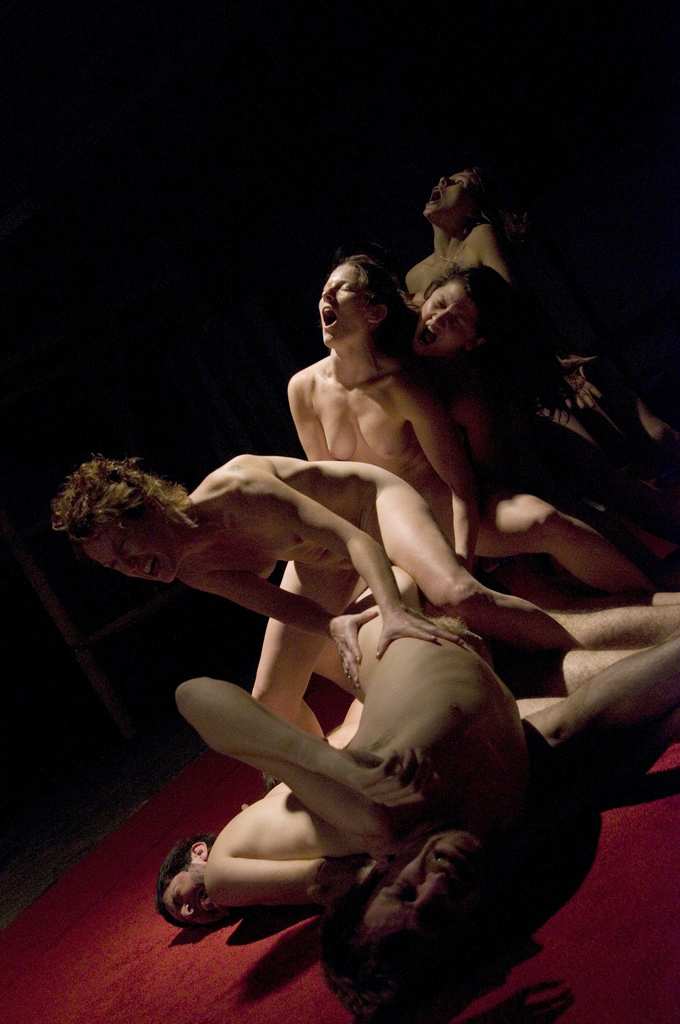

Never having seen Dionysus in ’69, I was fascinated to experience the Rude Mechs’ version, which was partly scholarly homage to and partly knowing send-up of the earnest and self-conscious edginess of the original production. We’ve now seen lots of nudity onstage and lots of productions where the audience gets to mingle with the performers. (Only a month ago on the same stage, in fact, was Keith Hennessy and Circo Zero’s Turbulence, the legacy of which includes NYLA asking audience members to sign waivers legally indemnifying the theater in case someone falls off a platform and breaks something.) Still, actors stripping naked in close proximity to the audience is never really old-hat. As soon as the show began, the Austin performers all shed their clothes, and the moment felt slightly racy, slightly tense, slightly brave, and slightly sacred – they proceeded to perform a kind of birth ritual, with the men lying face-down, the women straddling them, and the actor playing Dionysus sliding through the tunnel created by the other bodies (see above). The script wanders between clumps of Euripides and self-referential bantering among the actors (who use both their real names and those of the Performance Group actors they’re impersonating). Twice the show instigated rituals involving the audience in an attempt to evoke the Eleusinian revels that The Bacchae references: a drumming-and-dancing circle and an “orgy,” both of which were fairly tentative and lame. (Peering down from my perch on the highest platform like Pentheus spying from his tree, I was tickled to see my old buddy Jim O’Quinn, editor of American Theatre magazine, rolling around on the floor making out with two shirtless actors.)

The original production attempted to conjure contemporary resonances with the Euripidean drama about Apollonian restraint and Dionysian release, the politics of ecstasy, and the dangers of excess in either direction. Dionysus punishes Pentheus for disrespecting him by having him torn to pieces by his mother and her fellow cultists, but the tragedy redounds onto his followers as well, leaving Dionysus looking like a cruel, never-satisfied god. I kept hoping for the Rude Mechs to let us know what was important to them about reviving Dionysus in ’69 right now, and that never really came, which is why it remained an academic stunt for me. The pile of blood-smeared bodies made me think of the Hollywood murders committed by Charles Manson’s drug-addled followers as a deluded commentary on American society and the Vietnam war (those murders took place in 1969, the same year that the Rolling Stones’ concert at Altamont turned into a melee where Hell’s Angels killed an audience member – all of which happened after Dionysus in ’69 was already being performed). It also made me think about Abu Ghraib and how American soldiers turned torturing Afghan prisoners into a giddy festival. But the show stuck pretty much to its ‘60s bubble. The performers dutifully maintained their sense of ensemble, and their unbuff natural bodies seemed true to the period. But the original cast included some powerhouse actors, including Joan MacIntosh and Priscilla Smith (and later replacements included Spalding Gray and Liz LeCompte), whom none of these kids matched in intensity. There was a moment that I appreciated for the way it captured theater’s economical transformation of time and space – Cadmus is leading the blind Tiresias to a mountaintop. They simply make one orbit around the small stage area. Tiresias says, “Are we there?” Cadmus says, “We are there.” And we are there.

I blogged about the Wooster Group’s Hamlet when I saw it twice in 2007 (see here).  As usual with the Wooster Group, there’s much to be gained from seeing productions repeatedly. They’re always shifting and morphing, and I see the same things differently. The first showings in New York were at St. Ann’s Warehouse, when the piece was still developing. Later in the year it played at the Public Theater, where it seemed fully complete, plus there was the delicious resonance of its appearing under the auspices of the New York Shakespeare Festival. Now, after five years of periodic national and international tours, LeCompte wants to create a film version of the production (just to add one more layer of tech texture), so the company scheduled a few weeks of performances back at the Performing Garage for the first time since 2005’s Poor Theater.

I walked away from this viewing with a stronger sense of the show’s origin in Scott Shepherd’s wanting to play the role that is every young actor’s Mt. Everest and therefore the production as a fertile and intimate dance between him and LeCompte. Many Wooster Group pieces have been explicitly about recreations, and LeCompte has mastered the fine art of the theatrical mash-up and the remix as well as any of the coolest hiphop DJs. This show began with a more extended verbal introduction by Shepherd and a different program note capitalizing on how the Richard Burton Hamlet production was marketed in 1964 as a new form (“Theatrofilm”) made possible through “the miracle of Electronovision” – Shepherd suggested that the Wooster Group was experimenting with “Reverse Theatrofilm”: turning the filmed document of a live performance back into a live performance (and then, you know, FILMING IT). Throughout the show he calls out cues and instructs the video operator to fast-forward through scenes. You could say he turns Hamlet into Our Town, and he’s the Stage Manager, the narrator, the Master of Ceremonies, roles that Spalding Gray and Ron Vawter played in earlier Wooster Group shows. As Shepherd says, “We’re channeling ghosts.”

What propels the show is a tension among several different intentions: 1) the conceptual intention of recreating the Burton production live, which is the simplest and shallowest task; 2) Shepherd’s effort to both mimic Burton and to create his own visceral performance while sorting out strands from other filmed versions of the play (Kenneth Branagh’s, Michael Almereyda’s starring Ethan Hawke); 3) LeCompte’s contribution, which is to the keep the visual field lively and interesting and beautiful, with little regard for telling Shakespeare’s story or formulating coherent characterizations; and 4) the other actors’ battle to formulate some version of coherent characterizations while simultaneously performing the non-narrative tasks thrust upon them by LeCompte and Shepherd. And these performers (Wooster veterans Kate Valk and Ari Fliakos with a handful of guests) love nothing more than that kind of challenge. Valk gets to play both Gertrude and Ophelia, Fliakos plays Claudius and the Ghost of Hamlet’s father and the gravedigger. (My boyfriend Andy, who’s relatively new to the Wooster Group, said, “I don’t remember there being a nurse in Hamlet…” Which reminded me that I’m so used to seeing a nurse character running around making adjustments, as Koosil-ja does in this version, that I forget it’s LeCompte’s representation of herself, not a character in the actual play.)

As with my first viewing, this time I found the constant shifting set pieces slightly to match camera shots tedious after a while. But I continued to admire the visual field, especially the use of the closeup screen (picking out details such as the crucifix around Claudius’s neck) against the larger background screen (which LeCompte played with even more aggressively and brilliantly in her staging of Tennessee William’s Vieux Carre). And the performances by all the actors have gotten even stronger, freer, and more individual.

Since the performances functioned as a sort of fundraiser to subsidize the film, I bought high-priced “patron tickets,” which gave me “good seats” (in the tiny Garage) and the option to go upstairs and have a glass of champagne with LeCompte at intermission – a hilarious and somewhat awkward invasion of corporate style in the funky setting of the Garage. I did chat with LeCompte briefly about how Hurricane Sandy affected them (they kept rehearsing during daylight, and since their security gate is electronic, someone had to stay on the premises all night to keep intruders out) and met Jonathan Mills, director of the Edinburgh International Festival and a fellow big-time Wooster groupie.

The essence of the Wooster Group’s Hamlet is its ingenious, original way of upholding what Shakespeare calls “the purpose of playing, whose end was and is to hold as twere the mirror up to nature…to show…the very age and body of the time.” The time we live in, where more and more of our intellectual and interpersonal experience is mediated by electronic devices, is reflected even more pointedly, using many of the same technological strategies, in Belgian director Ivo van Hove’s ambitious and awe-inspiring Roman Tragedies, which his company Toneelgroep Amsterdam performed three times at BAM’s Next Wave Festival. (I saw the final show on Sunday November 18.)

First mounted in 2007, Roman Tragedies consists of three Shakespeare plays about politics – Coriolanus, Julius Caesar, and Antony and Cleopatra – performed back-to-back, without intermission, running about six hours. The costumes are contemporary business suits, and the set looks like the lobby of some sort of conference hotel – industrial gray carpeting, many sofas, flat screens everywhere. The audience is invited, even encouraged to sit onstage, where there are two bars serving continuously throughout the show, to take pictures with smartphones, and to post on Twitter (#romantragedies); they form a throng through which the actors move, followed by cameramen. A wide screen over the stage becomes a major staging area, with a steady mixture of video being mixed live from various parts of the stage, English subtitles (some but not all of it from Shakespeare), and dramaturgical footnotes delivered on a LED ribbon. The whole thing is timed and counted down as precisely as a live network TV show, and the actors (equipped with body mikes) fight, scream, love, and die their way through text that switches the gender of many characters (Cassius and Octavius Caesar, most notably, are played by women). In Olympic judging terms, the degree of difficulty for this undertaking is 9.9, and van Hove and company walk off with gold medals.

As with the Wooster Group’s Hamlet, the Toneelgroep actors do yeoman’s jobs of meeting the challenges of Shakespeare’s characters while rising to the demands of van Hove’s tech-savvy staging. The fighting that erupts between Coriolanus (a strong performance by Gijs Scholten van Aschat) and the nerdy bureaucrats serving as tribunes looked remarkably like the melee that broke out in the Ukraine parliament earlier this year. The indisputable star of the show is Hans Kesling as Marc Antony; in Julius Caesar, he gives an intensely original, deeply distraught reading of the famous funeral oration that shames Caesar’s killers into exile, but then in Antony and Cleopatra we see him as a road-weary politician-as-movie-star right out of Entourage, living in his own debauched bubble with Cleopatra (Chris Nietvelt, unlikely but inspired casting) and limping back to Rome to undertake a political marriage with Octavius Caesar’s sister that has all the sincerity of a reality-TV show.

The show has numerous points to make about how politics play out in public and in private, some of them bludgeoningly obvious in their irony (the pre- and post-show loop of Bob Dylan crooning “The Times They Are A-Changin’” becomes irritating), some of them subtle and clever, many of them deep and, indeed, timeless. It’s a huge, relentless feast, difficult to digest while you’re watching, and van Hove doesn’t let up even with the curtain call. As the audience is leaving, a long list of questions scrolls across the screen (does freedom exist? is political charisma a virtue? when do principles become unreasonable?) – part study guide to Shakespeare, part talking points for a civic dialogue, extremely pertinent in an election year though just as likely to provoke viewers at the end of this exhausting election year to cry “Enough already!”
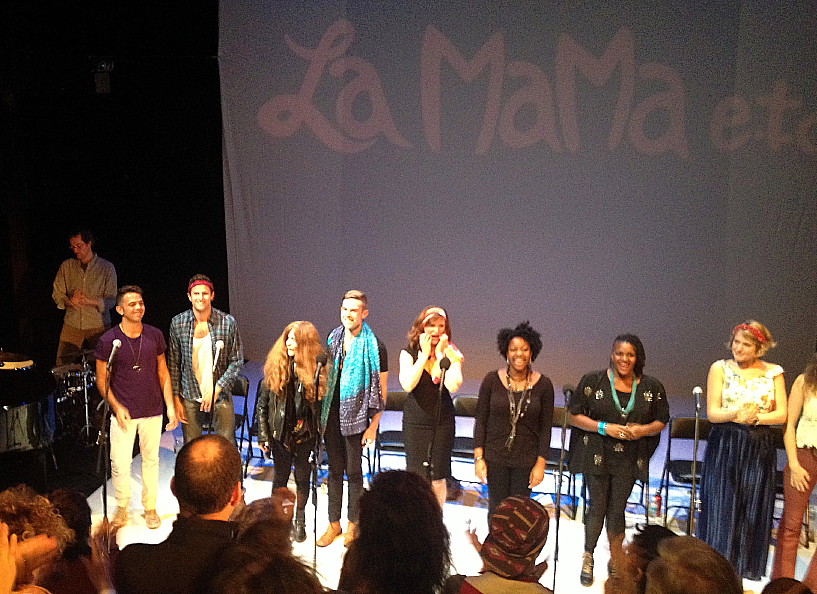

One last performance to make notes about, before the moment passes into history: a year ago Elizabeth Swados created La Mama Cantata, her tribute to Ellen Stewart, the legendary off-Off-Broadway pioneer who died in January of 2011 at age 91. The show had a run at La Mama ETC and then toured to Italy, Croatia, and Serbia before returning for a homecoming October 1. The text consisted of stories by and about Stewart – sentimental, inspiring, hilarious, intimate – and the music was some of Swados’s best in years, succinct and dense, well-performed by nine young La Mama babies. Two stories stood out for me, both touching and emblematic of Stewart’s spirit. During a tense press conference at the height of the deadly ethnic war that splintered Yugoslavia, Ellen said, “Look, I remember when you were all one thing – and you all can start loving each other any time you want.” And against a video of burning candles representing the AIDS crisis that devastated the East Village, she is quoted as saying, “How we got through that time, I don’t know.”

Performance diary: Amanda Palmer, INTO THE WOODS, and EINSTEIN ON THE BEACH

September 18, 2012

September 11 – Amanda Palmer first made her name as half of the Boston-based theatrical punk-cabaret duo Dresden Dolls. Most recently she achieved internet notoriety by raising over a million dollars with a Kickstarter campaign intended to raise $100K to finance the current tour supporting her newly released album Theatre Is Evil. In between she carved a major niche for herself as a DIY breast-baring grass-roots ukulele-toting championship social-networker, acquiring not only an ardent fan base but also a geek-idol husband, the charming, prolific and equally media-savvy science fiction-fantasy writer Neil Gaiman. I’ve been watching from the sidelines as Andy, a huge Gaiman fan, got intrigued and then swept up by the Kickstarter campaign. And I was perfectly happy to go along with reconfiguring September 11 as Amanda Fucking Palmer Day this year, even if it meant enduring the rigors of standing up for four hours straight at Webster Hall. (I swear I’m not going to say it, I refuse to say it, you’ll never hear me utter the words, but of course I’m thinking: I’m getting too old for this.)


It was a whiz-bang show, with three opening acts. We missed the first one. The second was a really young power-pop trio called the Pleasant Surprise led by AFP’s guitar player Jherek Bischoff. The third was Ronald Reagan, “Boston’s premiere ‘80s-rock saxophone duo” – a classic one-joke-two-song opening act who wailed out “Don’t Stop Believin’” and “Total Eclipse of the Heart” while half the audience sang out all the words (including my sweetie). Palmer had been traipsing out in her dressing gown to introduce each act and to whip up interest for the inevitable live-streaming webcast. Introduced by Meow Meow, an Australian female-impersonator-impersonating female, Palmer entered borne aloft through the crowd (above) and led her three-piece Grand Theft Orchestra through most of the new album, whose destined-to-be-some-kind-of-hit is the Bowie-esque instant earworm “Do It With a Rock Star.” There was stage-diving and crowd-surfing, there were costume changes, and there was the obligatory hilarious cheesy Top-40 cover encore (“Call Me Maybe”). Palmer made the pre-emptive strike of addressing an issue that would be all over the internet and the New York Times the next day – that she’s enhancing her touring band with crowd-sourced string and horn players (“crowd-sourced” meaning volunteer, meaning unpaid, meaning uh-oh, here comes the musicians’ union out for blood…). I think she’s handling the evolving music-world economy pretty well (giving her new album away online, trusting that fans will pay for it, for instance), but if she gets as big and successful as she seems to want to be, there will have to be some rethinking of all this.

September 15 – Andy has never seen Into the Woods, the Stephen Sondheim-James Lapine show, and he was dying to get tickets to see the production in Central Park this summer. We never managed to (which may have been a blessing), so we hunkered down instead with the DVD of the 1987 original Broadway production. The songs continue to dazzle, the performances hold up (especially Joanna Gleason as the Baker’s Wife, Danielle Ferland as Little Red Riding Hood, and Bernadette Peters as the Witch), James Lapine’s book….not so much. With the distance of time and home video, the holes in the second act gape like chasms. Without her magic powers, how does the Witch disappear in a puff of smoke? And the subtext related to AIDS, supplied by the zeitgeist when the show first appeared, is now completely imperceptible.

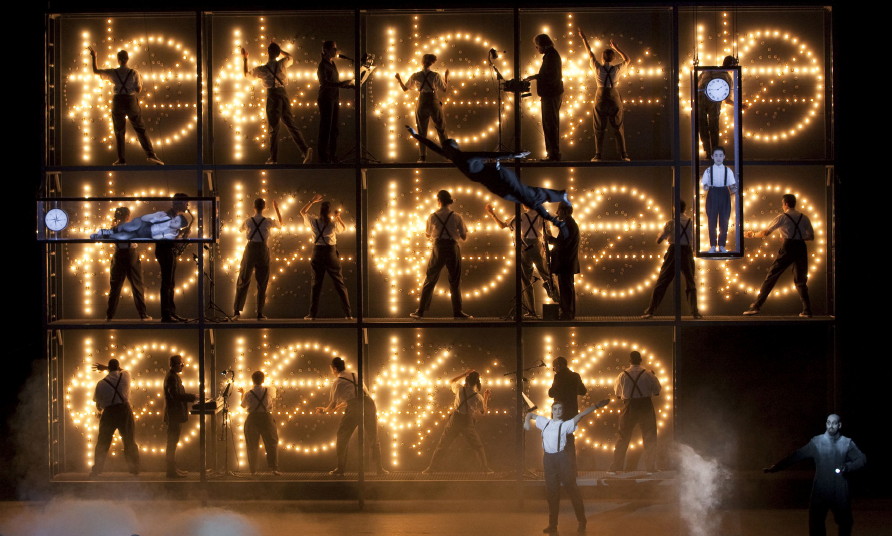
September 16 – Revisiting masterpieces is always worthwhile because they’re never the same twice. The original U.S. performances of the Robert Wilson-Philip Glass opera Einstein on the Beach (only two of them, at the Metropolitan Opera in 1976), epitomized the saying, “The legend is created by the people who weren’t there.” I heard about it as a college student in Boston, devoured the original cast recording, was thrilled to hear a concert version performed by the Philip Glass Ensemble at a church in Harvard Square, and couldn’t wait to actually see the first revival at BAM in 1984, in the early days of the Next Wave Festival. It lived up to all my expectations. This revival seemed, well, not exactly tamed but certainly different. My memory of the earlier production was that the music was extremely loud – body-bracing loud, rock-concert loud. This production is definitely not deafening (maybe because Glass isn’t playing in the band, for the first time ever?), and it’s funny to find that a little disappointing. Also in my memory of the first BAM revival, the performers maintained neutral facial expressions, which perfectly matched the Steinian prose of the spoken texts (by Christopher Knowles and Lucinda Childs, anyway) and the wordless vocals (all numbers and solfege syllables) as well as Glass’s monumentally release-avoidant score. In recent years, Wilson has been working a lot with German theater companies and incorporating much more expressionistic acting – white-painted faces, garish makeup, and exaggerated expressions at times virtually indistinguishable from clownish mugging. I didn’t like seeing that stuff in Einstein on the Beach. I wished the performances were as cool and sleek as the sets and the imagery and the lighting. But what the hell, to paraphrase what Paul McCartney said about critics who grumble about The White Album – “It’s fooking Einstein on the Beach. Shut up.” I was surprised that the music that grabbed me most was the choral music during the Knee Plays (maybe it helped that we could see the singers in the pit very clearly from where we were sitting). Four and a half hours without a break didn’t seem arduous at all. And I felt an unexpectedly strong wave of emotion when Wilson, Glass, and Childs came out and took bows at the end – three brave artists now old and gray who created a massive piece of work decades ago that still looks exceedingly strange and fiercely original.

Performance diary: Laura Nyro tribute at Lincoln Center Out-of-Doors

August 12, 2012

I’ve looked forward all summer to “The Triple Goddess Twilight Revue: Celebrating the Music Of Laura Nyro,” scheduled as part of Lincoln Center Out-of-Doors’ 29th Annual Roots of American Music Festival. It was a raggedy sort of family affair that opened with Nyro’s brother, Jan Nigro, performing a sort of skiffle-band arrangement of “And When I Die” with his band, the Ebony Hillbillies.

A young performer named Kate Fletcher, who does a Nyro-centered cabaret act called “One Child Born,” sat down at the piano for a fairly whitebread version of “Stoney End.” Much was made of the presence at the concert of Gil Bianchini, who is indeed the “one child born” Laura Nyro left behind when she died. He came out at the tail end of Desmond Child and Rouge’s rendition of “Eli’s Comin'” to perform a rap — let’s just say Jaz-Z needn’t lose any sleep worrying about competition from Gil-T, as he calls himself. Still, what Laura Nyro fan wouldn’t be thrilled to see the kid in person? (I met him briefly at the opening night of the Vineyard Theatre’s wonderful revue, Eli’s Comin’, directed by Diane Paulus.)


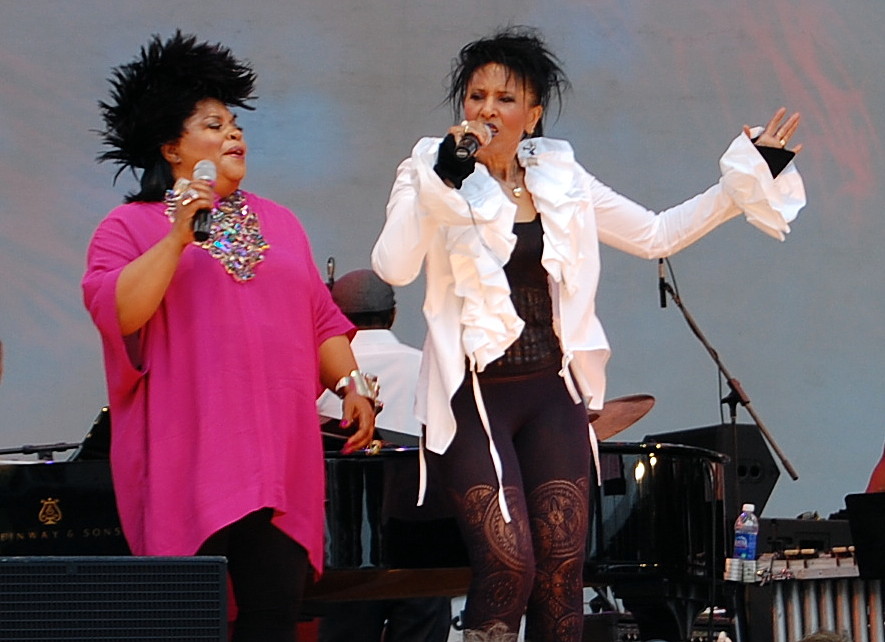
“Without Laura Nyro, there would be no Desmond Child,” the singer-songwriter-producer intoned, when his group took the stage. A little pretentious, of course — I doubt if more than ten people in the audience even knew who Desmond Child is. He and his female trio Rouge made two terrific, now-forgotten albums around 1980, before Desmond wrote and produced a bunch of hit records (most notably Cher’s “If I Could Turn Back Time”). I personally was thrilled to see them get up onstage and tackle a tricky non-hit song, “Beads of Sweat” with a taste of “Nowhere to Run” before moving into the better-known “Eli’s Comin’.” Felix Cavaliere — now there’s a name we haven’t heard in years! His Nyro connection is that he produced the Christmas and the Beads of Sweat album, and here he sat down at the Hammond organ and plunked out a fun version of “Blowin’ Away,” from Nyro’s first album. Clearly, this concert was barely rehearsed or sound-checked, because we couldn’t hear the singers backing up Cavaliere at all — eventually, the mike levels got straightened out, a good thing because these were some terrific singers. See above, mixed in with DC&R, Abenaa, Charlotte Crossley and Ula Hedwig (famous and beloved by cult fans as two members of the trio known as Formerly the Harlettes, Bette Midler’s back-up singers), Lesley Miller, and Toni Wine (if that name rings a bell, it’s because she’s a Brill Building-era songwriter whose credits include “A Groovy Kind of Love,” “Sugar Sugar,” and “Knock Three Times”).


I suspect a big chunk of the crowd was there because they know Laura Nyro mostly for her Gonna Take a Miracle album, re-makes of mostly Motown oldies for which she was joined by the trio Labelle. Miss Pat was nowhere to be seen, but her bandmates Sarah Dash and Nona Hendryx came out to sing “I Met Him on a Sunday,” “You Really Got a Hold on Me,” “Monkey Time,” and “Dancin’ in the Streets.” It was painfully evident that there is no love lost between Dash and Hendryx — they mostly stood as far apart onstage as possible, and there was diva shade thrown, for those who had eyes to see.


Next up was Melba Moore, not the most obvious choice but apparently she did record some Nyro numbers early on, including “Time and Love,” which she sang here, followed by “Wedding Bell Blues.” Closing the show was someone else we haven’t heard from in a while, Melissa Manchester (below, at the curtain call hugging Gil, who’s just gotten a big lipstick kiss from Sarah Dash) but she did a good job channeling Laura, pounding the piano and singing “Save the Country” and “Stoned Soul Picnic.” On my way out of Damrosch Park, I ran into fellow fanatic Alan Filderman, who noted that the concert stuck pretty much to the upbeat hits and steered away from the slow torchy ballads. We both fondly recalled the memorial concert at the Beacon Theater in 1997, where Sandra Bernhard and Rickie Lee Jones represented that soulful extreme side of Laura Nyro with their renditions of “Lonely Women” and “Been on a Train.” I went home and watched for the first time someone’s shaky hand-held YouTube video of Nyro’s induction into the Rock and Roll Hall of Fame this year. Bette Midler gives a wonderful, touching, heartfelt testimonial to Nyro as a quintessential New York City songwriter: “And she was writing in the 1960s and 1970s, when New York City was a pit. A pit! Way worse than Cleveland ever was! Even if you couldn’t see it, she made you want to live there….”

Performance diary: Jenifer Lewis at 54 Below

July 25, 2012


“Only in New York”: that’s the kind of vibe that 54 Below, the recently opened cabaret in the basement of Studio 54 that calls itself “Broadway’s Nightclub,” strives to create. And my first time there tonight, it worked. The headliner was Jenifer Lewis, a mouthy comic singer and performer who’s toiled in New York theater, spent five years on a TV show called Strong Medicine, and once toured as backup singer for Bette Midler. Along the way, she acquired an adopted daughter and became a poster girl for bipolar disorder. All of that figures in her act, much of it special material created for her by her musical director, Marc Shaiman, who’s a gifted composer and arranger but more than anything else is kind of a great diva wrangler (Bette being his first and foremost diva). He’s a superb accompanist, in that he’s a nimble piano player but also strikes the perfect balance on stage between invisible partner and sweet all-purpose straight man. Well, straight man who’s as gay as they come. The original material will not be covered by other singers any time soon — “Black Don’t Crack,” about how female celebrities of a certain age don’t have to submit to Botox-face the way their white counterparts do, and “Sang Bitch,” a tribute to other beloved performers. The cover songs are surprising and, I have to say, very well-sung. Imagine Kiki and Herb with less onstage drinking and better pitch. The show, directed by Scott Wittman (Shaiman’s partner in crime and life), runs through Saturday July 28.


Performance diary: COCK, PORGY AND BESS, and ONCE (thrice)

May 5, 2012


May 2 –
Cock is the provocative, titillating, and completely misleading title to Mike Bartlett’s play, which won awards when it premiered at the Royal Court Theater in London and is in previews at the Duke Theater on 42nd Street. Talk would be more appropriate. Ninety minutes of talk talk talk talk talk, no particular action. The audience sits on a small plywood five-row arena looking down at circular playing area roughly ten paces across. The actors use no props or costume changes. They stand and talk. We view them as specimens, I suppose, much the same as in director James Macdonald’s production of Caryl Churchill’s A Number at New York Theater Workshop, where the seating was similarly configured. The main character, John, is a twentysomething gay guy (played by Cory Michael Smith) in a relationship with M (Jason Butler Harner) who one day meets a girl (W, played by Amanda Only-Two-Names Quaid) in his neighborhood who talks him into sleeping with her. The play consists of their belabored hashing out of what this means, with some last-minute participation by M’s father F (Cotter Where’s-MY-Middle-Name Smith). Even setting aside the absence of any male genitalia onstage to justify the salacious title (extremely disappointing to the largely gay audience at the preview Allen and I saw), I found the main character’s dilemma both unbelievable and uninteresting. The characters talk in playwright-speak rather than anything that reflects honest or recognizable human sentiment. For instance, W (perhaps we can acknowledge Edward Albee as the inspiration for the character names) lets John know that she’s turned on because she has “a gap-on.” And singing her praises to M, John exclaims, “Her vagina is awesome!” I had a similar reaction to Alexi Kaye Campbell’s The Pride, another award-winning British play about a bisexual love triangle that MCC Theater produced a couple of years ago. I guess these plays must be somebody’s cup of tea, but not mine.

May 3 – My friend Misha Berson, tireless Seattle theater critic, invited me to be her guest to see The Gershwins’ Porgy and Bess, which was a mixed bag. In the interests of mounting a production that would be popular with Broadway audiences, director Diane Paulus and playwright Suzan-Lori Parks crunched the running time from four hours to two and a half, chopping down the play by DuBose and Dorothy Heyward that had inspired the opera and reducing the orchestra to 22 pieces in a piano-heavy adaptation by Diedre L. Murray. There are some magic moments and some misfires. I walked away thrilled by Audra McDonald’s raw emotional Bess and David Alan Grier’s high-energy Sportin’ Life, but not much else.

May 4 – Misha also took me to see Once, which I was happy to revisit, third time for me. I love just about everything about this show. (You can read my detailed review on CultureVulture.net.) Steve Kazee is just great in the central role, as are Cristin Miliotti and Anne L. Nathan and David Patrick Kelly, but really the whole ensemble is strong. Seeing a show repeatedly, you can’t help increasing your attention and affection for the supporting roles: Will Connolly’s Andrej, Elizabeth A. Davis’s Reza, Lucas Papaelias’s Svec, and Paul Whitty’s Billy in particular. I was glad Misha liked it as much as I did – she noted that ten years ago, before Spring Awakening, it would be impossible to imagine seeing a show like this on Broadway. One of the things I love most is how quiet it is. It makes the audience lean forward and pay attention, rather than get blasted back in their seats. I’m happy it got so many Tony nominations, and I can’t imagine that it won’t win Best Musical.