Archive for the 'performance diary' Category

Performance diary: THE FLICK, KINKY BOOTS, THE MOUND BUILDERS, and Liza Minnelli & Alan Cumming

March 21, 2013

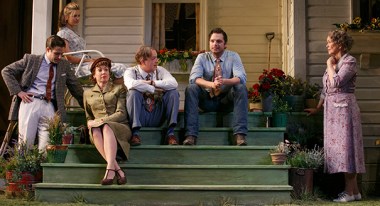
3.2.13 – THE FLICK. In the last five years, Annie Baker has distinguished herself among young playwrights by zeroing in on the minute particulars of mundane lives and mining them for drama with a richness that bears comparison to Beckett (with whom she shares a reverence for silence) and Chekhov (whose Uncle Vanya she adapted for a production at Soho Rep that was one of last year’s best). The settings are unpromising. Circle Mirror Transformation took place entirely within the confines of a small-town community drama workshop in Vermont. The Aliens happened on the back porch employees’ smoking deck of a restaurant in the same town, next to the dumpster. Baker’s latest, The Flick (at Playwrights Horizons through April 7), depicts a decrepit, barely populated movie theater in Bumfuck, Connecticut, one of the last in the country to project celluloid rather than digital films. Two of the three main characters – black teenage movie nerd Avery (Aaron Clifton Moten) and head usher Sam (the mesmerizing Matthew Maher) — spend the better part of three hours sweeping popcorn off the floor (the set designed by David Zinn immaculately recreates, let’s stay, one of the dingy theaters at the Quad) and pining for the projectionist, a girl in her twenties named Rose with long hair dyed washed-out green (Louisa Krause). Beautifully staged by Baker’s frequent collaborator Sam Gold, the production takes its perverse, pokey time telling this story, and plenty of people bailed at intermission, but I was riveted the whole time and by the end felt like I had witnessed these characters’ entire lives. There were one or two moments I didn’t quite buy, but they didn’t take away from my respect and enjoyment of the endless movie gab, Zinn’s dowdy costumes, and Jane Cox’s lighting, which tells its own story.

the flick

 Incidentally, the Playwrights Horizons website offers a bunch of cool additional info on the play: an interview with the playwright, an interview with Matt Maher, and a fascinating video about the set and props for the show, revealing how they keep the debris that the usher sweep up looking like “first-run trash” and how they avoid attracting mice (shellack the popcorn). If you “follow” Playwrights Horizons on SoundCloud, you can listen to podcasts of interviews with a whole slew of playwrights and other artists who’ve worked at the theater in the last five years — very cool.

3.8.13 – KINKY BOOTS. Based on the 2005 British movie about a family shoe factory saved from bankruptcy by reinventing itself as manufacturer of fetishy footwear for fierce drag queens, the musical Kinky Boots marks Cyndi Lauper’s debut as a Broadway composer, with book by Harvey Fierstein, directed and choreographed by Jerry Mitchell. With that creative team, it should be the most fun show on Broadway this season, right? I’m bummed to announce that it is not. The first act held my interest, even though the only song that really stood out was “The History of Wrong Guys,” the first trace of certified Cyndi Lauper-ism in the score, sung by the delightful Annaleigh Ashford. At intermission, Andy admitted that he had a headache from trying to love the show and failing. The second act fell apart – the creators didn’t trust the story on its own terms so ladled on a lot of sentimental preaching about what makes a man a man and accepting people for who they are. Two back-to-back Big Numbers stop the show dead in its tracks – super-earnest “The Soul of a Man,” sung by Stark Sands (a good actor but surprisingly bland as the factory owner), and what shockingly was staged to look like this show’s version of “And I’m Telling You I’m Not Going,” as performed by a drag queen at a nursing home, at the end of which said drag queen makes a bathetic speech to the audience, confessing abjectly “I am…a man.” Except for that mawkish scene, Billy Porter as Lola had the audience eating out of his hand – he’s a great performer and it’s nice to see him polishing up his Broadway star. We saw the show about halfway through previews. Undoubtedly there will be changes. Enough to make the show really fly? Much as I admire Jerry Mitchell as a fun pop choreographer who came up the ranks as a dancer himself, as a director he’s no Tommy Tune or Michael Bennett, or not yet anyway. I suspect a stronger directorial hand was needed to help shape this material.

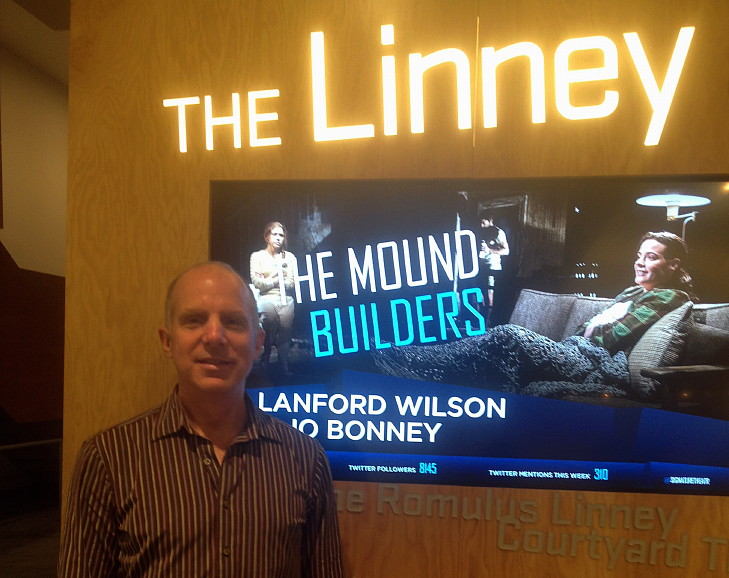
3.10.13 – THE MOUND BUILDERS is one of Lanford Wilson’s rarely performed plays. I’d never seen it, and I’m grateful to Signature Theater for programming it. Wilson was a master at creating complicated group narratives, partly the legacy of his intimate collaboration with the exceptional acting ensemble of Circle Repertory Company. Intelligent, energetic, highly skilled naturalistic actors like Tanya Berezin, Jonathan Hogan, Trish Hawkins, Joyce Reehling, Amy Wright, and William Hurt gave Wilson state-of-the art tools to work with in dramatizing the light and shadows of human beings. The Mound Builders won him an Obie Award when it premiered in 1975, and when I interviewed him for Rolling Stone he told me it was his favorite among all his plays. The story revolves around a group of hotshot archaeologists unearthing a Native American burial ground in southern Illinois on a site whose prospects for commercial development have the local residents dreaming of life-changing windfalls. Characters who are academics and writers give Wilson license to unleash the dense, smart dialogue he does best, and each of them has a distinct world-view and a personality strong enough so that the audience is constantly being thrown off-guard and having to reconsider where the story is going. Chekhov’s The Cherry Orchard unmistakably lurks in the background but Wilson gives the theme of class conflict a particularly American spin, with plenty of ambisexual juice below and above the surface. I thought Jo Bonney did a fine job staging The Mound Builders for Signature and coaxing good performances especially from Danielle Skraastad, Will Rogers, and Zachary Booth, whom I didn’t even recognize as one of the stars of Ira Sachs’ film Keep the Lights On until Tom pointed it out to me at intermission.
mound builders

3.13.13 – LIZA MINNELLI & ALAN CUMMING at Town Hall. Daniel Nardicio, a nightlife entrepreneur who specializes in underwear parties, produced a concert on Fire Island last summer pairing Liza Minnelli and Alan Cummings that was a big hit, so he booked Town Hall for a two-night return engagement. ‘Twas quite a scene. There were one or two homosexuals in the audience. As for the show: he was absolutely charming, and she was a wreck, hobbling around with an injured ankle and gasping for breath, none of which staunched the tidal wave of Liza Love pouring from the audience. After they did a medley from Chicago (“Nowadays” and “Class”), she toddled offstage and he did his act, the high points of which included: Adele’s “Someone Like You” (mashed up with Lady Gaga’s “On the Edge of Glory” and Katy Perry’s “Fireworks”), “Falling Slowly” from Once, an Elvis Costello song mashed up with Stephen Sondheim’s “Losing My Mind,” and a medley from Hedwig and the Angry Inch (“Wicked Little Town/Wig in a Box”). He’s handsome and sexy and graceful and utterly endearing. As a storyteller, he’s the world’s best talk-show guest, dishy and revealing and funny. Recalling their triumph last summer, he said, “Liza Minnelli in Cherry Grove…it was like a papal visit. If you can imagine the Catholic Church filled with homosexuals…Don’t cry for me, Argentina!” Without pause for intermission, Liza came out and sang her greatest hits, one after another: “New York, New York,” “Maybe This Time,” “The World Goes Round,” even “Liza with a Z,” which ought to be retired by now. Her voice is shot; she doesn’t bother to even reach for the big notes. I found it hard to watch her, with her strange twitchy body habitus. But I’ll never forget how great she was on film in Cabaret and New York, New York.

Performance diary: THE LARAMIE PROJECT CYCLE at BAM

February 26, 2013

LARAMIE 1

February 23 – When BAM announced that it would be presenting The Laramie Project Cycle – the Tectonic Theater Project’s original 1998 docudrama about the brutal murder of gay college student Matthew Shepard and an epilogue that takes place ten years later – my first thought was: why now, why so soon, didn’t everybody already see this show and/or the HBO movie? Then I realized that just because I saw it four times doesn’t mean everyone else has – maybe it has new relevance because of the focus on bullying in recent years. But I mostly thought, well, I’ve seen it plenty, don’t have to see it again. Somehow when I read Charles Isherwood’s rave review in the NY Times, though, I felt called to revisit the material, if only to come full circle with it myself.

And indeed, the show was very good, very moving – I was in tears almost continuously throughout The Laramie Project, sometimes making sounds involuntarily, even though I was trying not to sob uncontrollably.  I guess there’s such a sense of identification – in that time and place, it could have been me who ended up tied to a fence and beaten to death. But I admire the craft of the piece so much, not just the writing and the staging but also the way the performers perform their own experience of going to Wyoming and interviewing people. And I found that I felt surprisingly emotionally invested in the original cast: Stephen Belber, Amanda Gronich, Mercedes Herrero, Andy Paris, Greg Pierotti, and Barbara Pitts. Seeing them again brought back my own elaborate history with the show.

laramie AT cover

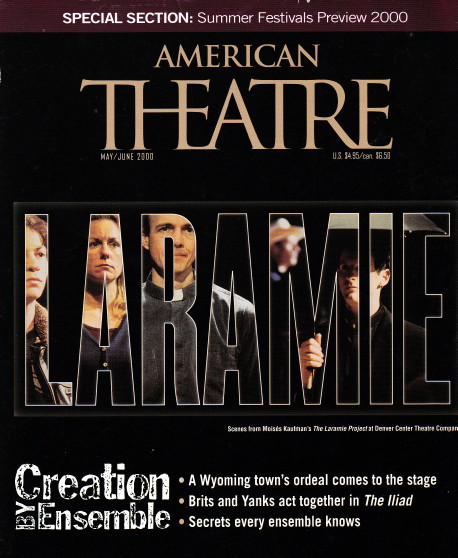
I flew out to Denver in February 2000 for the world premiere of the show at the Denver Center Theatre Company. I interviewed the Tectonic ensemble for an article for The Advocate and made especially warm connections with director Moises Kaufman, writer Leigh Fondakowski, and actor Greg Pierotti. I took my youngest sister to the opening night performance, where we sat next to Zackie Salmon, a Laramie resident portrayed in the show, and met Matt Galloway, the gabby bartender who was one of the last people to see Matthew Shepard alive. When the show moved to New York a few months later and opened at the Union Square Theatre Off-Broadway, I wrote “Town in a Mirror,” a cover story about it for American Theatre. And then two years later, when amateur rights became available and hundreds of high schools across the country started staging The Laramie Project, I wrote an article about that for the NY Times’ Arts & Leisure section. I attended a high school production in New Jersey with a posse that included Kaufman and Romaine Patterson, a close friend of Matthew Shepard who is also a character in the play.

Here are a couple of key passages from that Times article:

The Laramie Project has entered the mainstream of American culture the way few plays do. Through a combination of its topic, its timing, and the artistry with which it was created, it has become more than a docu-drama fleshing out a news story. Tapping the essential function of theater since it began in ancient Greece, it has become a catalyst for the community to discuss among themselves something of urgent importance — in this case, hate crimes, homophobia, and the treatment of difference in American society…

The Laramie Project is ultimately a meeting between two communities — a community of speakers (the residents of Laramie) and a community of listeners (the Tectonic Theater members who interviewed them). As a theater event, it models a way of speaking tough truths and listening respectfully that human beings crave but that we hardly ever see anywhere in public, especially in the news media, where sound-bites pass for insight and competing monologues masquerade as debate. The play doesn’t deliver any message that can be summed up in a bumper sticker, but the essence of it is captured in the tag line Mr. Kaufman chose for the HBO film: “Each one carries a piece of the story.”

During intermission at BAM, I ran into Moises and got to have a little chat with him. And after Part I, I talked briefly with Michael Winther, whom I know slightly through mutual friends. Not an original member of the Tectonic Theater Project, he told me he stepped into the show at the very last minute, the night before rehearsals began. He plays Moises and Dennis Shepard and a whole lot of other people and does a very good job with many different accents. (There’s one other actor who wasn’t in the original cast, Libby King, who plays Romaine Patterson and others.)

The second part of the cycle, The Laramie Project: Ten Years Later, was not nearly as emotionally affecting. When it was over, the audience didn’t automatically leap to its collective feet. Walking away afterwards, I started out thinking that it felt a little thin, an extended footnote, a history lesson, a journalistic follow-up more than a free-standing theater piece. And certainly compared to the original work, not nearly so original. And yet…I learned a lot from it that I didn’t know. There is a way that, by now, if you know anything about Matthew Shepard’s killing, you probably feel like you know everything about it, largely based on information conveyed in The Laramie Project. But when the company went back to Wyoming ten years later, they discovered that the narrative had shifted. Younger people only vaguely knew who Shepard was. Even older people who’d been around at the time of the original incident had come to believe that the murder that made their town internationally notorious was not a hate crime based on the killers’ homophobia but a drug-related robbery gone wrong. How did this narrative get implanted? Largely through the agency of a sleazy story broadcast on the TV newsmagazine 20/20, which claimed to have new information based on interviews with the killers in prison. Moises Kaufman and the members of the Tectonic Theater Project were deeply disturbed that the facts of the case could be so easily distorted and supplanted in the minds of the public, even the local population. So Ten Years Later is partly a meditation on irresponsible journalism and partly about how denial sets in to erase and correct facts that don’t match a community’s (or an individual’s) self-perception.

It seems clear from the theater piece that the artists, and many of the gay Laramie residents they interviewed, were attached to a political agenda promoting hate crime legislation – that is, laws that dictate harsher penalties for crimes driven by bigotry. I have mixed feelings about pushing for hate crime legislation – I think all horrible crimes such as murder should be prosecuted to the full extent of the law. As someone in the play says, “If you kill somebody, you probably hate ’em.” The play did cause me to understand one part of the reasoning, which has to do with forceful public education – it’s not the only way to teach that racism, misogyny, homophobia, and other prejudices are unacceptable, but it may be a powerful one.

The other question that drives Ten Years Later is: has anything changed? There is a certain amount of hand-wringing that homophobia still exists, but there are also some surprising revelations of positive change. A lesbian university professor who figured in The Laramie Project got elected to the state House of Representatives, and when a vote came up on whether to amend the state constitution to prohibit gay marriage, the measure failed, thanks to persuasive testimony from two conservative white male Republicans. And of course President Obama did sign into law hate crimes legislation named after Matthew Shepard and James Byrd, Jr. (the black man lynched by three white supremacists in Texas).

laramie 2
Theatrically, the high points of Ten Years Later are the scenes depicting jailhouse visits with the two men convicted of murdering Matthew Shepard, Russell Henderson and Aaron McKinney. The lengths the company went to in order to obtain these interviews, their efforts to view these guys with open eyes and open hearts, and the performances in these scenes by Greg Pierotti, Andy Paris, and Stephen Belber are all tremendously admirable. The scene between McKinney (played by Pierotti) and Pierotti (played by Paris) will stick with me for a long time. After Pierotti has spoken with McKinney’s spiritual counselor Father Roger, who has lectured the actor at length about having compassion for the murderer’s process of remorse, we’re prepared for a scene of redemption and forgiveness. Instead, we learn that in prison in Virginia McKinney has been reading lots of books about Germany and has acquired a giant swastika tattoo on his arm and one across his back saying NAZI. He expresses irritation at Judy Shepard because “she can’t shut up about it.” Pierotti/Paris quietly reminds him, “You did brutally murder her son.” Then McKinney says to the actor, “So you gettin’ any pussy down here?” Ashen, the actor says, “Aaron, I’m gay.” The convict says, “Yeah, I thought so when I first saw you, but I didn’t say anything because I didn’t want to hurt your feelings.” That’s the amazing thing about documentaries, isn’t it? You couldn’t make this stuff up.

Performance diary: Adam Guettel at 54 Below

February 20, 2013

2.19.13 — Adam Guettel is a fucking great songwriter and a fucking great singer (and super-handsome), so his gig at 54 Below is a rare treat for anyone who’s a fan of his work. His output is small but high-quality, and the show includes beautiful bits from Floyd Collins, his song revue Myths and Hymns (staged at the Public Theater under the title Saturn Returns), and of course the great Broadway musical The Light in the Piazza, as well as sneak previews from works-in-progress based on two films (Danny Boyle’s Millions and the Jack Lemmon classic Days of Wine and Roses). Guettel had two guest singers, both of them excellent — Whitney Bashor and Steven Pasquale performed a suite of three songs from Piazza (they’ve both been in the show) by themselves and a few duets with Guettel. All this music is complicated and tricky, far from any standard pop music or show tunes, but these wizardly singers made it sound effortless if dazzling. The incomparable music director Kim Grigsby (of Spring Awakening fame, among others) leads a crackerjack three-man band from the piano bench. The show runs through February 23, with two shows Friday and Saturday nights. I highly recommend it. I hope they record it and put it out on CD, as they did with Norbert Leo Butz — I missed Butz, heard it was great, and picked up a copy of the album (Memory & Mayhem) while I was at the club. If you’re not in New York, go to YouTube and look up Guettel — there are a few tasty treats on view there, including the Live from Lincoln Center broadcast of The Light in the Piazza.

adam-guettel

Performance diary: Under the Radar and other January miscellania

January 26, 2013

1.22.13 — Before the moment passes, I want to make brief notes about the Under the Radar Festival. Mark Russell, former maestro of PS122 in the East Village, has been running this parade of cutting-edge shows for several years. I’ve occasionally dipped into it but this year actually bought a pass and saw three shows:

Elevator Repair Service’s ARGUENDO. In contrast to their last three shows, which were epic adaptations of literary classics (by Fitzgerald, Faulkner, and Hemingway), the work-in-progress Arguendo is a chamber piece whose text draws verbatim from testimony before the Supreme Court about whether nude dancing is a First Amendment right (based on a 1991 case challenging an Indiana state law). ERS director John Collins let it be known in a program note (and in a fascinating talkback after the performance with law professor Bill Araiza) that he has developed a deep fascination with Supreme Court proceedings, and this case of course is an especially entertaining sample. It was fun to watch ERS company members Mike Iveson, Susie Sokol, and Ben Williams (below) impersonate the various Supremes. Iveson and Williams also took on the roles of the opposing lawyers, and Kate Scelsa appeared in a prologue and epilogue as a topless dancer who attended the hearings as an interested party. Watching the show was a little like having sex with a serious fetishist – an entertaining visit to a world you probably don’t want to live in.

arguendo_KM_2

The Debate Society’s BLOOD PLAY. This show got a lot of attention when it had a run at the Bushwick Starr last year, and I was happy to check out the company, whose key members are playwright-performers Hannah Bos and Paul Thureen and director Oliver Butler. It was more of an actual play than I expected, albeit a weird comic drama in the Mac Wellman vein: theatrical, rich language, creepy, unusually structured. A Jewish couple new to their neighborhood in Skokie, Illinois, host a cocktail party in their finished basement attended by another couple and a local door-to-door photographer; meanwhile, their pubescent son camps out in the backyard communing with supernatural forces. The period seems to be the 1950s, based on the music and the costumes and the language. The host makes a string of wacky invented cocktails involving strange ingredients, and the hostess leads everybody in a variety of quirky invented party games, all of which gave the actors plenty of opportunity for exaggerated cartoonish performances. Ultimately, I’m not sure what it all added up to, and it was one of those shows where the actors and the audience are all meant to feel smarter than the characters, which bugs me.

minsk ticket

Belarus Free Theatre’s MINSK 2011: A Reply to Kathy Acker (or MINKS 2011, as my ticket said). This was my first exposure to the much-acclaimed political theater who made their US debut in 2011 with Being Harold Pinter. Founded in 2005 by Nicolai Khalezin and Natalia Kaliada (a married couple) with Vladimir Shcherban, the company prides itself on its adversarial relationship with its country of origin. A program note says “BFT was formed in Europe’s last surviving dictatorship and every member of the company has, at one time or another, been imprisoned, threatened or mistreated by the authorities, or they live in fear for their safety. They have all lost their jobs. In retaliation, they defiantly produce, devise and perform plays which highlight repression in Belarus and educate others.” I know nothing about life in this particular corner of the former Soviet Union, and I gained from this performance a picture of how Soviet-style state control mechanisms impact everyday lives in Belarus, especially youth, students, workers, and gay people. These performers clearly have quite a bit of physical and spiritual bravery, and even if their theatrical methods aren’t exactly ground-breaking to savvy New York theatergoers, I still found the piece compelling. My old dear friends Elinor Fuchs and Jim Leverett attended the same performance; extremely savvy theatergoers (both teach at Yale), they had seen BFT’s earlier work and liked it better.

I suppose I was comparing Minsk 2011 to the show I’d seen earlier in the week at St. Ann’s Warehouse, Opus No. 7, created and performed by the Dmitry Krymov Laboratory from the Moscow Theatre School of Dramatic Art. It had some ingenious design elements and theatrical moments, but I left underwhelmed by the content and frustrated by the staging: with the audience facing a long shallow space, many crucial images appeared at the opposite side of the theater from where I sat, so I missed them completely, and the projected subtitles were badly lit and difficult to read. There were two separate pieces: “Geneaology,” an imagistic piece about young Russian Jews searching for their ancestors, and “Shostakovich,” a portrait of the composer as tortured cultural hero. My theatergoing companion John Werner came up with a perfect one-sentence summary: “The show seemed like two separate student projects without anything particularly new to say about old themes chosen for their potent impact (the Holocaust, freedom of artistic expression in Soviet times).”

My friend Jonathan Lerner, now a writer but briefly a dancer in his youth, took me to see The Men Dancers: from the horse’s mouth, an ever-changing vaudevillean piece created by his old colleagues Tina Croll and Jamie Cunningham. The format is simple: a number of dancers (or people from the dance world) get some version of 5 minutes to sit centerstage tell a personal story from their life in dance, and between stories three dancers simultaneously perform some movement of their own (with occasional duets), punctuated every so often by a promenade of several dancers across the stage. It’s a simple score that didn’t wear out its welcome. The show is usually a mixture of every kind of dancers, but this all-male-cast edition was a special tribute to Ted Shawn and his male dance troupe. The performers ranged from a teenager who performed in the original Broadway cast of Billy Elliott to some distinguished elders – David Vaughan talked about how he became Merce Cunningham’s archivist, and retired NY Times dance critic Jack Anderson (who gets around with a walker now) and his husband George Dorris brought tears to my eyes talking about their long careers as dance critics, aficionados, and life partners. It was a very down-to-earth, modest community event at the Theater at the 14th Street Y. I ran into the handsome and talented Sean Curran, who was there to greet his former colleague in the Bill T. Jones/Arnie Zane company, the terrifically talented and beefy Arthur Aviles, who was definitely a highlight of the show, twirling across the stage in several dresses before a final spin entirely naked, as is his wont.

I was excited to hear about Tales of Joni, a revue at 54 Below of Broadway singers doing Joni Mitchell songs, so I took my friend Ben Seaman for his birthday Thursday night. Boy, was that a fizzle. There were a few charming performers, notably Gabrielle Stavelli (who did a nice job with “Woman of Heart and Mind”), Lisa Asher (who led a rocking full-group rendition of “Raised on Robbery”), and Annie Golden (whom I always find appealing). But many of the arrangements by musical director Mark Hartman came off ham-fisted, reducing Joni’s sophisticated melodies to flat-footed blues or translating her guitar strumming into piano chord-pounding as if they were Billy Joel songs. And Nicholas Rodriguez, the one male singer in the bunch, epitomized narcissistic theater/cabaret singing at its worst, showing off his big voice at the expense of the songs. Ugh.

all the rage

In 2005, the veteran Broadway actor and singer Martin Moran debuted his one-man show The Tricky Part, based on his beautifully written and emotionally wrenching memoir about the consequences of being sexually molested from age 12 to 15 by a much older man who was his camp counselor. Now he has created a second solo show, All the Rage, that picks up where the other one left off, chronologically and spiritually. It’s a sort of Spalding Gray-like monologue about loss, death, life purpose, dreams, and anger, delivered with the same beguiling mixture of writerly detail, grace, and humor that characterized The Tricky Part. It plays at the Peter Jay Sharp Theater upstairs from Playwrights Horizons on W. 42nd Street. It opens officially Wednesday January 30, and I highly recommend it.


Performance diary: PICNIC

December 31, 2012

December 30 — I’ve never seen William Inge’s Picnic in any form. I’m not sure I’ve seen any play by Inge, once ranked alongside Tennesee Williams among America’s best-known playwrights, now associated with a certain kind of period drama about the emotional yearning of regular folks (and remembered as a sad closety gay alcoholic who committed suicide in 1973). I always picture an Inge play as being about a young stud who breezes into a patch of love-starved women, makes an impression, breaks a few hearts, and moves on – which is pretty much exactly what happens in Picnic. The original 1953 Broadway production starred Janice Rule as the prettiest girl in town, Madge; Paul Newman (in his Broadway debut) as Alan Seymour, the nice rich guy she’s supposed to marry; Ralph Meeker as Hal Carter, the sexy drifter who riles everybody up; Kim Stanley as Maggie’s plain younger sister, Millie; and Eileen Heckart as Rosemary, the wise-cracking schoolteacher with a desperate desire to be rescued. The play won the Pulitzer Prime for drama that year. Director Joshua Logan also made the 1955 film, which starred Kim Novak, Cliff Roberston, William Holden, Susan Strasberg, and Rosalind Russell. The Roundabout Theater’s revival, directed by the busy/ubiquitous Sam Gold, is perfectly built for people like me, who are curious about the play but have never seen it.

picnic 4
I was drawn in by the intriguing cast: Elizabeth Marvel as Rosemary, Reed Birney as the guy who’s been dragging his heels about marrying her, Mare Winningham as Madge’s mother, and Ellen Burstyn as the spinster who lives next door with her mean old (never-seen) mother and who is the one who hires Hal (played by Sebastian Stan, best-known for the Captain America movies) to do yard work and therefore parade shirtless in front of all these gals. Madeline Martin, the precocious youngster in August: Osage County on Broadway, plays Millie. All of them are enjoyable enough, but each plays his or her character as a caricature. By contrast, two actors new to me – Maggie Grace as Madge and Ben Rapaport as Alan – inhabit their roles with sincerity and understatement. Grace in her quiet way conveys the loneliness and oppression of being kept in the box of “prettiest girl in town,” and even though Alan could be the squarest, most thankless role in the play, Rapaport makes him genuinely kind and present in unpredictable ways. The two styles sort of clash, and I preferred the style of Grace and Rapaport. I think the show would have been stronger, more emotionally affecting if the others followed their lead. The show is still in previews. Who knows, it could look a lot different when it opens in mid-January. I will say that Chris Perfetti (below, with Maggie Grace), in the tiny role of the paperboy, is a sexy little fucker. And my favorite thing about the show is the line just before intermission, when Hal grabs Madge the way Stanley Kowalski grabs Blanche, and he says: “We ain’t goin’ to no goddamn picnic!”

picnic 3