Archive for the 'performance diary' Category

Performance diary: WE’RE GONNA DIE

August 18, 2013

8.16.13 —  I think Young Jean Lee is one of the bravest and most talented young(-ish) artists on the New York theater scene. She challenges herself relentlessly, never works in the same genre more than once, and collaborates with artists from other forms and aesthetics all the time. I was delighted when Lincoln Center Theater scheduled a return engagement of We’re Gonna Die, a piece Lee first performed at Joe’s Pub and then brought to Lincoln Center last year at this time to inaugurate LCT’s new tiny black box space, the Claire Tow Theater. Just before We’re Gonna Die, Lee created a stylized costume drama kinda-but-not-really-adapted-from-Shakespeare called Lear at Soho Rep; just after WGD, she made Untitled Feminist Show, a (mostly) wordless dance piece featuring all naked women, which was performed at the Kitchen, where she’d also presented The Shipment, a play in which an ensemble of black actors played white characters. Unlike any of those, of course, We’re Gonna Die is staged as a rock concert, in which Lee fronts a band of nerdy boys called Future Wife.

future wife
I expected much more rock ‘n’ roll, but there’s quite a lot of stand-up storytelling about family and boyfriends – at heart, it’s an emotional account of Lee’s father’s recent attempt to participate in an experimental cancer treatment. The band is great, but Lee’s songs and performance are flat and mundane, intentionally so but not especially interesting (in the direction of Jonathan Richman, but not even that witty). Nevertheless, I admired her courage in getting up and doing it – I can’t think of too many other contemporary playwrights with the guts to live out their singing-with-a-band fantasies (although it’s fun to imagine: Adam Bock? Richard Greenberg? Annie Baker? David Mamet?) – and the band is terrific. (They are Tim Simmonds, Mike Hanf, Nick Jenkins, and Benedict Kupstas.) And she does get the audience to sing along on the title song, which closes the show – feel-good existentialism? Future Wife has just released an album of the show with a stellar array of guests, including David Byrne, Laurie Anderson, and Adam Horovitz of the Beastie Boys. You can hear the studio version of that song (overproduced if you ask me) below:

Performance diary: return to THE DESIGNATED MOURNER

July 28, 2013

7.27.13 — I went back to see The Designated Mourner, and I can testify that after five viewings (the David Hare film twice and three live performances) I’m still absorbing new passages and nuances from Wallace Shawn’s extraordinary play about the demise of a politically independent intelligentsia from the perspective of a fellow traveler not especially unhappy about its disappearance. Somehow I’d never paid attention to the fleeting reference by Jack, the title character (played by Shawn himself in the Andre Gregory production at the Public Theater), to the moment when “my thing started – you know, mental problems or whatever you’d call them.” Suddenly, the character’s wayward cognitive associations and gaps in simple human empathy became clearer and more comprehensible to me. Over drinks afterwards, Dave and Tim and I tried to imagine how George W. Bush would describe life in America during his pathetic presidency – what events he would highlight and which he would omit that anyone else would consider important. And we talked a lot about the performances, especially that of Deborah Eisenberg, who plays Jack’s wife Judy. I think most people who see the play will know that she and Wally Shawn are a couple offstage (they’ve been together 40-some years), but not everybody knows that Eisenberg is an exceptionally gifted fiction writer herself. Recipient of many big awards (including a MacArthur Foundation fellowship), she has published several collections of short stories, many of them actually quite long, many of them first published in the New Yorker. (You can read a long interview with her in the Paris Review’s legendary “The Art of Fiction” series here.) She’s not a trained or especially experienced actor, but her performance in The Designated Mourner is compelling for its combination of sculptural stillness and emotional fullness. We sat in the first row directly in front of the wooden chair she occupies for most of the show’s three-hour running time, which gave us a perfect vantage point to study her amazing face.

Deborah Eisenberg

When Andy and I saw the show a few weeks ago, we arrived just after curtain time (7:00! Not 7:30!)  and weren’t seated until 12 minutes into the show, when Wally departs from the script to give a brief recap to the latecomers. This time, there were about 10 spectators who arrived late, and as they were ushered in Wally gave them an entirely different spiel than I’d heard before, and apparently it was new to the other actors because Eisenberg and Larry Pine were discreetly cracking up while he was improvising about the scenes the latecomers had missed. After the show, Wally observed his tradition of standing by the exit available for conversation, and he told me this performance was the best in the run so far. “Only one sleeper,” he noted. (Since the three actors speak most of the time directly to the audience rather than each other, they have plenty of time to study the crowd.) A good chunk of the audience, maybe 20 out of 99, left at intermission, but that didn’t bother him at all: “It was better after they left.”


Performance diary: SHUN-KIN and SAVAGE/LOVE

July 14, 2013

7. 13.13 — Shun-kin at the Lincoln Center Festival, co-produced by Tokyo’s Setagaya Public Theatre with London’s Complicite under the direction of Simon McBurney, has the theatrical stretch and narrative multidimensionality we’ve come to expect from McBurney, best-known in New York for Mnemonic (2001) and A Disappearing Number (2010). Never too many layers in a Complicite production. McBurney’s leaping-off point for this collaboration with a Japanese theater company was his admiration for the writing of Jun’ichiro Tanizaki  (1886-1965), especially his 1933 essay “In Praise of Shadows.” Finding it difficult to create a theater piece from an essay on Japanese aesthetics, he shifted his attention to Tanizaki’s story “A Portrait of Shunkin,” which purports to tell the true story of a blind female shamisen master and her intricate, erotic, even kinky relationship with her servant/pupil/lover Sasuke.

shun-kin by krulwich
Actually, Tanizaki’s story is a sort of faux-documentary – a little like Borges, he enjoyed creating fictions that read like factual accounts. Perfect cue for McBurney to proliferate multiple narrative layers – the show opens with a prologue in which the longtime Peter Brook actor Yoshi Oida telling a personal story about his relationship to the material, and the play is framed as the recording of an audiobook or radio version of the story performed in a sound studio by a narrator (Ryoko Tateishi). Tanizaki’s story itself begins and ends with the author searching in a cemetery for the gravesites of Shunkin and Sasuke, and the chronicle is staged in classical Japanese style with the main character played as a bunraku puppet (wittily, after two child puppets have grown up, the adult Shunkin is played by an actress still manipulated by two black-clad puppeteers), while all the music the characters play is written and performed (exquisitely) by a master musician, Honjoh Hidetaro, who sits on his own separate platform. Stitching all these pieces together is the audience’s job and our pleasure – with of course the added layer of English surtitles projected on a screen unusually high up above the stage. It’s a beautiful and elegantly sculpted piece of theater, though not nearly as spectacular or affecting as Mnemonic or A Disappearing Number. You’re not really aware of how hushed and dimly lit the staging is until the final moments of the show, when the rear curtain rises to shine blazing white light into the audience, coupled with a roar of contemporary ambient sound – the roar of contemporary urban life.

One of the major pleasures of the production is reading the program notes, especially McBurney’s essay, “Searching for Shun-kin,” which begins with him in a portable toilet: “In Japan, sometimes it’s hard to know what you are looking at. I gaze at the symbols beside me, my underwear still around my ankles…” Oh, that Simon McBurney! He’s very comfortable in his body. (He played the central role in Mnemonic, largely in the nude, see below.) You can read the whole essay and all the program notes online here.

mcburney

7.14.13 — My friend George Russell has been working for several months on a production of Sam Shepard and Joseph Chaikin’s Savage/Love with his company De Facto Dance. I’ve been consulting with George about the production, so I went to the first of three performances at HERE and was pleased to note that the program credits me as dramaturgy consultant, along with Wayne Maugans, a longtime Chaikin actor who also gives a strong performance in the show. It’s an absolute hybrid of dance and theater, an unusual but not crazy approach to the open-ended poetic text, originally performed as a solo by Chaikin.

7-14 savage love

7-14 savage love 2

7-14 savage love program

Performance diary: 3 KINDS OF EXILE

June 6, 2013

3 kinds of exile
June 2 –
You never know what you’re going to get with a new John Guare play. It’s never something generic. His brain is a repository of amazing stories, so you can count on some fantastic storytelling. 3 Kinds of Exile, his new show at Atlantic Theater Company, consists of three vignettes about European artists who left their homelands, each told in a different theatrical style. “Karel” is a monologue, performed by Martin Moran, who’s famous for his own solo shows (The Tricky Part, All the Rage), that asks “How much of your life have you made up?” It is a story within a story (about Karel Reisz, the Czech-born film director who staged Guare’s play Gardenia for Manhattan Theatre Club), with an O. Henry twist at the end. “Elzbieta Erased” is a duet performed by Guare himself with Omar Sangare, an actor who played young Paul in the Polish production of Six Degrees of Separation – together they tell the intricate, fabulous, sad story of Elzbieta Czyzewska, the actress famous in Poland who left when she married American journalist David Halberstam and almost never acted again. (In Ivo van Hove’s production of Hedda Gabler starring Elizabeth Marvel at New York Theater Workshop, she played the maid, sitting onstage smoking furiously the whole time and saying virtually nothing.)  “Funiage” uses nine actors to give a condensed biography of Witold Gombrowicz, a critically respected Polish writer (played by David Pittu) who spent most of his career living and working in Argentina. It’s a nutty chunk of theater, well-staged by Neil Pepe and worth seeing.

Performance diary: I’LL EAT YOU LAST, HERE LIES LOVE, and MURDER BALLAD

May 14, 2013

One of Broadway's biggest stars is back — as one of Hollywood's biggest star-makers! BETTE MIDLER returns to Broadway as the legendary Hollywood superagent in I'LL EAT YOU LAST: A Chat with Sue Mengers.  For over 20 years, Sue's clients were the talk o
5.10.13
  I’m enough of a diehard Bette Midler fan that I would pretty much pay to see her recite the alphabet. I’ll Eat You Last, the one-woman play by John Logan (subtitled “A Chat with Sue Mengers”), is not nearly that minimal, and yet walking away from the show, which made me laugh and entertained me well enough for 90 minutes, I couldn’t help thinking, “What a strange little nothing of a play.” When the curtain rises, after flurry of name-droppy celebrity voicemails, the first words out of her mouth are “I’m not getting up.” And she doesn’t. Playing the semi-legendary super-agent, she doesn’t do much more than sit on the sofa drinking and smoking and telling stories about her famous clients – the first time she saw Barbra Streisand sing in a crummy nightclub, how she pestered William Friedkin into hiring Gene Hackman for The French Connection, how Steve McQueen ruined Ali McGraw’s life and career. I suppose in Hollywood this might pass for substantial drama, but on Broadway it seems like pretty thin soup. It is reasonably well-staged by Joe Mantello, with an amusing little bit of audience interaction. And when I think back on the final moment of the play, when the star wanders offstage in a marijuana haze, what registers strongest is the sadness the playwright mentions in his program note, and I have some appreciation for the fact that the play does have an emotional core that makes its impact, weirdly, by never being mentioned or addressed. No matter what kind of life you’ve led, it’s over all too soon, close friendships evaporate, and things that were once all-important now seem pretty inconsequential.

5-10 andy bette

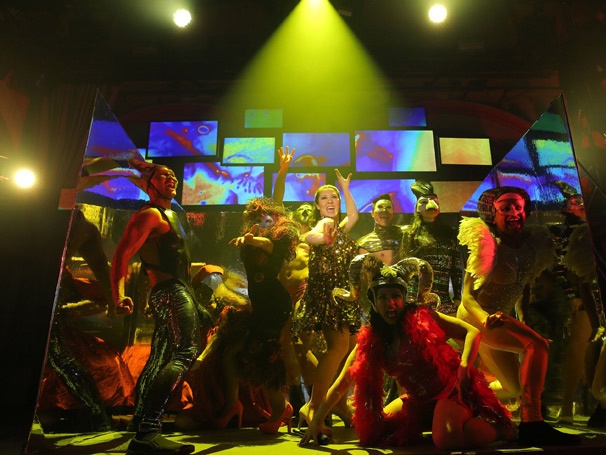
5.11.13 Another figure from recent history radiates from the center of Here Lies Love at the Public Theater, the musical about Imelda Marcos that began life as a concept album by David Byrne in collaboration with Fatboy Slim.

here lies love logo

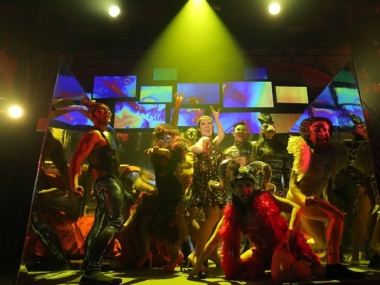
The 2-CD album featured a parade of female pop stars singing the songs: Cyndi Lauper, Tori Amos, Natalie Merchant, Martha Wainwright, Florence Welch, Nellie McKay, Kate Pierson of the B-52s, and Shara Worden from My Brightest Diamond, to name the most famous. The show is staged by Alex Timbers, who blew up the Public Theater with Les Freres Corbusiers’ production of Bloody Bloody Andrew Jackson and works similar magic here, casting the show as a karaoke disco party with the audience on their feet, the singers performing to tracks, and everybody constantly shifting all over the room. It’s a little hectic but a lot of fun for everyone, and an ingenious solution to a show that would never have withstood some kind of stodgy conventional mounting.
Here Lies Love Public Theater/LuEsther Hall
It’s really a series of fairly mundane pop songs running through the basic outline of La Marcos’s rags to riches life. The political history of the Philippines during the Marcos era is pretty crazy and we get a breezy recap with no real depth or analysis. It’s sort of Evita crossed with The Donkey Show but beautifully performed by a knockout cast of mostly young Asian actors, snazzily dressed by Clint Ramos, with choreography by Annie-B Parson that meshes impeccably with Timbers’ multimedia staging. Nothing gets belabored. Ruthie Ann Miles is sublime as Imelda. And the title song, which opens and closes the show, becomes an instant, persistent earworm. I’ve heard worse.
here lies love disco

The show has been extended through June 30, and I overheard an usher saying that it’s likely to be extended again through July.
5-12 tom ben murder ballad

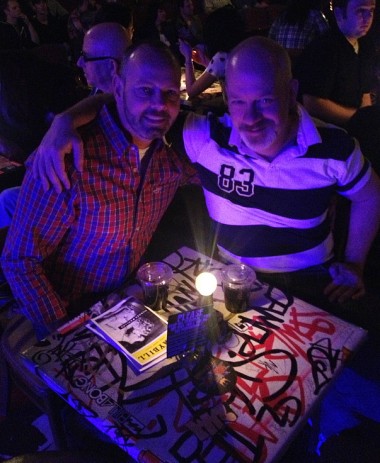
5.12.13 Ben and Tom (above) offered to take me out to dinner-anna-show for my birthday, and I picked Murder Ballad at the Union Square Theatre, because the musical by Julia Jordan and Juliana Nash got such rave reviews when it opened at Manhattan Theatre Club’s City Center space. We all left underwhelmed by Nash’s score, which wants to be Next to Normal, and Jordan’s play, which tries to sustain crime-story suspense and poker-game symbolism but boils down to a generic boy-girl love triangle. Trip Cullman went to great lengths to dress this tiny rock musical up with an environmental staging, plunking the action in the middle of the theater, audience on both sides and seated amidst the action in a barroom setting with cabaret tables that the actors climb all over throughout the show.
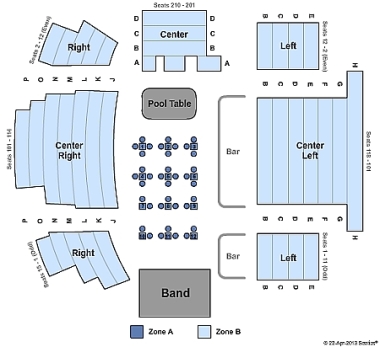
murder ballad seating chartThe actors are appealing and hard-working – Will Swenson, John Ellison Conlee, Rebecca Naomi Jones, and (replacing Karen Olivo) Caissie Levy. But despite the fact that they’re singing nonstop (there’s virtually no spoken dialogue) at least half the time I could not make out the words coming out of their mouths. I left with much more appreciation for the simple composition and delivery of the songs in Here Lies Love, which offered the audience the kindness of letting the words be heard. We had a yummy meal afterwards at Craftbar.


murder ballad logo