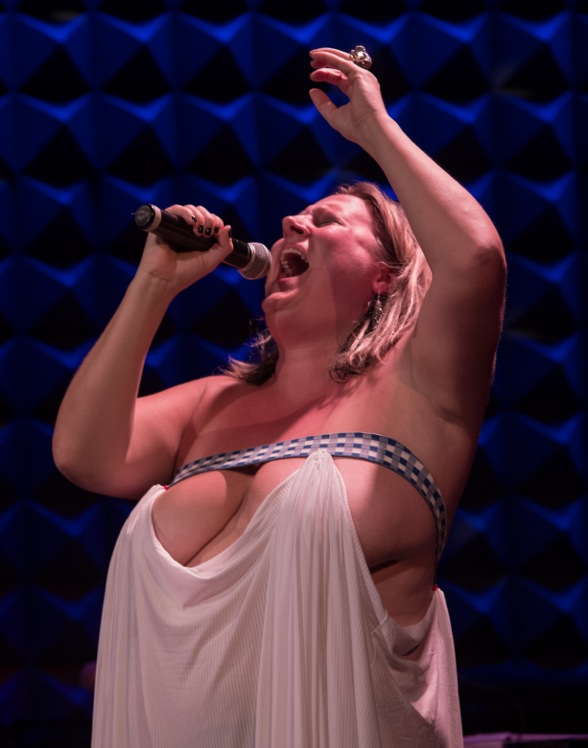
My favorite thing about seeing Bridget Everett’s show Rock Bottom at Joe’s Pub was tracking the various elements that Charles Isherwood was unable to cite in his rave review in the New York Times. Such as the title of her second number, “Does This Dick Make My Ass Look Big?” A reference to “finger-banging” whizzed by, along with something about a “bloody little rectum.” She mentioned that she has two sisters: “one’s dead, one’s a cunt, both are single.” And Isherwood never said anything about Everett’s lengthy story about an erotic overnight with a movie star, the morning after which she woke up aware that “my mouth smelled like Liza Minnelli after she went down on Kathleen Turner.”
Everett is a big hefty gal with a deceptively middle-American innocent face, blonde hair, blue eyes, operatic training, good chops, a dirty mind, a filthy mouth, and equal amounts of comfort with inhabiting her fleshy body and rubbing it (sometimes literally) in the audience’s face. She does very little to cover up her enormous jugs. Her persona combines Bette Midler’s Sophie Tucker impersonation with Amy Schumer’s sweet/shocking demeanor, with a scantily clad bow in the direction of Justin Bond. (In an interview with Artforum, Everett mentions Kiki and Herb as a major influence.)
She’ll say and do anything. She stashed two bottles of Chardonnay onstage and swigged from them continuously throughout the show, spitting the corks into the audience and occasionally spraying the front row with a mouthful of vino. She suggested that her drinking helps her combat her social anxiety: “If I have 8 to 10 alcoholic units, I come out of my shell.” But she was clearly taught by experts. A reminiscence of home life began with Mom “listening to Manilow and getting shit-faced. Just before she blacked out, she’d say, ‘Get in the car, we’re going for a ride,’” usually to spy on Everett’s father and his new girlfriend.
Her material is nothing if not edgy. (The songs were written mostly by Everett with Marc Shaiman and Scott Wittman, of Hairspray fame, with additional contributions from Adam “Ad-Rock” Horovitz of the Beastie Boys, who plays in Everett’s band, and Matt Ray. They’re not credited individually, but I assume that any song with the word “dick” in the title came from Shaiman and Wittman.) A story about terminating numerous pregnancies led to a song from the point of view of a month-old fetus; halfway through, Everett was joined onstage by a skinny boy naked except for a diaper and a stocking-cap singing “Let Me Live.”
The audience was an unlikely mixture of gays and straights, young and old. A hetero couple up front apparently talked so incessantly for the first half of the show that Everett stopped and told them to leave – a first, she said, and clearly unnerving even to her. Sitting next to me (in the back, safely out of range of Everett’s aggressive audience interaction) were four gals in their twenties who laughed loudly when Everett said, “Some of you may recognize me from the Hamptons…”
I always cringe when female cabaret performers come on sexually to obviously gay audience members. I guess I’ve never forgotten sitting ringside at a cabaret performance when Nell Carter shoved my face into her capacious bosom, which felt only humiliating to me. So I watched with some disapproval as Everett bore down on a shy theater queen I know from my gym, who gave every evidence of wanting to disappear under the table. She approached another guy in the audience commenting about his letterman jacket (it actually said Ptown on the back, which doesn’t have any varsity sports teams as far as I know) and tried to get him to lick a line of whipped cream off of her inner thigh. He was rescued by a 22-year-old girl named Phoebe who was sitting nearby with her parents and cheerfully simulated eating pussy.
Everett’s finale involves dancing with an audience member and then bringing him up onstage, laying him down, and sitting on his face. At this performance, she started out dancing with Phoebe, but before long she swapped her out for an enthusiastic Englishman named Paul. Apparently, she couldn’t in good conscience sit on a 22-year-old girl’s face onstage with her parents watching. “Maybe if she was 25…”
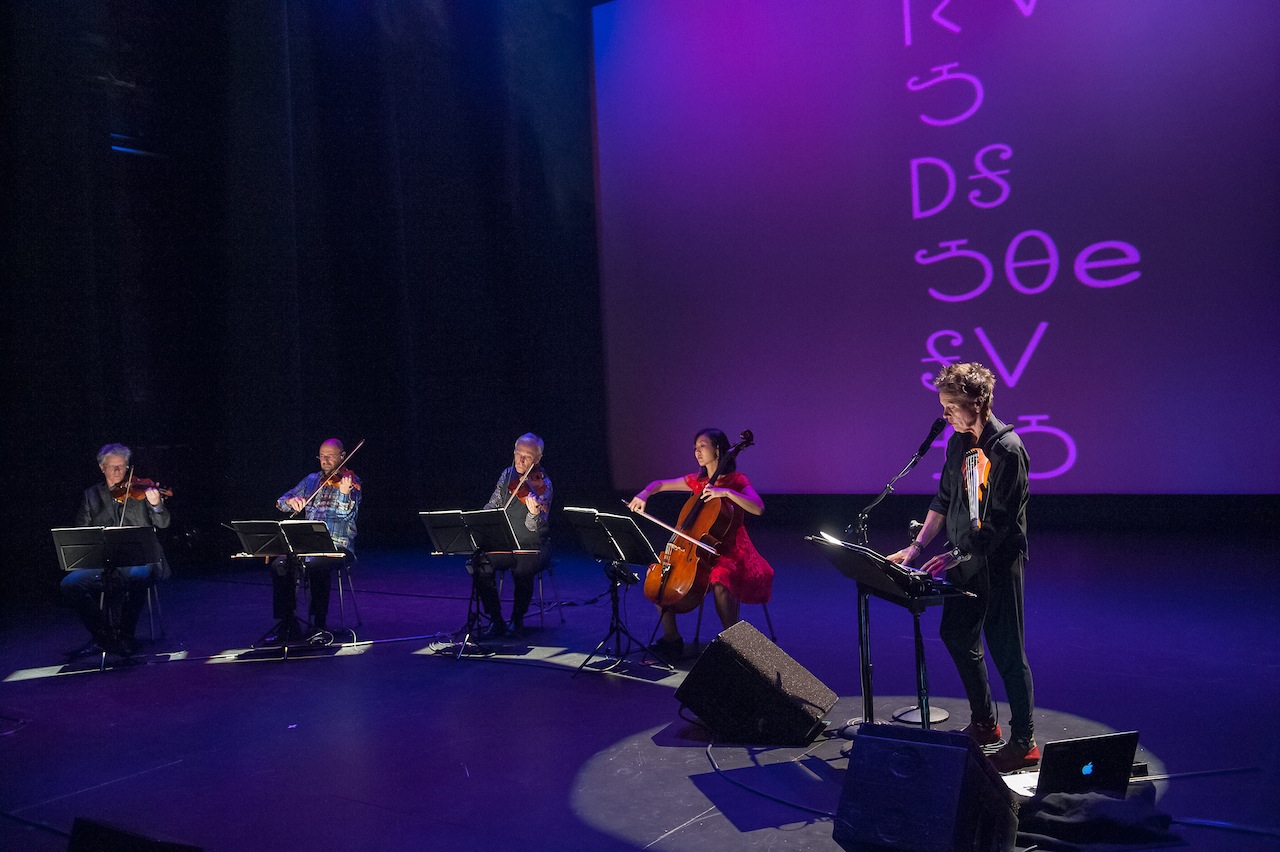
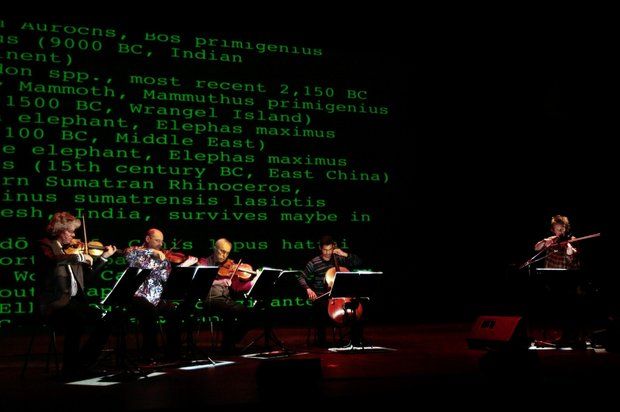
9.27.14 BAM’s month-long tribute to Nonesuch Records continued with Landfall, another legendary collaboration, this time between Laurie Anderson and the Kronos Quartet. It was a bit of a high-wire act – more speaking than you would get from a Kronos concert, more instrumental music than you would get at a Laurie Anderson concert, a theme (having to do with decay, erosion, corruption, extinction, glitches in verbal communication, technology, environmental integrity, cosmic meaning…) but not exactly a narrative, a visual element (generated by a program called Erst) of language streaming up and down and across the back wall, often too fast or cryptically to read or comprehend. The score fell into numerous discrete pieces, none of them songs exactly, not quite movements — in a program note, Laurie refers to them as “stories with tempos.” The first and last spoken pieces refer to Hurricane Sandy, but otherwise the stories stray to lists (extinct species, galaxies) and dreams (or rather, “Don’t you hate it when people tell you their dreams?”). There is no mention of the reality that during the time the work was created, Laurie’s husband Lou Reed was sick and dying, but there is a melancholy undertow to the surging, keening strings. The last words spoken, describing a basement full of water in which are floating all the things you’ve spent your life saving, are “beautiful, magical, catastrophic.” The piece kept me guessing every minute as to where it was going and how all the pieces fit together. The New York Times review was reprehensibly stingy – the music was challenging, varied, beautiful, adventurous, and well-played.
September 11: The BAM Next Wave Festival opened with a month-long tribute to Nonesuch Records, which is one of the great record labels in existence. And the first event of the festival was an unprecedented program of music by Philip Glass and Steve Reich, two contemporary composers often mentioned in the same breath as proponents of music that uses lots and lots of repetition — sometimes called minimalist, an adjective that neither composer embraces, and rightfully so. Their music is often quite dense and full and rich, using additive principles from non-Western musics (Indian, Indonesian).
The three-concert series at BAM was designed to be a historic occasion with both composers onstage playing together for the first time ever. I’ve interviewed both these guys and have been hearing their work and seeing their concerts for three decades, and I don’t remember hearing that they had some kind of feud going on, but much was made of that in the run-up to these three concerts. I chalked it up to promotional hype, but maybe there’s more truth to it than I know.
I found the opportunity for stark comparison between Reich and Glass so fascinating. For all his originality and power, Glass has a pretty small bag of tricks. Meanwhile, certainly for live performance purposes, Reich had more variety and theatricality —
flying mallets are somewhat more fun to watch than people on keyboards and saxophones noodling away at fast arpeggios. Reich performed his own brief piece “Clapping Music” with Russell Hartenberger to start the show, and after intermission he sat in with the Philip Glass Ensemble for “Music in Similar Motion.” But the pairing was pretty clearly a shotgun wedding, perfunctory and rather joyless. Nevertheless, I was glad to see the concert and to revisit beloved music by composers I admire. I especially dug Reich’s “Sextet.”
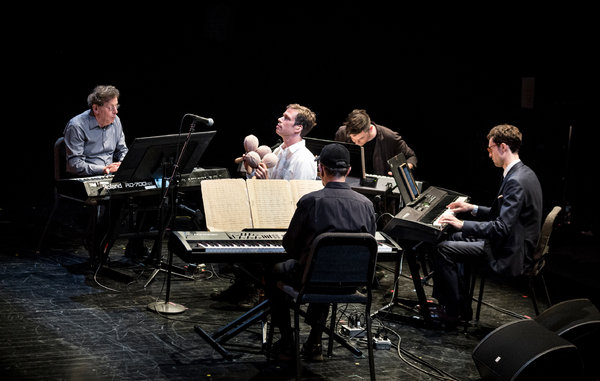
Glass and Reich performing together with David Cossin, Nico Muhly, and Timo Andres (not the show I saw)
Matinee: Kenneth Lonergan’s This Is Our Youth is not a play I’ve been longing to see again. I remember seeing the original Off-Broadway production directed by Mark Brokaw at The New Group in 1996 and thinking some version of, “Who cares about these overprivileged rich, bored, lost white kids hanging out in an Upper West Side apartment doing drugs and talking trash?” I admired the cast – handsome and sad Mark Ruffalo (this is the role that launched his career), Josh Hamilton (always brilliant, usually playing the second male lead with impeccable style and understatement), and Missy Yager (poignant as the plain girl left out of the fiery relationship between the two guys) – but not much else about the show. I kept telling myself that for months, as the revival of the play, directed by Anna D. Shapiro (famous for August: Osage County), made its way from Steppenwolf Theater in Chicago to Broadway. But I couldn’t help being mesmerized and tantalized by the cast: Michael Cera, the brilliantly deadpan young film actor whose performances in Juno, Superbad, and Scott Pilgrim vs. The World blew me away; Kieran Culkin, Macaulay’s brother who played the obnoxious gay roommate in Scott Pilgrim; and Tavi Gevinson, the already-legendary young media maven who started a fashion blog at age 11, runs her own magazine called Rookie, made her film debut last year in a small but well-done role in Nicole Hofcener’s Enough Said…and just graduated from high school in June.
I broke down and bought a ticket, making it a point to sit close, fourth row center. I’m definitely glad I saw the show. These actors made the play compelling to me, and I enjoyed watching them from close quarters. Cera’s Warren doesn’t stray far from the awkward young dudes he’s played in movies, but as in Sebastian Silva’s Crystal Fairy he doesn’t play for charm, he plays for truth, and he creates a very particular physical character whose arms rarely seem to bend at the elbows and whose face becomes more unreadable the more emotional he gets. Gevinson’s Jessica has the smallest amount of stage time, all of it engaged in an ambivalent post-teen romantic dance with Cera. They have great chemistry and stay locked into each other the whole time, through many emotional twists and turns, though afterwards I felt less wowed by her than I expected to feel and wondered if her character hadn’t been a little too polished up – I have a memory of Jessica being a little plainer (wasn’t she previously still in high school, rather than enrolled at FIT?). Meanwhile, I came away super-impressed with Kieran Culkin, who has to barrel through an unbelievable tangle of plot turns and manipulations, several of them exclusively conducted over the phone, which he does at high speed, at high energy, with high plausibility. Hats off, dude! I appreciated the script more than I did before, at least in its commitment to the naturalistic details of these kids’ lives, thoughts, and preoccupations – less so when it veered into long expository monologues, though Culkin manages the, what, five-page monologue in act two masterfully. Because it’s a play with three characters set in one room, I kept thinking about Mamet’s American Buffalo and Speed-the-Plow as well as Martin McDonagh’s A Behanding in Spokane, and a little bit about The Motherfucker with the Hat, which Shapiro also staged for maximum comedy AND drama, not always easy. Hats off to her, too.
Evening: There’s probably 20-25 minutes’ worth of good material in Robert O’Hara’s Bootycandy at Playwrights Horizons. Unfortunately, it’s stretched out over two and a half hours in a production that makes a definitive case against the proposition of playwrights directing their own work. There’s not a single joke in the show that isn’t milked for five to 50 times more than its worth. By the end, I couldn’t get out of the theater fast enough, apologizing to Andy for the single worst show I’ve ever dragged him to. (He didn’t hate it as much as I did, and he would reserve that honor for Ivo van Hove’s staging of Teorema on Governors Island.) Sure, lots of people in the audience hooted and hollered and laughed and talked back and stood up at the end. Some of them had loaded up on cocktails beforehand and during intermission, but I still contend that they deserved better, as did the fine hard-working actors, who definitely get to do lots of crazy stuff and chew all kinds of Clint Ramos’s scenery. I’ve followed O’Hara’s work from afar and have wanted to check it out, because how many openly gay black male playwrights are there in the world? I’m willing to believe he’s capable of writing a play that I’ll admire someday but, whew, it’ll have to be directed by somebody else.
7.21.14 — Last week I saw four shows, all of which revolved around ferocious female quartets. This year’s Lincoln Center Festival included a miniseries of Early Works by Anna Teresa de Keersmaker.
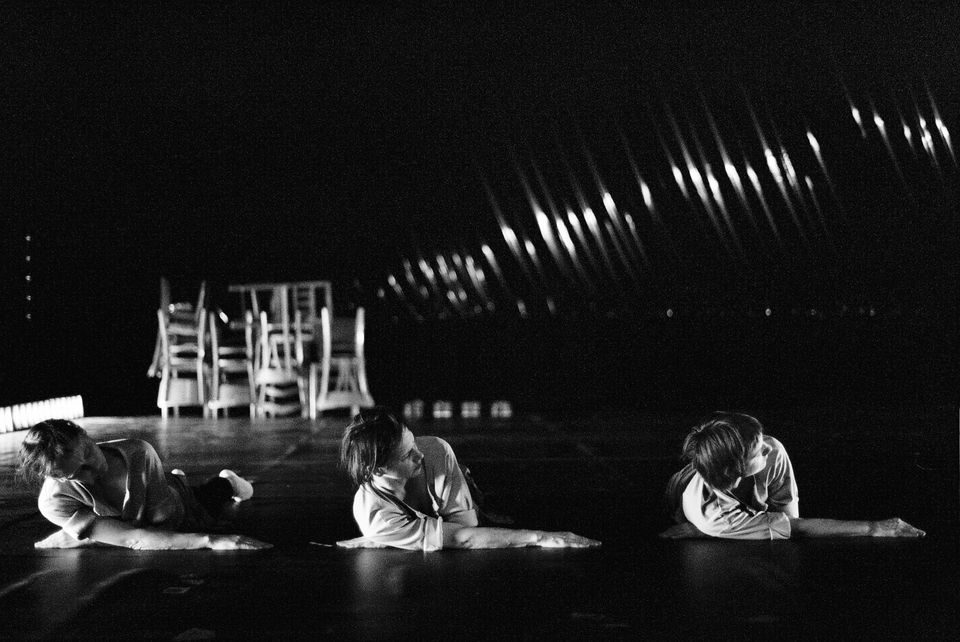
I’d seen Fase (from 1982) a few years ago when it was part of a Lincoln Center Festival tribute to Steve Reich — I remember seeing it with Jamie Bishton and loving the duet (although with its conceptual lighting and dancing shadows, you could just as easily call it a quartet or quintet). I bought tickets to all three of the other events. I took Andy to see Rosas Danst Rosas, which was de Keersmaker’s big international breakthrough. It is an iconic piece of work. I remember it vividly from seeing it at BAM in 1986 (in the Leperq Space, I believe). I took my actor friend Bob Boyle, whose comment afterwards was, “I wanted to watch the dance, not learn it.” Yes, lots of repetition, tightly structured in five chapters, four women identically dressed in simple schoolgirl shifts, Rolling on the Floor, Sitting in Chairs, Spinning Side to Side, Forward and Backwards, almost always in unison, keeping count unimaginably to a fiendishly demanding score by Thierry de Mey and Peter Vermeersch. Seeing the piece again at John Jay College, I kept thinking of them as postmodern dance’s version of The Ramones.
Elena’s Aria was less of a dance and more of a performance art piece, not unlike much of Pina Bausch’s work, except with an all-female cast, which is an ATDK trademark. I saw it when it first played at BAM in 1987, but strangely I retained almost nothing about the show. Seeing it again, I understand why – the images are elusive, ephemeral gestures. At the top of the show one performer walks across the front of the stage, sits at a chair downstage left, turns on a reading lamp over her head, opens a small cabinet, reads aloud from a book, puts the book back, flicks off the light, and hits a switch on top of the cabinet that activates a giant noisy industrial fan on the other side of the stage. She walks over and stands in front of it so the air blows her dress in such a way that makes it look like she’s shimmying. At the back of stage is a line of chairs occupied by two women whose hair blows in the breeze. That goes on for about ten minutes. This sequence is repeated three times in two hours – the passages read aloud are from Tolstoy (in Russian, English, and French) and the lyrics from Brecht-Weill’s “Surabaya Johnny,” interspersed with a lot of stillness and a lot of silence, five women (including the choreographer) slumped over a lot of chairs, waiting. Every so often a piece of music wafts in, old recordings by Caruso as if playing on a 78rpm Victrola in another room. An old-fashioned film projector is set up downstage – maybe two-thirds of the way through, someone turns it on and we see a montage of films of demolished buildings collapsing. As with Rosas Danst Rosas, there is a tiny curious coda in which a Mozart piano sonata plays while the five women sit and fidget in their chairs. A succession of adjectives presented themselves as I tried to describe the piece to myself: precise, perverse, aggressive, mysterious, maddening. I took my friend John Werner, new to ATDK – he was rapt and fascinated and we had a vigorous conversation about it over wine and cheese at Kashkaval Garden on Ninth Avenue afterwards.
Bartok/Mikrokosmos (made in 1987) was the only one of these Early Works being seen in NYC for the first time. It was another whimsically structured event in three chapters. In the first, Mikrokosmos, Jean-Luc Fafchamps and Laurence Cornez played seven pieces for two pianos by Bartok while a short woman and a tall man (Johanne Saunier and Jakub Truszkowski) performed de Keersmaker’s first male-female duets, whose loose-limbed twirling and child-like leaping reminded me surprisingly of early Twyla Tharp. The middle section, Monument, was a concert by the two pianists of a piece by Gyorgy Ligeti ostentatiously paying homage to Steve Reich and Terry Riley, titans of the New York “minimalist” school of composers. (I found it fascinating; Andy found it tedious.) The final section was a quartet, again set to Bartok, played by four musicians from Ictus (the Flemish contemporary music group and frequent de Keersmaker collaborators). The four female dancers stamped and circled through virtuosically precise deadpan variations on folk dances with a side trip to the Folies Bergeres, wearing black shifts with heavy shoes they clomped and dragged in a curious and amusing running sound joke.
It was a treat to see these works all in one week – the best kind of festival programming. I have a soft spot in my heart for de Keersmaker’s work, having watched the Flemish performance boom roll out in the 1980s and writing about it for the Village Voice (see “Survival Theater of the Eurokids”). I respond to de Keersmaker’s austere originality with a lot of admiration. Her work clearly bears a family relation to Bausch and Merce Cunningham, you could say, and the process-obsessed postmodernists (Steve Paxton, Yvonne Rainer, et al), yet its fierce female energy is a force unto itself. And the mind-meld among her spectacular dancers is amazing – how they manage the combination of repetition and precise unison is one of the company’s great mysterious achievements. (The company includes one founding member of Rosas, Fumiyo Ikeda; one rising star, dazzling red-haired Tale Dolven, above; and Sandra Ortega Bejarano, Cynthia Loemij, Sue-Yeon Youn, Elizaveta Penkova, and Samantha van Wissen, none of them slouches.) You can see a lot of de Keersmakers’s work online – there are beautiful films of Fase and Rosas danst Rosasalong with archival footage of some of the other pieces.
Friday night I made an expedition to Williamsburg, happy to check out the relatively new Rough Trade record store and its cozy concert venue, where the band OOIOO headlined a show to support their new CD Gamel. I’ve never heard of this band, but I came across them on NPR’s First Listen web page, and they caught my eye because this new album incorporates gamelan music, a passion of mine. Gamelan is an Indonesian style of percussion ensemble, and in comes in two varieties, Balinese (very fast, very loud, often in unison) and Javanese (slower, statelier, more polyphonic, which I prefer). I was aware that OOIOO was some version of a Japanese rock band – it hadn’t registered that they were all women until they took the stage, a classic rock quartet of two guitars, bass, and drums, with two guys sitting on the floor playing Balinese gamelan instruments.
The music they play was very new for me – if there is a lineage, I don’t recognize it. There’s a raw punk energy, most notably emanating from the leader Yoshimi P-We’s aggressive, unapologetically tuneless vocalizing, yet there are some gorgeous four-part choral passages and throughout an astonishing rhythmic sophistication, free-jazz arrangements that turn on a dime flawlessly, and what sounds like strange overlapping time signatures, not to mention the gamelan, which is ingeniously integrated into the mix.
Trying to identify the universe of the sound to myself or friends, the best I could come up with was a mash-up of Frank Zappa and the B-52’s with guest vocals by Yoko Ono. Or tUnEyArDs meets Dawn of Midi in Tokyo. But when I check out their videos on YouTube, I see that other viewers have also been watching Sonic Youth, Pavement, and Swans, the kind of noisy skronk that I rarely have much patience for. At Rough Trade, though, I found OOIOO completely compelling and exciting to watch. Toward the end of the show, Yoshimi P-We (who seems to have some renown as a founding member of the noise band Boredoms) addressed the audience shyly and said their name out loud, so now I know how it’s pronounced: oh-oh-ee-oh-oh.
Before OOIOO there was a set by Lichens, the sound artist also known as Robert Aiki Aubrey Lowe, who patches pieces into an analog synthesizer and adds spooky strung-out live wordless vocals. At Rough Trade his deck was set up on the floor, not on the stage. Sitting on a bench in the balcony, I had a vantage point from which to observe the phenomenon of a hundred people standing and watching Lichens perform, while behind them another hundred people were hanging out at the bar, schmoozing loudly as if the sound they were hearing was some kind of between-sets ambient DJ mix. At first I felt indignant and protective of the artist. I sensed or perhaps imagined he was feeling furious and/or humiliated at the lack of respectful attention to what he was doing. The schoolmarm in me wanted to go downstairs and shush people. But then I realized that if you’re a sound artist, interacting with the existing sonic environment is exactly what you’re doing, and whatever noise is happening in the room becomes an invigorating collaborator, not some kind of rude intrusion. That shift in perspective allowed me to relax and find the whole thing much more interesting.
My balcony perch also allowed me to watch another hilarious drama play itself out during OOIOO’s set. There’s always that one guy in the crowd who’s a super-fan, knows all the band’s songs and loves to sing along and jump around and perform his super-fandom. This guy was clearly also really high and kept moving through the crowd trying to whip his fellow concertgoers into a frenzy, without success. That didn’t discourage him at all – he kept bouncing and moving through the crowd, made his way to the front of the stage, took off his glasses, jumped onstage and attempted to crowd-surf, not once but twice, not getting very far. Everybody around him saw what was going on, let him bounce, but didn’t feel the need to match him or shame him. Bless his heart.






 another eye opens