Archive for the 'performance diary' Category

Performance diary: GROUNDED and THE NIGHT DANCE

April 27, 2015

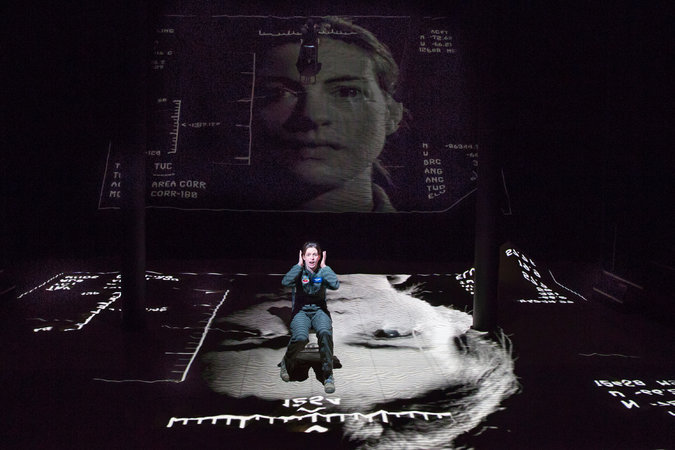
It was one of those only-in-New-York weekends of performance-going. Saturday night Andy and I went to the Public Theater where we sat 20 feet away from Anne Hathaway performing George Brant’s Grounded in a spectacular production staged by the great Julie Taymor. Hathaway plays a female pilot who, after many missions flying over Iraq and Afghanistan, meets a man on leave and gets pregnant, which means getting reassigned from “the blue” to the “chair force”: sitting and watching a high-definition black-and-white screen as the remote operator of a missile-mounted drone tracking targeted individuals in…Pakistan? Iraq? The play isn’t great literature; it arrives at a moral point of view most of us walked into the theater already holding. But it is an honest, dense, skillfully crafted performance poem that Hathaway handled with impressive skill (despite a wandering Wyoming accent).

GROUNDEDJP-master675

And the production surrounding her is intensely dazzling, thanks to Taymor and her stellar team of designers (Riccardo Hernandez sets, Christopher Akerlind lighting, Will Pickens sound design, Peter Nigrini’s projection design, Richard Martinez electronic music design , with original music and soundscapes by Elliot Goldenthal). As my friend Jeremy Gerard wrote in his review, “this master of spectacle is just as imaginative and ingenious working on an intimate scale as she is on larger canvases.”

RAMPLING-facebookJumbo

Then Sunday afternoon I went by myself to the Park Avenue Armory to see The Night Dance, an hour-long recital with Charlotte Rampling reciting poems by Sylvia Plath and Sonia Wieder-Atherton playing Benjamin Britten cello suites. It was a beautiful, elegant, austere, and — you can imagine — fierce performance. Wieder-Atherton bowed, plucked, and strummed her way through Britten’s pieces, by turns keening, lyrical, and brooding, usually on their own but occasionally overlapping with Rampling’s simple, inhabited recitations of familiar poems (“Daddy,” “Lady Lazarus”) and less familiar ones. “It is a terrible thing/To be so open: it is as if my heart/Put on a face and walked into the world.” The rapt audience in the cozy Board of Officers Room at the Armory (capacity 200?) was full of women Rampling’s age and temperament who grew up with these poems, felt all the rage and confusion and feeling contained in them, and still survived, miraculously.


Performance Diary: LIVING HERE and FUN HOME

April 19, 2015

4-16 living here set
I’ve gone to see many Foundry Theatre productions over the years — great shows from David Hancock’s Deviant Craft to David Greenspan’s The Myopia, from Rinde Eckert’s And God Created Great Whales to Claudia Rankine’s The Provenance of Beauty, season-long colloquia on topics like money, values, and hope — but the other night the Foundry Theatre came to me. The current production, Gideon Irving’s solo Living Here, happens in a different New York City apartment every night, and the performance I volunteered to host in my living room took place last Thursday.

4-16 living here audience
It was a trip to have 32 people (half of them my friends as guests, half paying customers unknown to me) cozily jammed into my midtown abode watching an extraordinary show. Gideon has been doing home shows for several years now. He used to play in a band and got tired of playing crappy venues to semi-attentive audiences. (You can read an interview about the evolution of the show online here.) He did his first home shows in New Zealand, pedaling his instruments from gig to gig in a wagon behind his bicycle. Living Here combines songs and stories. The songs displayed his magnificent eccentric roar of a voice and his exquisite restless musicianship (he played banjo, guitar, Irish bouzouki, mbira, kazoo, harmonium, and electronic keyboard with special effects, including a looper he used to sample a classic ringtone from an audience member’s iPhone). And his stories reported from the front lines of his peripatetic survey of humanity, full of juicy details from his encounters with a potato warehouse manager to the son of a kazillionaire (who hosted a show in a multimillion dollar apartment with a staff of nannies, caterers, and assistant nanny caterers), an audience with a goat, what little kids yell out in the middle of his show, and tidbits culled from the casual conversation he’d had with me about my apartment during the sound check (below). It was an amazing show. I don’t think anyone who came will ever forget it.

4-16 don gideon

I admire Melanie Joseph, who started the Foundry, as much as anyone I’ve ever met in the theater. Her commitment to high-quality artists, radically unconventional theater, and social awareness inspire and amaze me. It’s borderline crazy what she does. There’s very little money to be made doing this. It’s a constant high-wire act, and the stress must be overwhelming. And yet she and her artists keep going, making magic against all reasonable expectations. Living Here plays through May 2 — catch one of the remaining shows if you can.

Adventures like Living Here spoil you for regular theater. Almost any other conventional play or musical looks stodgy and staid by comparison. And then there’s Fun Home, another show so original, so deep, so beautifully made, so unusual that it lives in a category all its own. This is the musical based on the graphic memoir by lesbian cartoonist Alison Bechdel about her complicated relationship with her father, a funeral director and high school English teacher who was himself a closeted gay guy who committed suicide when she was in college. NOT standard material for musical theater, but as adapted by fantastic playwright Lisa Kron with a score by the great Jeanine Tesori guided by the fine director Sam Gold, it is nothing less than great theater.

FUN HOME PLAYBILLIt was a huge hit last season at the Public Theater, where Andy and I saw it twice. Now it’s been remounted on Broadway, extensively revised and radically restaged in the round at Circle in the Square. The work that the creators have done on the show had nothing to do with making it more palatable to an uptown audience or commercially viable but everything to do with making it a truer, deeper work of art. So much about the show is unprecedented — there’s never been a lesbian protagonist in a Broadway musical, a character played by three actresses representing the real Alison Bechdel (or T-Rab, as the cast apparently likes to call her) as a child, a college student, and an adult (Sydney Lucas, Emily Skeggs, and Beth Malone). Stories about fathers and daughters are relatively rare, but when do we ever hear lesbians talk about their relationships with their fathers? And this father (played by the excellent Michael Cerveris) is so complicated — brilliant, high-strung, overbearing, creepy, and increasingly crazy. The score is full of great songs, at least one major aria for each central character. We all know Jeanine Tesori is a wonderful composer, but the secret star of this show is Lisa Kron, whose book and lyrics excel. The strong cast give impeccable performances (I haven’t yet mentioned Judy Kuhn, Roberta Colindrez, and Joel Perez). The staging in the round sometimes diffuses focus (there are definitely moments I miss from the Public Theater production) but just as often it opens up new pockets of theatricality in telling the story and revealing the relationships, thanks to David Zinn’s protean set design and Ben Stanton’s essential lighting. This is clearly not a show for everyone — two small groups of women (a pair and then a foursome) walked out of the intermissionless show, apparently unable to tolerate the sight of two gals making out in a college dorm-room bed — but for me (and surely most of the otherwise sold-out house that leapt to its feet as soon as the show was over) it’s right up there in the pantheon of great unorthodox original musicals, a la Spring Awakening and Fela! We walked out emotionally shaken, thought-provoked, and ecstatic.

4-18 fun home

Performance Diary: GHOST QUARTET, ANCIENT LIVES, and INTO THE WOODS

January 18, 2015

1.11.15 Ghost Quartet is a beautiful little show written by writer-composer-lyricist Dave Malloy, the creator of the immersive musical gem Natasha, Pierre, and the Great Comet of 1812. It began life last year at the Bushwick Starr in Brooklyn, where it earned rave reviews and made many “Best of 2014” lists. Now it’s installed for a very limited run at the McKittrick Hotel, home of Sleep No More, where it’s been playing Sunday and Monday nights in the space occupied other nights of the week by the restaurant, The Heath. The audience sits on chairs, at tables, and on cushions on the floor around a bunch of well-worn Persian rugs in a circle along with Malloy at his piano, Brent Arnold on cello, guitar, and other stringed instruments, and two singers, Brittain Ashford and Gelsey Bell (both Natasha veterans), who mostly occupy the space’s small stage. The setting is super-cozy, like a concert in someone’s living room.

GhostQuartet3(Ryan Jensen)
The show is both extremely modest and extremely ambitious. Modest in that it’s staged (by Annie Tippe) simply as a concert of 23 songs from a concept album, each one introduced as such: “Side One, Track One, ‘I Don’t Know.’” (The musical equivalent of Brechtian scene titles.) Ambitious in that the songs are really smart, somewhat dense, extremely tuneful, spinning out a deceptively folksy non-linear narrative that weaves together several strands of story derived from two dozen different sources listed in the program. The most immediately recognizable include Arabian Nights, Edgar Allen Poe’s The Fall of the House of Usher, and Grimm’s Fairy Tales, with a tip of the hat to Into the Woods. But Malloy also cites influences as varied as Neil Gaiman’s Sandman, Ken Wilbur’s A Brief History of Everything, The Twilight Zone, English murder ballads, Ziggy Stardust, Stephen King, and the Disney movie Frozen. Characters appear and reappear in different time periods, and I suppose not unlike Sleep No More, the show invites you to pick a character or theme and follow it all the way through – could be Rose, could be Pearl, could be sisters, astronomy, storytelling, photography….

Malloy belongs to the cohort of composers whose work straddles theater music and singer-songwriter pop (cf. Adam Guettel and Gabriel Kahane, to name a couple). The combo of plangent, country-folk female voices and bowed strings reminded me at times of the lovely pop band Hem. Thelonious Monk gets name-checked, and a few of his most familiar tunes get stirred into the pot. As a lyricist, he mixes things up and enjoys strategies, structures, and puzzles. “Any Kind of Dead Person” revolves around a series of party-game questions (“If you were a part of breakfast, what part of breakfast would you be?”); “The Photograph” also employs questions, more of an existential interrogation (“How did Rose lose her camera? How did her belief system break down with the appearance of the ghost?”). “Four Friends” pays tribute to several brand-name whiskeys. (Do you get that this guy relishes his drink?) Some songs traffic in frisky dialogue; others are melancholy monologues the likes of which you might hear on a Gillian Welch album. On “Tango Dancer,” Bell sings a simple sad refrain, solo the first time, then joined by the others: “I was empty then/And I’m empty now/But it’s not the same at all.”

For all its modesty, the show delivers a bunch of theatrical surprises – a long stretch of several songs takes place with the lights out, the audience is enlisted to play some simple instruments, bottles of good whiskey are passed around, and you’re never able to guess what’s going to happen next. The show speeds by, and I’m glad I bought the original cast recording, because so many of the songs reward repeated listens. (You can buy it online here. The website generously lets you listen to the whole album, download individual tracks, AND read the lyrics — very cool!) The initial handful of performances sold out, so they’ve added six more at the end of February and early March. I encourage you to treat yourself.

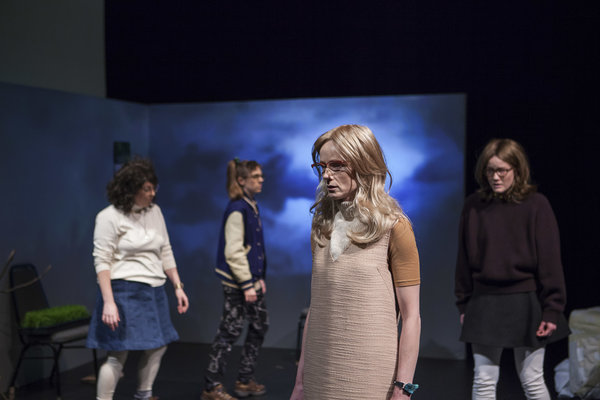
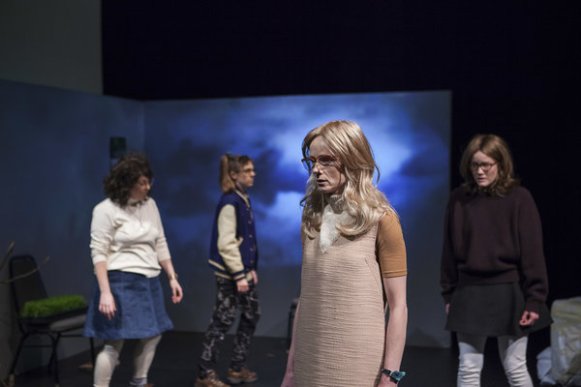
1.14.15 Founded in 2008, writer-director Tina Satter’s Half Straddle ranks among the newer downtown theater companies getting a lot of attention in the last couple of years. It won an Obie Award in 2013; Satter’s Chekhov remix Seagull (Thinking of you) is also listed among Dave Malloy’s sources for Ghost Quartet (not surprisingly, given the teeny-tiny overlapping worlds of New York theater, he’s also married to Eliza Bent, a founding member and performer with Half Straddle). So the recent run of Ancient Lives at the Kitchen gave me a chance to catch up with this crew. I love that it’s essentially an all-female company. This play concerns a sort of charismatic schoolteacher named Paula (played with, I think, an intentional lack of charisma by Lucy Taylor of Elevator Repair Service) who takes three of her female students to live out in the woods away from society. One them becomes her bride (Emily Davis); the other two fall into the roles of happy camper (Bent) and grumpy camper (Julia Sirna-Frest). They encounter a male witch (warlock? played by Jess Barbagallo) who disturbs their communal equilibrium. All of them collaborate on various forms of alternative performance ranging from radio broadcasts to cheerleading to acting out scenes from Arthur Miller’s The Crucible.
ancient lives
One thing I loved about the show was how the cult of Paula distinguishes itself by wearing sort of frumpy wigs and eyeglasses (this is never explained or referenced in the text). I dug Chris Giarmo’s live score (and the way Giarmo and Jess Barbagallo managed to write gender-neutral bios). But mostly this was so so so not my cup of tea. You don’t even have to study her bio to know that Satter studied playwriting with Mac Wellman – 90 minutes of one non sequitur after another, alternately arch and mundane, spoken and acted by game performers as if it all made perfect sense. I see the lineage (Gertrude Stein to Richard Foreman to Mac Wellman and his students) and I appreciate the experimental spirit but I lose interest when there turns out to be no substance, or the substance is encoded in thrice-refracted pop-cultural references that I just don’t get. All the most interesting post-Wooster Group downtown ensembles play constantly with vacillating along the edge of smart and dumb. It’s a tricky balance and I guess entirely a matter of personal taste. ERS and Les Freres Corbusier do it for me. Young Jean Lee and Richard Maxwell – I go in and out with them. Radiohole and Half Straddle…um, sorry, ehhh.

I did treat myself afterwards to a delicious meal of Basque tapas at Txikito on Ninth Avenue.

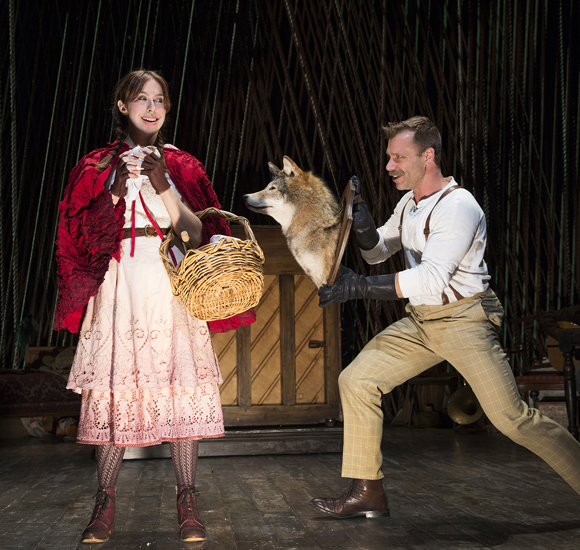
1.17.15 Fiasco Theater consists of a group of actors who met as students in Brown University/Trinity Rep’s MFA program and stayed together afterwards. They made their name doing scaled-down small-cast adaptations of Shakespeare (Twelfth Night, Measure for Measure, and most notably Cymbeline). Now they’ve applied their house style to Stephen Sondheim and James Lapine’s Into the Woods in a production that started at Princeton’s McCarter Theater, traveled to the Old Globe in San Diego, and now has landed in New York at what the Playbill clumsily calls “Roundabout at Laura Pels Theatre/Harold and Miriam Steinberg Center for Theatre.” (Veteran New York theatergoers will probably always just think of it as the American Place Theater.) This show is vastly different from the original Broadway production staged by James Lapine, and from the punky British production that showed up at the Delacorte in Central Park a couple of summers ago and from the new movie version. It is very much an ensemble piece, co-directed by two of Fiasco’s three co-artistic directors: Ben Steinfeld, who plays the Baker, and Noah Brody, who plays the Wolf, Cinderella’s Prince, and one of the wicked stepsisters. (With his pornstache and buff body, Brody radiated gay vibes to both Andy and me at first sight — see below with Emily Young as Little Red Riding Hood — but it turns out he’s married to the other co-artistic director, Jessie Austrian, who plays the Baker’s Wife. So much for gaydar, or should I say wishful thinking?)

into the woods noah broady emily young

The set is highly conceptual – instead of a fairy-tale forest, it takes place inside a piano (and if the design reminds you of I Am My Own Wife, good connection – they’re both the work of Derek McLane). The performance style borrows something from Shakespeare’s Globe (as we saw last year when Mark Rylance brought Twelfth Night and Richard III in rep) and something from Story Theater. Everybody’s onstage the whole time, everybody sings and acts and plays musical instruments and moves the furniture.

roundabout into the woods
The level of theatrical inventiveness is very high minute by minute. Having seen several other productions of Into the Woods already, I enjoyed the clever ways they found to play various moments and to solve the problems that arise when you have actors playing multiple roles (what happens when Brody’s Prince tries Cinderella’s slipper on Lucinda, the stepsister that he plays?). The downside is that musical values take a beating. The orchestra mostly consists of an upright piano at center stage, joined occasionally by lovely pockets of ingenious additional instruments (cello, guitar, autoharp – the same down-homey sound and costumes seen in Ghost Quartet, come to think of it). But this is definitely a cast of actors who sing, rather than singers who act. Some of the better singers are non-Fiasco members, especially Patrick Mulryan’s Jack and Jennifer Mudge’s Witch. (Andy pointed out that when Mudge transformed out of her ugly-witch garb, for a moment it suddenly looked like Nina Arianda had stormed in from Venus in Fur). Sondheim enthusiasts might be delighted to note the inclusion of “Our Little World,” the mother-daughter duet for Rapunzel and the Witch that was added for the first London production and frequently interpolated since then, and they will either be pleased or displeased at the removal of the Narrator character, one aspect of James Lapine’s original book that has always been a bit of postmodern prank, not easy to pull off. I mostly liked the show. I was less bothered by the less-than-perfect singing than Andy was. We went home and listened to the complete 2-CD movie soundtrack with Jonathan Tunick’s orchestrations conducted by Paul Gemignani, which definitely satisfied the last bits of nagging hunger left over from Fiasco’s stage production.
Performance diary: Sam Shepard’s A PARTICLE OF DREAD

November 28, 2014

11.26.14 I’m impressed that the Signature Theatre’s production of Sam Shepard’s A Particle of Dread (Oedipus Variations) is as powerfully acted and beautifully staged as it is, because the script doesn’t make much sense as a play. It’s more of a collage of poetic fragments, and in that way it bears a distinct family resemblance to many early Shepard plays, though the pieces add up to much less of a dramatic narrative than most of its predecessors. These days, when Shepard is not working for a living playing supporting roles in medium-quality Hollywood movies, he plunks himself down at his desk as scholar-in-residence at the Santa Fe Institute and does what a writer does: churns out pages. He’s said he’s working on a novel, slowly, and in recent years he’s been using his residency to explore fascinations with classic texts, specifically King Lear and Oedipus Rex, with their themes of exile, outcasts, identity, self-knowledge (or lack thereof), fathers and children, and blood curses. shepard 2008Shepard is an old man now – he turned 71 on November 5 – with three grown kids (one from his marriage to O-Lan Jones, two he fathered with Jessica Lange) and a fourth he parented (the daughter Lange had with Mikhail Baryshnikov). He’s single again, and when he’s not involved with his film or theater projects, he’s living alone in the desert, not far from where his own father spent the last years of his life before falling down drunk and getting run over by a car. Along with the questions his writing has always wrestled with – “Who am I?” and “How did I get here?” – now there’s the added poignancy of “How did I turn into my father?”

All this manifests in A Particle of Dread as riffing, short takes on images of prophecy, crossroads, blindness, wordplay, some of them with the wispiness of Shepard’s collaborations with Joseph Chaikin, all of them scrambled in time and space. Some scenes ostensibly take place in ancient Thebes, before and after Oedipus is born, including scenes of married life with Laius and Jocasta that Sophocles never wrote about (that we know of). Other scenes take place in the contemporary American Southwest, where a Las Vegas mobster has been murdered on a deserted stretch of highway, attracting the professional attention of a highway patrolman and a forensic investigator as well as the idle curiosity of Otto, a man in a wheelchair, and his wife Jocelyn. Plus, there’s a big streak of Irishness that comes partly from Shepard’s own ancestry and his admiration for Samuel Beckett, and partly from the play’s being written to be performed by Field Day, the theater company in Derry, Northern Island, co-founded by Stephen Rea and Seamus Deane.

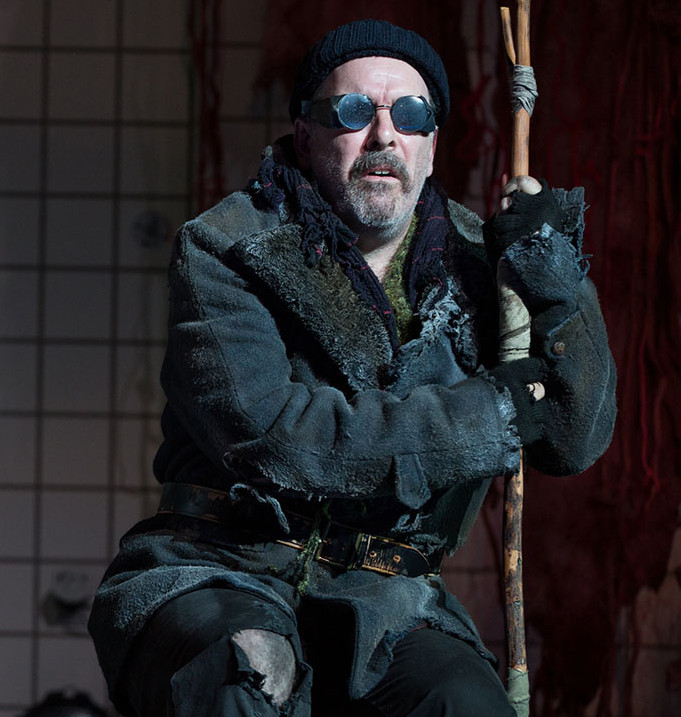
particle rea goggles
Rea, a terrific Irish actor (The Crying Game, V for Vendetta, The Butcher Boy), has a long association with Shepard, dating back to the original production of Geography of a Horse Dreamer in 1974. A Particle of Dread is the third play Shepard has written specifically for Rea to perform in recent years (Kicking a Dead Horse played at the Public Theater in 2007, Ages of the Moon at the Atlantic Theater Company in 2009). It grows directly out of Field Day’s mission. The theater’s bio in the Signature program sheds more light on the play than anything else that’s been written about it: “By presenting an alternative analysis of Irish cultural history that highlights the shortcomings of the official narrative, Field Day has sought to make a cultural intervention into the failed political discourse of Northern Ireland, which, from 1969 to the mid-1990s, had descended into a seemingly unbreakable pattern of rebellion and repression…Whether read in ancient Greek or in the contemporary American and Irish vernaculars of Shepard’s new version, the Oedipus story addresses the idea of collective guilt arising from unresolved historical trauma – it’s an idea that particularly resonated with the original Derry audience in 2013, though the message is timeless and universal.”

I can see how certain aspects of the play might resonate heavily with the Irish actors who performed in the original production of A Particle of Dread, including Frank Conway’s set, a white-tiled abbatoir splashed with blood, a stark image of Ireland’s modern history. Americans have plenty of blood on our hands and our own “collective guilt arising from unresolved historical trauma,” as unfolding events in Ferguson, Missouri, attest. But the ancient Greek, Northern Irish, and American elements mesh a little uneasily, as Shepard signals by bouncing back and forth from somberness to slangy sarcasm (“Piss on Sophocles’ head! The truth will set you free – that’s a crock of shit!”). Nevertheless, the actors give powerful performances. I don’t know how they do it, but surely Nancy Meckler’s steady direction helped guide them. The script requires them to abandon any such thing as coherent characterization in favor of performance-art-like commitment to strong images and transitory moments. It was only by giving up expecting coherent characterizations that I was able to perceive what the play was and to embrace its modest pleasures. particle_of_dread_hutchinson_still
Some moments that interested me: Rea as Oedipus in bloody overalls with goggles full of liquid dripping from his eyes down his cheeks (tears, pus); Rea as king speaking to the Theban populace through a hand-held microphone; Rea as Otto in the wheelchair, an image that echoes Shepard’s play States of Shock; Lloyd Hutchinson playing a somewhat confusing array of commentators – a bones-tossing oracle, blind Tiresias (with shades of Endgame’s Hamm, see above), a guy known as Maniac of the Outskirts – all with blazing eyes and the relish of a great barroom storyteller; handsome Aidan Redmond as a haughty and haunted Laius; Brid Brennan’s Jocasta, making her entrance bizarrely trapped in a revolving cage; and the several passages where Judith Roddy, the lovely young actress ostensibly playing Antigone (see below), sang beautiful tiny scraps of song (composed by cellist Neil Martin who performs live in a sort of balcony/window alongside dobro played Todd Livingston). There’s not a lot about A Particle of Dread that you could point to as an unqualified good show – but every moment of it screams Sam Shepard.

particle-roddy

Performance diary: ST. MATTHEW’S PASSION at Park Avenue Armory

October 5, 2014

St-Matthew-103-c-Andreas-Knapp
10.4.14 – The two performances (October 7 and 8) that Lincoln Center’s White Light Festival scheduled of Bach’s St. Matthew’s Passion, performed by the Berlin Philharmonic with staging by Peter Sellars at the Park Avenue Armory, apparently sold out almost instantly. (Or almost – there are a few seats left.) I hadn’t really thought about going, but when I got an email saying that they’d added a couple of open rehearsals, I decided to buy a ticket. I can almost never pass up an opportunity to see anything Peter Sellars does. I’ve been following him since he was a freshman at Harvard, and of course there he was at the Armory. We shared a nice hug, and I told him I’ve been trying to count how many productions of his I’ve seen in 35 years. Could it be almost 100? Definitely over 50, in Boston, New York, Washington, Chicago, La Jolla, and Amsterdam.

ParkAvenueArmory-3_r1_sro

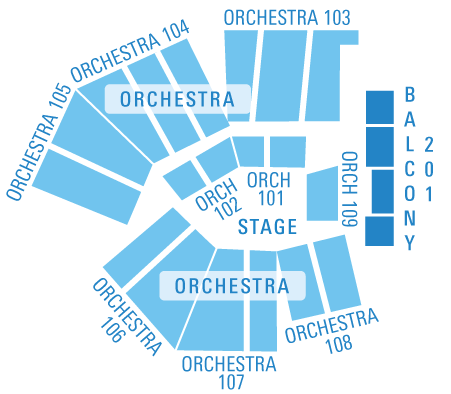
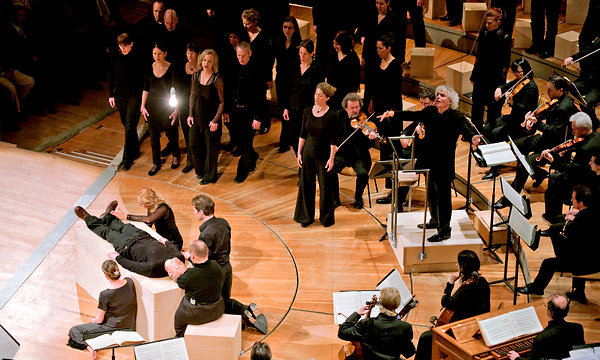
This staging of St. Matthew’s Passion originated at the Salzburg Festival in 2010 and played in Berlin the same year. Peter said they’ve been trying to bring it to NYC ever since. And the Armory provided a perfect opportunity to create an unusual intimacy between the audience and the orchestra. I was lucky to get a seat (in section 107) that was the equivalent of sitting onstage, behind the musicians (two sections of orchestra) and next to one of the two sections of chorus. The brilliant conductor Simon Rattle was spitting distance away. I don’t know if I’ve ever heard the Berlin Philharmonic live, but this performance could not have been more exquisite. They had rehearsed part 1 in the morning, and in the afternoon we saw part 2.

SELLARS-articleLarge

This piece is almost always performed as an oratorio, but Sellars staged it as a ritual and had not only the featured singers moving around the stage reenacting the trial, crucifixion, and death of Jesus Christ but also brought musicians with key solos forward. So at times John the Baptist (here called Evangelist and sung by Mark Padmore with what one review aptly called “heartbreaking eloquence”) would be addressing the cellist, or the mezzo-soprano Magdalena Kozena (playing Mary Magdalene) would be standing in a circle with two violinists. Asking chorus members to emote in unison could sometimes verge on corny but mostly Sellars’ staging had the intended effect of making an already sublime piece of music extra-dynamic. When it was over there was a silent pause of deep satisfaction for at least a minute before the applause began, morphing into a (justified, for once) standing ovation.

Big props to Park Avenue Armory for adventurous programming and the extra care involved in creating a beautiful, thorough, free program with the text and translation and essay material about the event.