Archive for the 'performance diary' Category

Performance diary: A VIEW FROM THE BRIDGE

January 28, 2010

January 26 – I don’t think I’ve ever seen an Arthur Miller play staged and acted as beautifully as the new Broadway revival of A View from the Bridge, directed by Gregory Mosher, starring Liev Schreiber, Scarlett Johansson, Jessica Hecht, and Michael Cristofer. The previous record-holder was Michael Mayer’s 1998 production of the same play, which was a revelation to me. I’d previously thought the play was hokey and dated beyond belief, but Mayer’s rendition proved me wrong, thanks to a fiery cast headed by Anthony LaPaglia as the pent-up longshoreman Eddie Carbone, Alison Janney as his devoted but tough-talking wife Beatrice, and the late Brittany Murphy, who made her Broadway debut as the teenaged niece that Eddie loves too much. I never would have believed it but Mosher’s production leaves Mayer’s in the dust.

A View from the Bridge is Miller’s supremely self-conscious adaptation of Greek tragedy to a contemporary American setting. Eddie’s lawyer, Alfieri (played here by Cristofer), stands in for the Greek chorus, speaking directly to the audience, telling us from the very beginning what’s going to happen and commenting on the action along the way. We know that a man is going to betray himself and be destroyed in the process, and knowing all that in advance should make it all seem mechanical and hokey. Right? Yet from the very first instant, this production grabbed me and held me, because Mosher has deliberately and exquisitely steered away from the sentimentality and melodrama that often washes over and ruins Miller’s plays for me, while amping up the pure raw feeling and the psychological tension. Mosher made his name in the theater as David Mamet’s director-of-choice for many years (most notably, he directed the original productions of Edmond, Glengarry Glen Ross, and Speed-the-Plow). Together, Mosher and Mamet ran a tight ship, preferring productions with a Brechtian spareness and performances with a dry yet energetic matter-of-factness.

Mamet the philosopher-playwright insists that there are no bad guys, that every character is doing what he thinks is good and right. And that concept applied to the staunchly moralistic Miller’s work is bracing and extremely welcome. Scene after scene, showdown after showdown, you keep thinking you know where an argument is going and you keep getting surprised. One person speaks, and you think, He’s right (or she). Then the other one speaks, and you think, She’s right, too. Now that’s fine playwriting for you, and I must say that Mosher and his spectacular cast made me respect the incredibly fine craftsmanship of Miller’s play. He’s captured a stream of sophisticated emotions in this play, to which the actors bring extraordinary nuance and (extremely important) zero commentary, zero signaling to the audience.

One of the great things about Liev Schreiber is that he’s so large and powerful (and skilled and talented, and handsome!) that he doesn’t have to beat you over the head. He inhabits Eddie with phenomenal naturalness, conveying his passion while also inhabiting his peculiar lostness. The sexual stuff is especially sophisticated. I’ve never seen Eddie’s attraction-repulsion to Rodolpho played with more detailed notes. “He ain’t right….he ain’t right,” Eddie keeps saying to Alfieri, unaware that he’s also talking about himself. And I missed the tiny little throwaway line in which we find out that, after neglecting his wife in bed for months, Eddie’s been trying to get in the back door – Andy had to point it out to me afterwards.

I was a little afraid for Scarlett Johansson – you never know about these young movie stars and how they’ll play onstage – but she did a good job playing a character who’s just realizing that there’s a difference between being a girl and being a woman, for better and for worse. (There’s a little inside joke early on, when Eddie refers to Catherine a couple of times as “Madonna” – with her pale skin and dark brown ‘50s hairdo, Johansson looks uncannily like Madonna did in Speed-the-Plow.) Andy was a little bugged by Jessica Hecht’s broad New York accent, but I really really loved her performance as Beatrice, who tries so hard to speak the truth without sounding like a nag, and yet she can’t help crossing that line. And on down the line: Cristofer is terrific, Morgan Spector as Rodolpho is as well (though I was sorry not to get to see Santino Fontana in the role), and Corey Stoll is also fantastic (I would never have recognized him as the same guy who played the Jewish fabric merchant in Intimate Apparel).

I have no idea what Gregory Mosher has been up to since he turned over the reins at Lincoln Center Theater to Andre Bishop. But I’m delighted to see him back in the saddle, and I can’t wait to see what he does next.

Performance diary: David Greenspan’s THE MYOPIA

January 24, 2010


January 16 –
I often feel unsettled by how cranky and picky I am about theater. Will nothing satisfy me? Then something comes along to remind me that, yes, excellence in theater is totally possible. The latest example: David Greenspan’s The Myopia. Greenspan is a major cultural hero of mine, and virtually everything he’s involved with piques my interest. His participation as an actor or adaptor in other people’s work amps up the excellence factor tenfold. And his own work is practically unparalleled. With The Myopia, beautifully produced by the Foundry Theatre and skillfully directed by Brian Mertes, Greenspan is at the peak of his form. As a playwright, he is inventive, poetic, hilarious, entertaining, and erudite all at once. As a performer, he is an absolute master of economy in gesture, vocal dexterity, and focus. How is it possible that this one man can appear onstage with no props other than a wooden armchair and a water bottle and keep 100 people mesmerized and barely breathing for two hours? It’s possible because Greenspan is a rare breed of theatrical showman who is also a philosopher and teacher, in a smart, engaging, and charismatic way. The Myopia is a play that he wrote ten years ago (it was published in Yale’s Theater journal and is available online as a PDF here), and he’s performed it under limited circumstances before. The Foundry is presenting it in tandem with weekend performances of Gertrude Stein’s Plays, a lecture about theater that Greenspan makes hilariously entertaining but also lucid and extremely illuminating. These works are all part of Greenspan’s ongoing work in the theater, which operates at the highest level of scholarship and passion. A couple of years ago Target Margin produced The Argument, which was Greenspan’s explication of Aristotle’s Poetics – again, an excellent and entertaining stylized performance that digests Aristotle in a way I’d never encountered before. The Myopia tells a very elaborate story with four interwoven strands having to do with Warren G. Harding, a man writing a musical about Harding, his wife who’s a fairy-tale princess (she starts off as a Rapunzel-like character in a tower and ends up a gigantess whose fist is bigger than her husband), and a narrator/orator and his doppelganger, who sounds remarkably like Carol Channing. It sounds crazy and impossible, and nothing is more thrilling than a theater artist pulling off something crazy and impossible. Greenspan is one of those geniuses of the theater (not really comparable to anybody else, but of the caliber of Charles Ludlam). If I were a nominator for the MacArthur Foundation fellowships (aka “genius grants”), I’d be militating for Greenspan big-time. But I’d also nominate Foundry Theatre maestro Melanie Joseph for that honor as well. The Myopia is only the latest in a long string of eccentric, brilliant theater pieces she’s sponsored.

Excited packed house for the show. Also in the audience: Andrea Stevens, who was my editor for years at the New York Times, and theater critic-scholar Eileen Blumenthal. I went with Marta and Andy, who both loved it as well. Andy and I had dinner at Suenos, yummy Mexican/Southwestern food, where we spotted David Byrne at a nearby table.

Performance diary: As You Like It at BAM

January 22, 2010

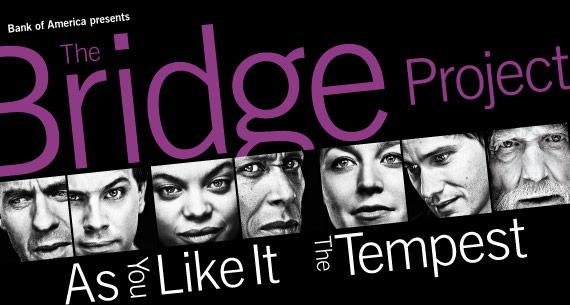
January 20 – As You Like It is, strange to say, the only major Shakespeare play I’d never seen onstage before, except indirectly via David Greenspan’s nutty She Stoops to Comedy (in which he played a lesbian actress cast as Rosalind in a regional theater production). So I decided to check out The Bridge Project’s production at BAM. I’ve been a little dubious about this project, a collaboration between BAM and the Old Vic in its second year now of combining American and British actors into one company to do two classical plays in rep directed by Sam Mendes. Their first season last year got pretty good reviews, but I gave it a pass, mainly because Ethan Hawke was in the company, and he wore me out with The Coast of Utopia. Sad to say, this production confirmed my worst fears – an extremely mediocre staging with extremely undercooked performances. First of all, what a weird play, not easy to follow or fathom in the first place. So if you’re gonna do it, how about either a) having some ideas about it or b) at least making it very clear? No such luck on either front.

OK, there were a few ideas. Mendes noticed that the first half of the play is dark, violent, not funny, dramatic in a King Lear-y way, and the second half is lighter, funnier, highly comedic and entertaining. So the production design (sets by Tom Piper, costumes by Catherine Zuber) for the first half is a relentlessly drab palette of browns and blacks, shadows, bare trees for the Forest of Arden; the second half is all colors! and brightness! and fields of tall grass! The cast includes some good New York stage actors not at their best (Christian Camargo, Ron Cephas Jones, Alvin Epstein). The quirkiest role in the play is Jaques, “a melancholy gentleman” whom Mendes makes sure we associate with any number of Chekhov’s anti-heroes, Vanya or Ivanov. He’s played by Stephen Dillane, definitely a wonderful British actor (superb in the Broadway revival of The Real Thing), and when he entered, finally there was a spark of energy onstage. But neither he nor Mendes arrived at anything specific to do with Jaques. When the various characters exiled to the forest gather around the fire to sing songs, Dillane gives Jaques a Bob Dylan croak – and just in case you didn’t get it, he pulled out a harmonica and started playing it. That level of choice is about all we got. When Rosalind (unimpressively played by Juliet Rylance) gets up in drag as Ganymede, she’s dressed to look exactly like Ellen DeGeneres – which is fine if you’re going to really play with the gay implications of the cross-dressing plotline, but nope, it’s just a sight gag. Thomas Sadoski plays the clown, Touchstone, and he grabs at whatever he can get – like fixating on the fishing line that Corin is carelessly flinging around, afraid of the hook – but nothing really coheres. Ugh. I could have done without that three hours in the theater. I’d still like to see a good production of As You Like It – maybe directed by Lisa Peterson?

Performance diary: Mamet and Shepard

January 19, 2010


January 13 – It’s hard to know whether to call Race a classic David Mamet play or a generic one. It recombines familiar elements of previous Mamet plays in a way that inspires multiple and conflicting reactions – which is fitting, I suppose, because that seems to be how he wants audiences to respond. I recognize how individual his voice is at the same time that I feel slightly cheated by his recycling familiar tropes; I witness how he employs a playwriting formula in a way that’s almost cynically mechanical, and yet I can admire the ways in which that formula operates theatrically. At the center of Race are two savvy guys (extremely well-played by James Spader and David Alan Grier) talking tough about their line of work, in this case lawyering. (Their predecessors include the coin thieves in American Buffalo, the real estate hawks in Glengarry Glen Ross, the Hollywood producers in Speed-the-Plow, and the Washington insiders in November, to name a few.) They face off against a hapless customer, in this case a wealthy white businessman (played with suitable stiff unlikeableness by Richard Thomas) accused of raping a young black woman. (This character has echoes of the duped home-buyer in Glengarry, the turkey farmer in November, Bobby in American Buffalo, etc.) And there is The Girl, in this case a young, smart yet untrustworthy legal assistant – an always-thankless role (see precedents in Speed-the-Plow, November, and Oleanna). The wise guys spew volumes of blunt, rude, sometimes outrageous comments about race, sex, politics, law, justice, and truth (some of it reminiscent of November and Wag the Dog, for which Mamet wrote the screenplay). There is a key philosophical contention – that people have a need to confess – that is very familiar from other Mamet works, most notably the film House of Games. And there’s a ruthless way with narrative construction that Mamet is fond of and extremely adept at, throwing in plot reversals and character incongruities that defy logic and often feel extremely manipulative and contrived…and yet they succeed in creating a certain amount of tension in the theater. And in the case of Race, that tension is a reflection of tension in the culture about how sex, race, politics, and justice chase one another round and round the mulberry bush, in service of the American way, if not of truth. I was glad that my friend Misha Berson, visiting theater critic from Seattle, invited me to see the play with her. The last two plot points seemed lame, forced, unbelievable to me, but otherwise I appreciated the play and the performances.

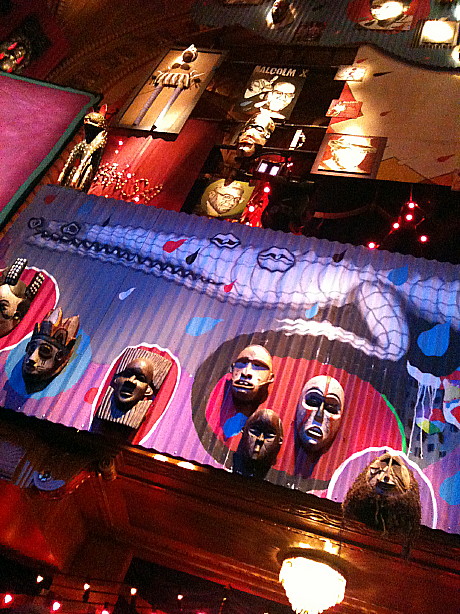
January 15 – I went with Misha to see Fela! – my third time, her first, and she loved it as much as I did. The full house, fervent weekend crowd, and the momentum of a hit show had the cast working up a sweat big-time. I especially enjoyed having the leisure to spend more time watching the individual dancers, who are phenomenal. The show is such a spectacle that it’s easy to take for granted and overlook the choreography, which is not generic at all but amazingly intricate. And I never get tired to taking in every inch of Marina Draghici’s environment (above) and watching how it interacts with each number and the ever-flowing video. We sat in great seats, row G on the aisle, and John Lithgow sat right behind us. So in the processional after the curtain call, all the performers spied him and lit up and high-fived him. There are probably celebs in that seat many nights of the week, but it was fun watching how the actors deal with it. I bought the fancy souvenir program, fanboy that I am, just to drool over the pictures…but they’re from the Off-Broadway production and don’t quite give me the kick I hoped they would. But here’s a tip: if you want a free mp3 download of  the real Fela performing one of his biggest hits, “Zombie,” send an e-mail to felaonbroadway@fela.net and type “free download” in the subject line. You’ll get a reply instantly with a link to the track.

Andy met us afterwards for drinks at Pigalle and to look at the photo research Misha has been doing for her forthcoming book Something’s Coming, Something Good: West Side Story and the American Imagination.


January 16 – The University Glee Club of New York hosted the Cornell Glee Club for a concert at Alice Tully Hall that Andy, a fervent Cornell alum, bought tickets for, so I went along, like a good boyfriend. It’s kind of wacky watching a stage full of 100 almost-all-white alter kockers crooning sea chanties and Negro spirituals. The Cornell undergrads were a little crisper and more interesting musically. Their a capella doo-wop subset, the Hangovers, did a lovely rendition of “Fire and Rain.” Both clubs did a couple of numbers together, and then the conductor invited all the Cornell Glee Club alums in the audience to join them onstage for the school cheer and alma mater. Andy, a former Hangover, ran up to the stage as if his pants were on fire. Very sweet, however dorky. There was a black-tie reception afterwards, so we even wore tuxedoes! But the reception looked pretty stodgy so we bailed fast and wound up at Bartini, where Andy’s swimming-team mates were celebrating Win’s birthday. Whew! Talk about packt like a tin of sardines! And when the DJ sprayed the crowd with Lady Gaga’s “Bad Romance,” the three queens next to me went apeshit, practically tossing the furniture in the air with drunken glee. As they left, one of them said to me, “I’m so sorry you had to see that. We don’t get out much….”

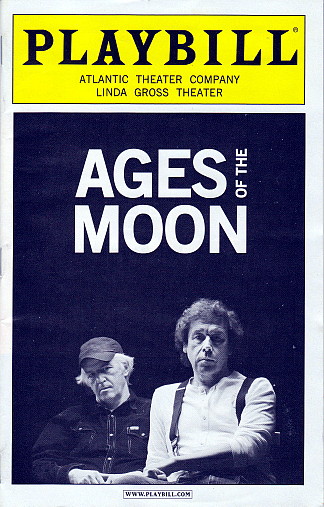
January 17 – My final date with Misha Berson for her most recent theatergoing spree sent us to the Atlantic Theater Company for Sam Shepard’s new play, Ages of the Moon. This is the second of two plays Shepard wrote specifically for the actor Stephen Rea to premiere at the Abbey Theatre, Ireland’s most famous theater. (The previous one, Kicking a Dead Horse, played at the Public Theater last season.) The reviews from Dublin focused on the play’s debt to Beckett, which is fair enough. It’s got minimal action, two guys sitting on a porch in some desolate location philosophizing – not unlike Waiting for Godot, the first play that Shepard ever encountered and that launched his playwriting career. Misha and I both have long, intricate histories with Shepard. Misha came of age as a theater critic in the Bay Area when Shepard was out there in residence at the Magic Theatre, in his pre-Jessica Lange days. And I wrote a biography of Shepard that was first published in 1985, then again in a revised edition in 1997. I can’t really encounter any of Shepard’s work with any other perspective than that of The Biographer, and given what I know, all his writing comes across as intricately autobiographical.

As with David Mamet (see above), Shepard has a certain formula that he returns to repeatedly. His writing has virtually always been a dialogue with himself. At the center of many, many, many of his plays are two guys bantering – True West is the best-known, and a perfect example of one male ego split into two parts, one sort of polite and erudite, the other ornery and given to bursts of macho violence that would be tired clichés if they weren’t so comically lame. Ages of the Moon harks back to Shepard’s very earliest plays, Cowboys and Rock Garden (his first double-bill in New York City), both two-handers, but forwarded now to middle age. All of Shepard’s writing these days (including his prose, like the new collection Days Out of Days, which Walter Kirn reviews on the front page of today’s Sunday NY Times Book Review) chronicles the restlessness of his soul, barely acknowledging his 30-year relationship with Lange and his movie stardom (he’s made 50 movies, most recently playing Jake Gyllenhaal and Tobey Maguire’s father in Brothers) but reflecting his incessant cross-country drinking, driving, and guilty womanizing. Ages of the Moon begins, like any number of Shepard’s plays, with the main character, Ames (Rea), having summoned his best buddy, Byron (Sean McGinley), to his side to commiserate over the latest, always seemingly irreconcilable blowout with his woman. This time she found scribbled on his fisherman’s map a woman’s name and phone number, a woman Ames can barely remember and would never ever think of calling up “even for a minor blowjob.”

These two guys sit drinking bourbon all day long, waiting for the total eclipse of the moon, as Ames rambles through a disjointed remembrance of his beloved, how they met and cemented their relationship, including a wacky story involving Roger Miller. In advance, it sounded like thin soup, and I suppose it is, relatively speaking, but I was surprised at how much it held my interest, thanks to no small degree to the Irishmen who staged (Jimmy Fay) and performed it. Rea is a wonderfully haggard actor, perfectly suited to span the gap between Beckett and Shepard, and McGinley, who’s new to me, is sensational in what could be a thankless second-banana role. Although the characters are absolutely American, holed up in a cabin somewhere in Virginia or Kentucky, framed by country music classics, the Irish/Beckett flavor seeps out in their synchronized bourbon-sipping and their wry humor, understated where American actors would be tempted to amp up the slapstick.

Performance diary: Ragtime

January 7, 2010


January 6 –
Ragtime closes on Sunday, having gotten a week’s reprieve because ticket sales picked up. David Zinn invited me to see it with him. We’d both seen the original production at the Ford Center, directed by Frank Galati, and didn’t care for it. (See my review here.) Hope springs eternal. Maybe director-choreographer Marcia Milgrom Dodge found something thrilling to do with this mediocre adaptation of E. L. Doctorow’s fantastic novel (book by Terrence McNally, score by Stephen Flaherty and Lynn Ahrens)….? Wrong. I can see how it would be perfectly acceptable at the Kennedy Center in Washington, or anyplace accustomed to touring productions of mediocre Broadway musicals with second- or third-tier casts. But there wasn’t enough to hold our interest past intermission.

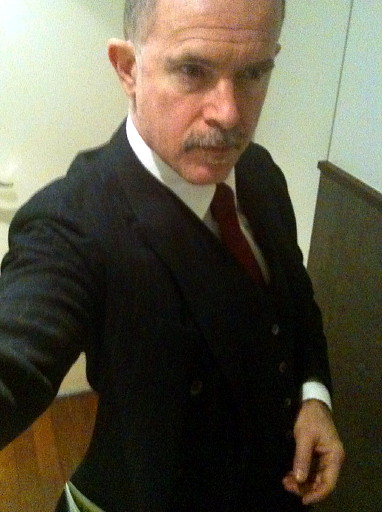
It did give me an opportunity to wear my vintage handmade three-piece pin-striped wool suit (above), a look that Herr Zinn approvingly dubbed “mean little gangster” (he’s become a big fan of Jersey Shore). We went for a drink at Park Blue, which – sadly – has closed, and ended up down the street at Seasonal, the Viennese wine bar, which was cozy and quiet. I heard all about his post-Christmas trip to Berlin and Thomas Ostermeier’s spectacular production of Hamlet at the Schaubuhne, which I hope Joe Melillo brings to BAM.