March 15 – In 1985, Stephen Holden and I sat in the tenth row center to see “Follies In Concert” at Avery Fisher Hall, which turned out to be one of the most memorable nights of musical theater I’ve ever experienced. If you’ve heard the excellent recording, you can imagine what I mean. Happily, Stephen invited me to be his guest for “Sondheim: The Birthday Concert,” the spring gala for the New York Philharmonic – same venue and some of the same cast. The occasion was Stephen Sondheim’s 80th birthday, and the show was a tasteful and surprisingly low-key affair, directed by Lonny Price – pleasurable, never boring but never actually thrilling either. For one thing, hardly any surprises. The one Sondheim rarity showed up early in the program, when Victoria Clark came out to sing “Don’t Laugh,” a number that Sondheim wrote for Judy Holliday as a favor to Mary Rodgers when the short-lived 1963 musical (Holliday’s last) Hot Spot was in trouble out of town.

The biggest musical discovery for me was Nathan Gunn, whom operagoers have been drooling over for a few years (both for his gorgeous baritone and his gorgeous bod, stripped to the waist in Billy Budd — see above). He sang “Joanna” from Sweeney Todd and “Too Many Mornings” from Follies with Audra McDonald, which was the highlight of the evening for me – what a great song! Laura Benanti sang a lovely version of “So Many People” from Saturday Night. It was great to see some original cast recreations: Chip Zien and Joanna Gleason from Into the Woods, Mandy Patinkin and Bernadette Peters from Sunday in the Park with George. And the show culminated in a Diva Showdown where Bernadette, Audra, Patti LuPone, Donna Murphy, Marin Mazzie, and Elaine Stritch (all in beautiful red Diane von Furstenberg gowns) sang songs they’re not associated with. Stritch was forgivably shaky, and the others were fine, but there were no revelations. David Hyde Pierce made for a droll host, nattering on about wanting to hear Sondheim songs in other languages and perpetually chiding conductor Paul Gemignani (who did a spectacular job, by the way) to stay away from Sweeney Todd (“We’re eating cake tonight, not people!”). The choruses from a bunch of Broadway shows filled the stage and the aisles and the balconies to end the show with a blast of “Sunday.” And Sondheim himself took a curtain call, sweet and humble, as you might expect, and moved to tears, which I don’t think any of us would have expected.

We had fun chatting at intermission with Tony Kushner and Mark Harris (Tony said he’s freakishly adept at memorizing lyrics and had astonished Sondheim at dinner once by reeling some off) and afterwards with Tony Tommasini and his friend Scott Wheeler.
Archive for the 'performance diary' Category
Performance diary: SONDHEIM: THE BIRTHDAY CONCERT
March 16, 2010Performance diary: A BEHANDING IN SPOKANE and MR. & MRS. FITCH
March 10, 2010March 3 – I’m in awe of Martin McDonagh as a playwright for his humor, for his theatricality, for his sly storytelling, and for his sheer mastery at composing sentences that explode in the air. His new play, A Behanding in Spokane, had me from the very beginning and never lost me. First of all, there’s Christopher Walken with his wild hair and ruined face, sitting on the bed in a crappy hotel room with one hand and one stump, looking grim. That gets a laugh all by itself, somehow. The flimsy latticed wardrobe door starts rattling, being kicked by someone apparently bound and gagged inside. That gets a laugh. (The crappy hotel room is beautifully designed by Scott Pask: the wardrobe has been built as an afterthought to the room, without any attention to the wallpaper pattern.) Walken goes to the wardrobe, opens the door, leans in and fires two shots. That gets a laugh. He closes the door, walks over to the phone, dials a number, and speaks the first line of the play: “Hi, Mom.” Laugh. This insane mixture of menace, goofiness, surprise, and mundanity – the essence of McDonagh’s dramatic universe – may not be everybody’s cup of tea but it’s absolutely mine.
The play occupies a territory midway between David Mamet and Sam Shepard. Like American Buffalo, the play is a caper that involves bumbling low-level thieves, terse sentences, and fast-flying obscenities. Walken’s character, Carmichael, has spent the last 47 years trying to retrieve the hand that a gang of hillbillies chopped off when he was 11 years old. Somehow he ends up in small-town Arizona (?) where two young dumbass pot dealers (Toby and Marilyn, played by Anthony Mackie and Zoe Kazan) claim to know where they can get his hand for $500. There’s always been a strong connection to Shepard in McDonagh’s plays – as here, at the center is a showdown between two guys who are more or less alter-egos, and there’s a wittily self-conscious theatricality afoot. Carmichael’s unlikely sparring partner is Mervyn (played by Sam Rockwell), the guy who works at the front desk of the hotel. Mervyn, who is quick to insist that he’s NOT “the receptionist” and was apparently doing sit-ups in his boxer shorts when Carmichael arrived to rent the room, is the play’s Fool, meaning he seems like a loser but winds up being the voice of truth and reason, sort of. He’s both a character and a device, the picture pointing to the frame, the writer talking to himself and punching holes in his own story.
The plot is very slight and not especially plausible, but key moments tell us to let go of naturalistic drama and pay attention to McDonagh’s postmodern hijinks. Mervyn first appears at the door to inquire about the gunshots he heard, and after repeating back the ludicrous explanation Carmichael gives him he asks, “Where is this story going to go?” Carmichael says, “We’ll find out as soon as you leave the room.” And although it wouldn’t seem too hard for two energetic kids to run away from a one-handed man, even if the other hand was holding a gun, all Carmichael has to do is whistle and jerk his head and his two captives willingly walk across the room to be handcuffed to heating ducts, as if under a spell. There’s no intermission, but the action is interrupted by an interlude in front of a drawn curtain in which Mervyn steps out to give us his hilariously discursive back-story. It’s a kind of vaudevillean moment that contributes to lifting the play out of the kitchen sink and conjures both Beckett and Brecht. And the scene is written and played in a manner very close to the bravura letter-reading monologue in The Beauty Queen of Leenane, the play that introduced us to Martin McDonagh.
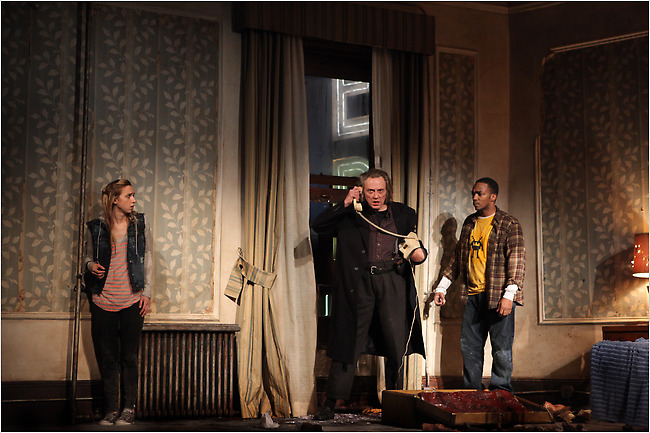
Directed by John Crowley, the cast is spectacular – David Zinn called it “the character-actor Olympics,” although as he pointed out, the roles of the two kids are so thinly drawn that you end up feeling sorry for the actors, especially Anthony Mackie, an excellent actor (see him in The Hurt Locker!) who has to spend most of the show playing a stoopid guy with vocabulary that ranges from “motherfuckin’ this” to “motherfuckin’ that.” The New Yorker’s Hilton Als was enraged by the shallow stereotypical nature of the character and Carmichael’s casual racism, and DZ objected to Carmichael’s needling Toby for “crying like a fag.” Somehow those things didn’t bother me – I saw them as part of McDonagh’s edgy examination of theatrical language, which included Marilyn’s hilariously earnest/lame challenging Carmichael for his homophobia and his use of “the n-word.” If anything, I wound up thinking that Mackie and Kazan were miscast. They’re terrific actors, up-and-coming stars (in Ian Rickson’s production of The Seagull last year, she was the best Masha I’ve ever seen), but a little too squeaky-clean to really represent small-town losers. Christopher Walken is, of course, amazing – ceaselessly inventive, scary, present, vulnerable, and as DZ put it, he has the deadest deadpan on earth. I was knocked out by Sam Rockwell’s performance because he goes nose-to-nose with Walken and holds his own without budging, and his performance is a comic triumph of its own.

The show got mixed reviews – Ben Brantley in the Times called it “erratically enjoyable” – but then so did McDonagh’s debut as filmmaker, In Bruges, which I think is one of the funniest and best-written movies of the last decade. David was much cooler toward the play than I was, but we had a good juicy conversation about it over drinks at Angus McIndoe, where McDonagh apparently does all his interviews and post-show drinking. I didn’t see him there, but he was at the theater greeting well-wishers, and I got a kick out of seeing the silver fox in person (see above).
March 5 – DZ called Behanding “the slightest excuse to gather 1000 people in a room,” but that encomium is much more appropriate for Mr. & Mrs. Fitch at the Second Stage, Douglas Carter Beane’s hard-hitting satire about…celebrity journalism. In an attempt at Noel Coward-style brittle and topical comedy of manners, John Lithgow and Jennifer Ehle play gossip columnists who drop about 100 literary names to suggest that they’re superior to everybody else. But it’s thin, hasty stuff that recycles old jokes (“Bi now, gay later”) and dispenses with character continuity altogether (one minute She’s avidly encouraging Him to invent a fake celebrity – the play’s major plot point – and the next minute she’s castigating his journalistic ethics for doing so). The funniest idea is that headline writers at the New York Post use “Camptown Races” as the rhythmic model for their creations – you can tell they’ve hit on a classic if you can follow it with “doo-dah, doo-dah!”

March 6 – Andy sings with the Dessoff Choirs, a volunteer group that symphony orchestras job in for massive choral works (like Britten’s War Requiem). Every so often they do a concert by themselves, and this program at Merkin Concert Hall consisted of three contemporary pieces: three Psalms by the recently deceased Lukas Foss, a pretentious and ugly piece by Harold Farberman called Talk inspired by dialogue overheard at an upstate diner, and Kyle Gann’s Transcendental Sonnets, based on a series of poems by Jones Very (1813-1880). The Foss and the Gann at least provided some beautifully lush choral singing, and the two soloists were excellent – tenor Jeffrey Hill and soprano Megan Taylor.
Performance diary: THE HIDDEN SKY and the Charles Ludlam films
February 23, 2010February 20 – Some friends of Andy’s, writer-director Kate Chisholm and composer-lyricist Peter Foley, have spent the last few years developing a musical called The Hidden Sky, based on Ursula LeGuin’s short story, “The Masters.” It’s currently having a production at the Prospect Theater Company, so we went to have a look. It’s truly Off-Off-Broadway: performed in a disused church, minimal production values, amateur actors, minimal orchestration (two live musicians, everything else on tape), terrible sound, etc. And wouldn’t you know, the woman playing the lead was out sick, so another member of the cast was stepping in, with book in hand. But the musical values were respectable – the choral arrangements (by Foley) were especially lovely, and most of the cast had pretty good voices.

The main draw is the story, set in “a time other than now” but very much about now nevertheless. (It could be taking place in Afghanistan, or Iran, or Iraq, or Albany — any place where religious fanatics are trying to bring back the Stone Age.) The world is dominated by a highly religious culture that worships the sun as God…only the environment has been destroyed so God has not shone through the clouds in many years. Knowledge and thought has been banned, but an underground tribe of “seekers” continue to pursue scientific experimentation and mathematical calculation. A young woman named Ganil, who’s achieved mastery in the crude industrial culture and is engaged to be married to the son of a mucky-muck, possesses unusual aptitude for math. Despite being cautioned against this pursuit and the prospect of bodily mutilation and ostracism, egged on by a renegade from another region named Lee, Ganil focuses on numerical patterns that exist in nature, studying them to the point of neglecting other concerns. (Can you say Sunday in the Cave with Ganil?) In one of the weirder yet fascinating musical numbers I’ve encountered in the theater, she basically discovers or re-invents the Fibonacci sequence. The climactic moment of the show is when she realizes that there is a predictable, elaborate, elegant pattern that shows up in nature, and she proclaims this awesome phenomenon to be “the face of God.” Are we meant to take that seriously and agree with her? Is she truly seeking a scientific alternative to the superstition of the mainstream culture, or is she exchanging one fundamentalist faith-based system with another? Does she have no other language for something mysterious and powerful than to call it “God” and is that the show’s point? (I haven’t read LeGuin’s story, so I don’t know how much of this is original to her or shaped by the adaptors.) Is the show making a case for intelligent-design theory? I had a good juicy discussion of all this over drinks and dessert at French Roast with Andy and Allen, who are both science-fiction/fantasy geeks and enjoyed the show more than I did.

February 22 – Steven Watson had an extra ticket at the last minute to see the showing of “The Lost Films of Charles Ludlam” (two black-and-white silent shorts left unfinished when he died in 1987) in the “Queer/Art/Film” series at the IFC Center, hosted by filmmaker Ira Sachs and BUTT magazine editor Adam Baran. I was delighted to go, and I’m glad I went. Not that the movies are great. They’re decidedly not. It was a little like watching the dailies from an extremely low-budget student film – zero editing, bad lighting, mugging rather than acting, every shot going on 20 times longer than necessary (every shot!). But still…there was the late great Charles Ludlam, playing a bisexual convict on the lam in Museum of Wax – it’s thrilling to see his incredibly expressive face on film. And you get a glimpse of him naked on a train in The Sorrows of Dolores, a madcap takeoff on The Perils of Pauline starring Everett Quinton (above) with Ridiculous Theater stalwarts Black-Eyed Susan, Lola Pashalinski, John D. Brockmeyer, and Minette in smaller roles. (Both films would probably be better off being shown as slideshows — brief slideshows! But with some of the terrific music Peter Golub apparently whipped up at short notice for these screenings.) Everett introduced the films alongside Anthony Hegarty (of Antony and the Johnsons fame), who selected the films for showing in the festival and gave a rambling but personal and touching talk about his introduction to the lineage of gay drag theater. The audience for this event pretty much WAS the event. Lots of familiar faces, art fags of every age and gender. It was one of those nights where New York felt like a little tiny cozy village.
Performance diary: A LIE OF THE MIND
February 20, 2010February 18 – I’ve been on the Sam Shepard beat for thirty years now, and every time I think it’s time to take a break, the universe sends me a different message. I thought I could live my whole life without ever seeing A Lie of the Mind again, and then I woke up the other morning absolutely convinced that I had to see the New Group’s revival directed by Ethan Hawke with a hot cast including Josh Hamilton, Laurie Metcalf, Marin Ireland, Karen Young, and Keith Carradine. Minutes later, I got an e-mail from my friend Richard inviting me at the last minute to the opening night performance (he’d won tickets at a fundraiser for the New Group, whose executive director Geoff Rich is an old friend of his). And the seats turned out to be front row center – an almost overwhelming vantage point from which to study not only the spectacle of hairy-chested Alessandro Nivola in boxer shorts (where is After Dark magazine just when you need it?) but also Hawke’s carefully rethought, re-imagined, and beautifully performed production of a problematic Shepard play.

The 1985 original production of A Lie of the Mind is one of those legendary star-studded New York shows. Shepard himself directed an unbelievable cast: Harvey Keitel, Amanda Plummer, Geraldine Page, Aidan Quinn, Will Patton, Ann Wedgeworth, Jim Gammon, and Karen Young. The show was four hours long, with lots of live music by a bluegrass band, the Red Clay Ramblers. Unlike Ben Brantley, whose rave review of the New Group production declared it a “masterwork,” I thought it was a little ponderous and self-consciously epic. Having just written my Shepard biography (the book party was held in the lobby of the Promenade Theater, where A Lie of the Mind was playing), it was hard for me to see the play as anything other than a sequel to his four previous, more than semi-autobiographical plays (Curse of the Starving Class, Buried Child, True West, and Fool for Love). The previous plays had lots of merit as free-standing entities. In A Lie of the Mind, at least when it opened, the lines between imagination and autobiography were especially blurry because Shepard’s celebrity had suddenly pushed his personal life in public consciousness. He’d famously hooked up with Jessica Lange on the set of Frances, and he left his wife and 10-year-old son to live with her. The agony of that situation clearly propelled the writing of A Lie of the Mind, which opens with Jake calling his brother Frankie to say he’d just beaten his wife Beth to death (it’s easy to understand how the guilty party in a divorce might feel that way).
Ethan Hawke has a long history with Shepard: he was in Steppenwolf’s 1995 production of Buried Child in Chicago directed by Gary Sinise, Shepard played Hamlet’s father in Michael Almereyda’s fascinating film of Hamlet with Hawke in the title role (Shepard brought tears to my eyes when he pulled his son into his arms and growled into his ear “Remember me!”), and Hawke played one of the two leads in the New York premiere of The Late Henry Moss (see below, in the role originally played in San Francisco by Sean Penn). A whole generation younger than Shepard (he is, in fact, the same age as Shepard’s first-born son, Jesse), Hawke rounded up a posse of actors like himself who tread back and forth from theater to indie film with occasional forays into mainstream movies and TV.

From the get-go, his production departs from Shepard’s. First of all, he cut out almost all music except for underscoring and occasional bursts of song provided by Latham and Shelby Gaines, playing on homemade sound sculptures from a cubbyhole visible to the audience stage left. And instead of two separate areas floating in space, Jake’s family and Beth’s family occupy the same resolutely indoor set, fantastically crammed floor to ceiling with dusty old wooden drawers and boxes and family baggage. It looks like a cross between my grandparents’ farmhouse (I come from exactly the same kind of Midwestern white-trash family Shepard did) and I Am My Own Wife.
I understand that Shepard took one look at the set and declared “You ruined the play.” He was wrong. To my mind, Hawke and his cast have rescued the play by applying a vast amount of attention to the specifics of each character and each scene in such a way that, paradoxically, they open out into something much bigger and broader. For one thing, there’s no pretense that these folks are normal, psychologically stable individuals. They’re all quite out of their minds, in one way or another. Beth’s mother Meg and Jake’s mother Lorraine pretend not to know that their kids are married to each other. Even though Jake has indeed beaten Beth up badly enough for her to sustain brain damage, she clearly had more than a few screws loose beforehand. The way she attaches to Frankie when he comes to check up on her tells us a lot about her boundarylessness (and her love-starved relationship with her father). And especially in Nivola’s riveting performance, we see Jake’s violence as a highly unstable, combustible compound of genetics, alcoholism, wounded masculinity, love, fear, and blazing self-ignorance.

I could talk at length about each scene, each character, and each performance, but I don’t have all day so I’ll just hit the high points.
1. Although Shepard pooh-poohs psychological reality, the psychotherapist in me can’t help identifying the impact of trauma on both Jake and Beth. One lie in Jake’s mind is that he’s killed Beth, but that’s a strange displacement of his guilt about his participation in his father’s death, which he’s buried so deep that he doesn’t remember it. It only surfaces as a seizure that takes over his body, although he tries to articulate it in a scene that Nivola plays with terrifying clarity, when he says, “There’s this thing – this thing in my head…A scream from a voice I don’t know. Or a voice I knew once but now it’s changed. It doesn’t know me either. Now. I used to but not now. I’ve scared it into a different form.” In other plays (such as The Unseen Hand), Shepard has dramatized this phenomenon in almost science-fiction terms. And I know from my research that this self-alienation relates philosophically to the Gurdjieff work that Shepard has studied deeply. But Nivola plays it in a fantastically visceral, emotionally immediate way.

2. The mothers in a lot of ways seem like the same character – the same paradoxically ditsy and down-to-earth woman, paradoxically scornful of men and ferociously attached to them. I found it touching to watch how these actresses pulled that off – Young’s Lorraine infantilizes Jake like some textbook bad mother, completely unruffled by his bad behavior (as above — she’s seen it all her life and pretty much expects it) and Metcalf’s Meg doggedly serves her neglectful husband — without any extra commentary.
3. I found some moments of the performance unexpectedly personal and shocking. In the first scene with Jake and Frankie, during Jake’s frenzied temper tantrum Frankie instinctively knows to go stand in a corner and avoid eye contact, which certainly matches my experience of living with a raging alcoholic madman. My father, like Shepard’s, was a military man (and drunk) who died in 1996. He was still alive when I first saw the play, whose first act ended with the beautiful and touching image of Jake blowing his father’s ashes into the air. This time around, as soon as that scene began, I kinda lost it and watched the rest of it through tears of re-living my own father’s funeral — being presented with the American flag by uniformed riflemen, handling the box of ashes, the whole bit. Surprisingly powerful.
4. The romantic triangle and the family dramas that drive A Lie of the Mind speak to virtually anybody, but close followers of Shepard’s work will inevitably see the connections to his other plays. I was very impressed with the specific ways Hawke conjured the creepy, claustrophobic, murky tone of Buried Child – the set is very important in that way, but also the way Frankie spends most of the play stretched out on the sofa echoes the succession of lame (and lame-brained) men who occupy that position throughout Buried Child (and lower-class middle American life – as Sandra Bernhard would say, “the picture Norman Rockwell forgot to paint”).
 And I was amazed to see the way he conjured Fool for Love in the unmistakably erotic tension between Jake and his sister Sally. That did NOT exist in the original production. Karen Young, in the role of Sally, had zero sexual energy. (A little gossip: Rebecca DeMornay was originally cast in the role, but after Jessica Lange walked into a dressing room and caught her with Shepard, DeMornay was gone, and Karen Young took her place. Young’s blank sexuality works a lot better in the role of Lorraine, even though she seems quite a bit too young for the part.) Maggie Siff has taken shit in the blogosphere for her supposedly weak performance in this show. I completely disagree. She comes in with a different energy from the others in a way that recollects Shelley in Buried Child, fittingly. She is a terrific match for Nivola’s scary/sexy energy. Plus, the two of them are so fucking hot I was afraid/hopeful that they would have sex right in front of me. (Or with me.)
5. Some other echoes of the Shepard canon: in the original production, Meg and Baylor folded up the American flag in a very simple way that communicated both domestic familiarity and unquestioned patriotism. Since then, Shepard wrote a whole play basically decrying post-9/11 flag-mania (The God of Hell) so Hawke shrewdly plays the scene for a few different flavors, including one pointedly stylized moment where they’re holding the flag fully open behind Jake, who says “Everything lies!” We seem to be in a moment of political commentary…and then it’s dropped. Which I think is cool and preserves the several mysterious undercurrents of the play. And at the very end of the play, having the oilcan of Lorraine’s family memorabilia burning in the same room where Meg is looking out the window to see “a fire in the snow” conjures the inside/outside speech of Action, one of my favorite early Shepard plays.
6. With this kind of omnibus set, lighting is crucial. Designer Jeff Crotter does a fantastic job of using light to define, slice up, isolate sections of the stage to create the simultaneity of time and place that is part of the quirky magic of Shepard’s plays.
7. A few quibbles. Shepard plays fast and loose with naturalistic action in this play. Still, in this production Beth seemed to move with amazing swiftness from not being able to stand up straight to lap-dancing with Frankie on the sofa. I’m a huge admirer of Josh Hamilton, who played Frankie, and he does a terrific job here, though sometimes that leg injury seemed to come and go. And during the whole weird scene when Beth’s brother Mike (a pretty thankless role, reasonably fired up by Frank Whaley) drags Jake into the house with a rope around his neck, Laurie Metcalf has to lie on the floor conked out, pretending to be invisible. I felt a little sorry for her in that moment. Otherwise, Metcalf was nonstop brilliant. The one cast member who didn’t do it for me was Keith Carradine as Baylor. All the other actors succeeded in suspending my memories of the original cast, but Jim Gammon was completely believable as a crusty old pig-headed hunter with feet so gnarly and calloused that he needed to rub them with mink oil. Carradine – no way.
Opening night was predictably buzzy, attended by the New Group in-gang: Wally Shawn and Debby Eisenberg, David Cale, Matthew Broderick, etc. I chatted with Scott Elliott, who’s about to go into rehearsal with the musical of The Kid, Dan Savage’s book about gay parenting. There was a party afterwards at Montenegro, a new restaurant in the NY Times building. I was happy to run into Emily McDonnell, who was in Wally’s play Grasses of a Thousand Colours in London. And I was amazed to see that Sylvia Miles is still around a kicking and going to opening-night parties.
Performance diary: Suzanne Vega and “The Pride”
February 1, 2010I continue to be haunted by A View from the Bridge. I think one thing that makes this production so compelling is the strong relationship between Eddie and the lawyer Alfieri. Sometimes that aspect of the play feels overly symbolic, a plot convenience, but as played by Liev Schreiber and Michael Cristofer, there’s a powerful father-son flavor to their connection. Eddie really trusts this guy, looks up to him, speaks his heart, and listens carefully. And Alfieri speaks hard truths to him in a loving way. The more I think about it, the more I admire Cristofer’s performance.
I also admire the way Miller folds in the inevitability that is a key feature of Greek tragedy. It’s Eddie, after all, who spells out for Catherine the clan’s code of ethics toward squealers who drop a dime on undocumented immigrants. It’s no accident that John Lee Beatty’s set features a pay phone that’s visible from the first moment of the play. Miller wrote the play in the midst of the McCarthy era, when turning people in and naming names was not in the slightest bit hypothetical. Today, this aspect of the play conjures the Homeland Security motto, “If you see something, say something.” I’m sure I’m not the only one who finds those subway posters creepy, knowing that such “protective” measures are more often used to divide and persecute the citizenry rather than offer true protection.

January 28 – At the American Songbook series, Suzanne Vega offered what amounted to a retrospective of her career. It certainly made me happy that she opened with three of my favorites: “Marlene on the Wall,” “Small Blue Thing,” and “Caramel.” (The first has generated a persistent, not unpleasant earworm: “Marlene watches from the wall/Her mocking smile says it all/As she records the rise and fall of every man who’s been here/But the only one here now is me/I’m fighting things I cannot see/I think it’s called my destiny/That I am changing changing changing….”) There were songs that I’d forgotten that I loved, like “Left of Center” and “Gypsy” (which she wrote when she was 17! At summer camp! With its extraordinary line about “night is the cathedral”). Stephen and I remember seeing Suzanne Vega at Folk City in 1984 before she even had a record deal (actually, Stephen’s review was instrumental in getting her a record deal), and Andy is way into more recent albums, especially Beauty and Crime. So we all dug the show, especially when the encore was the remix version of “Tom’s Diner.” She had a hot band – a cute and terrific bass played named Michael Visceglia (“Left of Center” was just the two of them) and a fantastic guitarist named Gerry Leonard who was a wizard with pedals and playbacks. A string quartet also accompanied several numbers. Suzanne looked elegant and amazingly youthful, though for some reason she commented a couple of times that she was surprised at how “well-behaved” the audience was. She expected what, catcalls? Flung jockey shorts? Premature requests for “Luka”?
January 30 – Alexi Kaye Campbell’s The Pride, produced by MCC Theater at the Lucille Lortel, gives us two versions of a trio named Oliver, Philip, and Sylvia (played by Ben Whishaw, Hugh Dancy, and Andrea Riseborough). In 1958 Oliver is a modestly successful children’s book writer, Sylvia is his somewhat mentally unstable illustrator, and Philip is her realtor husband who has an affair with Oliver that sends him into aversion therapy. In 2008 Oliver is a sexually compulsive magazine writer, Philip is the photographer boyfriend who just left him, and Sylvia is the fag hag who wants to get them back together. As a first play, it’s obviously indebted to Caryl Churchill’s Cloud 9 (which premiered in New York at the same theater, come to think of it), though Campbell intersperses his eras throughout the play. It’s a flashy showcase for actors, directed by Joe Mantello, but I found the play ludicrous, a kind of sensationalistic soap opera.
 another eye opens