Archive for the 'performance diary' Category

Performance diary: Rufus Wainwright at Carnegie Hall and the Juilliard Orchestra at Alice Tully Hall

December 23, 2010


December 6 –
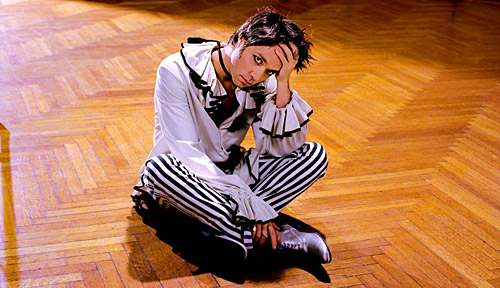
I’d heard in advance that Rufus Wainwright was making a strong request to audiences for his current concert tour that they hold their applause during the first half of the show, while he plays the song cycle that makes up his most recent record release, All Days Are Nights: Songs for Lulu. I didn’t realize until seeing the show at Carnegie Hall that he was treating this song cycle as a kind of theater piece. He makes a dramatic entrance in silence, processing slowly across the bare stage wearing a thick black cape with a 20-foot train. He sits at the grand piano and proceeds to perform the album’s dozen songs, while video plays of a gigantic blinking blue eye smeared with too much dark eye shadow.  (Visuals by Douglas Gordon, whose photography also graces the cover of the album.) Three of the songs are adaptations of Shakespeare sonnets; the others are somber, dark, and sad, reflecting as they do on his feelings during the final days of Kate McGarrigle, his beloved mother. They’re not his best songs, not especially melodic, rather monotonous in fact, with florid show-offy piano arrangements and lyrics that sound like hasty blog entries. At Carnegie Hall, with its billowing acoustics, many of the lyrics were as difficult to hear as they are to read in the liner notes of the album, where they are written out in Rufus’s flourish-crazy handwriting. When the set was over, he got up and processed offstage as slowly as he arrived. Many of his diehard fans found this act a little hard to swallow, including me, but it certainly showed off the many sides of Rufus: the self-indulgent narcissist, the diva, the ambitious artist always wanting to stretch himself, the little kid playing dress-up, the grieving son.

After intermission he came back onstage dressed more casually in sweat pants (“don’t worry, they’re very expensive!”) to do a another set of favorites for the fans, again with only piano accompaniment. By himself he did “Grey Gardens,” “Memphis” (his tribute to “another New York legend, Jeff Buckley”), “Going to a Town,” “Cigarettes and Chocolate Milk,” and “Dinner at Eight,” a song about him and his father, Loudon Wainwright III, who was in the audience. Rufus brought out Stephen Oremus, the music director for his remake of Judy at Carnegie Hall, to accompany him on a bunch of Garland standards: “Do It Again,” “A Foggy Day,” “If Love Were All,” and “The Man That Got Away.” And he brought out his sister Martha (who looked fabulous in spangly tights and super-high heels) to sing with him on “Moon Over Miami,” “Complainte pour La Butte” (from the Moulin Rouge movie), and “Hallelujah.” And then of course there were tons of encores, beginning with “Poses,” for which Martha came back onstage, this time with her infant son Arcangelo. “We start ‘em young in the Wainwright/McGarrigle tribe,” Rufus cracked. And then a couple more Judy Garland numbers, “Alone Together” and “You Made Me Love You/Me and My Gal.”

It was a celebratory and fun evening, but I was very aware that Rufus started the second half with “Beauty Mark,” his great zesty song about his mother, and ended with one of hers, “The Walking Song,” about the early days of her courtship with Loudon: in its own way a sweet memorial tribute to a wonderful musician and Rufus’s best friend.

Lots of famous fans showed up for the concert. I saw Antony Hegarty (of Antony and the Johnsons), who was sitting in front of Stephen and Alvaro. I spied Frances MacDormand with her Coen Brother, and I chatted with Laurie Anderson, who was there with Lou Reed. Laurie looked great and remarkably relaxed, considering that she’s been on tour much of the year with three different shows. She told me she just performed at a benefit concert with her dog Lolabelle. I was trying to track Lou’s possible connection to Rufus, and then I remembered that Kate and Anna sang the odd little “Balloon” song on his Edgar Allen Poe album, The Raven.

December 11-12: I got behind on blogging because I had a couple of performances of my own with Gamelan Kusuma Laras at the Indonesian Consulate. It was a long and somewhat challenging program. I wasn’t surprised that several of my friends who came to the concerts had their fill and left at intermission. It was a gas for me. I got to play kethuk on one number (the welcoming music, “Clunthang/Kasatriyan”), and then I sang with a chorus of other folks on three other numbers (in ancient Javanese!). It’s been decades since I did so much singing in such a short amount of time. I was a little hoarse afterwards. And then for days I could not get some of this music out of my head….!

December 13: Thanks to my friend Roman, I found myself sitting sixth row center at Alice Tully Hall for a concert by the Juilliard Orchestra, playing two pieces new to me: Prokofiev’s Piano Concert No. 3 and Ravel’s Daphnis and Chloe. Both were fantastic. The Prokofiev turns out to be one of those fiendishly difficult show-offy vehicles for a virtuosic pianist, like Rachmaninoff’s Piano Concert No. 1. In this case, the performer was an unbelievably talented 19-year-old Juilliard student from Virginia named Julian Woo with impossibly long fingers, all the better to play long stretches of crazy cross-handed piano, his fingers literally tickling the ivories, diddlly-diddly-dee. The orchestra, of course, includes basically the cream of the crop of young musicians, passionate and confident and highly attentive, dreamy to hear. And the conductor for the evening is some kind of rising star, Yannick Nézet-Séguin, the Quebecois music director of the Rotterdam Philharmonic who will take over the Philadelphia Orchestra in 2012. He’s a Leonard Bernstein-like dynamo, fantastically expressive, at times leaping off the floor, other times caressing his own cheek to cue the string section. The Ravel was equally exciting and exacting. The excellent programme notes by James M. Keller informed me that Daphnis and Chloe, commissioned by Diaghilev for the Ballets Russes, is Ravel’s longest composition ever with the largest orchestral accompaniment as well, including such rarities as celeste and wind machine. The Dessoff Choirs, which Andy sings with, provided the choral contribution, which consisted entirely of swoony non-verbal aah-ing and oo-ing that at times sounded like the music accompanying certain kaleidoscopic Busby Berkeley dance routines. I’m laughably uneducated at the history and appreciation of the classical repertoire, so I’m glad to get exposed to such treasures, however that happens.

Performance diary: The Dessoff Choirs at St. James’ Church

November 21, 2010


November 20
The Dessoff Choirs, which Andy sings with, have spent all fall rehearsing with their new conductor, Christopher Shepard, for a concert of French choral music. The concert, titled “In Paradisum: French Masters from Josquin to Duruffle,” was sublime. I’m no expert on the history of choral music, but I love a lot of French impressionist music (Faure and Debussy), and this concert turned me on to a lot more. It opened gorgeously with Faure’s “Cantique de Jean Racine” and closed with Duruffle’s “Requiem,” which is sterner, less lush than Faure’s famed Mass but exquisitely performed. Poulenc’s “Four Motets for Christmastime” were spectacular – for one thing, the acoustics at St. James’ Church gave unaccompanied voices an almost perfect environment. The church was chosen partly to show off its new organ, and keyboardist Christopher Jennings got a slot to play something without the singers. I’m no fan of organ music, but he plays Saint-Saens’ “Prelude and Fugue in B Major,” which was beautiful and weirdly made me to understand that Brian Wilson must have looked to Saint-Saens as an inspiration. The most ambitious and thoroughly successful segment of the program was Shepard’s selection of Madrigals and Chansons, alternating between Renaissance church music and modern art songs. Out of eight pieces, two struck me particularly: Vincent d’Indy’s “Madrigal dans le style ancient” and Faure’s “Madrigal.” The latter had a text by Armand Silvestre so deep and wise that it made me cry. The English translation by Miriam Lewin goes:

You should know, o cruel Beauties,
That the days for loving are numbered.
You should know, fickle gents,
That the fruits of love are fleeting.
Love when someone loves you,
Love when someone loves you!

The same destiny awaits us
And our folly is the same:
To love the one who flees us,
And to flee the one who loves us!

The Dessoff were supposed to be spending next week accompanying Ray Davies on his East Coast tour, singing choral arrangements of classic Kinks songs. But Herr Davies fell ill and had to cancel. So their next performance will be Ravel’s Daphnis et Chloé with the Julliard Orchestra December 13 at 8:00 pm at Alice Tully Hall.

Performance diary: THE HOPEY CHANGEY THING

November 15, 2010

November 9 – The Public Theater has been running an aggressively political season this year, starting with Bloody Bloody Andrew Jackson opening on Broadway, then Lisa Kron’s In the Wake and Lawrence Wright’s The Human Scale, and soon to come The Great Game — Afghanistan. A late addition to the schedule was Richard Nelson’s The Hopey Changey Thing, a play audaciously set on November 2, 2010 – that is, election day – which is also the same night the production (directed by the author) opened at the Public Theater. Talk about a high-wire act! I admire Nelson for being willing to write a play with a short shelf life in order to capture — for the theatrical record, as it were – some of the conversations and issues in the air right this minute without waiting to view from the cool distance of history. How current is it? The first line of the play is “Fuck you, Andrew Cuomo! Fuck you, Kirsten Gillibrand, and the horse you rode in on, whose name is Chuck!”

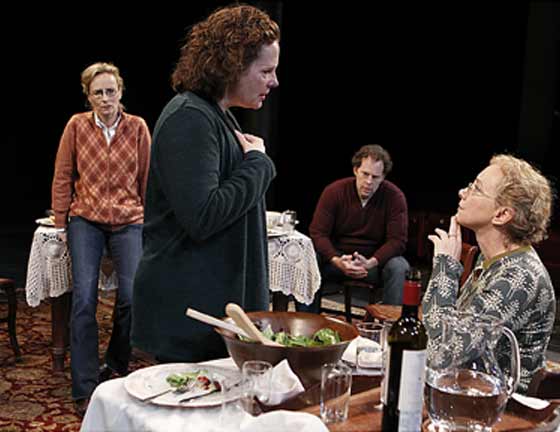
The speaker is Richard (Jay O. Sanders), a lawyer in the State Attorney General’s office, holding court in the kitchen of his sister Barbara’s house in Rhinebeck. Unmarried Barbara (Maryann Plunkett) teaches high school and looks after their Uncle Ben (Jon deVries), an actor who’s recently suffered a heart attack and has amnesia. They have two other sisters, Marian (Laila Robbins), an elementary school teacher in Rhinebeck who helps look after Ben, and Jane (J. Smith-Cameron), a recently divorced writer who lives in Manhattan with her new boyfriend Tim (Shuler Hensley) and does everything she can to avoid spending time in the depressing company of Barbara and Ben.

Three sisters, a brother, an elderly dotty uncle…Chekhov anyone? Nelson lays out this family dynamic in a blatantly schematic manner, assigning each character a single trait and having them always and only live out that role. Richard is the blowhard lawyer, Barbara is the long-suffering “old maid” who can’t stand conflict in her vicinity, Jane is the insecure one who sides with Richard in any family conflict, and Marian is the bossy unpleasant one who says whatever she thinks and is rabidly attached to the Democratic party line. I can’t help contrasting “Hopey Changey” with Lisa Kron’s play, which eschews obvious Republican-bashing and portrays characters thinking deeply and independently about political issues. Nelson’s up to something else, presenting characters who are not ostensibly mouthpieces for the author’s opinions but the semi-informed and semi-clueless, semi-smart and semi-defensive liberals whose opinions are formed by an attachment to the New York Times and the Huffington Post as middle-American households might be driven by Fox News. These New Yorkers see themselves as the center of American culture in a way that’s both patronizing and ignorant. Marian holds people in rigid party-line categories. Barbara claims never to have met anyone from Texas, and her sibs chime in with writing off that state as populated only by yahoos. Richard didn’t vote at all in the election – he admired his former boss, Eliot Spitzer, and despises Cuomo – and Jean did her me-too act.

As the characters talked about Sarah Palin, the election, the wars, campaign financing, Obama’s performance as president, I found myself going back and forth – outraged when I didn’t agree with them, absorbed when I did. Ultimately, I found the play thin and not especially illuminating. (For one thing, Uncle Sam, I mean Uncle Ben’s illness was so metaphorical, Susan Sontag must be spinning in her grave.) Nevertheless, I’m impressed that Nelson was able to get the play up and running at all. He certainly was able to amass a cast of excellent veteran actors, whom I was happy to see even if they were playing limited generic parts. And if the family aspect of the play is modeled on Chekhov, the political aspect is pure Brecht: if you don’t like the world, change it.

November 11 – Andy is a big fan of Radiolab, the WNYC-FM program and podcast whose hosts, Jad Abumrad and Robert Krulwich, weaving storytelling and science into sound and music-rich documentaries. So we went to a live show at Greene Space in the West Village, where the hosts were trying out material for a forthcoming show on the subject of symmetry. I found their approach disconcertingly random, more trivia-mongering than persuasive argument, but they had John Cameron Mitchell as a musical guest to sing “The Origin of Love” from Hedwig and the Angry Inch – a lovely song and lovely performance, even if I reject Aristophanes’ thesis that we are born with a longing for our “other half” that turns into love. We went out for dinner at Trattoria Toscana on Carmine Street with Andy’s friend Steve Kass, and David Hollander joined us after a concert at Lincoln Center.

Performance diary: Justin Bond’s RE:GALLI BLONDE at the Kitchen

November 1, 2010

October 27 – Keith Hennessy flew in for a couple of days, mostly to see Ishmael Houston-Jones’s piece Them at PS 122, but he got in Wednesday night early enough for us to see Justin Bond and the House of Whimsy perform their show Re:Galli Blonde (A Sissy Fix) at the Kitchen. The piece was inspired by a chapter from Randy Conner’s invaluable scholarly book Blossom of Bone: Reclaiming the Connections between Homoeroticism and the Sacred about the galli, the tribe of eunuch priests who devoted themselves to worshipping the Roman goddess Cybele in the four or five centuries B.C.E. The galli were forebears of the South Asian hijra or the Native American berdache and other populations of two-spirit individuals who served as gatekeepers between male and female, this world and the other world. “They were considered gender variant in both appearance and behavior, and they appear to have engaged in same-sex eroticism,” says Conner, who goes on to describe that appearance and behavior in great detail, some of which was detectable in the performance.
There was a Cybele figure, played by Justin Bond, with two attendants in lion headdresses (above), and there were numerous references to the galli’s animal totem, the rooster. (Gallus means rooster, and even in 5th century B.C.E. Rome the association of rooster/cock/phallus was already in currency.) But as a whole Re:Galli Blonde was as tortured and incoherent as its title. It was framed as a pagan ritual. As the audience arrived, there were radical faeries drumming (below) and drag queens circulating through the house as Cybele sat on her throne waiting for her disciples to gather in a circle before her to re-enact the Queen of Heaven’s descent to the underworld to comfort her recently widowed sister Ereshkigal (played by tranny superstar Glenn Marla in a spangly red dress). This descent was the loose framework for a series of vaudevillean songs, dances, and drag numbers that wouldn’t have been out of place at Trannyshack, the legendary weekly punk-rock drag cabaret that ran for years at San Francisco’s Stud bar, or at a faerie gathering. Somehow Cybele got mashed up with Kathryn Kuhlman, a Midwestern evangelist and faith healer who had a national TV show in the 1960’s and 70s called “I Believe in Miracles.” And the Queen of Heaven story somehow became a creation myth about how gays came to be despised. When the Queen of Heaven’s male escort refused to kiss Ereshkigal, she delivered a blistering curse. To heal from this curse, Bond as Kuhlman/Cybele lined up the cast and had them say how they had been personally affected by homophobia/femmephobia/ transphobia. No matter how lame, vague, or naïve their testimonials were, they each received a pat affirmation (“You are beautiful, powerful, magical”) and pronounced healed. Seriously? It’s that easy?
I could see how Justin Bond was working several layers of spiritual and theatrical mythology, following in the high-heel footprints of Jack Smith, Ethyl Eichelberger, and the Cockettes. I was pretty appalled, though, at how shallow, simple-minded, un-ironic, unfunny, and unsexy the whole thing was, although to be fair it’s not like the forebears’ work was uniformly brilliant, deep and hilarious. The performances were surprisingly amateurish, which doesn’t necessarily have to be a bad thing — but I will say I’ve seen sharper performances and more historically/politically/spiritually astute acts thrown together in an afternoon for a “no-talent show” at Short Mountain Sanctuary. I suppose the best thing to be said about Re:Galli Blonde is that it gave the incredibly talented Machine Dazzle another occasion to create a set of spectacular costumes and it spurred me to go back and re-read the chapter in Conner’s book, which is full of fascinating crazy details. For example: “In Greco-Roman iconography, the finger and the penis are often interchangeable symbols. Moreover, the finger in perpetual motion is a Greek sign signifying digital or penile stimulation of the anus, referred to as ‘siphnianizing,’ as the inhabitants of Siphnos were thought o be especially fond of anal eroticism…To inscribe the name [of a loved one] on a finger suggested that the youth willingly yielded to anal eroticism.”

Performance diary: Jackson Browne at the Beacon Theatre

September 15, 2010

September 14 – Tom’s sister-in-law gave him some tickets to the Jackson Browne concert at the Beacon Theatre, and he invited me. I hadn’t seen the Beacon since they spruced it up several years ago – wow! It’s beautiful now. And it was definitely a trip down memory lane to see Jackson Browne again. He was an important singer-songwriter in my college days, and his first three albums figure heavily in my pantheon. I saw him a few times back in those days, but I don’t think I’d laid eyes on him for years til I watched the Rock & Roll Hall of Fame ceremony last year, where he looked pretty good (for a guy in his sixties!), much better than Crosby, Stills, Nash, or Young. And his voice has held up pretty well, too. He’s not anywhere near as great a songwriter as, say, Joni Mitchell or Laura Nyro – the rolling shapelessness of his compositions is both endearingly particular to him and a little monotonous – but as a lyricist he’s unafraid to explore emotional depths that are unusually nuanced, especially for men. In songs like “My Opening Farewell,” “Fountain of Sorrow,” and “Late for the Sky,” he zeroes in on the loneliness that erupts surprisingly in the middle of an intimate relationship. Hearing him sing “Fountain of Sorrow” in concert brought tears to my eyes, especially the verse that goes

When you see through love’s illusions, there lies the danger
And your perfect lover just looks like a perfect fool
So you go running off in search of a perfect stranger

While the loneliness seems to spring from your life
Like a fountain from a pool

He did a few recent songs I didn’t recognize, but I was surprised and pleased that he did a lot of his early (and best) songs: “For Everyman,” “For a Dancer,” “Rock Me on the Water,” and of course crowd-pleasers like “Running on Empty,” “The Pretender,” and “Doctor My Eyes.” For me the highlight was his stripped-down, almost solo piano rendition of “Late for the Sky,” which Tom had never heard and also liked.

There wasn’t exactly an opening act, but Browne came out with his wizardly guitarist and longtime buddy David Lindley to play a bunch of acoustic duets, including songs by Warren Zevon, Danny O’Keefe, and Bruce Springsteen. The Springsteen was a song I don’t remember hearing before, “Brothers Under the Bridge,” about homeless vets. A moving song, beautifully constructed with a Springsteen twist – after several verses of rhymed couplets ending in the title phrase, the song ends up in the air like this:

Come Veterans’ Day I sat in the stands in my dress blues
I held your mother’s hand
When they passed with the red, white and blue
One minute you’re right there … and something slips…