Archive for the 'performance diary' Category

Performance diary: FESTEN and ONE MAN, TWO GUVNORS

May 2, 2012

April 26 – After seeing the Polish theater company T. R. Warsawa’s visually spectacular and theatrically inventive demolition of Macbeth at St. Ann’s Warehouse in 2008, I resolved to see anything they decided to bring to New York. Wouldn’t you know, they put me to the test: the next production they brought to St. Ann’s was Festen. Known in English as The Celebration, Festen began life in 1998 as a Danish film written and directed by Thomas Vinterberg, who with Lars von Trier crafted the manifesto of cinematic austerity that launched the Dogme 95 movement. It portrays an elegant 60th birthday party for Helge, a wealthy hotelier, attended by his extended family. Shadowed by the recent suicide of his older daughter Linda, the event gains further tension when Christian, Helge’s older son and Linda’s twin, reads a prepared speech that simply and bluntly reveals a family secret: that when they were children, the twins were repeatedly and ritualistically raped by their father.

It’s an admirably truthful if emotionally excruciating dramatization of the denial and complicity that go along with sexual abuse within families. But it’s not exactly the kind of story that gains from repeated viewings. Nevertheless, I saw British playwright David Eldridge’s stage adaptation, which appeared on Broadway in 2006 in a production directed by Rufus Norris with a cast including Larry Bryggman, Michael Hayden, Jeremy Sisto, Julianna Margulies, and (making her Broadway debut) Ali McGraw. So I wasn’t keen to encounter the material yet again, but I dutifully bought a ticket and went. The production has justifiably garnered glowing reviews and strong word-of-mouth. It’s not nearly as rock-em-sock-em as Macbeth. Grzegorz Jarzyna has staged the play with ingenious simplicity. A stage bare except for a table formally set for 18 and a curtained bathtub becomes every room in a large rambling house, thanks to the many-doored set design by Matgorzata Szczesniak and the lighting by Jacqueline Sobiszewski. (Could Polish names possibly include any more zzzzzzs?) The acting is fine, although it’s the kind of production where you know what you’re supposed to think about each character from the minute he or she appears onstage, which I consider cheating. Andrzej Chyra as Christian holds the center with quiet strength.
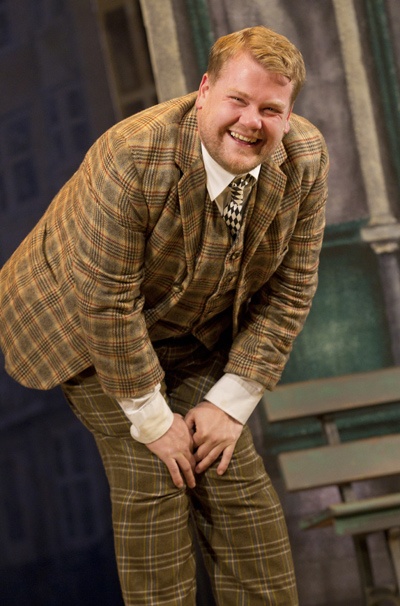

April 29 – One Man, Two Guvnors lives up to all its rave reviews. I really appreciate how skillfully Nicholas Hytner, as artistic director of the National Theatre of Great Britain, makes pockets of theater history spring to life with his big, bustling productions cast with unlikely choices of actors. Richard Bean’s adaptation of Carlo Goldoni’s commedia dell’arte classic The Servant of Two Masters balances vintage shtick with axiomatic absurdity: “Love passes through marriage faster than shit through a small dog.” But the best reason to see the show is the amazing high-wire performance in the leading role by James Corden (above), who sweetly and astonishingly underplays the broadest of comic scenes – very much to my taste. As my friend Liam pointed out, there’s a little too much music by the onstage band, the Craze – they help set the period (early Beatles) but after a while the songs (originals by Grant Olding) start sounding alike.

Performance diary: ONCE again

April 10, 2012

Andy and I loved Once so much when we saw it in previews (on St. Patrick’s Day) that we immediately bought tickets to see it again (on Easter Sunday) with some friends. When we sat down, I was chagrined to find in the Playbill a notice that the male lead, the wonderful Steve Kazee, was out and that Guy would be played by his understudy, Ben Hope. After fuming for a few minutes, I decided to let it be an opportunity to experience something fresh! and possibly wonderful! And Hope was fine — quite a different performance from Kazee’s, and a little shaky out of the gate. Especially in the opening number, “Leave,” he overdid it with the understatement so that key words dropped out of hearing altogether. In his favor, he’s more of a reg’lar-looking Everyman with a nice voice, which suits the story about a street musician trying to give it a go. Ultimately, though, I did miss Kazee’s handsomeness and charisma and the chemistry he and Cristin Miliotti (below) have built up during the time they’ve been doing the show. But I still admired the show every bit as much as I did the first time around.


The curtain call morphed into the annual fundraising pitch for Broadway Cares/Equity Fights AIDS. David Patrick Kelly, who plays the da, stepped forth and gave one of the most eloquent and touching speeches of this kind I’ve encountered. He made it very personal by first calling out the names of four fellow artists “gone too soon” from AIDS (including Reza Abdoh) and asked us to honor them and our own dearly departed with donations to help others struggling with life-threatening illness. Love that David Patrick Kelly — a real mensch.

And then later, the sad news that Steve Kazee had missed the performance to be with his mother as she passed away that day, after a long battle with breast cancer. Condolences to Kazee and his family.

Performance diary: Javanese Wayang Kulit at Asia Society

March 18, 2012
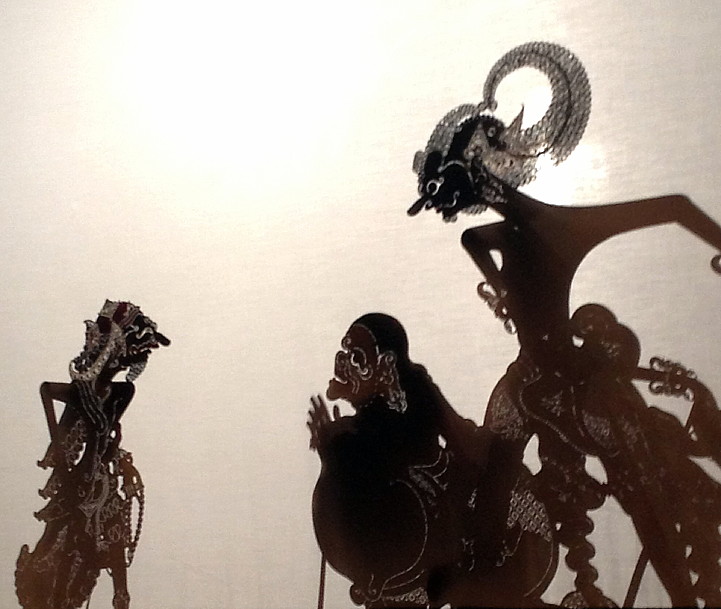
Gamelan Kusuma Laras, the Javanese percussion orchestra that I’m part of, presented a wayang kulit (shadow-puppet play) at Asia Society last Friday night featuring famous dhalang Ki Purbo Asmoro and members of his company Mayangkara (from Solo, Java). Originally I was supposed to perform in the show with the gerongen (chorus), but I had to miss a bunch of rehearsals so at a certain point I realized I wasn’t going to be able to learn the music well enough, so I decided to sit it out. Much as I love playing and have enjoyed being in concerts in the last couple of years, I’m really glad that circumstances were such that I got to sit out front and enjoy the show this time.


For me, it was an opportunity to revisit the experience of falling in love with gamelan the first time I saw a wayang (performed by the Royal Court Gamelan of Yogyakarta at the 1990 Los Angeles Festival). Certainly, for a Westerner, you start out paying close attention to every single thing, trying to “make sense” of the gestures, each puppet, each sound, each word on the screen, each song that is sung… Watching wayang as if it’s a play in the theater and trying to tune out everything else pretty quickly becomes exhausting, confusing, and frustrating. Somehow, slowly, imperceptibly, you give that up, and the whole thing takes over, and you realize that you’ve entered another world, a kind of trance state, where no single element is primary, but hundreds of little tiny elements are adding up to a whole experience. Extraordinary! Then everything becomes completely engrossing and enjoyable, including the movements of people in the audience coming and going, people taking pictures, musicians laughing and joking among themselves (and yes, even making “mistakes”!).


Typically for wayang, Dewa Ruci (Bima’s Spiritual Enlightenment) is based on an episode from the Mahabharata and follows one of the five Pandawa brothers on his quest for perfection in life. He undergoes two big adventures, one in the forest and one in the sea. In between these parts of the tale, there was a comic interlude, which is the part of the show which the dhalang improvises at every performance, tailoring his remarks to current events and the particular audience he’s playing to. In this case, President Obama made a surprise appearance among the various wayang characters (wise men and ogres and mothers and brothers, etc.), and Ki Purbo invited (or should I say commanded?) Kitsie Emerson, who had been sitting at her laptop skillfully providing translations for the English-speaking audience, to play kendhang (the drum that leads the gamelan). Here’s a small, sort of random excerpt from that passage of the performance:

The singer, Yayuk Sri Rahayu, was fantastic. Andy and I watched most of the show from the auditorium, where you could see all the musicians and the dhalang and his puppets as he manipulated them, while off to the side was a video screen showing what the shadows looked like. As is traditional for wayang, the audience was invited to go up onstage and sit behind the screen and watch the show from there, so we sampled that perspective as well. It was hard to read the translations (projected onto a screen over the stage) from there, but the detail of the puppets (carved into thin buffalo hide) was the reward for sitting here.


Good show, gamelanistas!

Performance diary: tUnE-yArDs at American Songbook

February 12, 2012

Every musical education is necessarily idiosyncratic. Watching Merrill Garbus’s ebullient performance at the Allen Room with her band tUnE-yArDs, I had fun tracking the pieces of my own listening history that allowed me to even begin to comprehend her startling, wildly original musical attack. The first time I heard someone use looping to create a rhythm track was in the fall of 1980, when Laurie Anderson started performing “O Superman” (ha-ha-ha-ha-ha-ha) — now any number of solo performers have pedals at their feet and keyboards at their fingertips to conjure a digital orchestra. Garbus has a particularly goofy yet precise way of building tracks using her voice, a tomtom, a snare drum, and a high-hat with a tambourine parked on top of it. The additive principles of her compositions/arrangements remind me a lot of gamelan music, which I first heard at the Los Angeles Festival in 1990 but didn’t really understand until I started playing with a gamelan myself a couple of years ago. And the long-lined polyrhythms churned out by the rest of her band — bassist Nate Brenner and saxophonists Noah Bernstein-Hanley and Matt Nelson — unmistakeably refer to the Afro-beat sounds of Fela Kuti, whose music I heard for years but never really grasped until I saw Bill T. Jones’s dazzling stage musical Fela! That’s a pretty unorthodox lineage for a singer-songwriter, n’est-ce pas? Garbus is pretty ostentatious about her performance-art background and kooky self-presentation — she took to the stage with yellow and black stripes painted on her face and led the audience through mini-workshop exercises in communal toning and “breath of fire” in and amidst performing tracks from her breakthrough album w h o k i l l (especially exhilarating renditions of “Bizness” and “Gangsta”). She’s definitely one of the more eccentric entries in Lincoln Center’s enterprising American Songbook series.

At the end of the show, she invited ticketholders to join her outside in Columbus Circle, where some of her faithful tUnE-yArDs army assisted her in creating a tongue-in-cheek political/spiritual ritual wrapping the statue of Christopher Columbus with yellow-and-black-striped police tape only custom-designed to say “Occupy.”  Fun!

Performance diary: Neil Gaiman, BY THE WAY, MEET VERA STARK, Dessoff Choirs, and GOOD PEOPLE

May 19, 2011

Quick and dirty notes on stuff I saw that I don’t have time to write about in more detail:

April 27 – “Magical Realism: The World of Marvelous Stories with Neil Gaiman” at Symphony Space was Andy’s choice. He’s a huge fan of Gaiman (the deluxe edition of the Sandman series on his bookshelf is testimony to that), whom I know only from seeing the stage and film versions of Coraline, which I enjoyed very much. I’m always impressed by the cool New York actors that show up for these Selected Shorts evening. Tonight it was Marin Ireland, Boyd Gaines, and Josh Hamilton joining Gaiman himself, who is very well-spoken and rock-star hip. The thread through all the stories had to do with stories eating themselves. I especially enjoyed Gaiman’s “The Thing About Cassandra,” performed by Hamilton with a surprise return appearance by Ireland. And the evening was introduced by the legendary Isaiah Sheffer, who does political literary stand-up to match the best of them.

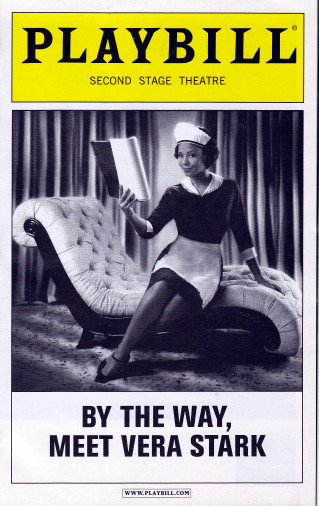
April 30 – went with Misha Berson to a matinee of Lynn Nottage’s By the Way, Meet Vera Stark. It’s essentially an essay about how black women in three different eras were affected by Hollywood’s reflections of their lives. It’s well-performed by a good cast (I especially admired Stephanie J. Block as the pampered Gloria Mitchell, Karen Olivo as super striver Anne Mae, and David Garrison as the late ‘60s TV talk-show smoothie Brad Donovan) and well staged by Jo Bonney (with a terrific black-and-white film by Tony Gerber that opens act 2). The first act is often funny watching the ridiculous and humiliating lengths perfectly intelligent black actresses went through to get cast in stupid demeaning roles as housemaids and eye-rolling slaveys. But I can’t say that Nottage conveys anything especially new on the subject, and the second act traffics in tired trashing of academic jargon about pop culture (too easy a target).  The play is nowhere near as original and impressive as her last three – Intimate Apparel, Fabulation, and Ruined – but those three were pretty damned good, so topping them would be a tough job for any playwright.

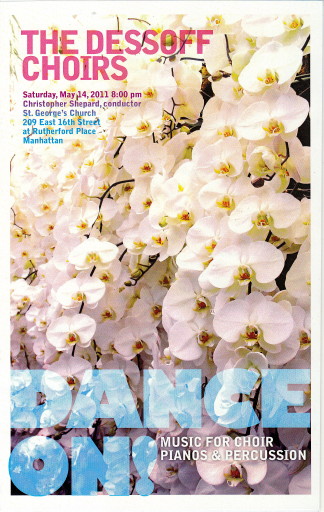
May 14 – The Dessoff Choirs, which Andy sings with, gave their spring concert at St. George’s Church in Stuyvesant Square, a fascinating eclectic program called “Dance On! Music for Pianos and Percussion.” The first half consisted of Leonard Bernstein’s “Chichester Psalms,” selected “Liebeslieder Waltzes” from Brahms, and a long interesting song cycle for double chorus by the contemporary British composer Jonathan Dove called “The Passing of the Year” set to poems by Blake, Tennyson, Emily Dickinson, Thomas Nashe, and George Peele (my favorite, “Hot Sun, Cool Fire”). The second half contained another odd mixture of pieces by Charles Ives, Samuel Barber, Henryk Gorecki (a gorgeous a capella “Tonus Tuus”), David Conte (“Invocation and Dance,” a setting from Leaves of Grass), and a composer new to me named Gwyneth Walker. The acoustics in the church sounded a little muddy at first but overall the singing was exquisite, conducted by Christopher Shepard.

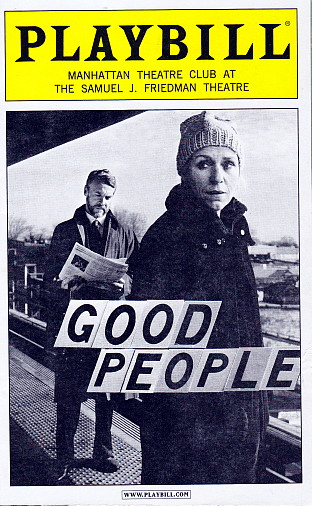
May 17 – I avoided seeing David Linday-Abaire’s Good People for a long time, because I’ve never liked his plays. I don’t always agree with John Lahr’s opinions, but his review in the New Yorker described this one as Playwriting by Numbers, which is one of my pet peeves. But enough people I respect spoke very highly of Good People, so I broke down and actually bought tickets. The play did bug me, but I’ve spent a lot of time thinking about it and trying to figure out why. I know that it bugged me that the play (and/or the production, directed by Daniel Sullivan) seemed to encourage the audience to laugh at and feel superior to the working-class Bostonians portrayed by Frances McDormand, Becky Ann Baker (loved those shaved eyebrows), and Estelle Parsons (loved her costumes by Mr. David Zinn). And the schematic set-up of the second act, which pits McDormand’s tackily dressed Margie (so desperate for a job that she’ll stalk a high-school boyfriend to beg for janitorial work at his office) against the suburban chic of said boyfriend, now a successful doctor with a beautiful young (and black! ooooh!) wife, totally replays God of Carnage’s bogus, self-congratulatory, guilt-trippy drama of class-consciousness. I think what bugged me most was what how thinly drawn the character of the doctor is – we know nothing about what happened to him between high school and Margie’s knocking on his door asking for work, except that he’s kept his (over-broad) Southie accent and married a doctor’s daughter from Georgetown. Meanwhile, we’ve learned a lot of nuanced information about Margie’s life (although the playwright also stacks the deck to make her as put-upon and victim-y as possible). This is lazy, manipulative playwriting. For better and fairer treatment of similar material, look at the plays of Annie Baker (Circle Mirror Transformation, The Aliens). Nevertheless, little scenes stick with me. Except for Tate Donovan, playing the thankless role of Mike, all the actors give terrifically honest performances. I think I was most touched by Patrick Carroll in the smallest role of Stevie, who has to fire Margie from her job at the Dollar Store and takes shit from the peanut gallery because he likes to play bingo.