Archive for the 'In this week's New Yorker' Category

In this week’s New Yorker

November 28, 2010

Trust Alex Ross to turn me on to some fascinating corner of contemporary classical music previously unbenownst to me. Now I know something about Swiss composer Georg Friedrich Hass, whose Third String Quartet, Ross says, “makes such extreme demands on players and audience alike that at one concert in Pasadena listeners were required to sign a waiver absolving the venue of legal responsibility….”

The work is subtitled “In iij. Noct.,” a reference to the Third Nocturn of the old Roman Catholic Tenebrae service for Holy Week, which marked Christ’s sufferings and death with the gradual extinguishing of candles. Haas, who grew up in Tschaugguns, a Catholic village in the Austrian Alps, asks for total darkness during performances of his quartet, the score specifying that even emergency lights should be covered.
In September I saw, or didn’t see, a performance [by the JACK quartet] at the Austrian Cultural Forum, on East Fifty-second Street. When the blackout began, I initially felt a fear such as I’ve never experienced in a concert hall: it was like being sealed in a tomb. No wonder the members of JACK usually try out a brief spell of darkness with each audience, to see if anyone exhibits signs of distress. (Indeed, one young man sheepishly got up and left.) yet the fear subsides whne the music begins. The perfoemrs who are positione din the corners of the room, seem to map the space with tones, like bats using echolocation to navigate a lightless cave. They have memorized the socre in advance, and it is an unusual document: Haas sets out eighteen musical “situations” — with detailed instructions for improvising on pre-set motifs, chords, and string textures — and a corresponding series of “invitations,” whereby the players signal one another that they are ready to proceed from one passage to the next.
Often, the music borders on noise: the strings emit creaks and groans, clickety swarms of pizzicato, shrill high notes, moaning glissandos. At other times, it attains an otherworldly beauty, as the players spin out glowing overtone harmonies. Toward the end comes a string-quartet arrangement of one of Carlo Gesualdo’s Responsories for the Tenebrae service (“I was like an innocent lamb led to the slaughter…”). That music is four hundred years old, and yet, with its disjointed tonal language, it sounded no less strange than the contemporary score that surrounded it. Weirdness is in the ear of the beholder.


In another direction altogether is “Nutty,” Paul Rudnick’s latest bit of comic ephemera — definitely good for a chuckle.

In this week’s New Yorker

November 21, 2010

In the Thanksgiving-related Food Issue, Burkhard Bilger writes a fascinating long article about a culinary trend new to me, fermented foods. I was fascinated to see that the article centers on an old acquaintance of mine from ACT UP and Radical Faeries, Sandy Katz, author of “The Revolution Will Not Be Microwaved.” (Go, Sandy, aka Sanderkraut, aka Sandorfag!). Besides providing a glimpse of life at a pseudonymous Radical Faerie sanctuary in Tennessee, the article definitely speaks to my own sentiments about the silliness of modern-day germ-phobia:

“In the past decade, biologists have embarked on what they call the second human-genome project, aimed at identifying every bacterium associated with people. More than a thousand species have been found so far in our skin, stomach, mouth, guts, and other body parts. of those, only fifty or so are known to harm us, and they have been studied obsessively for more than a century. The rest are mostly new to science…Given how little we know about our inner ecology, carpet-bombing it might not always be the best idea. ‘I would put it very bluntly,’ [UMass Amherst biologist Lynn] Margulis told me. ‘When you advocate your soaps that say they kill all harmful bacteria, you are committing suicide.’ The bacteria in the gut can take up to four years to recover from a round of antibiotics, recent studies have found, and the steady assault of detergents, preservatives, chlorine, and other chemicals also takes its toll. The immune system builds up fewer antibodies in a sterile environment; the deadliest pathogens can grow more resistant to antibiotics; and innocent bystanders such as peanuts or gluten are more likely to provoke allergic reactions. All of which may explain why a number of studies have found that children raised on farms are less susceptible to allergies, asthma, and autoimmune diseases. The cleaner we are, it sometimes seems, the sicker we get.”

Bilger also bravely sits down for lunch with opportunivores, people who eat roadkill and do their grocery shopping by dumpster-diving. Yikes!

In Talk of the Town, Elizabeth Kolbert writes about the scary ignoramuses angling for power in the newly established Republican majority in Congress: “John Shimkus, of Illinois, is one of four members now vying for the chairmanship of the House Committee on Energy and Commerce. At a congressional hearing in 2009, he dismissed the dangers of climate change by quoting Genesis 8:22: ‘As long as the earth endures, seedtime and harvest, cold and heat, summer and winter, day and night will never cease.’ He added, ‘I believe that’s the infallible word of God, and that’s the way it’s going to be for His creation.’ ”

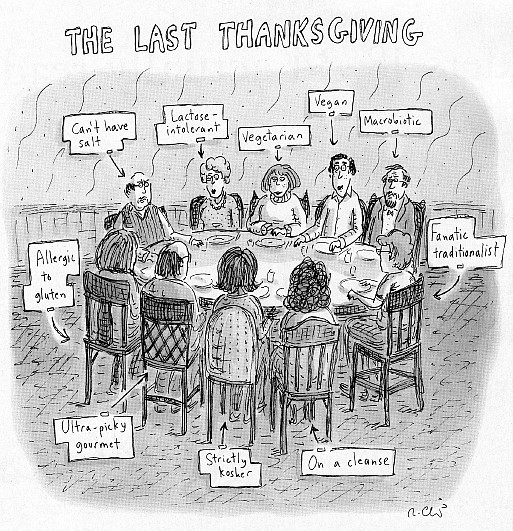
Aside from the fabulous Roz Chast cartoon (above), my favorite thing in this issue is this poem by Clive James:

“Whitman and the Moth”

Van Wyck Brooks tells us Whitman in old age
Sat by a pond in nothing but his hat,
Crowding his final notebooks page by page
With names of trees, birds, bugs, and things like that.

The war could never break him, though he’d seen
Horrors in hospitals to chill the soul.
But now, preserved, the Union had turned mean:
Evangelizing greed was in control.

Good reason to despair, yet grief was purged
By tracing how creation reigned supreme.
A pupa cracked, a butterfly emerged:
America, still unfolding from its dream.

Sometimes he rose and waded in the pond,
Soothing his aching feet in the sweet mud.
A moth he knew, of which he had grown fond,
Perched on his hand as if to draw his blood.

But they were joined by what each couldn’t do,
The meeting point where great art comes to pass —
Whitman, who danced and sang but never flew,
The moth, which had not written “Leaves of Grass,”

Composed a picture of the interchange
Between the mind and all that it transcends
Yet must stay near. No, there was nothing strange
In how he put his hand out to make friends

With such a fragile creature, soft as dust.
Feeling the pond cool as the light grew dim,
He blessed new life, though it had only just
Arrived in time to see the end of him.

In this week’s New Yorker

November 14, 2010

The best thing is this week’s issue is the very first thing: Hendrik Hertzberg’s editorial in Talk of the Town analyzing the results of this year’s midterm election.

As for “the American people” themselves, it seems clear enough that their rejection of the Democrats was, above all, an expression of angry anxiety about the ongoing economic firestorm. Though ignited and fanned by an out-of-control financial industry and its (mostly) conservative political and intellectual enablers, the fire has burned hottest since the 2008 Democratic sweep. By the time the flames reached their height, the arsonists had slunk off, and only the firemen were left for people to take out their ire on. The result is a kind of political cognitive dissonance. Frightened by joblessness, “the American people” rewarded the party that not only opposed the stimulus but also blocked the extension of unemployment benefits. Alarmed by a ballooning national debt, they rewarded the party that not only transformed budget surpluses into budget deficits but also proposes to inflate the debt by hundreds of billions with a permanent tax cut for the least needy two per cent. Frustrated by what they see as inaction, they rewarded the party that not only fought every effort to mitigate the crisis but also forced the watering down of whatever it couldn’t block.

Part of the Democrats’ political problem is that their defense, confusingly, depends on counterfactuals (without the actions they took in the face of fierce Republican opposition, the great slump would have metastasized into a Great Depression), deferred gratification (the health-care law’s benefits do not kick in fully until 2014), and counterintuitive propositions (the same hard times that force ordinary citizens to spend less money oblige the government—whose income, like theirs, is falling—to spend more). Another part of the problem, it must be said, is public ignorance. An illuminating Bloomberg poll, taken the week before the election, found that some two-thirds of likely voters believed that, under Obama and the Democrats, middle-class taxes have gone up, the economy has shrunk, and the billions lent to banks under the Troubled Asset Relief Program are gone, never to be recovered. One might add to that list the public’s apparent conviction that illegal immigration is skyrocketing and that the health-care law will drive the deficit higher. Reality tells a different story. For ninety-five per cent of us, taxes are actually lower, cut by around four hundred dollars a year for individuals and twice that for families. (The stimulus provided other tax cuts for people of modest means, including a break for college tuition.) The economy has been growing, however feebly, for five straight quarters. Most of the TARP loans have been repaid and the rest soon will be, plus a modest profit for the Treasury. And the number of illegal immigrants fell by close to a million last year, thanks in part to more energetic border enforcement. The health-care law, the nonpartisan Congressional Budget Office says, will bring the deficit down.

But why don’t “the American people” know these things? Could it be because the President and his party did not try, or try hard enough, to tell them?

Hmmm…are “the American people” ignorant because the President hasn’t properly educated them? Isn’t it much more likely that they’ve been successfully fear-mongered by Fox News into believing falsehoods and overlooking truths they don’t want to see? Fear creates more biochemical reaction in the body than appeals to calm and rationality do — that’s just survival, and that’s how demagogues and screamers get their way over the steady-speakers. Depressing.

Alec Wilkinson writes terrific profiles of musicians for the New Yorker. This week we read his report on Bettye Lavette, a minor soul singer overlooked for decades who’s had a resurgence of critical acclaim in recent years. I’m not a big fan of her singing, and the article makes her sound quite unpleasant to be around. But I had to chuckle at the frankness of this particular self-assessment: “I really don’t have a lot of talents. I can cook, and I can fuck, and I can sing. And I’m proud of all of them.”

I doubt if I would like Lena Dunham’s feature film debut as writer/director/star, Tiny Furniture, but I enjoyed reading Rebecca Mead’s profile of Dunham and her description of the movie. “In its merciless investigation of its creator’s character flaws, Tiny Furniture resembles Larry David’s Curb Your Enthusiasm mashed up with Whit Stillman’s Metropolitan, or Manhattan if it had been directed by Mariel Hemingway rather than by Woody Allen.”

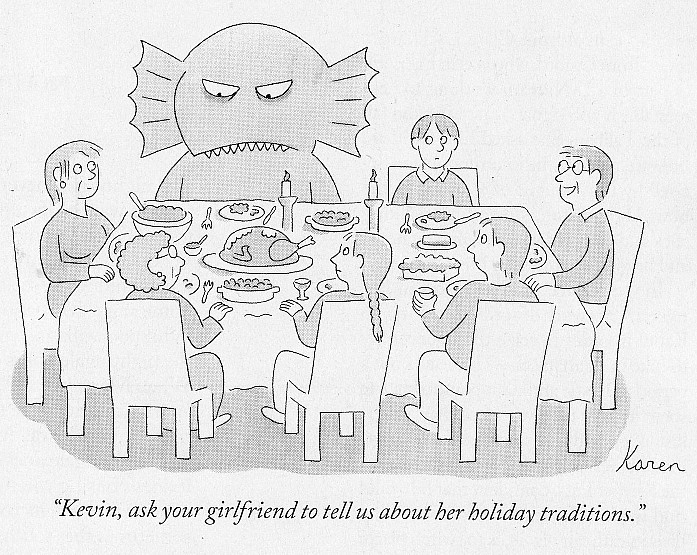
And then there’s this delightful cartoon by Karen Sneider:

In this week’s New Yorker

November 1, 2010

The high points include appreciations of two artists I love, Ntozake Shange and Elvis Costello.

Like me, Hilton Als had a life-changing experience seeing for colored girls who have considered suicide/when the rainbow is enuf on Broadway in 1997, and like me he’s dubious about Tyler Perry’s movie of it that’s opening any day now, starring Janet Jackson and Whoopi Goldberg. He delivers a lovely summation of that work and a quick skim of her subsequent 30 years’ worth of writing, along with some details of her personal life that I didn’t know (a string of suicide attempts, a bipolar diagnosis) and some that I did (sadly, she had a stroke six years ago that has left her seriously disabled).

Nick Paumgarten is also a big Elvis Costello nut and spent quite a bit of time hanging out with him and delivers an intriguingly detailed mid-career check-in.

Also: Roz Chast makes her writing debut this week with not one but two prose pieces — a Talk of the Town memorial tribute to her fellow cartoonist Leo Cullum, who died recently, and a Shouts and Murmurs rant on the ickiness of the banana. On the latter subject, Steve Martin and I respectfully disagree — like me, the other Man from Waco believes that the banana is one of nature’s most ingenious packaging triumphs.

In this week’s New Yorker (and other publications)

October 24, 2010

Here’s what is foremost on my mind politically these days: yes, I am disappointed with President Obama on any number of fronts,  but I’m not willing to let that disappointment turn the 2010 midterm election into a referendum on his presidency by thumbing my nose at him. To do so would be to allow the newly energized far-right to gain more power than would be good for anybody.

I suppose I’m one of those who would like to think that Tea Party candidates like Sharron Angle and Christine O’Donnell and Linda McMahon are wingnuts whom the populace can’t possibly consider worthy of office. I am persuaded by David Barsamian’s interview with Chip
Berlet,
a journalist who has taken as his subject the rise of right-wing populism, that this would be stupid and naive. The Tea Party, Berlet says, “started out as a fake grass-roots movement funded by political elites. We call them ‘Astro-Turf’ movements. Republican and conveservative poltiical operatives were trying to create the impression that there was a groundswell of antagonism toward the Obama agenda. Some of the early activities were very thinly disguised Astro-Turf, but as the media began to pick up on it — especially Fox News — the Tea Party turned into an actual social movement. It escaped the specific economic-libertarian agenda set for it by Dick Armey, the former Republican House leader from Texas whose organization funds a lot of Tea Party events. Other agendas were brought in: anti-immigrant, anti-gay, anti-abortion, even conspiracy theories about the ‘new world order’ and the UN coming in black helicopters…”

Berlet goes on to say, “Sociologist Rory McVeigh did a great study showing how right-wing movements arise in defense of power and privilege. People on the right are fighting to keep something they don’t want to lose. That’s a strong motivator…You don’t build a campaign of prejudice out of thin air. It has to be rooted in the culture. So you start out with a rhetoric of us versus them: We’re good; they’re bad. We’re going to save America; they’re going to destroy it…It’s portraying the political opposition not as people with whom you disagree but as a force of evil with whom there can be no compromise. How can you compromise with Satan? How can you compromise with the people who want to destroy America? What happens in this situation is that people started getting killed.”

The interview ends with Berlet saying, “When you build a major social movement around scapegoating and resentment, things can move quickly in a bad direction…We’re not going to have a Hitler; we’re not going to have storm troopers marching in the streets. What we’re going to have is a Republican Party that moves to the Right and openly embraces racist, xenophobic ideologies, following the anger of the predominantly white Republic middle class. And the Democrats will follow them, or at least not mount a real opposition. There will be more anti-Muslim and antifeminist and antigay rhetoric. There will be more support for foreign intervention. And that’s our future, unless the progressive movement stands up and starts raising hell.”

Meanwhile, in the New Yorker this week there’s a long insightful profile by Nicholas Lehmann of Nevada Senator Harry Reid, the Senate Majority Leader who is one of the main targets that the Tea Party movement (i.e., all the money the Republican party and the oligarchy can come up with) is trying to take down. Reid is anything but a hell-raiser, quite uncharismatic and therefore quite susceptible to media-enflamed attacks by his opponent Sharron Angle. As the New Yorker so often does, Lehmann’s reporting takes us behind the scenes to see exactly how Reid has succeeded as majority leader in helping Obama make any number of legislative gains on the kind of unsexy but overwhelmingly important issues that government is supposed to address but that get undervalued in our crazy media world.

“Obama, with his big congressional majority and keen sense of the fleeting nature of political momentum, decided to be bold in his first two years in office. Although liberal voters are disappointed, the plain truth is that Obama, aided by Nancy Pelosi and Harry Reid, passed much more liberal legislation at the outset of his term than his immediate Democratic predecessors, Bill Clinton and Jimmy Carter…In the partnership between the Obama White House and the Reid Senate, Obama supplied the eloquence and grace and originated the policy ideas. Reid’s role was to get it done. Between Obama’s Inauguration, in January, 2009, and the congressional recess early last month, more consequential liberal legislation passed than at any time since the Great Society: health-care reform, the economic-stimulus package, financial regulation, a big education bill, the rescue of the auto industry, and the second phase of the rescue of the big banks. Others (a large expansion of protected public lands, funding for universal broadband access) didn’t get the attention they normally would have.”

And I was very impressed and grateful to read the story in New York magazine by Jesse Green on Tony Kushner, whose analysis of this political moment I share:

“And the LGBT community, what are they, we, looking for? Yes, we’ve been asked to wait a very long time, asked to eat oceans of shit by the Democratic Party; we’ve been 75 percent loyal for decades without a wobble and without a whole lot of help from these people. And it’s important that somebody keeps screaming; the trick is how do you scream, and who do you scream to? If we’re dissatisfied with these Democrats, let’s get better ones instead of fantasies about mass uprisings that are going to resemble the October Revolution. Yes, it might sometimes feel good to throw the newspaper across the room. There’s much criticism of Obama that’s legitimate. He backs down on things, he waffles, like on the mosque, and you wince. And I consider his decision to appeal the Federal court ruling abolishing DADT to be unethical, tremendously destructive, and potentially politically catastrophic. But is Obama really supposed to say, as the first African-American president, that same-sex marriage is his first priority? Clearly he believes in it; he’s a constitutional scholar. It’s not conceivable to me that he believes that state-sponsored marriage should be unavailable to same-sex couples, even if he has religious scruples. But do I think he should have lost the election for the chance to say he supported same-sex marriage? No. Given that we would have had John McCain and Sarah Palin, I would have said, ‘Say anything you need to.’ So if he’s moving very cautiously, with two wars he’s inherited and a collapsing global economy and the planet coming unglued—Okay!

I continue, in my obsessive way, to appreciate and digest the Broadway show Bloody Bloody Andrew Jackson for the way it cannily captures the proud, delusional self-righteousness of under-informed ideologues — Jon Meacham, whose biography of Jackson won the Pulitzer Prize last year, writes a detailed (and approving) response to the play in today’s New York Times, “Rocking the Vote, in the 1820s and Now.”