Archive for the 'In this week's New Yorker' Category

In this week’s New Yorker

March 26, 2011

For a fashion issue, this week’s New Yorker is remarkably substantial. Of course, the disaster in Japan looms over the issue and our minds. Evan Osnos writes a terrific “Letter from Japan” with on-the-ground reporting of the immediate aftermath of the earthquake and tsunami, noting among other things the notable and very Japanese calm in the face of catastrophe (no looting) as well as the fantastic stories that have rushed into the vacuum of the government’s stingy information about the nuclear crisis. Osnos compares the current tragedy to past earthquake-related disasters in Japan and includes this bit of information new to me: “After the 1923 quake in Kanto, rumors swept Tokyo and Yokohama that Koreans were committing arson and poisoning wells. And so, amid the still smoking ruins of those cities, angry mobs, some including members of the police force and other officials, murdered thousands of Koreans—a massacre that remains a source of shame today.”

A bridge in Nishinomiya, Japan, fourteen miles from Kobe, after an earthquake struck on January 17, 1995

I’m not a huge fan of Karuki Murakami, so I didn’t read his short story “U.F.O. in Kushiro,” but it’s illustrated with amazing pictures taken of the aftermath of the 1995 earthquake in Kobe (above).

Peter Schjeldahl’s review of the inadvertently timely art show at the Japan Society called “Bye Bye Kitty!!!” makes me definitely want to see the show.

Among the fashion stories, I was surprised to find myself riveted by Alexandra Jacobs’s story about Sara Blakely and the invention of Spanx (and its related industry of shape-slimming underwear) and also by Lauren Collins’s extremely well-written and intimate profile of shoe designer Christian Louboutin, he of the red soles. One thing I love about the exceptionally sophisticated coverage of fashion in both the New Yorker and the New York Times these days is the almost inevitable and matter-of-fact way that high-end designers’ homosexuality is acknowledged — something that was just not done even a generation ago.

Malcolm Gladwell contributes an astonishing encapsulation of what sounds like an unusually good book, Ruth Brandon’s “Ugly Beauty,” which is a double biography of two cosmetics magnates, Helena Rubenstein and Eugene Schueller (creator of L’Oreal). Gladwell’s piece, which includes a side visit to the history of Ikea, muses on the interplay of politics and business — it’s a dense good read.
In this week’s New Yorker

March 16, 2011

Quick spin through this week’s issue:

Excellent Talk of the Town piece by David Remnick on how Benjamin Netanyahu is increasing Israel’s isolation.

Paul Tough’s article “The Poverty Clinic” asks “Can a poor upbringing make you sick?” Obviously, yes, don’t need to read that.

Ian Frazier on seals in New York harbor: St. Theresa not interested.

D.T. Max on a chess prodigy: yawn.

Dana Goodyear on two therapists who help movie industry creators with writer’s block by focusing on Jungian shadow work: I’m a therapist, so of course I read this story eagerly.

Ben Marcus’s short story “Rollingwood”: I met Ben at a writers’ colony once and liked him. His work is very strange narratively, and this is no exception — it’s a little tamer than usual but still unsettling.

Peter Schejldahl on Glenn Ligon’s retrospective at the Whitney Museum: very interesting.

Anthony Lane on Battle: Los Angeles and Paul: I always like reading Lane when he writes about dumb movies I’m probably not going to see. Very entertaining.

In this week’s New Yorker…

February 21, 2011


Well, before the new issue arrives, I want to take a moment to comment on the last issue, the double anniversary issue dated February 14 & 21. There are several exceptional pieces, including a hilarious excerpt from Tina Fey’s new book (and the source of this devastating quote: “The definition of ‘crazy’ in show business is a woman who keeps talking even after no one wants to fuck her anymore”) and a story by the ever-edgy Mary Gaitskill called “The Other Place.” But the absolute must-read is Lawrence Wright’s extremely long, extremely interesting, factually fastidious story on the Church of Scientology, triggered by the recent departure from the church of Paul Haggis (above), the Hollywood screenwriter and director who wrote two Academy Award-winning Best Pictures in a row (Crash and Million Dollar Baby). It’s the definitive expose. It doesn’t tell you anything you don’t already know or suspect, realistically or prejudicially. But it gives you all the evidence you need to believe what you already know. I’m willing to believe that people get attached to  Scientology out of a sincere desire to live a better life. But like many religions, this one seems to be run by people with decidedly unspiritual intentions and behaviors. The physical and financial abuses, the lying and hypocrisy and deception — it’s all scrupulously documented. The New Yorker took no chances that Scientology could question a single shred of what they report. At one point, Wright notes: “In late September, [Scientology PR director Tommy] Davis and [his wife Jessica] Feshbach, along with four attorneys representing the church, travelled to Manhattan to meet with me and six staff members of The New Yorker. In response to nearly a thousand queries, the Scientology delegation handed over forty-eight binders of supporting material, stretching nearly seven linear feet.” I’ve never read an article with so many parentheticals saying “So-and-so denies that this is true.” But you come away from the story convinced that Tommy Davis and other Scientology representatives are lying sacks of shit. It’s an awesome piece of journalism, and you can read the entire thing online here.

In this week’s New Yorker, and the week before, and…

February 6, 2011

OK, so I got a little behind digesting my favorite magazine and passing along links. I had a busy January. I’ve been a little cranky about all the snarky commentary about Spiderman — Turn Off the Dark, but I have to say I did find the cover of the January 17 issue pretty funny, and everything Joan Rivers said to Julie Taymor, as reported by Patrick Healy in today’s Arts and Leisure section of the New York Times. A lot of people, including rumblings from the esteemed Times, have been acting like it’s some heinous crime against humanity for STOTD to be playing weeks, even months of previews without getting reviewed. But I don’t get what the BFD is. Theatergoers who bought tickets thinking the show would be finished and have been reviewed already can always ask for their money back. Meanwhile, because of all the publicity, anybody who sees the show nowadays has tremendous bragging rights, especially if the show has to stop to fix some technical glitch or if somebody gets hurt. (Dancers get hurt every day of the week, but nobody ever gets self-righteous about how dangerous New York City Ballet is for its performers.) Maybe the show is crappy. But I’d rather wait til the artists making it say it’s done before judging it. Then the gloves are off.

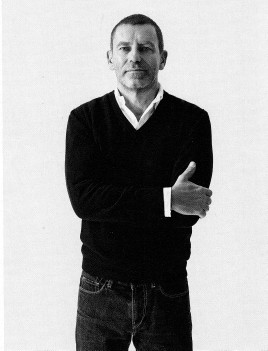
Going back a few weeks: the New Yorker has been providing great fodder for all kinds of geeks and obsessives lately. Daniel Mendelsohn’s story on the Vatican Library gives bibliophiles and scholars a satisfying peek at that inner sanctum. I’ve never heard of the designer Tomas Maier but enjoyed reading John Colapinto’s profile of this hunky guy. I just noticed that the striking photo that ran with the story is by famed painter/artist Robert Longo. (I’m also struck by how thorough matter-of-fact both the New Yorker and the Times are these days in writing about subjects who are gay and their domestic partnerships.) In the same issue, Jeffrey Toobin wrote a thorough and sad story about a young prosecutor whose participation in the case against Alaska congressman Ted Stevens ended tragically. And David Denby wrote a lively piece about Joan Crawford.

The following week, another juicy issue with Mike Peed’s fascinating reported article on bananas, how they’re bred, and the disease that is threatening the world supply of this beloved fruit (well, beloved by me and everyone else except Roz Chast), Ian Buruma on how Belgium threatens to implode, Evan Osnos on psychoanalysis in China, and Joan Acocella — hilarious as ever — on the strange saga of best-selling mediocre author Stieg Larsson, who died before even his first novel came out.

Last week forced me again to spend several hours reading absorbing articles on subjects I didn’t know interested me: the evolution of theories about preventing food allergies in children (by Jerome Groopman), the science of crowd control (John Seabrook, who details the weird and distressing story of how a 6’5″, 485-pound stockroom employee was trampled to death at a Wal-Mart on Long Island on Black Friday, 2008), and the monster-making imagination of Guillermo del Toro, director of Pan’s Labyrinth and other arty horror films (profiled by Daniel Zalewski, whose article provides the only glimpse we will ever see of what would have been del Toro’s take on Tolkein’s The Hobbit). And then there’s Joan Acocella again, writing another hilarious and trenchant essay about another excellent, underappreciated writer and one of my faves, J. R. Ackerley — note again the astonishing bounty of details about his (rather pitiful) homo sex life.

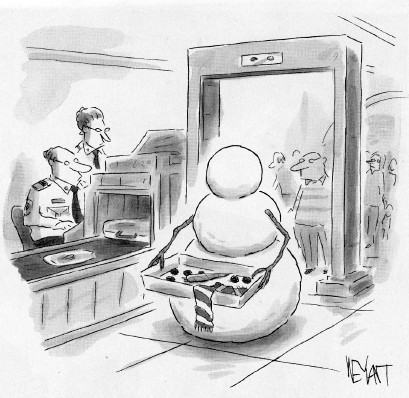
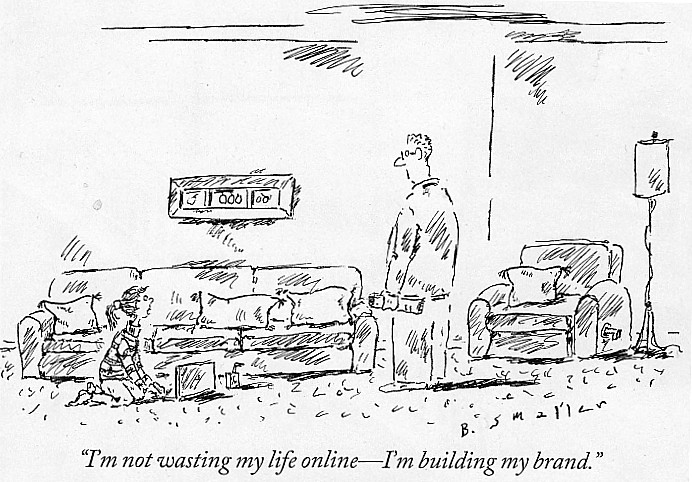
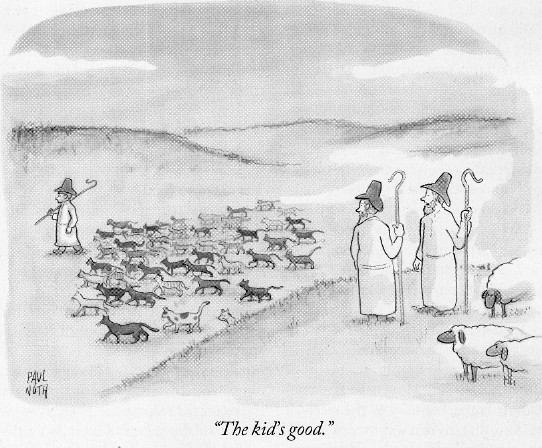
Plus, the cartoons.

and

In this week’s New Yorker…

November 30, 2010

Aside from the cheeky and up-to-the-minute cover image by Barry Blitt (above), I was most intrigued with Kelefa Sanneh’s Critic-at-Large essay, ostensibly a review of Jay-Z’s book Decoded, which betrayed an extreme familiarity with every scrap and tittle of Jay-Z’s music and discusses it with the detailed obsessiveness that Stephen Sondheim fans apply to every new item from the master. And then Sanneh goes on to review Sondheim’s memoir Finishing the Hat. A rare cultural critic whose sphere of reference spans hip-hop and Sondheim, innit? Go, Kelefa!

Speaking of cross-cultural stretch and the New Yorker, I was intrigued to read in New York magazine that the New Yorker‘s rapacious pop music critic Sasha Frere-Jones has been hired as culture editor of The Daily, Rupert Murdoch’s new iPad-aimed digital newspaper.

What else? I was also fascinated to read Gay Talese’s almost breathlessly starstruck account of traveling with the young opera star Marina Poplavskaya, currently appearing at the Metropolitan Opera in Don Carlo. She sounds like a terrific singer — can’t wait to hear her in person.