Archive for the 'In this week's New Yorker' Category

In this week’s New Yorker

September 24, 2011

This week’s Style Issue is one of those exceptional issues, stuffed with goodies, that reminds me why I revere this magazine. The writing is so excellent that the magazine frequently serves as a writing manual. This issue alone has five exemplary non-fiction reporting stories that are marvels of fine prose that I would hand out to students if I were teaching a writing class.

Take, for instance, the lead of David Owen’s “Survival of the Fitted”: “On my first day in Colombia, two women in an old Toyota drove me to an industrial park on the outskirts of Bogota. There, in a building that from the outside looked like a warehouse, the man I’d come to interview — early forties, black hair, not tall — shot me in the abdomen with a .38-calibre revolver.”  The story is about bulletproof couture, and it’s vintage David Owen, who has made a name for himself by focusing on fascinating and unpredictable array of little-scrutinized pockets of contemporary culture. His writing style is both crisply journalistic and full of facts but also endearingly droll. For instance, he discusses cultural differences in armored clothing, which cultures have to deal with knife attacks more than gun attacks, and casually mentions that “Most ammunition used by soldiers…goes right through the kinds of bulletproof material that are worn by cops and recording artists.”

I’d never heard of Daphne Guinness and wouldn’t have thought I would be interested in reading about an eccentric aristocratic fashionista, but Rebecca Mead is such a good writer that I never lost interest in reading her engrossing story about this creature who clomps through the world in crazy designer shoes without heels, who was a close friend and customer of the late Alexander McQueen, and whose grandmother was Diana Mitford. Mitford, Mead reminds readers, married Sir Oswald Mosley, the founder of the British Union of Fascists, at the home of Joseph Goebbels. Among the wedding guests was Adolf Hitler, with whom Diana’s sister Unity was very close. Mead reports: “When [World War II] broke out, Diana spent three years in London’s Holloway prison. ‘She told me she read a lot of Racine,’ Guinness said. Meanwhile, when Britain declared war on Germany, Unity Mitford short herself in the head. ‘Why didn’t Unity shoot Hitler instead of herself?’ Guinness said. ‘Then we’d be descended from heroes instead of villains.’ ”


Whenever this annual issue rolls around, I always think to myself, “I don’t care about fashion,” and I don’t really. But again I could not resist reading every word of Susan Orlean’s profile of Jean Paul Gaultier (above). Among the exotic creatures we meet in this story are Donna and Meghan Spears, who own a designer boutique called Consortium, in Oklahoma City, and Gaultier is the best-selling designer in the store. “I admitted to the Spearses that I wouldn’t have guessed that Gaultier had many fans in Oklahoma, but Donna said, ‘Oklahoma City is much more progressive than people think. In our target market, everyone has more than one home, more than one airplane. In the past, everyone went to Dallas or Aspen or La Jolla to shop. Now they come to us. At the end of the season, we never have any Gaultier left.’ ” Plus — and I guess this is a generational thing — I never get tired of noticing how matter-of-factly fashion writers for the New Yorker and the New York Times (most of them women) write about the personal lives of famous designers (most of them gay men). There was a time when gay private lives were just never mentioned in the pages of these magazines. Just saying.

There are also two emotionally affecting gay life stories mentioned in passing in Peter Hessler’s terrific article “Dr. Don,” which focuses on a small-town pharmacist in a hippie-dippie utopian enclave in southwestern Colorado, a world I would never have imagined or known about before reading this story.

Anytime Janet Malcolm writes something for the New Yorker, you know that inevitably she will find some way of referencing some awkward complicated relationship between the journalist and her subject, and that does indeed show up halfway through her profile/essay about German photographer Thomas Struth, whose portrait of the Queen of England and the Duke of Edinburgh she dissects meticulously. I also learned from her the typically German compound expression Vergangenheitsbewältigung, which means “comes to terms with the past.”

Hilton Als has been thinking a lot about Stephen Sondheim recently. His Critic-at-Large piece about Diane Paulus’s new production of Porgy and Bess carefully and thoughtfully rebuts Sondheim’s now-famous letter disparaging the remarks Paulus and playwright Suzan-Lori Parks made about the Gershwin opera in a New York Times Arts & Leisure story several weeks ago. Perhaps not surprisingly, he sides with Paulus and Parks in their revisionist take on Porgy and Bess and ever-so-gently trashes Sondheim for championing DuBose Heyward. That doesn’t stop Als from also writing a beautifully considered review of the current Broadway revival of Follies.

I also liked Jenny Diski’s piece on the history of shoplifting and Anthony Lane’s review of Drive. And, of course, there’s always Roz Chast:

In last week’s New Yorker….

September 12, 2011

Last week’s New Yorker, like all other magazines on the newsstand, devoted itself almost entirely to the manufactured media event known as “the 10th anniversary of 9/11.” No one needed this whoop-de-do, and many of us seethed all week long with a barely suppressed, barely understood sense of rage about being coerced into this Orwellian ritual of remembrance of SOMETHING NOBODY HAS FORGOTTEN.

The streets were full of policemen and firemen from all over the country, who seem to have taken this day on the calendar as a national holiday commemorating those brave public servants who risk their lives every day and occasionally lose them. They deserve their honor. The families of people who died are completely justified in mourning and remembering however they see fit. I’m certain that I’m not alone, though, in feeling a deeply sinister force afoot in the energy around the 9/11 industry, a force that sacralizes the names of the people who died in the attacks that day and obsessively replays the details of the event…as if nothing of consequence has happened since then. This particular event over the weekend registered for me not as sorrow but as outrage.

You want me to remember? By all means! I remember the unnecessary wars that were launched in reaction to 9/11, the hundreds of thousands of military and civilians from many nations who have died in those ill-conceived, ill-managed wars, the obscene amount of money both spent and wasted in those wars, how the US Treasury (riding on a historic surplus at the end of Bill Clinton’s presidency) got virtually emptied into the pockets of the war-profiteer friends of Dick Cheney — AND NONE OF THEM HAS BEEN HELD ACCOUNTABLE for any of this, least of all the one man who is personally responsible for the state this country, its raggedy-ass politics, and its economy on the brink of collapse, namely George W. Bush.

I think the smartest and most cogent article I read all week was George Packer’s essay “Coming Apart,” subtitled “After 9/11 transfixed America, the country’s problems were left to rot.” Here’s a key passage:

“No one appeared more surprised on September 11th, more caught off guard, than President Bush. The look of startled fear on his face neither reflected nor inspired the quiet strength and resolve that he kept asserting as the country’s response. In reaction to his own unreadiness, Bush immediately overreached for an answer. In his memoir Decision Points, Bush describes his thinking as he absorbed the news in the Presidential limousine, on Route 41 in Florida: ‘The first plane could have been an accident. The second was definitely an attack. The third was a declaration fo war.’ In the President’s mind, 9/11 was elevated to an act of war by the number of planes. Later that day, at Offutt Air Force Base, in Nebraska, he further refined his interpretation, telling his National Security Council by videoconference, ‘We are at war against terror.’

“Those were fateful words. Defining the enemy by its tactic was a strange conceptual diversion that immediately made the focus too narrow (what about the ideology behind the terror?) and too broad (were we at war with all terrorists and their supporters everywhere?). The President could have said, ‘We are at war against Al Qaeda,’ but he didn’t. Instead, he escalated his rhetoric, in an attempt to overpower any ambiguities. Freedom was at war with fear, he told the country, and he would not rest until the final victory…His entire sense of the job came to depend on being a war President.

“What were the American people to do in this vast new war? In his address to Congress on September 20, 2001 — the speech that gave his most eloquent account of the meaning of September 11th — the President told Americans to live their lives, hug their children, uphold their values, participate in the economy, and pray for the victims. These quiet continuities were supposed to be reassuring, but instead they revealed the unreality that lay beneath his call to arms. Wasn’t there anything else? Should Americans enlist in the armed forces, join the foreign service, pay more taxes, do volunteer work, study foreign languages, travel to Muslim countries? No — just go on using their credit cards…Never was the mismatch between the idea of the war and the war itself more apparent. Everything had changed, Bush announced, but not to worry — nothing would change.”

In this week’s New Yorker

September 3, 2011


After reading most of this week’s issue on my iPad, it finally showed up in my mailbox. But I’m glad it worked out that way because otherwise I wouldn’t have seen the coolest thing: the video that accompanies Ian Frazier’s piece about Theo Jansen’s mind-blowing wind-powered kinetic sculptures (he calls them Strandbeests), which I guess you can’t see unless you’re a subscriber. But you can see a bunch of other videos on YouTube, including this BMW commercial. (He’s also done a TED talk.) Very cool.

Then there’s the ever-droll Rebecca Mead’s profile of Timothy Ferriss, author of best-selling self-help books, most recently The Four-Hour Body. “The book, which is five hundred and forty-eight pages long, contains a lot of colorfully odd advice—he recommends increasing abdominal definition with an exercise he calls ‘cat vomiting’—but it also reassures readers that they need not go so far as to have Israeli stem-cell factor injected into the cervical spine, as Ferriss did in the name of inquiry. Nor need they necessarily incorporate into their regimen Ferriss’s method for determining the effectiveness of controlled binge eating: weighing his feces to find out exactly what kind of shit he was full of.”

I’m not sure why, but I read all of Larissa MacFarquhar’s piece on an Oxford philosopher named Derek Parfit and also Tad Friend’s heart-sinking report on how the town of Costa Mesa, California, has gone broke and alienated its working people. Like the best (read: most depressing) documentary films, Friend’s story gives you a new person to hate, a Costa Mesa city council member named Jim Righeimer.

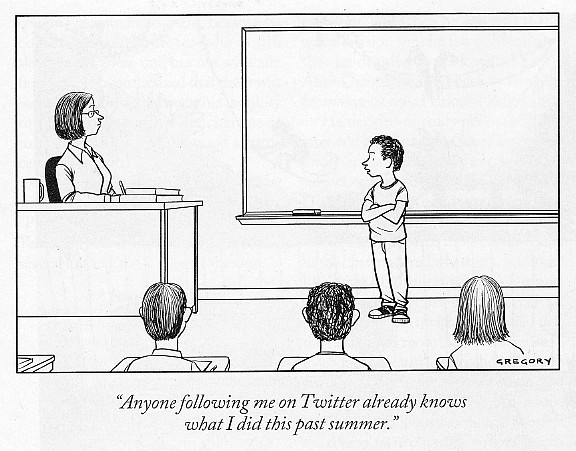
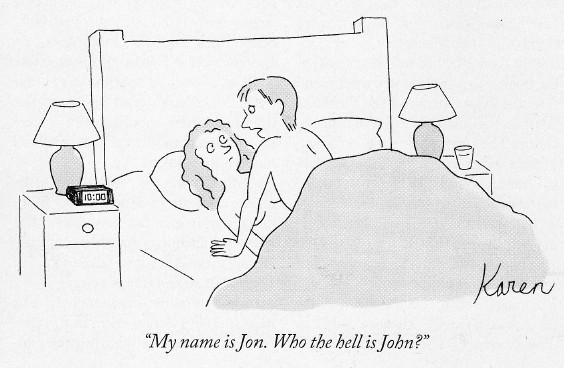
And then of course, as ever, the cartoons. Thank you, Alex Gregory (above) and Karen Sneider (below) .

In this week’s New Yorker

September 1, 2011

…there may be some good stuff, but I haven’t read it yet because it hasn’t arrived in my mailbox. (Hey! Irene ate my New Yorker!) I can read it on my iPad but somehow it’s not the same. Plus there’s a long takeout on Ry Cooder by Alec Wilkinson that’s ONLY available on the magazine’s website. I’m like Wilkinson: Cooder is a huge culture hero of mine (and was the first famous musician I ever interviewed, as an extremely callow college sophomore in Houston, at the time of his Paradise and Lunch album).

But instead of talking about The New Yorker, I want to give a shout out to New York magazine for this week’s 9/11 issue. I didn’t think anyone could come up with anything about 9/11 that a) hasn’t been done before and/or b) that I would want to read. But leave it to Adam Moss to come up with an ingenious concept, “The Encyclopedia of 9/11,” which manages to encompass some pockets of curiosity that managed to intrigue me and lure me into reading stuff I never would have otherwise. (Some entries that stand out: The Fake Widow, how Saturday Night Live handled that week, the weird story of Sneha Anne Philip.) It’s impressive journalism without straying too far into cheesy or cheap sentiment. I’ve known Adam since we were both kids (he edited my profiles of Phoebe Snow and Wally Shawn back when he was a junior editor at Esquire, and he hired me as arts editor for 7 Days), and I continue to admire his editorial restlessness, creativity, fearlessness, and insistence on quality.

In this week’s New Yorker

August 23, 2011

clever cover by Istvan Banyai

I read Wendell Steavenson’s absorbing report of street protests in Syria, admirably persistent in the face of a regime that seems to think dissent can be permanently stifled. “The demonstrations are so fleeting that they are nicknamed ‘flying protests.’ Activists have tried to confound the authorities by singing the national anthem or throwing roses into the fountain in Marjeh Square. They have tied messages of defiance to balloons, and tucked them inside packages of dates given out at mosques, and taped them to Ping-Pong balls thrown into the street from high buildings. In one ingenious scheme, they wrote ‘freedom’ on banknotes, but then banks refused to take notes with any markings on them. One day during my visit, dozens of people simply wore white and walked around a block in an upscale neighborhood. Several were arrested.”

I love Susan Orlean, but I skipped her piece on Rin Tin Tin — not interesting subject to me. I read every word of Jeffrey Toobin’s piece on Supreme Court Justice Clarence Thomas and his wife Ginni, who is one of the Tea Party’s most prominent champions and funders. The most astonishing passage:

By the fall of last year, Ginni Thomas’s activities had become so public that she began to draw journalistic scrutiny. On Saturday, October 9th, the Times ran a front-page story headlined “ACTIVISM OF THOMAS’S WIFE COULD RAISE JUDICIAL ISSUES,” which was a straightforward account of Ginni’s political activities. Still, the story may have unnerved its subject, because at seven-thirty-one that morning Ginni Thomas left a voice mail for Anita Hill, at her office at Brandeis University, where she teaches. “Anita Hill, it’s Ginni Thomas. I just wanted to reach across the airwaves and the years and ask you to consider something. I would love you to consider an apology sometime and some full explanation of why you did what you did with my husband.” She went on to urge Hill to “pray about this,” and then signed off, “O.K., have a good day!”

Sasha Frere-Jones’ piece on Ishmael Butler told me everything I wanted and needed to know about Shabazz Palaces and mainly inspired me to go back and listen to the complete Digable Planets on Rhapsody. Daniel Mendelsohn’s piece on Rimbaud interested me, especially this quote from one of the young poet’s letters: “The first study of the man who wishes to be a poet is complete knowledge of himself. He searches his mind, inspects it, tries out and learns to use it.”