Archive for the 'In this week's New Yorker' Category

In this week’s New Yorker

January 28, 2012


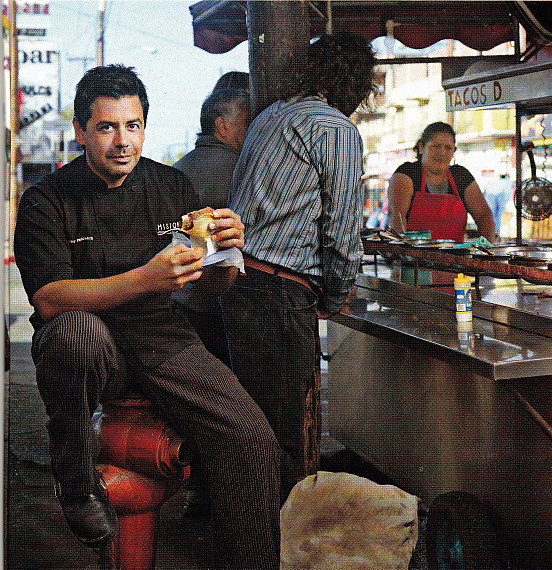
My favorite thing about this week’s New Yorker was learning, from “The Missionary,” Dana Goodyear’s article about Mexican chef Javier Plascencia, above), the origin of Caesar salad:

“Caesar Cardini, an Italian restaurateur with places in Sacramento and San Diego, moved his operation to Tijuana in the early nineteen-twenties. He opened Caesar’s, a bistro with a long wooden bar and a black-and-white checkered floor, on Avenida Revolucion — once known as the most visited street in the world — where American couples went for margaritas, sombreros, and a quickie divorce.

“The first successful culinary export from Tijuana was the Caesar salad: hearts of romaine tossed tableside with coddled egg, oil, Parmesan, lemon, and crushed garlic, and designed to be eaten with the fingers, like asparagus. According to Julia Child, one of her first restaurant memories was of visiting Caesar’s with her parents around 1925. ‘My parents, of course, ordered the salad,’ she wrote. ‘Caesar himself rolled the big cart up to the table, tossed the romaine in a great wooden bowl.’ She went on, ‘It was a sensation of a salad from coast to coast, and there were even rumblings of its success in Europe….Before then, too, salads were considered rather exotic, definitely foreign, probably Bolshevist, and, anyway, food only for sissies.’ In 1953, a French epicurean society declared the Caesar ‘the greatest recipe to originate from the Americas in fifty years.’ “

In this week’s New Yorker

January 22, 2012

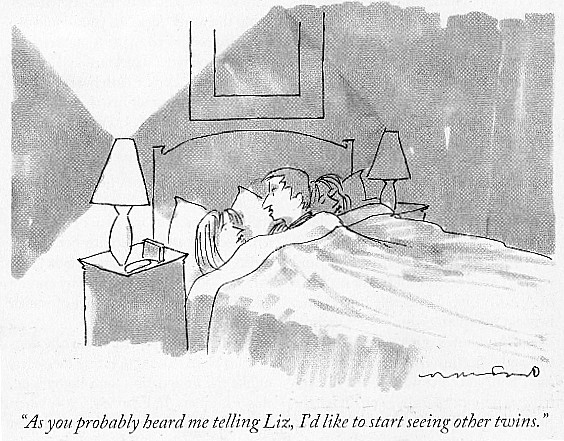
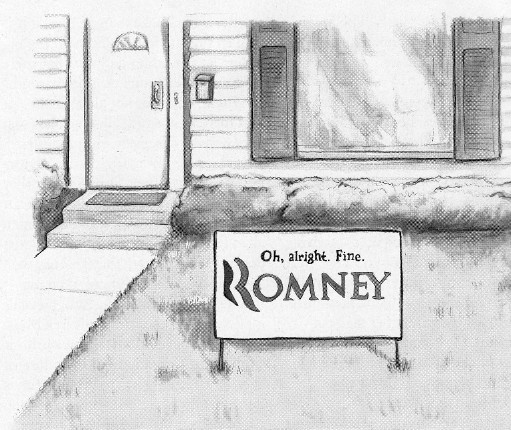
Another stellar batch of cartoons!


Along with fine reporting by Ariel Levy on Callista Gingrich, Steve Coll on “Looking for Mullah Omar,” and William Finnegan, who traveled to Madagascar with club and restaurant superstar Eric Goode to observe his passion for saving rare breeds of tortoise. The latter piece is a real vocabulary expander; I picked up “chelonian,” “gular scute,” and “opuntia cactus.” Lots of astonishing tortoise lore: “Chelonians actually predate many dinosaurs. They have been lumbering around for more than two hundred million years, and have changed very little in all that time. Nobody knows how long individual plowshares live. Captain James Cook took away a radiated tortoise, the plowshare’s closest relative, and gave it to the King of Tonga, in 1777. It died in 1966.” And the next time there’s a lull in conversation over dinner, try telling your guests “Endoscopic turtle sexing will not become common practice in Madagascar any time soon.”

Poet Donald Hall contributes a poignant Personal History essay on aging, “Out the Window,” and Anthony Lane applies his characteristically droll erudition to reviewing Ralph Fiennes’ film adaptation of Shakespeare’s Coriolanus: “The movie unfolds in a modern setting, and in modern dress. This will obviously be disappointing to any Gerard Butler fans who hoped to see their man reprise his majestic outfit from 300, which consisted of helmet, cloak, and pull-up Spartan diaper.” And whichever poetry editor has been slipping lyrics by pop songwriters such as Joni Mitchell and Paul Simon into the magazine has now added to the list Leonard Cohen. As usual, the lyric doesn’t fly so well on the page, but on the website you can scroll down and hear the track “Going Home” from Cohen’s forthcoming album, Old Ideas, hotly anticipated by me.

In last week’s New Yorker

January 18, 2012

I’m not a huge shopper and can’t imagine reading a magazine like Lucky, but I enjoy reading Patricia Marx’s special brand of shopping dispatches for the New Yorker. Last week she concentrated her laser-beam observational skills on NYC supermarkets. Of my very favorite, Fairway, she had this to say: “The main store, at Broadway and Seventy-Fourth Street, can be an anxiety-filled combat zone. Are you tough enough to venture into the crowd and do battle with the strollers, the walkers, the killer shopping carts, and the line-cutting, salt-phobic, food-sample-noshing regulars, each of whom has more neuroses than you’ll find in the waiting room of the average West End Avenue shrink? No wonder the management hired a woman last year whose job is simply to roam the store, being nice to customers.”  And at Dean & DeLuca in Soho: “As for the chocolates, delicate hand-carved and painted pieces of sculpture: in the words of one friend, never eat anything prettier than you are.”

In his review of Jodi Kantor’s book on the Obamas, David Remnick gives it more credence than I would have imagined, plucking out numerous good quotes” “Obama was elected to lead ‘a rational, postracial, moderate country that is looking for sensible progress,’ a White House official tells Kantor. ‘Except, oops, it’s an enraged, moralistic, harsh, desperate country. It’s a disconnect he can’t bridge.”

Then there’s the hilarious Talk of the Town piece by Andrew Marantz in which some Brooklyn Republicans watching the results of the Iowa caucuses discover by Googling the way Rick Santorum’s name has been repurposed, under the instigation of columnist Dan Savage. It’s weird that Marantz describes the definition of santorum as “unprintable,” given the various verbal barriers that the once-staid New Yorker has leapt over in recent years, but whatever. (Google it yourself and see.) But I love that Marantz contacted Savage himself for a response. Asked by e-mail if he felt he had helped make history, Dan Savage wrote back: “No, I’ve made mischief.”

And it’s an issue with a high ratio of especially good cartoons, too.

In last week’s New Yorker

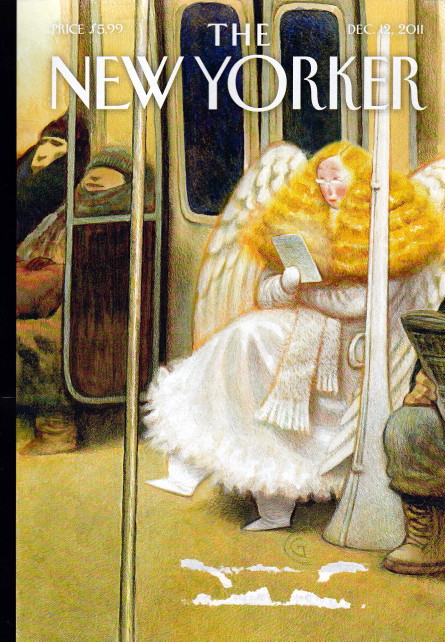
December 12, 2011


Last week was a big one for brutal news stories. I was haunted all week by three in particular:

1) Family Guy screenwriter Patrick Meighan wrote a lengthy account of the reprehensible treatment of Occupy Los Angeles protestors by the LAPD. Meighan, who was cuffed with his hands behind his back and thrown face-first to the pavement before being made to kneel for seven hours in a parking garage, contrasts his treatment with that of Citigroup CEO Charles Prince, who after defrauding investors received $53 million in salary and an additional $94 million in stock holdings. Read the whole story here.

2) In New York Matthew Shaer wrote a detailed heart-sickeningly reconstruction of the abduction and murder of 10-year-old Leiby Kretzky by a mentally deficient member of his own Orthodox community in Borough Park. Ugh. It’s online here.

3) And in The New Yorker, Mattathias Schwartz contributed a long report on the massacre of citizens in Kingston, Jamaica, as part of a sweep to nab Christopher (Dudus) Coke, drug trafficker and community “don.”

Philip Gourevitch’s fascinating, informative “Letter from Paris” about French president Nicolas Sarkozy is another major downer. The only thing worse about Sarkozy’s decline from exciting and inspiring campaigner to corrupt politician is the scary rise of Marine Le Pen and the National Front.

And yet: the same week, Secretary of State Hillary Clinton gave an astonishing and eloquent speech to a United Nations gathering in Geneva specifically focused on the importance of including LGBT populations in human rights watch campaigns. She was clearly speaking to many countries with terrible records of harassing and ostracizing gay people, and the response in the room was apparently not so warm. But she spoke the truth, and no one can say they didn’t hear it. You can read the transcript here. The video also widely available online.

President Obama also gave a compelling and sensible address in Kansas giving a lot of clear history and good thinking about the economic crisis, who’s responsible, who’s working to fix it, and who’s intent on jamming up the works. If only he were as good at getting out front with his executive powers as he is with his speaking and teaching…… You can read the text here and also easily find it online if you prefer to watch it.

In this week’s New Yorker

December 4, 2011


A lot of terrific stuff in this issue, starting with the cover by the great comic-book artist Daniel Clowes, “Black Friday” — notice the amount of shelf space in the “bookstore” available for actual books…. The ever-excellent George Packer contributes a closely reported piece focusing on a representative Occupy Wall Street regular (“All the Angry People”). Calvin Tomkins, one of my all-time heroes as an arts journalist, profiles Carl Andre, a once-prominent visual artist whose work most American art followers haven’t kept up with largely because of the mystery surrounding the death in 1985 of his wife, Cuban-born artist Ana Mendieta. Andre was charged with her murder and acquitted, but many people harbor the belief that he was to blame. Tomkins, as usual, provides a clear-eyed 360-degree portrait of this artist.

I learned more about contemporary politics and economics from Nicholas Lemann’s Reporter at Large story on Brazil than I have from any other political reporting I’ve read this year. It is ostensibly a profile of Brazil’s current president, Dilma Rousseff, the incredibly smart protege who was hand-picked as successor by the hugely popular former president Luis Inacio Lula da Silva, known as Lula. Rousseff, raised in an affluent family, was radicalized in reaction to the 1964 coup that established Brazil’s military dictatorship. She and her former husband, Lemann writes, “are said to have planned the single most financially successful operation of the militant resistance: the 1969 theft of two and a half million dollars from a safe in the home of the mistress of a former governor of Sao Paolo. In early 1970, the military finally caught up with her. She spent three years in prison, where she was reportedly subjected to extensive torture with paddles, electric cattle prods, and other devices.” And now she’s President!

Lemann’s piece serves more generally as a survey of Brazil’s journey from being a low-functioning democracy with an enormous poverty-level population to a country that become a world economic power while increasing political freedom and income equality. Lemann spends some time with Fernando Henrique Cardoso, the two-term president who succeeded in turning the economy around. “Cardoso has spent his life analyzing Brazilian society. He has an ability, rare in a politician, to pull back emotionally from the field of play. In his memoirs, he says that he first discovered that poverty existed, as a child growing up in an overwhelmingly poor country, by reading John Steinbeck’s ‘The Grapes of Wrath.’ But distance isn’t the same as dispassion. Another anecdote has George W. Bush, in one of their talks, asking him, ‘Do you have blacks in Brazil?’ Cardoso was shocked. About half of Brazil’s population is made up of people of African descent.”

I was impressed with this unflinching observation about American politics from Governor Sergio Cabral, who may be a future president of Brazil: “The Republican opposition is different from the opposition here. I think the anger against a black man as President should not be enough to put the country in trouble. They disrespect Obama because of his race. It’s not just bad for Obama — it’s bad for the country. In Brazil, the opposition tried tricks against Lula, but the people made solidarity with Lula. The worker, the black man, the workingman, the woman. The world is changing. Thanks God.” But I was most impressed with Lemann’s fascinating conversation with Lula, a straight-talking man of the people. I wish I could provide a link to the whole article, but it’s worth buying the issue or, if you’re a subscriber, not skipping over it but sitting down with this article for 45 minutes.

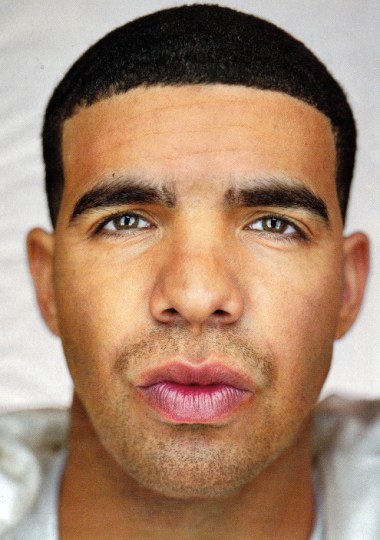
Elsewhere in the issue: I don’t get fantasy fiction, but I get the truth of what Adam Gopnik says in his long essay about the genre. “Of all the unexpected things in contemporary literature, this is among the oddest: that kids have an inordinate appetite for very long, very tricky, very strange books about places that don’t exist, fights that never happened, all set against the sort of medieval background that Mark Twain thought he had discredited with A Connecticut Yankee in King Arthur’s Court.” I also don’t really get hip-hop’s new superstar, Drake, whose chorus of praisers is joined by Sasha Frere-Jones, but he sure is handsome.