Archive for the 'In this week's New Yorker' Category

In this week’s New Yorker

June 19, 2012


Top stories this week for me start with Ezra Klein’s “Unpopular Mandate,” which traces all the ways that former Republican legislative policies have gotten demonized and trashed as soon as bipartisan support for them showed up, thereby making it entirely likely that Obama’s Affordable Health Care legislation will be reversed by the Supreme Court. Pretty sickening.

I have almost no interest in television or Hollywood movies, yet I often find myself reading every word of New Yorker profiles, such as Tad Friend’s long story about Ben Stiller (or last week’s long report on Seth McFarlane, creator of Family Guy). It shocks me that Stiller is seen as the world’s biggest comedic movie stars simply because he has acted in three billion-dollar “franchises” (movies and their sequels). Madagascar? Night at the Museum? Meet the Parents? This is what sells? Okay….

Among the reviews, James Wood writes about an intriguing young Canadian writer named Sheila Heti and Jill Lepore digests some choice chaotic biographical details David Maraniss unearthed in his book on Barack Obama.  Sasha Frere-Jones makes new albums by Norah Jones and Fiona Apple sound mouth-watering. Plus, you know, Gayle Kabaker’s sweet cover illustration (see above).

Before the moment passes, I want to tag as recommended reading the always-scrupulous Jane Mayer’s terrific “Letter from Tupelo” about Bryan Fischer, a raving lunatic radio preacher from Mississippi who represents the kind of crackpots that Mitt Romney Republicans cater to these days. Fischer was the one whose homophobic railings about Romney hiring an openly gay press secretary, driven by insane 1950s stereotypes about homosexual blackmail, hounded the guy out of his job. One more creep to keep an eye on this electoral season. It will be full-time work to keep calling a creep a creep as the money of the Koch Brothers continues to steamroll the American public with lies and propaganda.
In this week’s New Yorker

June 6, 2012


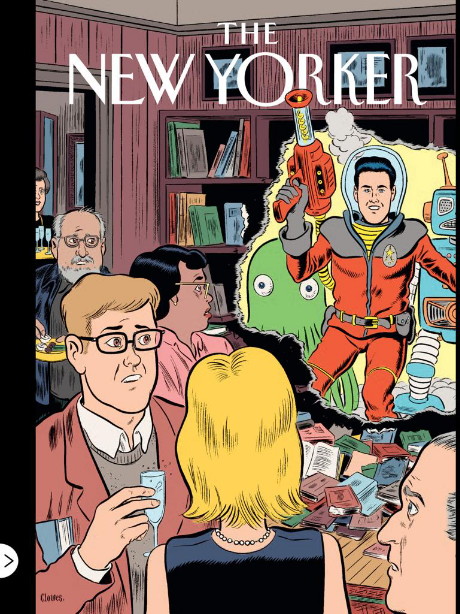
A very fine double issue on the theme of Science Fiction, starting with the Daniel Clowes cover. Some excellent fiction by Sam Lipsyte, Jennifer Egan, and Junot Diaz, a long fascinating “Personal History” piece by Colson Whitehead about his childhood fixation on B-movies, and several excellent short essays on sci-fi by famous writers (Ray Bradbury, who just died today, Ursula LeGuin, China Mieville, Margaret Atwood, William Gibson, and — my favorite — Karen Russell). Also a good piece about “Doctor Who” and “Community” by television critic Emily Nussbaum.

In this week’s New Yorker

May 23, 2012


A super-downbeat issue whose highlights include Kelefa Sanneh’s piece about the dysfunctional state of Arizona (though Democratic Senate candidate Richard Carmona sounds like a pretty good guy); Lorrie Moore’s short story, “Referential,” about the parents of a mysteriously disruptive kid; and Charlayne Hunter-Gault’s horrifying story about the dismayingly widespread phenomenon in South Africa of “corrective rape” of lesbians. Oy.

In this week’s New Yorker

May 18, 2012


Aside from the cover by Bob Staake and Margaret Talbot’s right-on editorial about Obama’s endorsing gay marriage, the most remarkable thing about this issue for me is the indication that Robert Falls has upped the profile of Chicago’s Goodman Theater so much now that many of its productions command coverage by New York critics. Hilton Als reviews Falls’ production of The Iceman Cometh, starring Nathan Lane but featuring a couple of young actors who Hilton thinks are stars of tomorrow (Patrick Andrews and Kate Arrington). And the always plugged-in culture reporter Alec Wilkinson’s “Stage Secret” follows the acclaimed black Shakespearean actor John Douglas Thompson to clown school. I have yet to see Thompson onstage but I plan to repair that lacuna the next chance I get.

Otherwise, not a lot of essential reading. Jeffrey Toobin’s long piece on the Citizens United court case — the one that has unleashed a bottomless flood of unaccountable corporate donations to this year’s elections — reveals the couple of small errors on the part of the Solicitor General’s office that allowed this egregious legislation to get by the Supreme Court. But Toobin basically establishes that the Supreme Court has a very, very long history of being very conservative in the direction of considering corporations to be “people” whose First Amendment right to self-expression is sacrosanct. Which is of course of a lot of horseshit that denies what should be perfectly obvious to any impartial law court, which is that the money corporations have to sling around allows them to drown out the voices of actual people.

I also read with interest Xan Rice’s story, “Finish Line,” about Kenyan runners in general and Olympic champion Samuel Wanjiru in particular.

In this week’s New Yorker

May 13, 2012


The “Innovators” issue contains any number of astonishing sentences, including this one, from Michael Specter’s “The Climate Fixers,” about geoengineers laboring to find drastic solutions to global warming:

“The Stratospheric Particle Injection for Climate Engineering project, or SPICE, is a British academic consortium that seeks to mimic the actions of volcanoes like Pinatubo by pumping particles of sulfur dioxide, or similar reflective chemicals, into the stratosphere through a twelve-mile-long pipe held aloft by a balloon at one end and tethered, at the other, to a boat anchored at sea.”

From the same article: “In 2008 Chinese soldiers fired more than a thousand rockets filled with chemicals at clouds over Beijing to prevent them from raining on the Olympics.”

And Joan Acocella’s essay about English usage manuals and the battle between prescriptivists and descriptivists offers this summary of Ruth Wajnryb’s 2005 book Expletive Deleted:

“Arabic and Turkish, she says, are justly praised for elaborate, almost surrealist curses (‘You father of sixty dogs’). Bosnians focus on the family (‘May your mother fart at a school meeting’). Wajnryb gives generous treatment to the populations, such as the Scots and the African-Americans, who hold actual competitions of verbal abuse, and she offers memorable examples:

I hate to talk about your mother, she’s a good old soul,
She got a ten-ton pussy and a rubber asshole.

In addition to these, other excellent pieces include Evan Osnos’s “The Love Business,” about Gong Haiyan, who created the most successful online dating website for Chinese match-seekers, and an extremely illuminating and well-written profile by Larissa MacFarquhar of Clayton Christensen, who wrote a classic book called The Innovator’s Dilemma. Christensen has applied a huge amount of research and thinking to the subject of why and how successful businesses can and almost inevitably do fail. He’s an incredibly smart who is also a devout member of the Church of Jesus Christ of Latter-Day Saints who fervently prayed to God to tell him whether the Book of Mormon was true, which He did. Go figure.