Robert Brustein, who just passed away at the age of 96, was one of the titans of American theater in the 20th century: producer, critic, mentor, public intellectual, playwright and adaptor, educator. I studied with him only from afar, but I learned something very important from him — to assess artists and institutions by the body of their work, not on the basis of hits and flops. I interviewed him a few times for major publications (the New York Times, the Village Voice, American Theatre) and made many pilgrimages to Boston to see shows at the American Repertory Theater. I felt respected by him, which meant a lot to me as a young journalist and theater critic. I just posted the text from my 1987 American Theatre cover story — check it out here.
Sad to hear of the death of Treat Williams at 71, from a motorcycle accident in Vermont. I interviewed him in 1986 for Caught in the Act: New York Actors Face to Face, a collaboration with Susan Shacter, who took the most beautiful and sexy portrait of this guy that I’ve ever seen. (A print of it hangs in my hallway art gallery.) When I met him, his hair was just starting to grow out after he shaved his head to play Ernest Hemingway for a movie that never happened. The first thing he did when I arrived for the interview was invite me to run my hand over his buzzcut, which did indeed feel very soft and lovely and, you know, flirtatious all at the same time.
I don’t mind if I’m not being taken advantage of, if they’re really unsure. Nothing’s handed to you. The only things that come easily are the things you’ve already shown you’re capable of doing. In life, you have to struggle to get what you want.
But there are other uses for auditions besides seeing if you’re right for the role. The reason you have so many meetings on a movie is often just to see if you’re emotionally compatible with the director. After all, you’ll be working together five or six months, up to fourteen hours a day.
How do you determine if you’re compatible?
First you see their work. Then you meet them. If you go to dinner with someone you’ve never met, and he starts slapping you on the back and calling you “baby,” something’s wrong. You’re interested in their approach to the work. You’re interested in the unspoken – Is he clearheaded? Is he abusive? Is he a drunk? Will he let me take chances? Will he let me use my sense of humor? Will he force me to play the character the way he sees it? Does he have a discerning eye, or will he edit out the good stuff? Does he know what kind of movie he wants to make, or is he just making a movie? None of those things are talked about, but they’re all going on.
I could have sworn that I wrote a feature article about the lighting for Bob Fosse’s 1978 show Dancin’ (now in revival on Broadway) at the time of the first national tour. My memory of the show is that it was mildly entertaining with a sizzling show-stopping act three number set to Benny Goodman’s “Sing, Sing, Sing.” I looked high and low among my far-flung archives, and the only thing I found was my review of the pre-Broadway tryout for the Phoenix, which was…well, the headline was “Throwin’ the night away,” and the subhed was “Fosse shoulda known better.”
DANCIN’, a musical entertainment directed and choreographed by Bob Fosse. Music and lyrics by various artists. Scenery by Peter Larkin. Costumes by Willa Kim. Lighting by Jules Fisher. At the Colonial Theater through March 11.
Almost every musical Bob Fosse has directed since Sweet Charity has been praised for its staging and criticized for its book. But the script to Dancin’ is no more than a pamphlet; the only “book” involved is the one that should be thrown at Fosse for turning a potentially spectacular, all-dance Broadway show into a lame-brained revue studded with sleazy sex-skits — Hellzapoppin’ with humpin’.
Everything about Dancin’ sounds great. Sixteen top dancers in a celebration of show biz set to the music of composers ranging from J. S. Bach to Edgard Varèse to Cat Stevens, with choreography from Bob Fosse’s famous grab-bag of styles? One imagines — with considerable excitement — some combination of A Chorus Line‘s shameless high-stepping, Twyla Tharp’s fractured boogie, the Joffrey’s hybrid of classical technique and pop ballet, and Pippin‘s non-stop theatricality. And at its very best, Dancin’ lives up to such feverish expectations. “Sing, Sing, Sing,” which kicks off the last of three short acts and is set to the swing era classic, is a show-stopping blaze of precision ensemble dancing punctuated by an audaciously delicate tap duet; a loose-limbed, slump-shouldered trio; and the obligatory electrifying solo by Ann Reinking, who has several leaps during which she seems to hover in mid-air and then lurch to the stage as if from Mars. “Sing, Sing, Sing” is the kind of dance number that keeps you on the edge of your seat, completely enthralled.
Unfortunately, I spent much of the rest of Dancin’ cringing into the Colonial’s plush cushions. Apparently, Fosse got nervous about presenting an entire evening of dance and felt obliged to tell some stories. So he wrote some. They include “Welcome to the Big City,” in which a middle-aged rube visiting New York for the first time is harassed by hookers, masturbated by masseuses, groped by salesgirls, and mesmerized by strippers before being mugged and left lying in the street; “The Dream Barre,” in which a homely ballet student fantasizes that he is fucking the female student next to him as the dancer instructor counts time; and “Joint Endeavor,” in which three men and three women smoke pot and trade partners in a series of solemn, semi-pornographic pas de deux while several leather-coated figures stand around singing sinister versions of Melissa Manchester songs. I wish I could shrug off these sketches as outtakes from an as-yet-unfinished Fosse vehicle called Let My Danskins Come (or, You Gotta Have a Hard-on), but I can’t — they’re really offensive. Atrociously written, they have nothing to do with dancing and are appallingly sexist. (Thanks to Fosse’s surprisingly limited sexual imagination, several of Broadway’s finest female dancers spend endless stage time flat on their backs; thanks to Fosse’s dishonesty, this is a show about dancers that refuses to acknowledge some of them are gay.)
Then there is the show’s finale, in which Fosse abruptly takes his hand out of his pants and places it over his heart for an astonishing salute to America called “Yankee Doodle.” The cast members sing and dance to a medley of patriotic songs and some of them have lines to say, such as “American women — boy, they are really something!” and “It might be corny and unsophisticated, but I’m proud to say that I’m an American.” This segment is not convincing (it is pseudo-patriotic in the same way that “Welcome to the Big City” is pseudo-cynical), nor is it satirical — or meant to be. Perhaps scene designer Peter Larkin simply wanted to create a huge eagle to fly in and flap its wings. Or perhaps Fosse really has deceived himself into thinking this is what a Broadway audience wants at the end of the show. How sad.
There is surprisingly little in Dancin’ that falls between the very good (the opening of each act) and the very bad. The show’s flaws could be eliminated by a few drastic measures: 1) cut out any and all dialogue; 2) delete all of the imitation Oh! Calcutta! sequences and 3) replace the raggedly performed live music with recordings. That would leave a short but stunning two-act musical, instead of a blot on the career of a choreographer with more talent than brains.
Oddly enough, the choreography in Dancin’ very rarely draws on the slinky, turned-in style most associated with Fosse; there is plenty of crotch-bumping and ass-shaking, but it is more rhythmic and less menacing, partly because of the different musical styles. Some of the songs could be better chosen. Edgard Varèse is just not very interesting to dance to, and Jerry Jeff Walker’s “Mr. Bojangles” is too obvious. Predictably, Fosse seems happier with the jazzy material; “Big Noise from Winettka” inspires a nifty trio, and the previously mentioned “Sing, Sing, Sing” is the show’s highlight. The dancers are invariably superb, though Ann Reinking is deservedly the unspoken star. It does, however, seem a little unfair that she gets all but one of the female solos; René Ceballos, who projects all the best qualities of a circus showgirl, deserves to be seen more. Wayne Cilento is outstanding, and Blane Savage and Charles Ward, both unusually large and athletic dancers, work together often and splendidly.
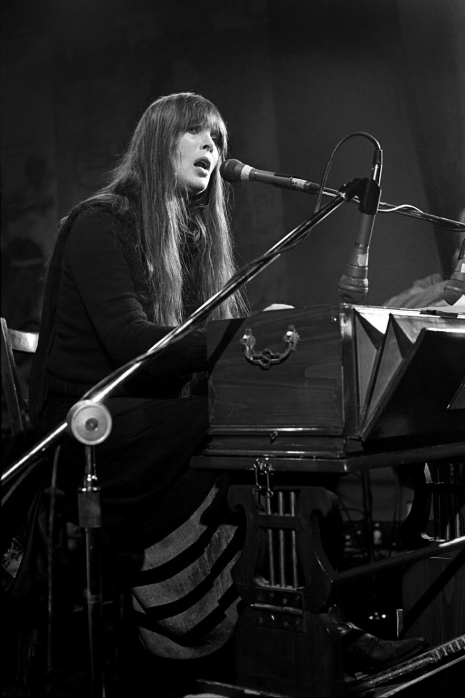
Earlier I’d been to the Paradise Theater to see Nico, which was hilarious, wonderful & absurd. She had long, dark hair, with bangs down to her eyelashes, loose flowing clothes, & a heavily-accented slow voice. “I’m so happy that you remember me,” she said first. Sat down at the harmonium & announced she would play some new songs. The first she said was “Genghis Kahn – or is it Jenghis Khan?” (“I have come to lie with you/to die with you”) The next one was something about “Do you dare to be insane?” Between those two someone brought her a tissue & a glass of wine – she said, “excuse me, I have something in my eye,” dabbed at her eye a little bit, then whispered “thank you.” For the 3rd song, which she introduced as “Henry Hudson,” she was joined by a man with beautiful long blond hair and a guitar. When he started playing, we decided it sounded like “Both Sides Now.” (I was sitting with Liz Ireland and Bill Tupper [Boston-based rock critics].) Then she said she would do some Lou Reed songs & did “Femme Fatale” (with the guitar, I thought it sounded like a George Harrison song; Tupper suggested Melanie) and “All Tomorrow’s Parties.” Then the guitarist went away. Nico thanked Lou Reed, and when someone asked, “Where’s Lou?” she said “He’s probably on his farm. He is always on his farm a lot these days.” At some point she mentioned “I have never done a concert so sober as I am tonight.”
photo by Ebet Roberts
Then she did a smattering of songs from her albums – she did a song from The End LP dedicated to Baader & Meinhof, it went something like “His sweat is my innocence/must they kill my fate/can’t I betray my hate?” which made me ponder “the right to hate.” Then she did a song in German from (she said) The Marble Index but it was actually from Desertshore – but she couldn’t finish the song. She just stopped for a moment, then said “I don’t know where the notes are.” A fan brought up a trinket to her, & she said “Is it black magic?” The woman assured her it was not. Oh, before that, just after the Lou Reed songs, she had said, “Are there any special requests?” People had yelled various of her songs. The only thing I could think of was “The Hissing of Summer Lawns.”
Anyway, after the song she didn’t finish, she said “I’m supposed to make mistakes. Andy Warhol said that.” A fan said, “Your mistakes are perfect.” She said, “I don’t think so.” Then she launched into a song I thought was called “You Will Know Me.” Maybe it’s “You Forgot to Answer.” It began, “If I could remember what to say…” but she didn’t finish that song either, forgot how it went. She seemed upset, & for a minute it was like Ronee Blakely in Nashville. Then she sang “No One Is There,” & everything went smoothly. Another couple of songs – “Frozen Borderline,” “Secret Side,” one about vestal virgins, then she introduced her last song — & it was “The End” [long lugubrious song from the Doors’ first album]. We all groaned. It is pretty dumb. But she came back for an encore – I asked who was on the button she was wearing and she said, “oh – Sid Vicious.” And, finally asserting herself, she said, “whether you like it or not, I’m going to do another German song. That doesn’t mean I’m a fascist.” It was “Deutschland Uber Alles.” & it was over.
The harmonium is an odd instrument, very monotonous, but intriguing to watch her pumping the pedals & hearing the repetitive wheeze. Soho News said her CBGB’s gig was eerie like a wake, and this was spooky, too, but more like watching an eccentric woman who makes old-time radio shows. Her enunciation is painfully precise, her pitch often painfully uneven. But I wouldn’t have missed it for anything.
Seeing God’s Fool, Martha Clarke’s exquisite music-theater piece about St. Francis of Assisi, which finished up its three-week run at La Mama ETC on July 2, reminded me of another Martha Clarke piece, Endangered Species, that opened (and quickly closed) at the Brooklyn Academy of Music in 1990, which I wrote about for the Village Voice.
This is how my article began:
“The show opens on Sunday, the reviews appear Tuesday morning – another pan from Frank Rich! – and boom, the producer announces that the show’s closing at the end of the week. An all-too-familiar Broadway scenario, right? Except that this time the location is Brooklyn, the producer is Harvey Lichtenstein, and the show is Martha Clarke’s Endangered Species, which opened BAM’s Next Wave Festival and then closed October 14, two weeks into a scheduled five-week run. With typical journalistic sensitivity, I checked in with Clarke, her longtime producer Lyn Austin (whose Music Theatre Group developed endangered Species for the Next Wave Festival), and Lichtenstein to see how everyone was feeling.”



 another eye opens