A dreary overcast Christmas Eve turned out to be a perfect day for a stroll through the Whitney Museum (first time there since the onset of the pandemic). We started on the top floor with Working Together: The Photographers of the Kamoinge Workshop, a community new to me of photographers who chronicled civil rights activism, culture heroes, and everyday black life in the ’60s and ’70s — wonderful shot of Sun Ra.
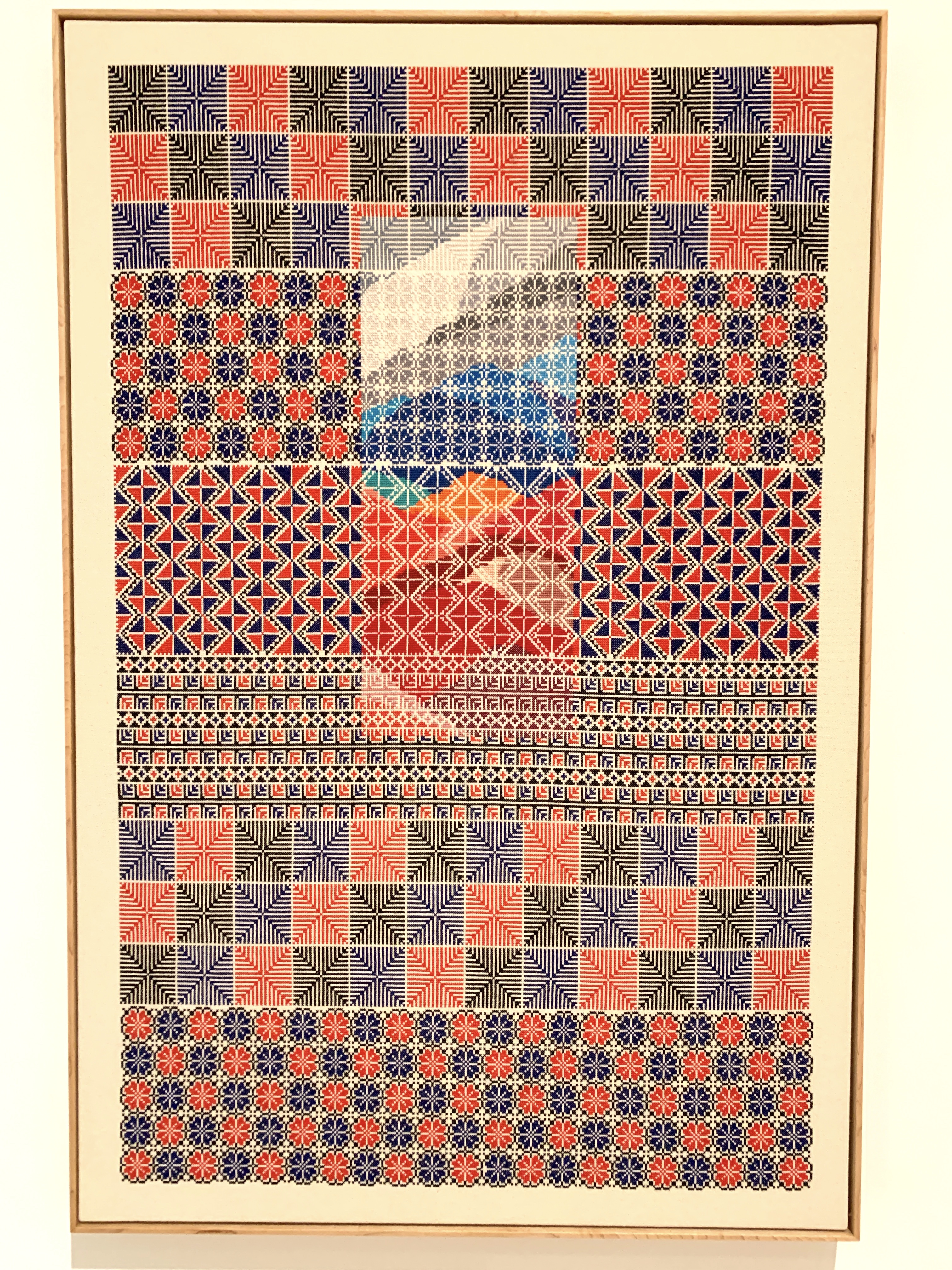
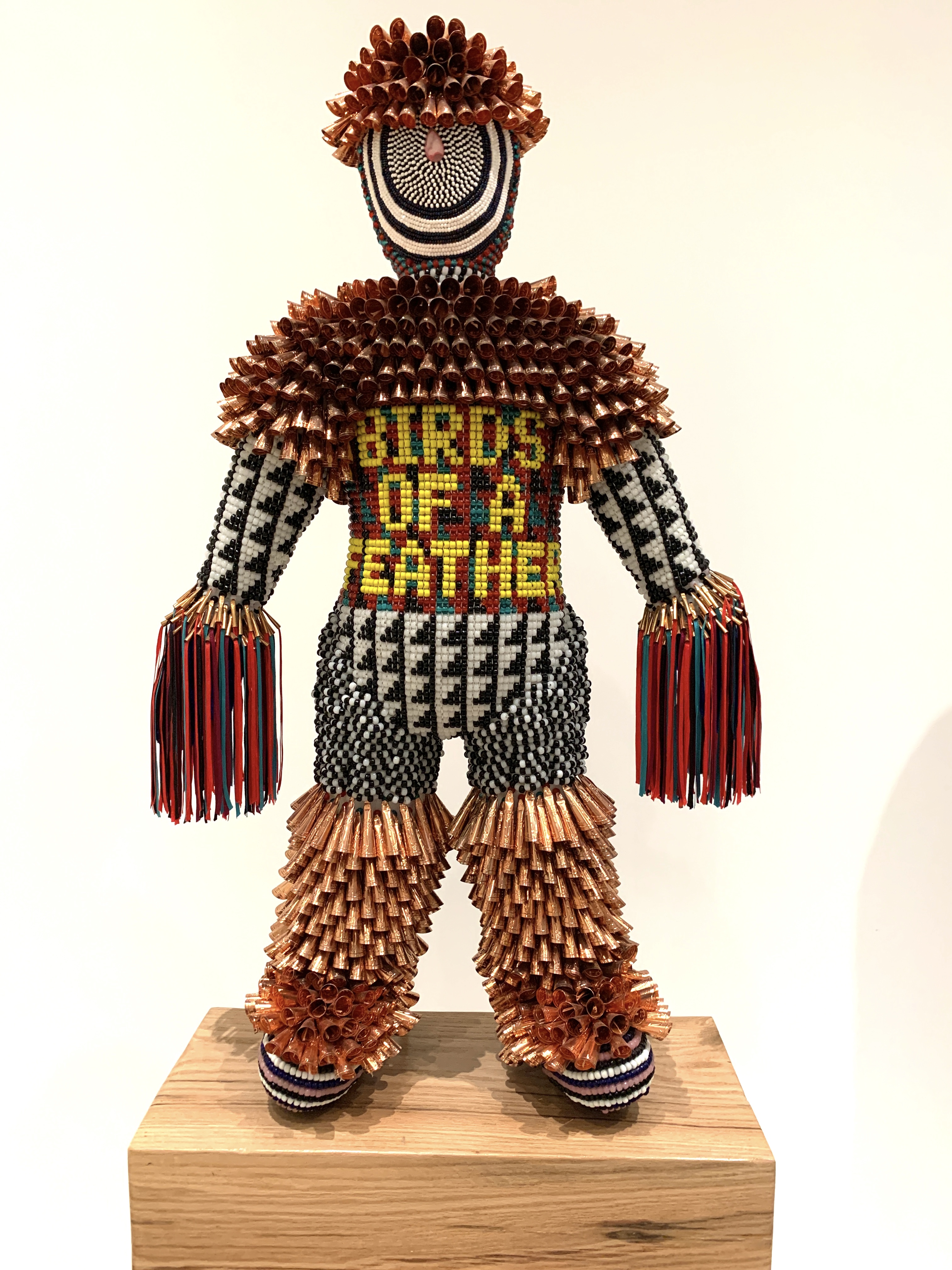
Next: Making Knowing: Craft in Art, 1950–2019, whose high point is Liza Lou’s beaded Kitchen, but I also loved Jordan Nassar’s mesmerizing A Lost Key (above) and Jeffrey Gibson’s Birds of a Feather (below).
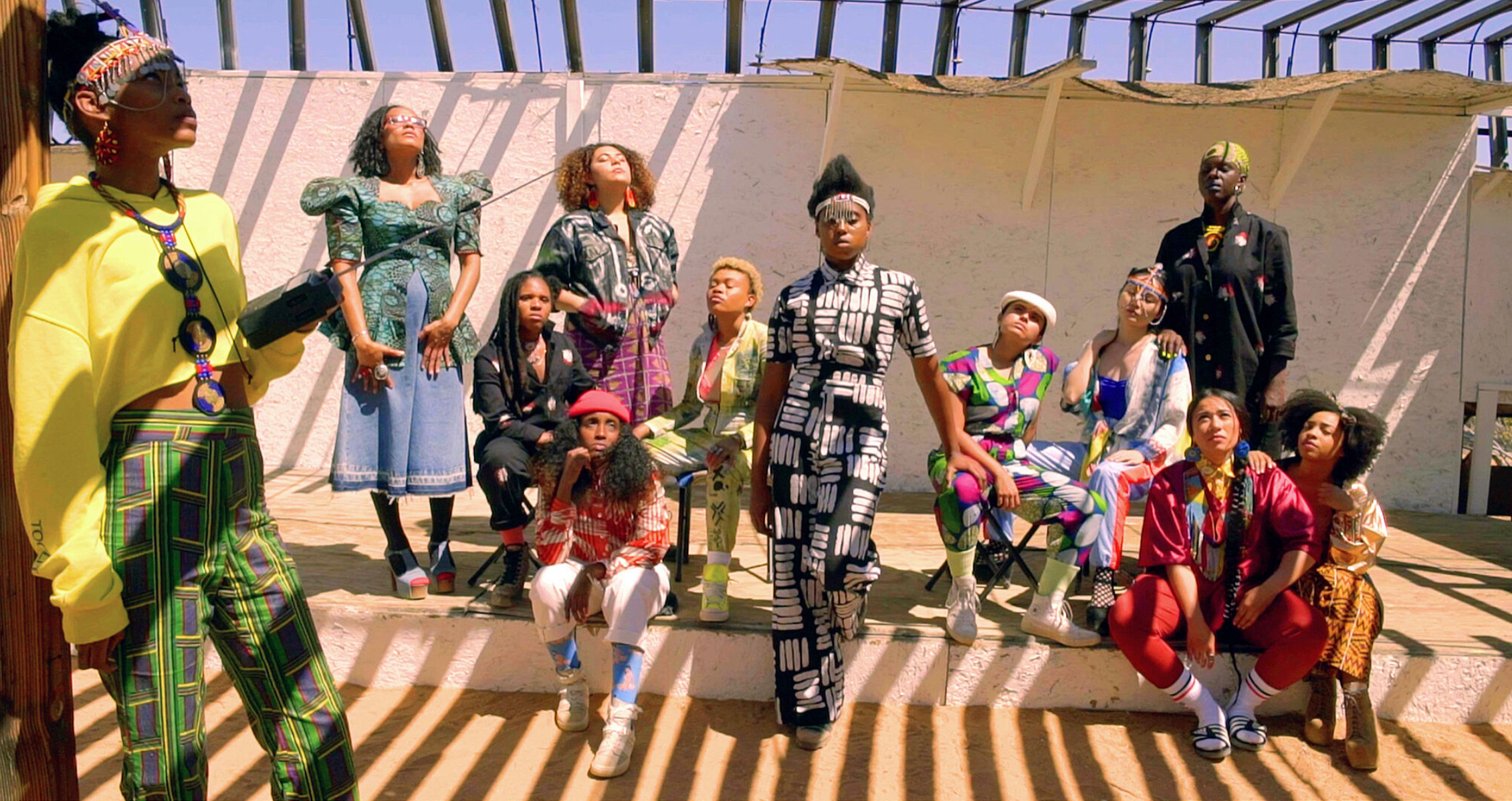
We poked our heads into Cauleen Smith: Mutualities and watched some of her film Sojourner in which a group of sisters in dazzling outfits take in a recorded lecture on black feminism.
The main attraction at the Whitney these days, though, is Vida Americana: Mexican Muralists Remake American Art, 1925–1945, which runs through January 31. The show focuses on three artists — Diego Rivera, David Alfaro Siqueiros, and José Clemente Orozco — and the impact they had on their contemporaries. I’ve always loved Siqueiros’s paintings, which seem psychedelic to me, and I made a pilgrimage to the house in Guanajuato where Rivera lived with Frida Kahlo for a time (it’s now a museum).
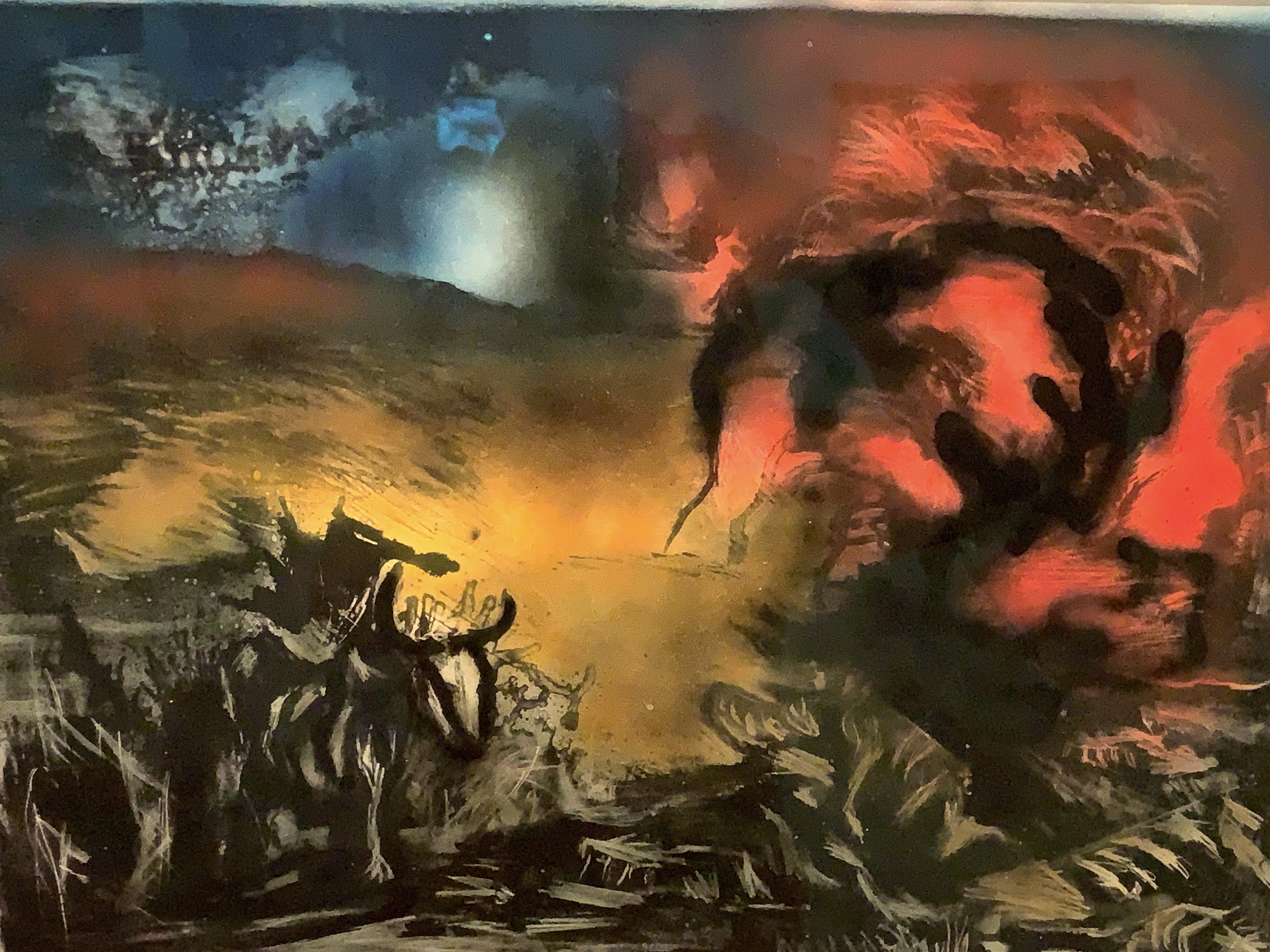
I was surprised and fascinated to see a bunch of figurative (pre-drip) paintings by Jackson Pollock directly influenced by Siqueiros’ dreamy shellacked surfaces (Landscape with Steer, above) and Orozco’s death-obsessed iconography (the two images below, both called Untitled (Figure Composition).
Also intriguing to learn that Philip Guston got his start studying with Siqueiros in Los Angeles and absorbing his politically charged mural work, as in this sectional model of a piece for the University of Michoacán.
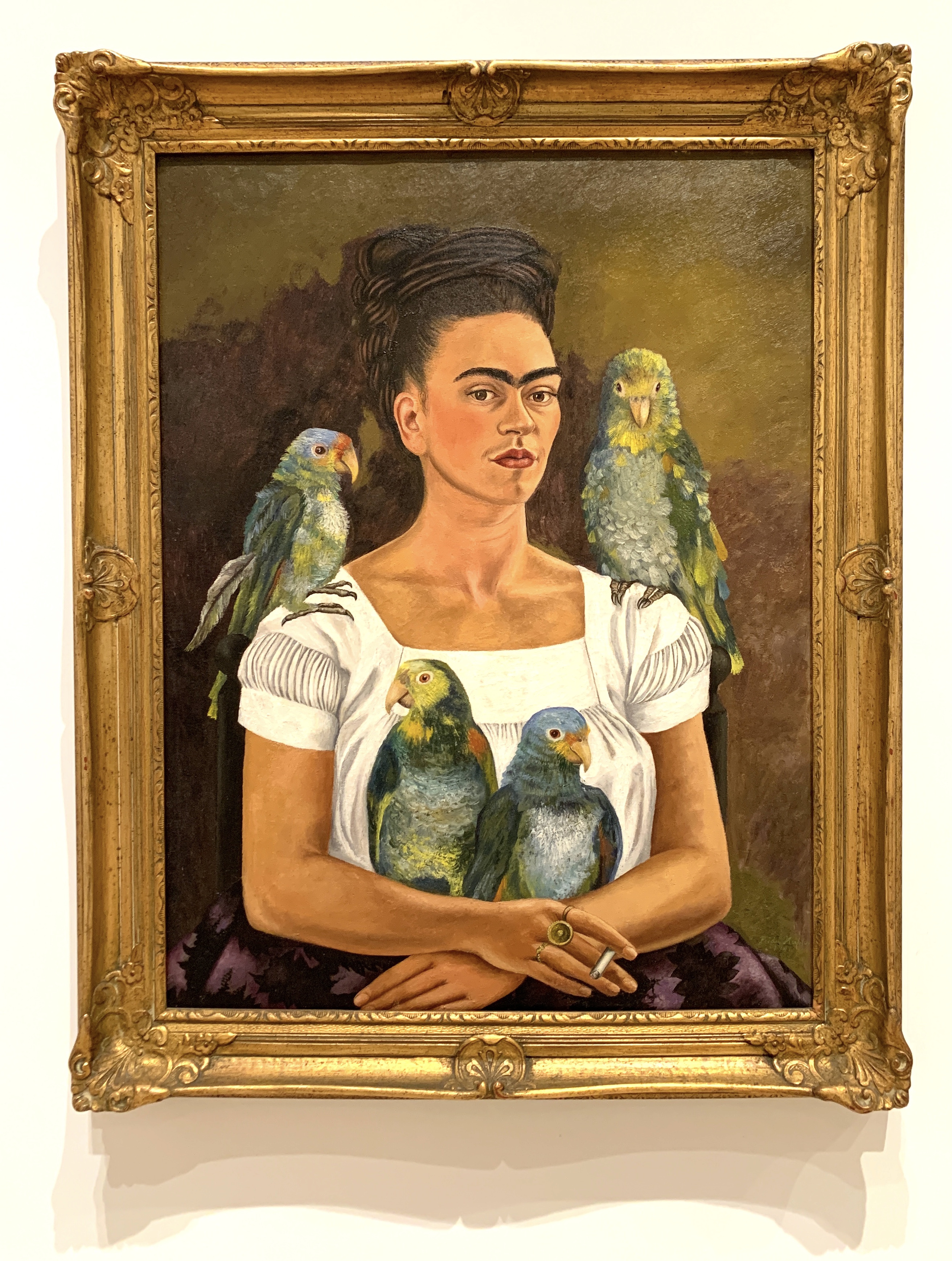
And, as dessert, Kahlo’s beautiful, tender, funny self-portrait Me and My Parrots.
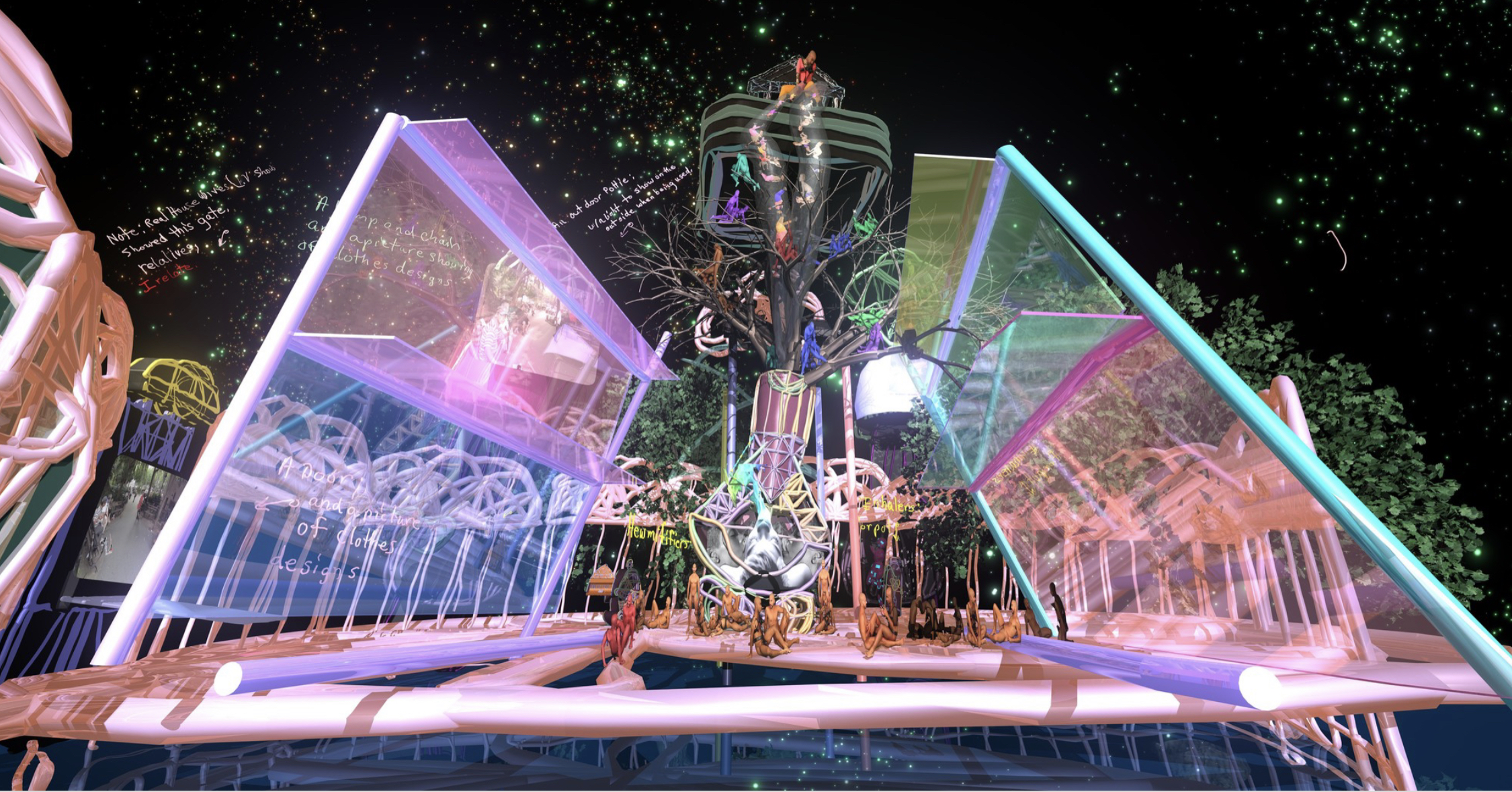
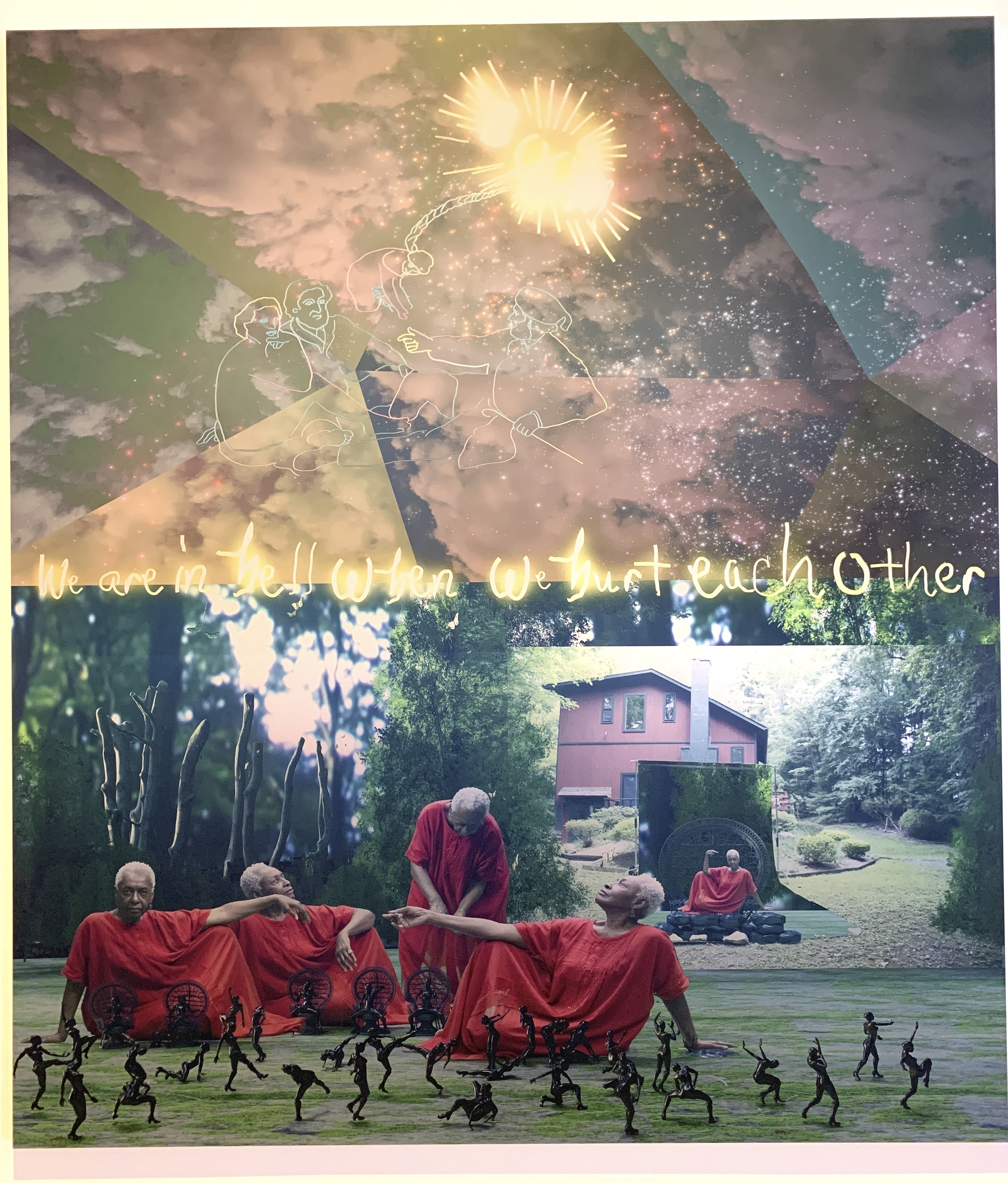
I’m pretty sure the first time I laid eyes on Jacolby Satterwhite’s work was when it appeared in the 2014 Whitney Biennial in the form of “Reifying Desire 6,” an eye-popping animated video (above) densely populated by writhing black male figures, words, phrases, and a kaleidoscopic meteor shower of images and objects. It was sexy, psychedelic, groovy, and unforgettable.. I couldn’t wait to see more. Happily, he’s super-prolific so there’s been lots to follow. I knew he had a show this fall (his Instagram kept reminding me), and by chance I wandered onto his website just in time to realize it was closing the next day. So I hopped on my bike and in less than half an hour I was at the Mitchell-Innes & Nash gallery in Chelsea walking through “We Are In Hell When We Hurt Each Other,” a luscious visual, aural, trippy, intellectual bombardment.
It comes at you from so many angles. One launching point for the show was the album of dance tracks the artist put together (with collaborator Nick Weiss) based on original songs his beloved mother Patricia (who lived with schizophrenia and died in 2016) sang a cappella into a cassette recorder. The songs serve as soundtrack to an 18-minute virtual-reality film that one viewer at a time could watch at the gallery; I came too late to get a crack at the headset, but selected scenes were projected onto the gallery: a tribe of CGI fembots (modeled on the artist’s own body but decked out as Grace Jones-like warriors) inhabit a video-game landscape of menacing orbs and other intruders whom the figures easily vanquish. (The artist has said he got into the video game Final Fantasy while being treated for cancer as a kid.)
Present as a sort of goddess-matriarch figure in many iterations is the legendary fashion model Bethann Hardison, still looking magnificently regal at 78 (above); the ritualistic battles she oversees resolve into the final image of a floral shrine to Breonna Taylor.
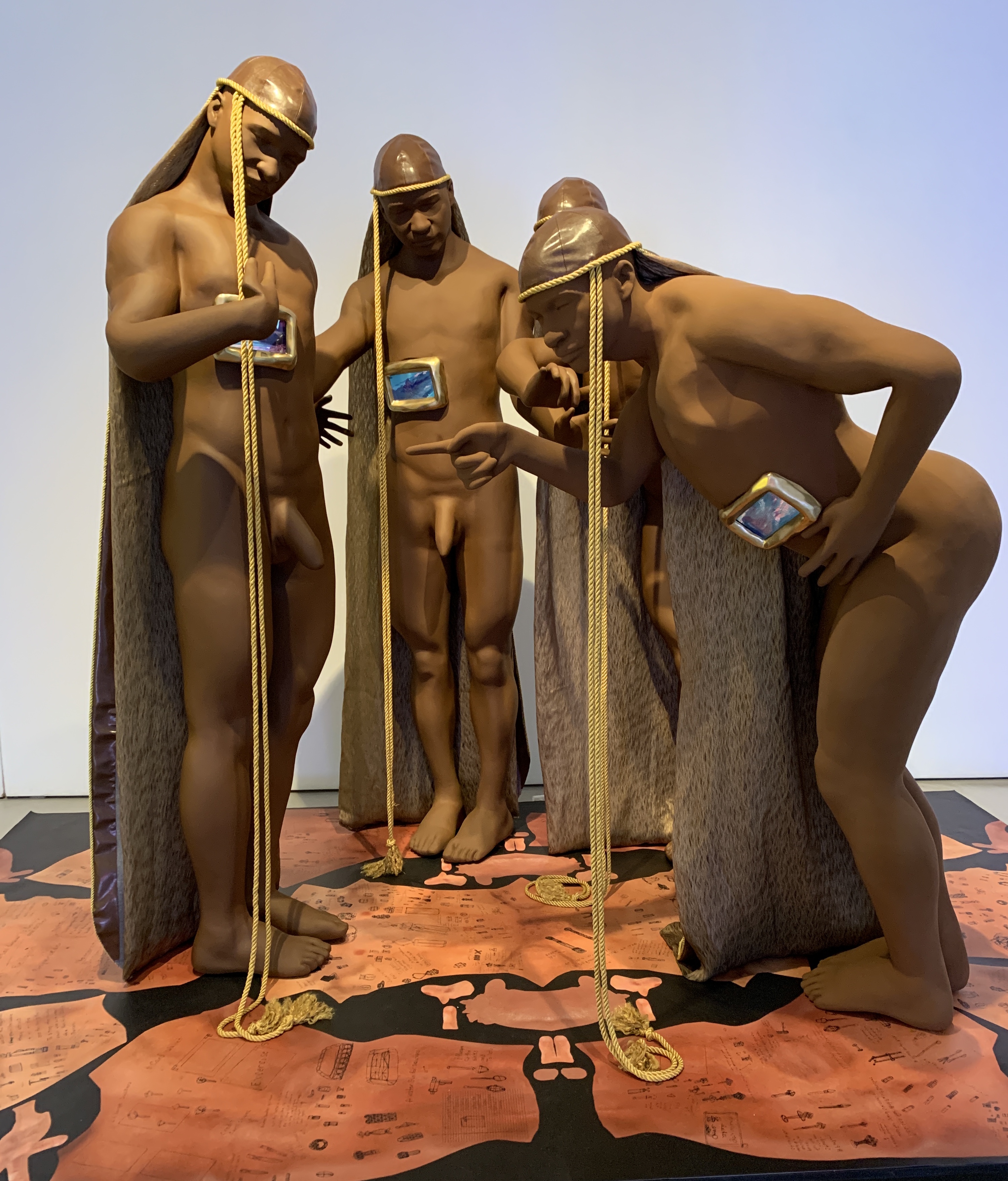
Then there’s a multimedia sculpture called Room for Doubt – four larger-than-life nude male figures (again modeled on the artist’s body) in the midst of some kind of cryptic healing ritual involving golden ropes tied around their heads.
As Patty Gone wrote in her review for the online magazine Hyperallergic, Room for Doubt reimagines Caravaggio’s 1603 painting, “The Incredulity of St. Thomas,” in which the famous non-believer dips a finger into Christ’s wound. In Satterwhite’s version, four life-size nudes mimic the poses of Jesus and company, their torsos containing small screens showing a performance in which Satterwhite grimaces as he drags his body across a floor. There’s no messiah or disciple here, only shared sacrifice. Stillness creates room to behold another’s pain.” On the floor in the shape of animal hides are papyrus-like scrolls with rough drawings and notes (not unlike the note-to-self scribblings Jean-Michel Basquiat would include in his rich collage-landscapes).
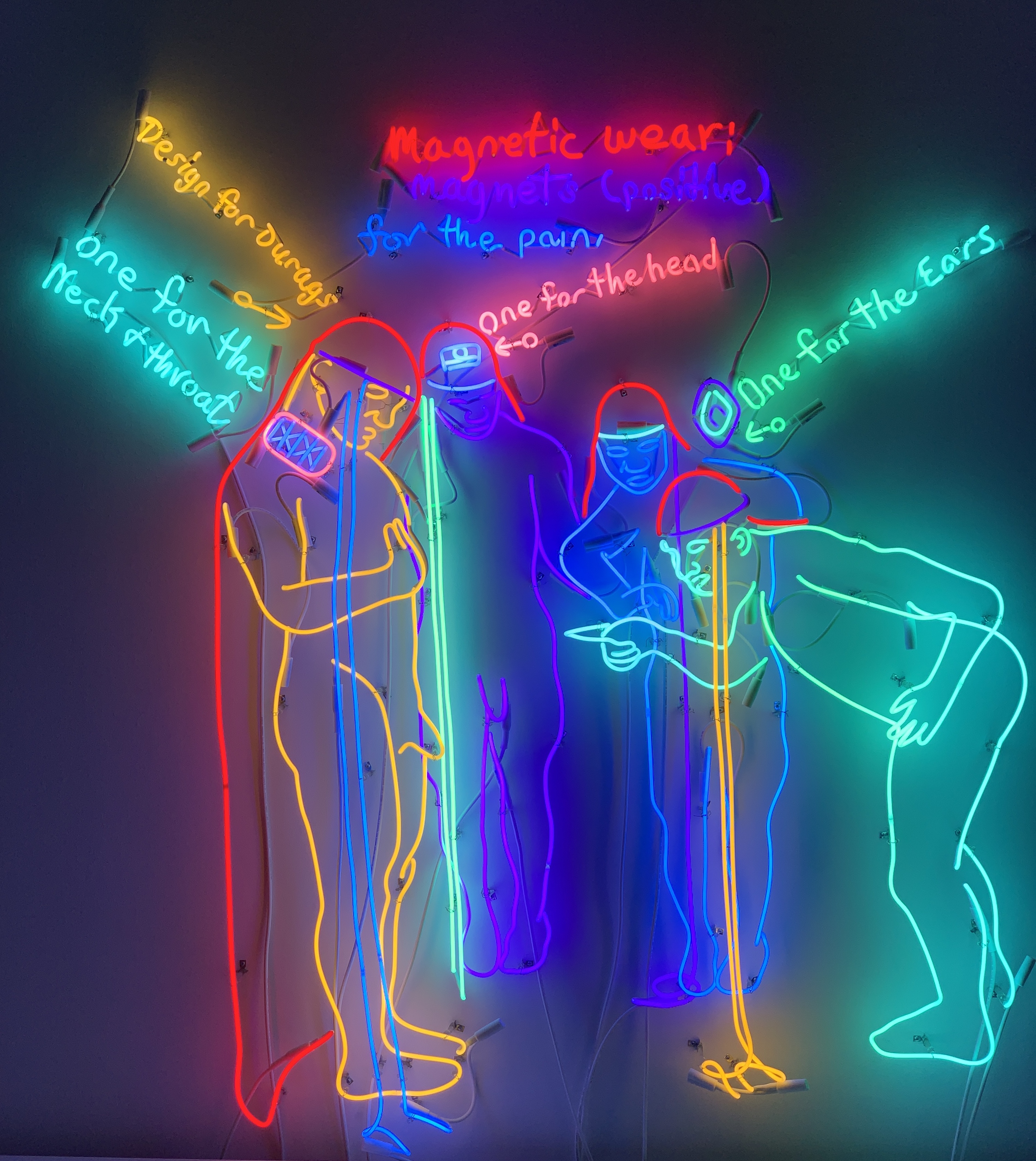
A version across the room, called simply Doubt, is one of several works in neon, including a kind of hilarious, witty neon version of Manet’s Dejeuner sur l’herbe, Picasso’s rendition of which formed a key moment in the emergence of Cubism as a modern way of seeing and making art.
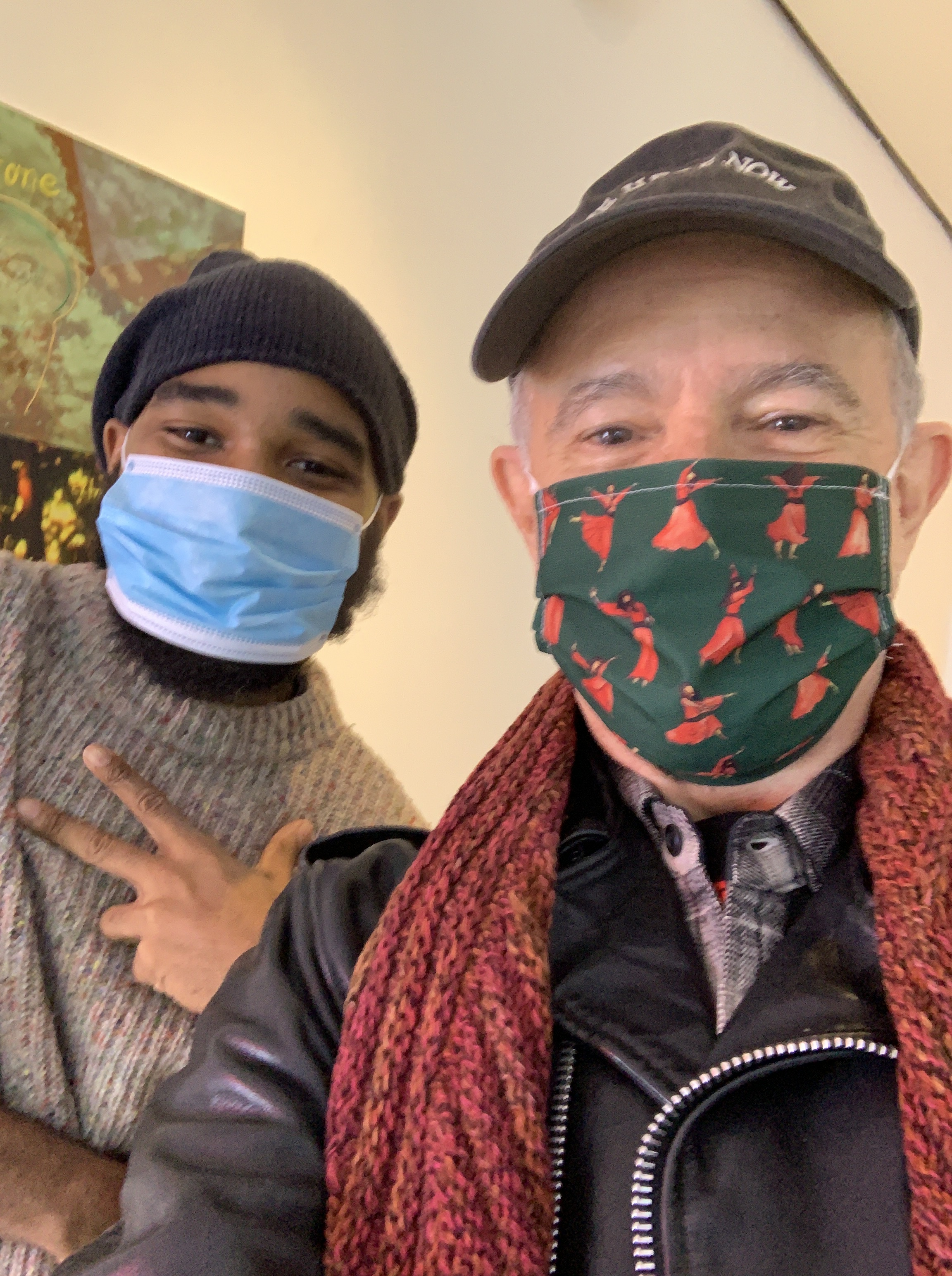
Besides drinking in these heady, color-saturated works, the high point of my visit was meeting the artist, whom I instinctively knew would be there. (Where else would an artist want to hang out?) He turned out to be friendly, handsome, and chatty, the kind of artist whose temperament lends itself to effortlessly discoursing about his work, where it comes from, what dots he’s connecting, etc.
You could happily entertain yourself for some time disappearing down the rabbit hole of his videos and interviews, enumerated on this page.
He told me I could watch the video in extra high-def on YouTube at home, and I scanned the QR code but couldn’t find the video later. Instead, Andy and I wound down from the crazy week by watching Spike Lee’s film version of David Byrne’s American Utopia on HBO Max. It was great revisiting the show, which we saw and loved on Broadway for the design, the lighting, and the exuberant performances. Spike Lee clearly had fun capturing Annie-B Parson’s fluidly inventive choreography from all angles, including backstage and Busby Berkeley-like aerial shots.
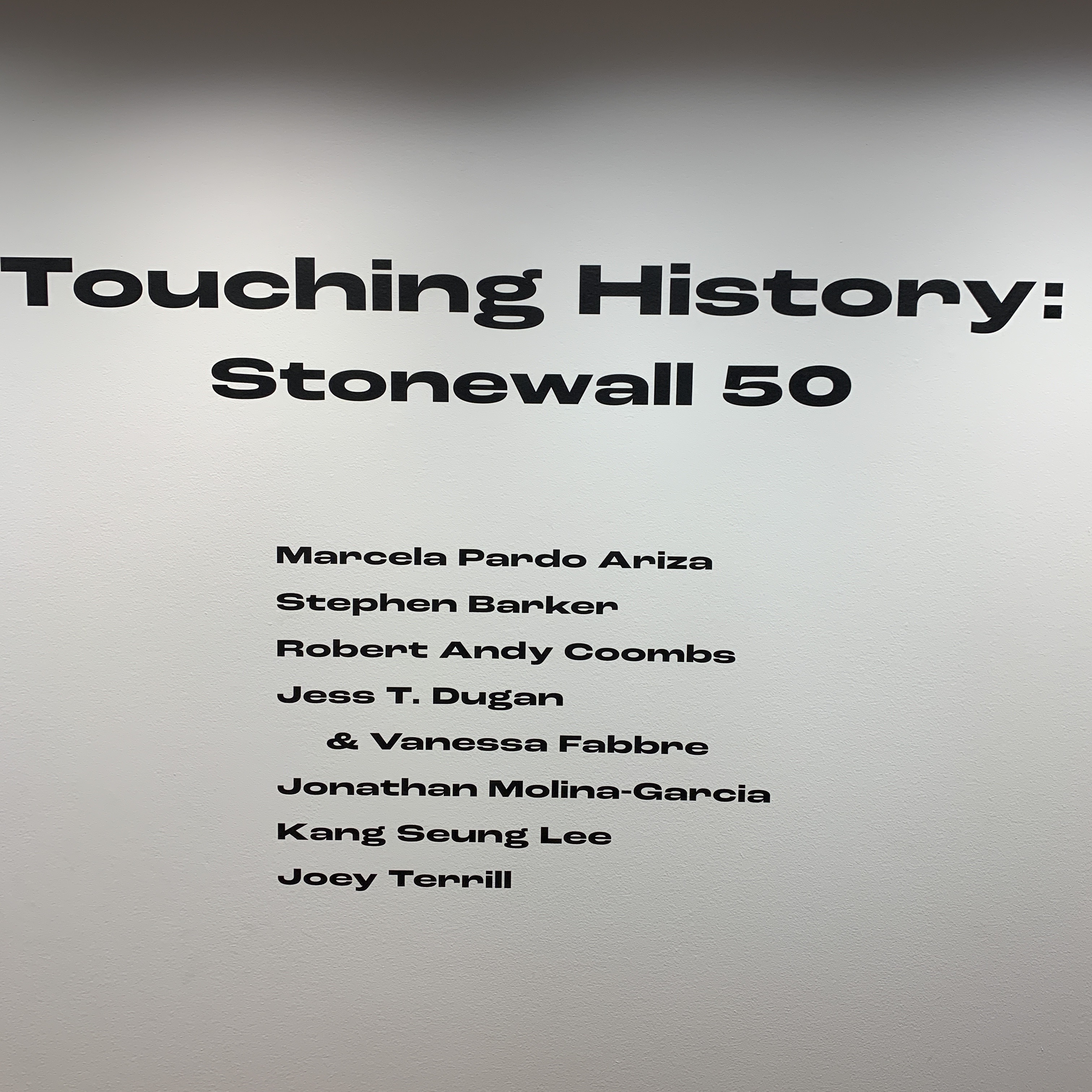
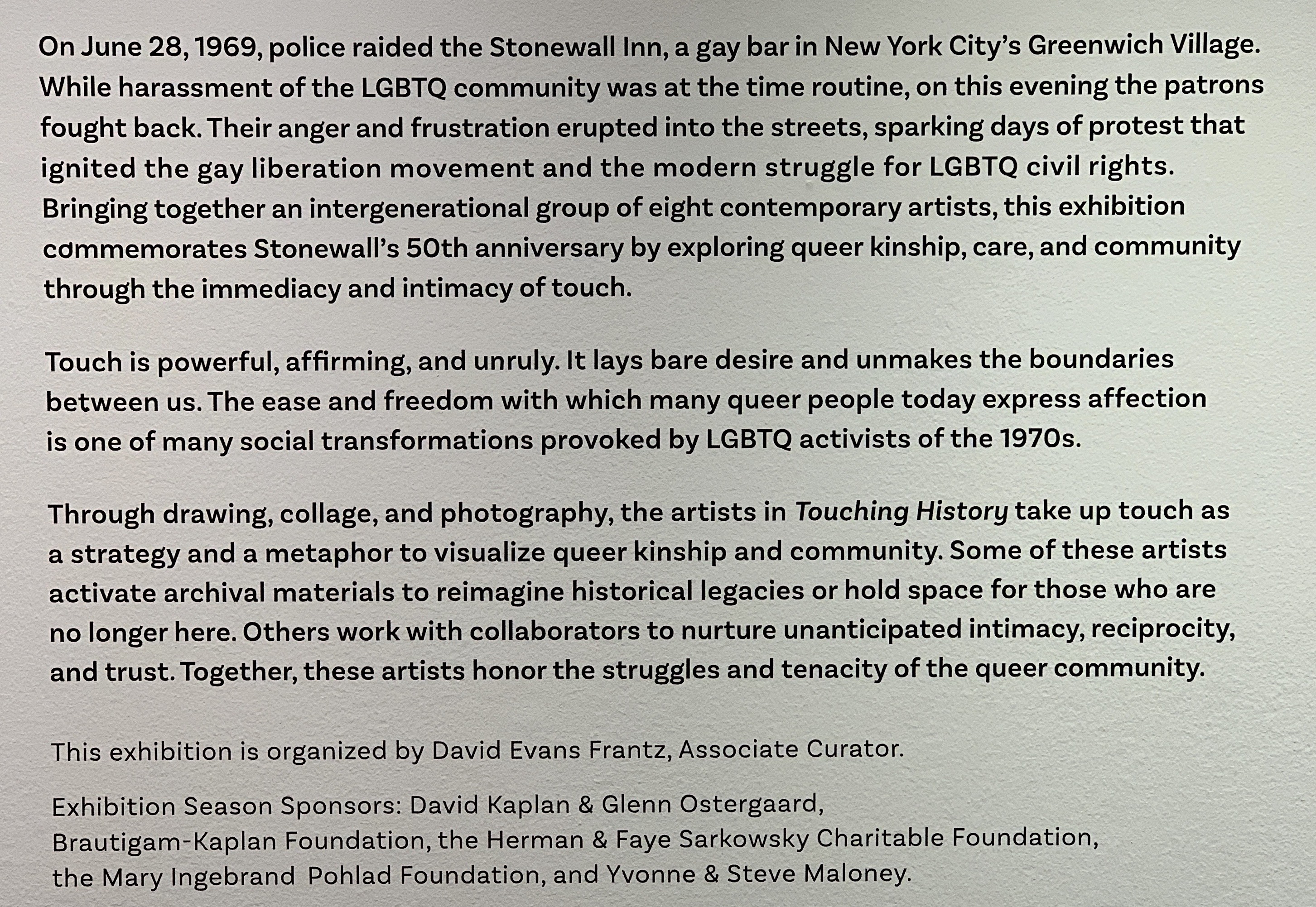
To quote Alanis Morrissette, isn’t it ironic? When the Palm Springs Art Museum decided to mount the first exhibition on the West Coast commemorating the 50th anniversary of the Stonewall gay-liberation rebellion, associate curator David Evans Frantz chose to commission eight contemporary artists to create new work, and the theme he selected was…Touch. That certainly seemed entirely reasonable, unremarkable, or simply admirably out-of-the-box when the show opened last October. It felt that way even when I saw “Touching History: Stonewall 50” Sunday March 8, when museum docent Vinny Stoppia gave a guided tour for members of the local chapter of California Men’s Gathering aficionados.
By the time the museum closed to the public March 17, the show had become a relic of a bygone era, one that has given way to the new era of Touching Nobody.
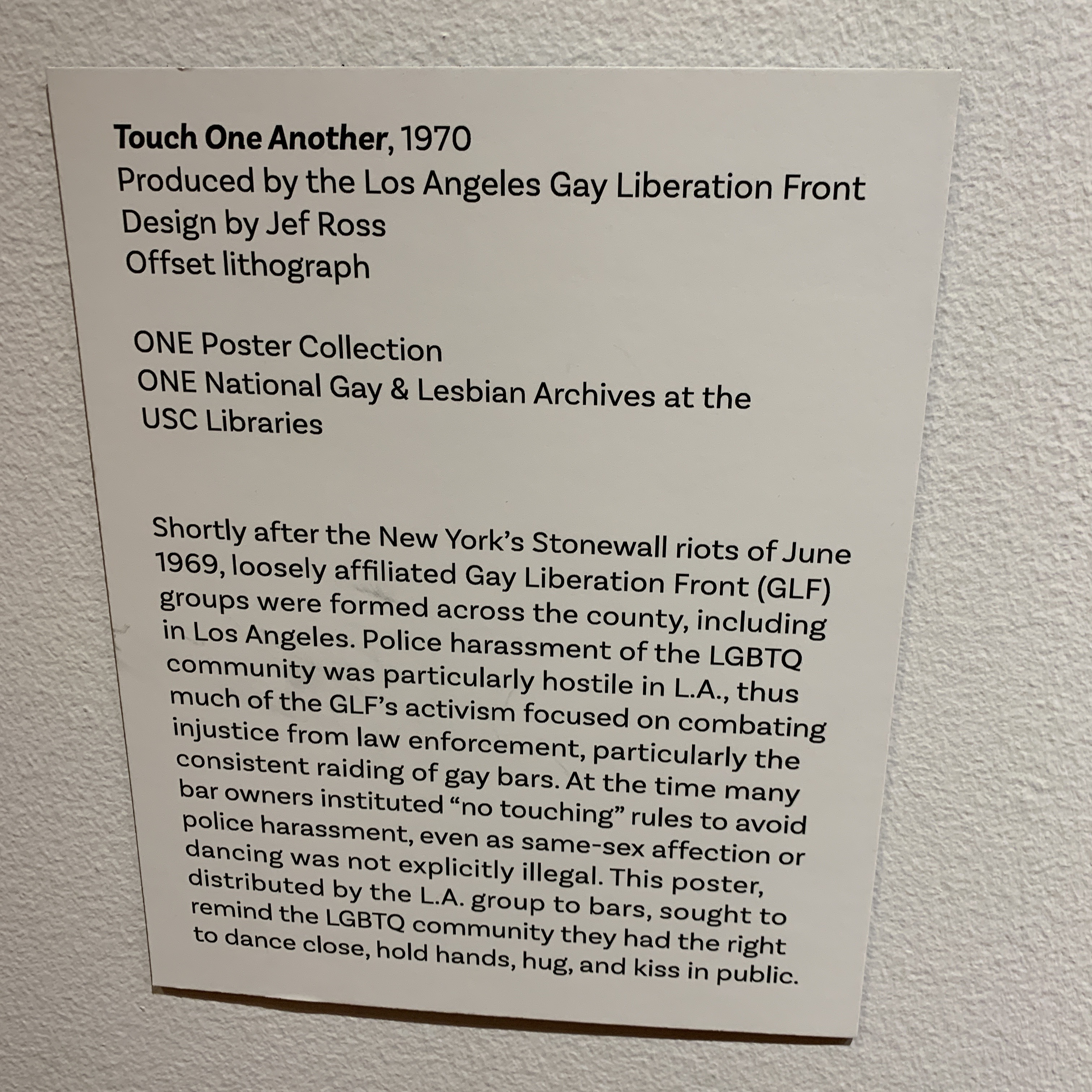
But let me take you through a few of the high points of the exhibition for me, starting with the vintage poster that seems to have inspired Frantz to adopt the theme of touch for this overview of post-Stonewall gay life. (click on images to enlarge)
“Touch is powerful, affirming, and unruly.” I love that!
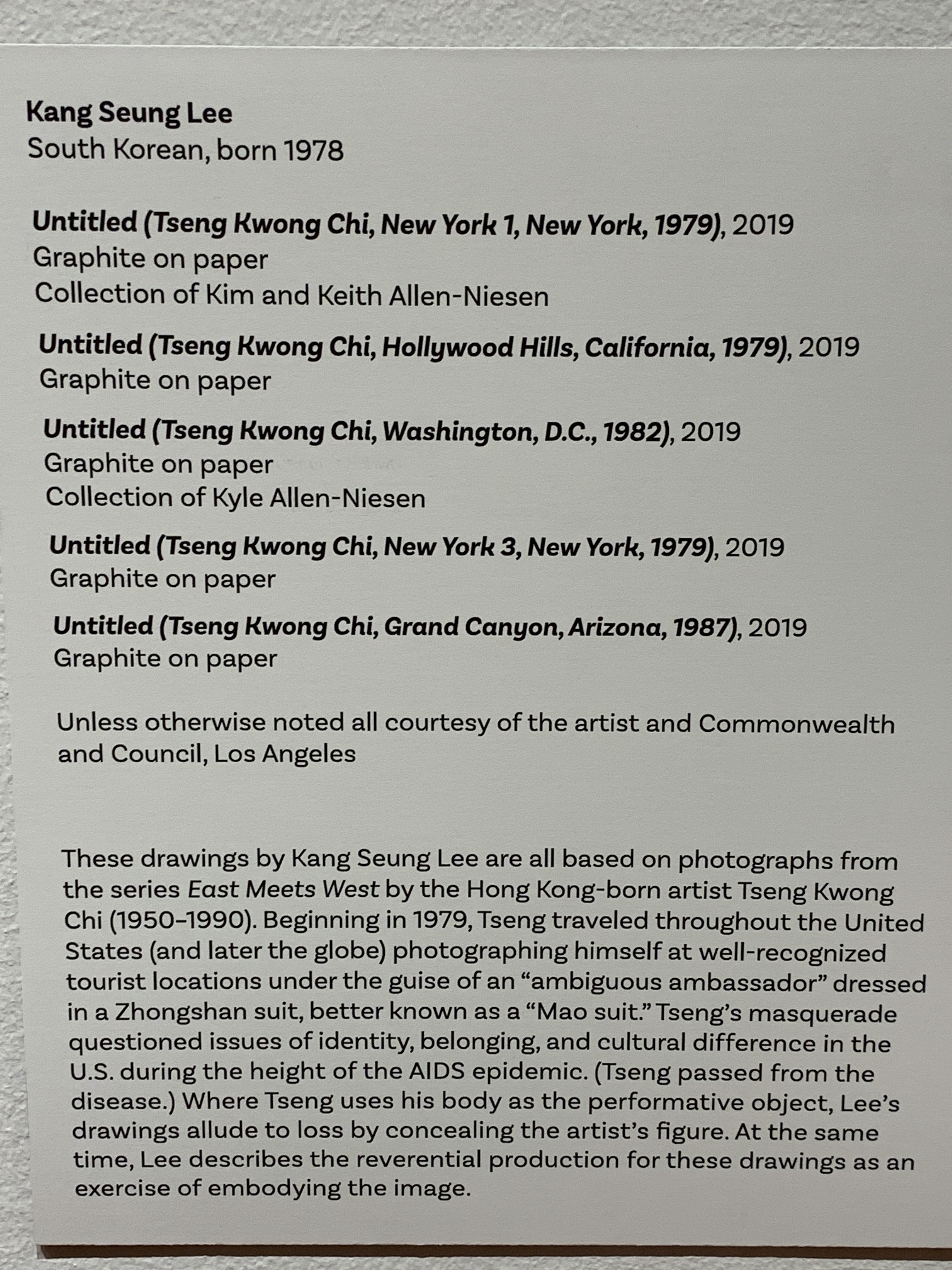
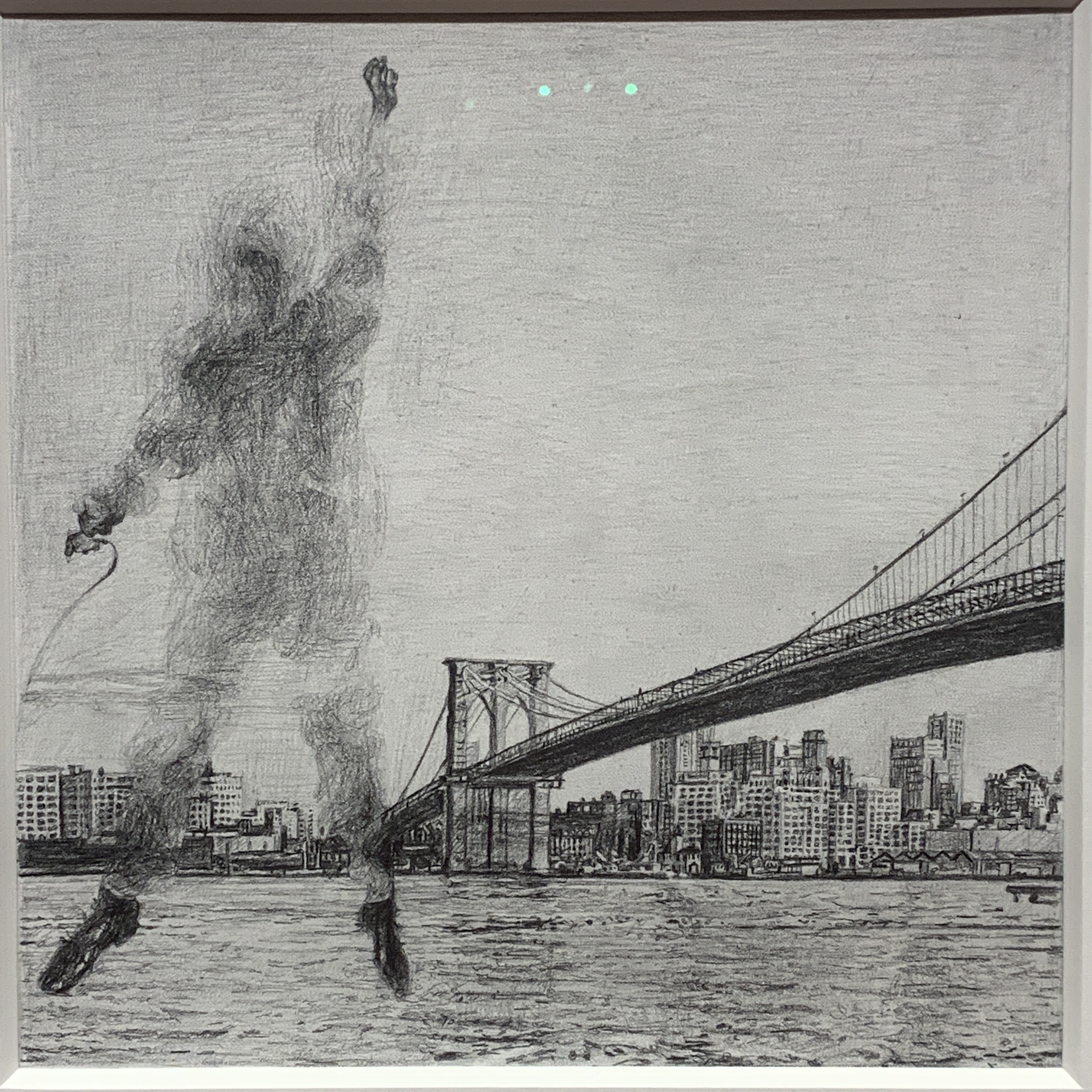
I was particularly moved to see these works paying homage to Tseng Kwong Chi, a downtown legend and a colleague of mine when I worked for the Soho Weekely News when I first moved to New York. Kwong Chi produced a number of iconic images, including the photograph of statuesque dancer Bill T. Jones that became a widely beloved poster by Keith Haring (a signed copy of which hangs in my apartment to this day). A number of artists have used the erasure technique (including Christian Holstad) but Kang Seung Lee’s representation-by-absence of Tseng Kwong Chi felt especially poignant to me.
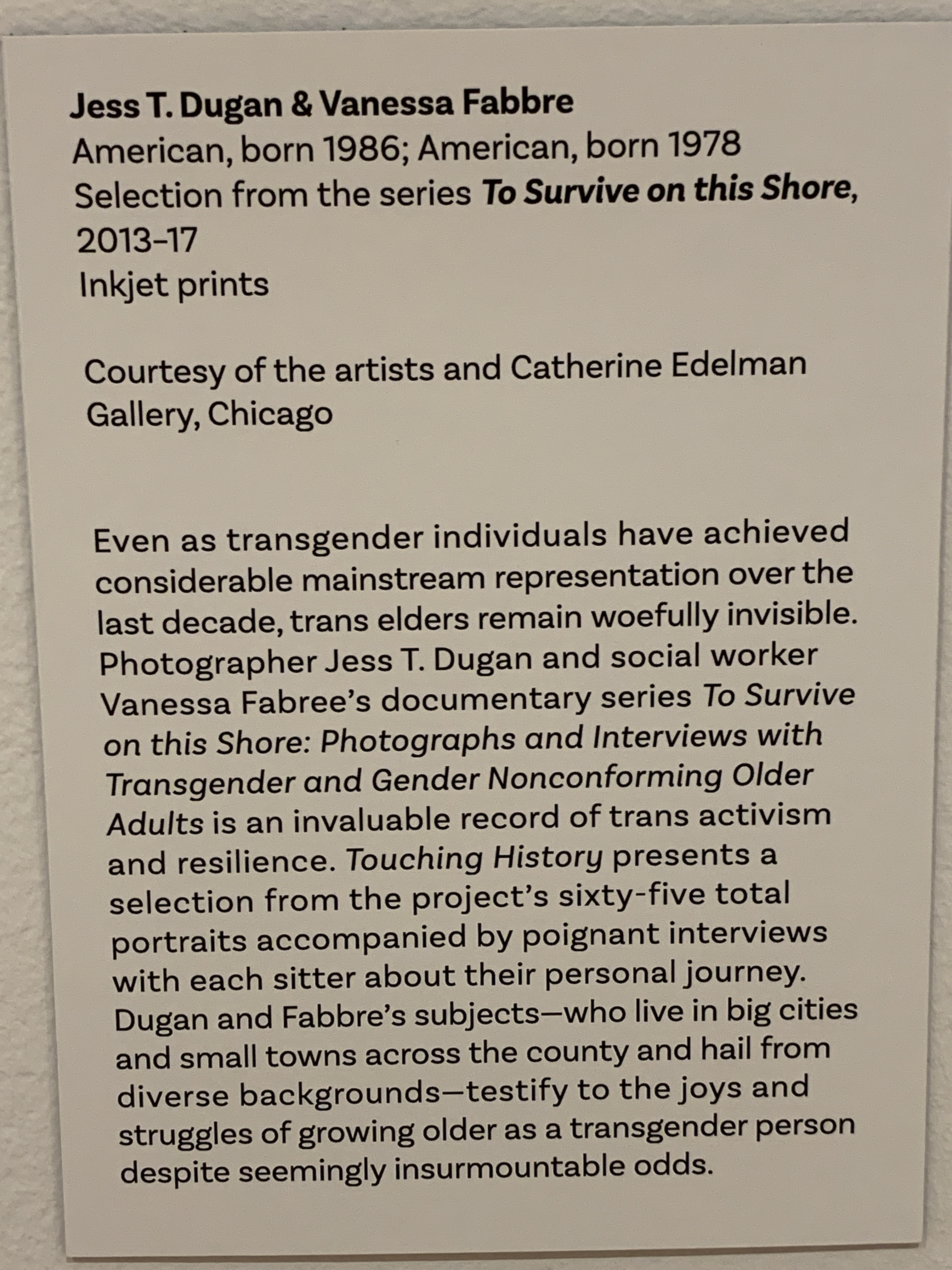
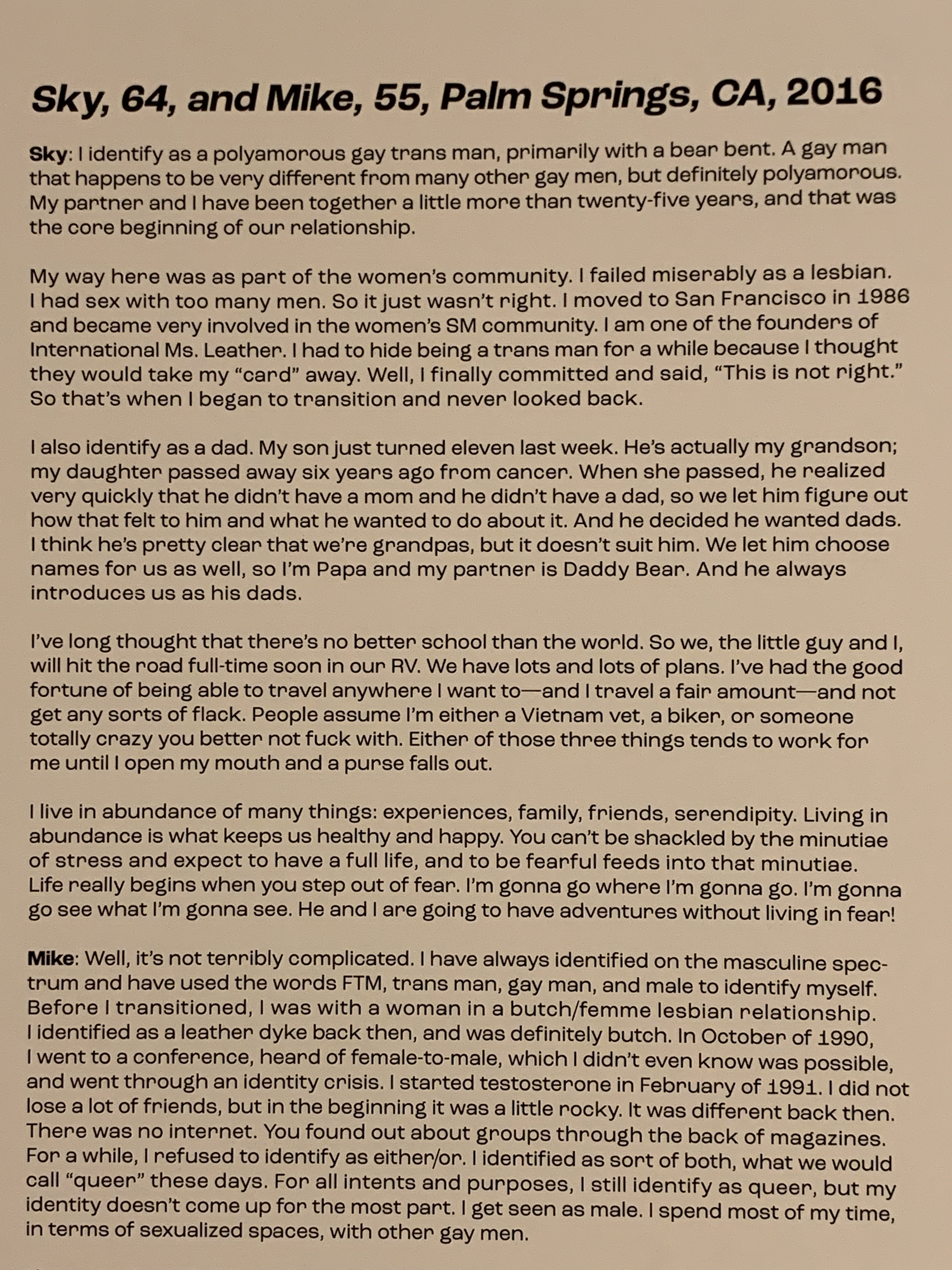
Jess T. Dugan and Vanessa Fabree’s portraits of trans elders are gorgeous.
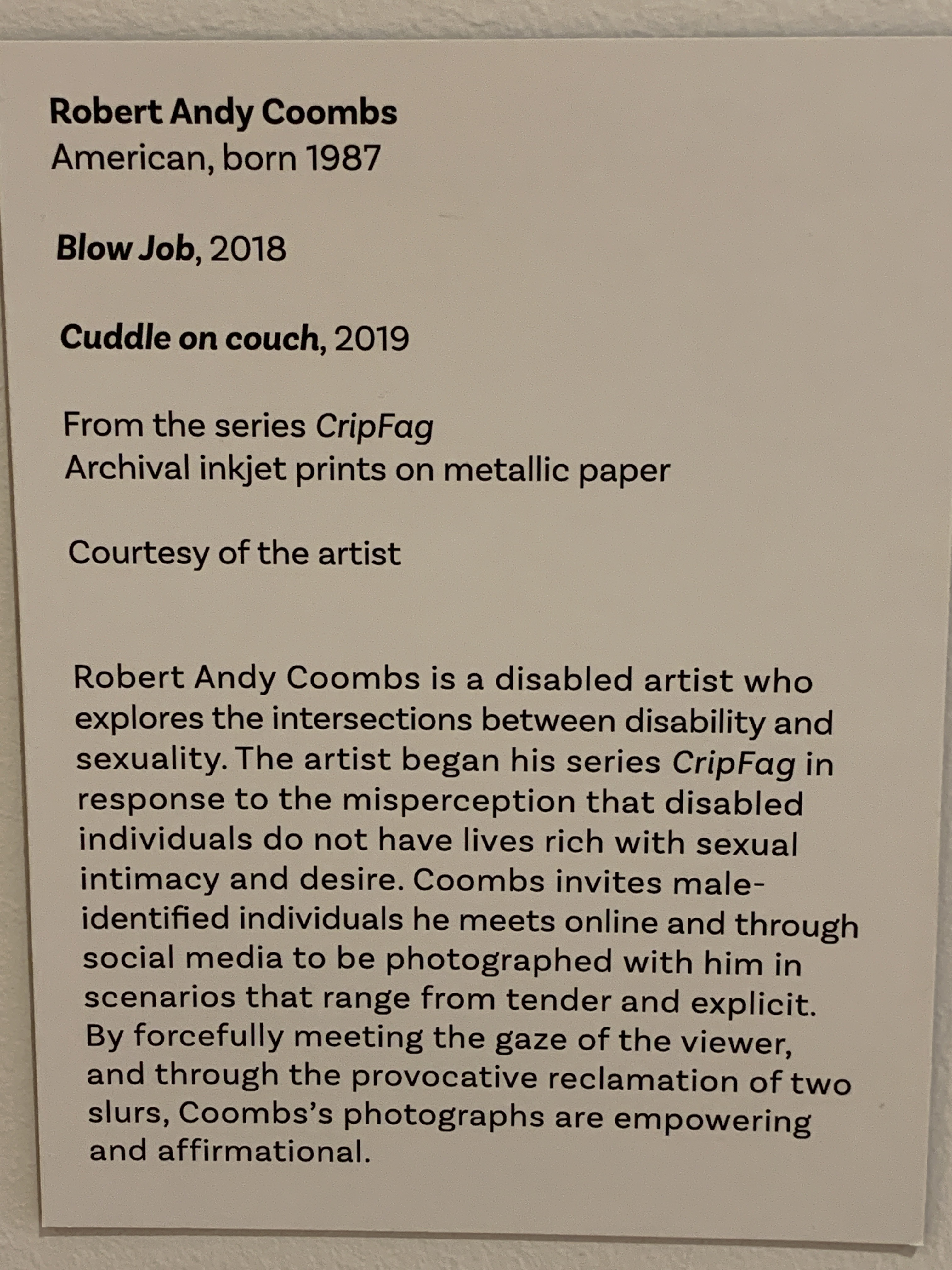
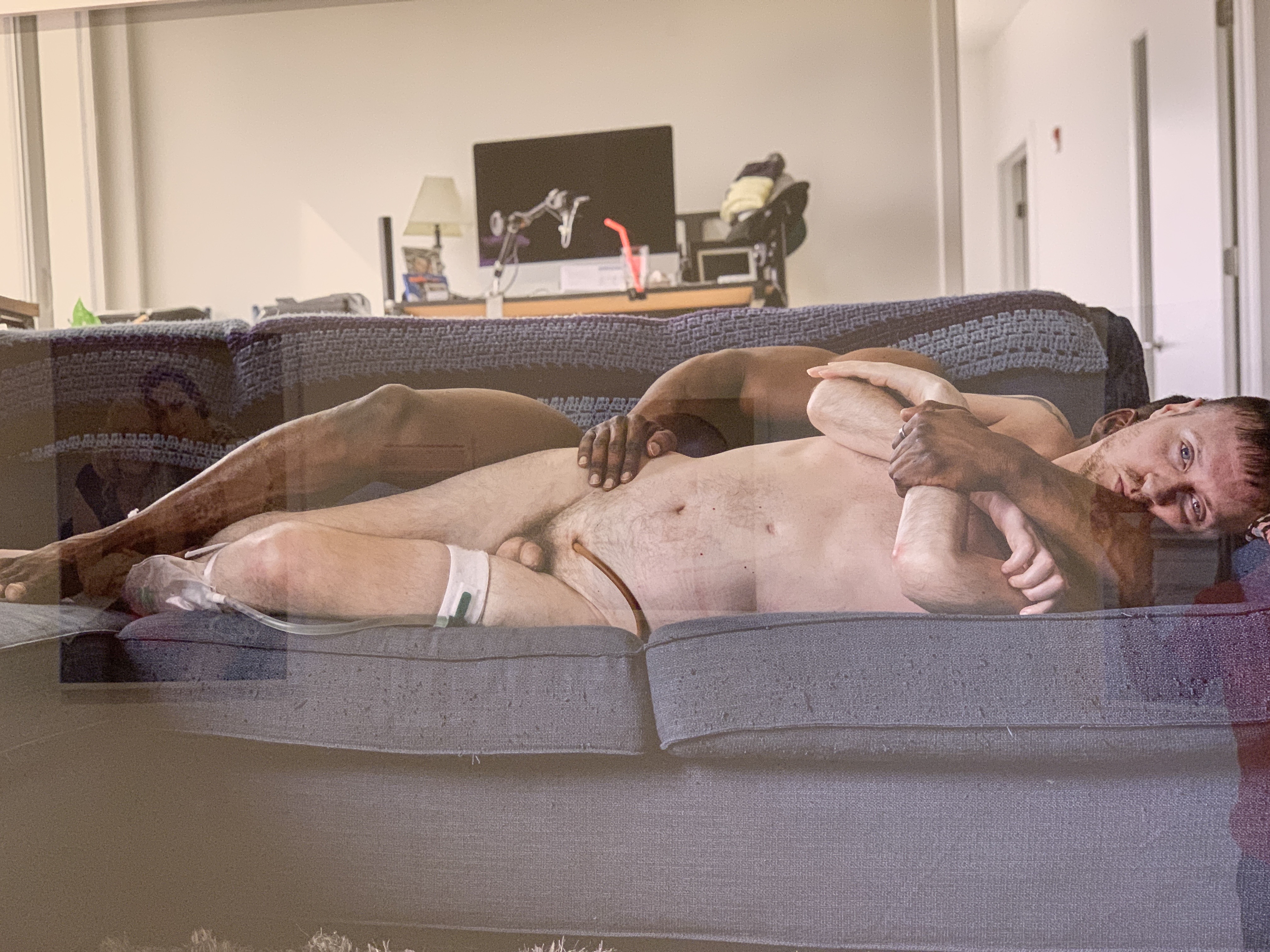
The first inkling I got about this show came from reading an article by Jerry Saltz in New York magazine about Robert Andy Coombs, the remarkable young white disabled artist whose work consists largely of beautiful, boldly erotic portraits of the artist interacting affectionately with naked friends. The article suggested that there was an entire show devoted to Coombs at the Palm Springs Art Museum. Actually, there are only two photographs by Coombs in the show but they’re amazing — intense, frank, beautiful.
Under the Radar, the annual festival of cutting-edge international work centered at the Public Theater, always opens the year with a bang. I feasted on three events in one day.
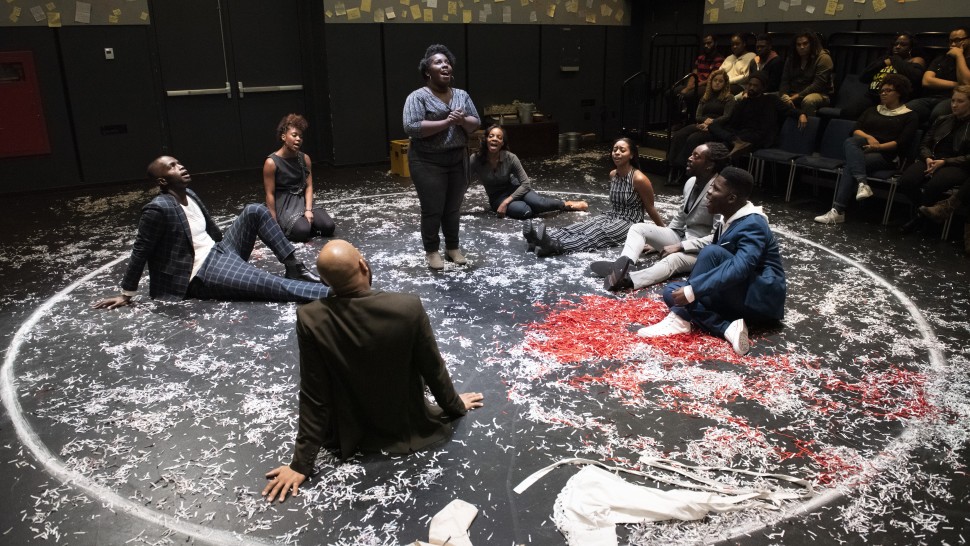
Aleshea Harris, one of the cadre of fierce amazingly original playwrights of color who’ve emerged in the last few years, created WHAT TO SEND UP WHEN IT GOES DOWN , which presents itself very specifically as a ritual first and foremost for black people to heal/address the situation of violence against black people in this country. “Please note that it is not often that Black people have a safe, public space for expressing their unfiltered feelings about anti-Blackness. We are taking that space today.” The playwright and the company she works with (Movement Theater Company) incorporate many elements of pagan ritual, African village ceremony, trauma therapy, and spiritual workshops to make every moment of the experience participatory, not sit-back-and-watch theater. Whitney White directed the uniformly strong performers: Alana Raquel Bowers, Rachel Christopher, Nemuna Ceesay, Ugo Chukwu, Kambi Gathesha, Denise Manning, Javon Q. Minter, and Beau Thom (above, photo by Ahron R. Foster).
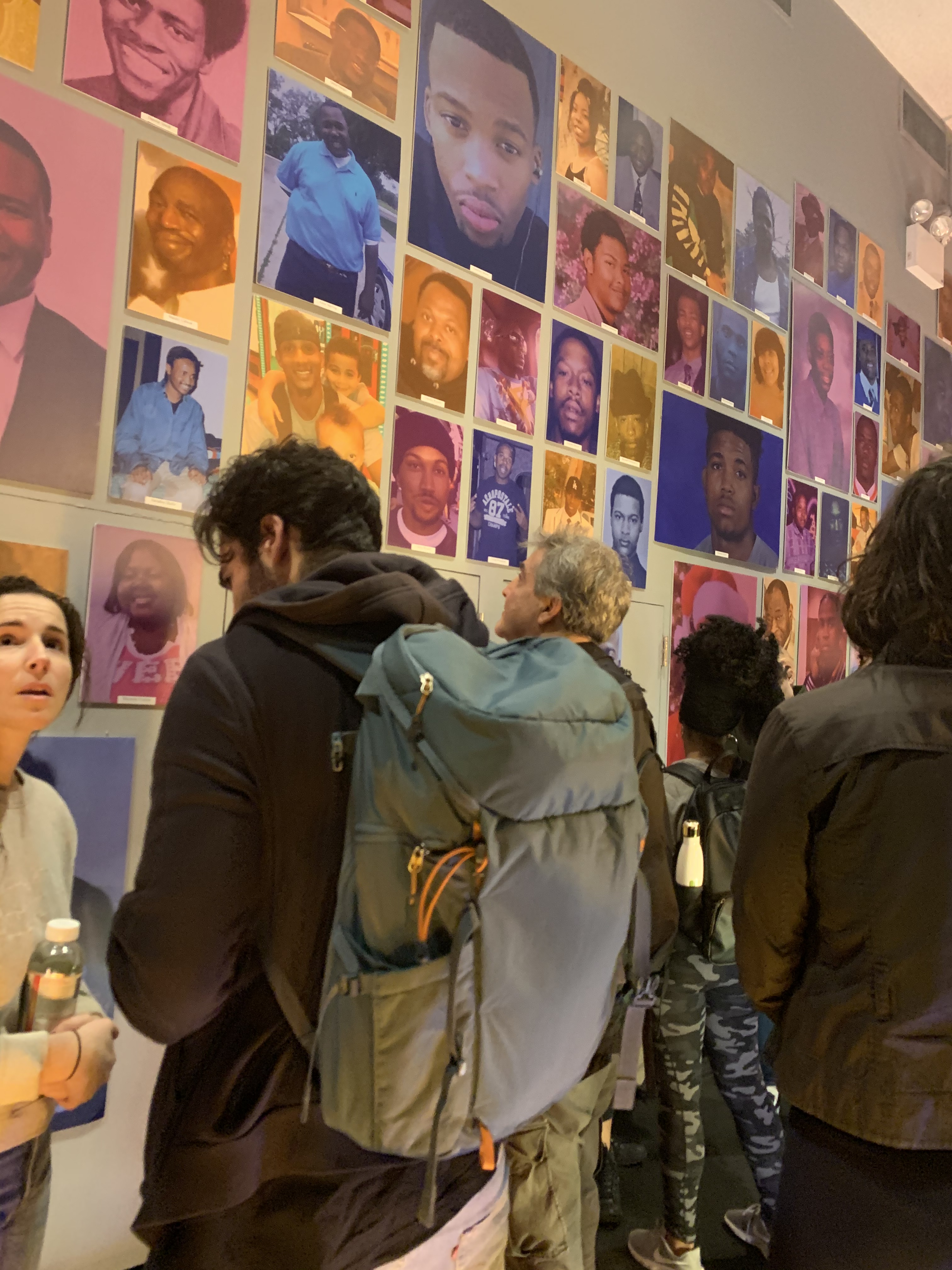
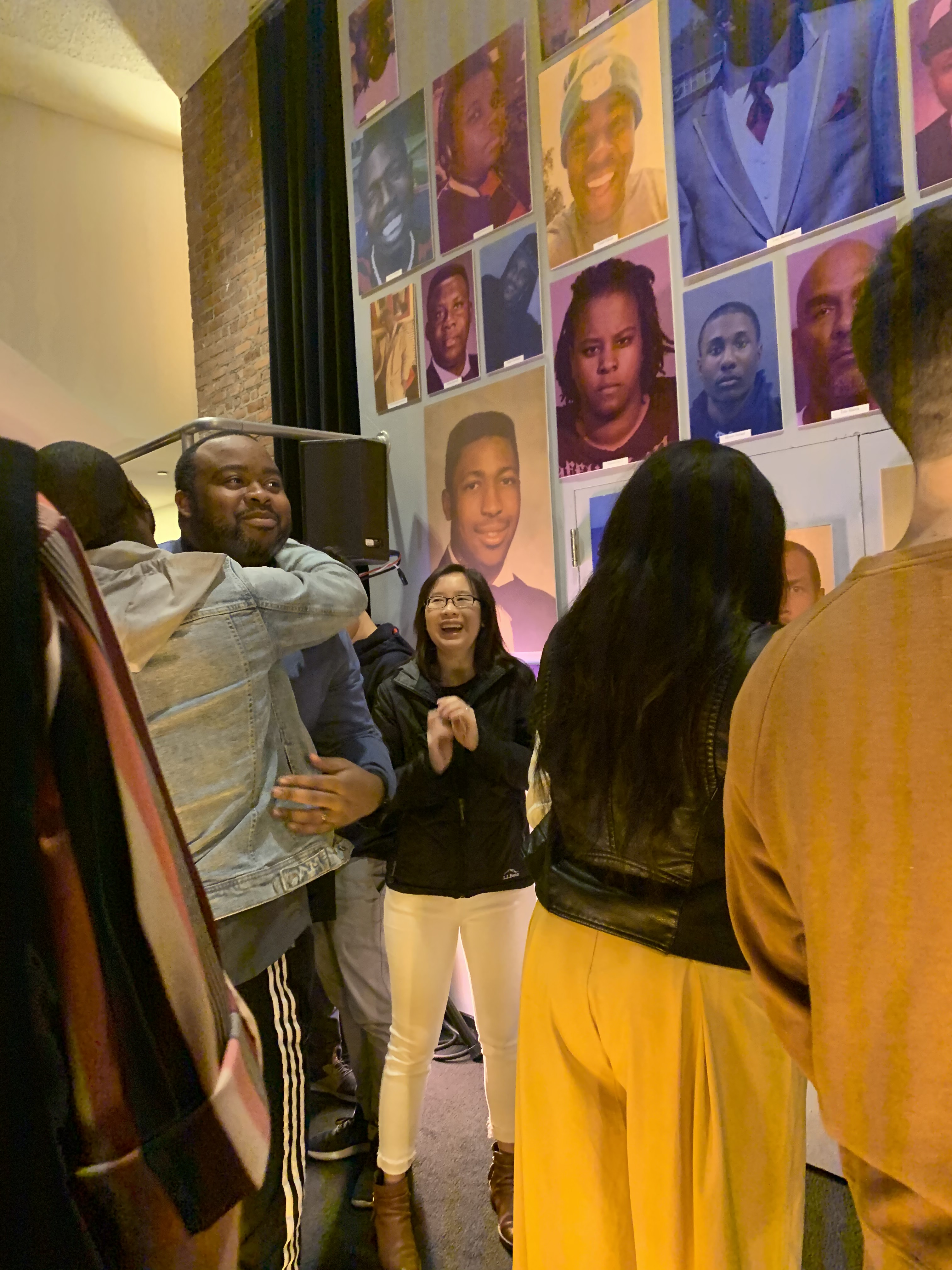
I read the text when it was published in American Theatre last year, which blew me away, and the experience itself is super-powerful, from gathering in the lobby surrounded by photographs of black people killed by police to the very end of the show, which looks different for black and non-black audience members. I took very much to heart the statement Harris has an actor read at the end of the show to the non-black audience: “A good friend once told me that we each have a different job where challenging racism is concerned. She spoke to the ways she could use her privilege as a white woman to dismantle the white supremacist ideology that contributes to the deaths of so many people. As a Black woman and writer, I am uniquely positioned to create a piece of theatre focused on making space for Black people. This is one way I can contribute. This is my offering. I’d like to end this ritual by challenging you to consider what you are uniquely positioned to offer. As a non-Black person, what is a tangible way you can disrupt the idea responsible for all these lives needlessly taken? My hope is that you will consider this deeply. My further hope is that your consideration will turn to action.” I have some ideas. I want to percolate more. WHAT WE SEND UP had a short run Off-Broadway last year and will have another short run at Playwrights Horizons this summer.
I went from that intense reality directly to the moon – via TO THE MOON, a 15-minute virtual reality piece co-created by Hsin-Chien Huang and Laurie Anderson. Five people at a time sit on stools wearing a headset and holding joysticks for a trip through space. There were some beautiful images and speeches familiar from Anderson’s recent work, but the piece as a whole was so SCARY! I’m not a gamer and I’m amazingly prone to vertigo, so I stayed pretty low to the ground. When the video provided the opportunity to fly through space or climb a high steep mountain, I had to shut my eyes. It was so crazy: I knew I was sitting on a stool with a headset on and my feet on the floor but my palms were sweating and I was making involuntary fear sounds.
Then I got to see MUKHAGNI, created and performed by a young-ish gay male couple, one of them Bengali-American (Shayok Misha Chowdury), the other biracial/African-American (Kameron Neal). They do the entire 90-minute performance totally naked: cook food, stand with video projected onto their naked bodies, lie on the (stage-soil-covered) floor speaking into microphones dangling inches above their faces, talk about death and death rituals in various cultures and cremation and their respective families. (The title means “mouth fire,” which is how cremations along the Ganges begin.) They take a pile of birch trunks and build a kind of square seating area, then they rearrange the tree trunks into a kind of bonfire structure. Then the lights come up and they sit in folding chairs and talk to the audience about their relationship in a funny structure (“on our 15th date we did this…on our 312th date we did that…on our 186th date we decided to make this piece,” etc.) — a regular activity on “dates” was to visit cemeteries — then there’s a mourning ritual where Chowdury creates a garland of fresh flower blossoms while Neal shaves his head with a clipper. So amazing and sweet and strong and not exactly like anything I’ve seen before. But it’s the sort of thing I’ve watched my friend Keith Hennessy create over the years, elements of spiritual ceremony combined with pop-culture savvy non-linear performance art. I wish this show would have a longer run somewhere. You can see more pictures on their website: http://www.shayokmishachowdhury.com/mukhagni
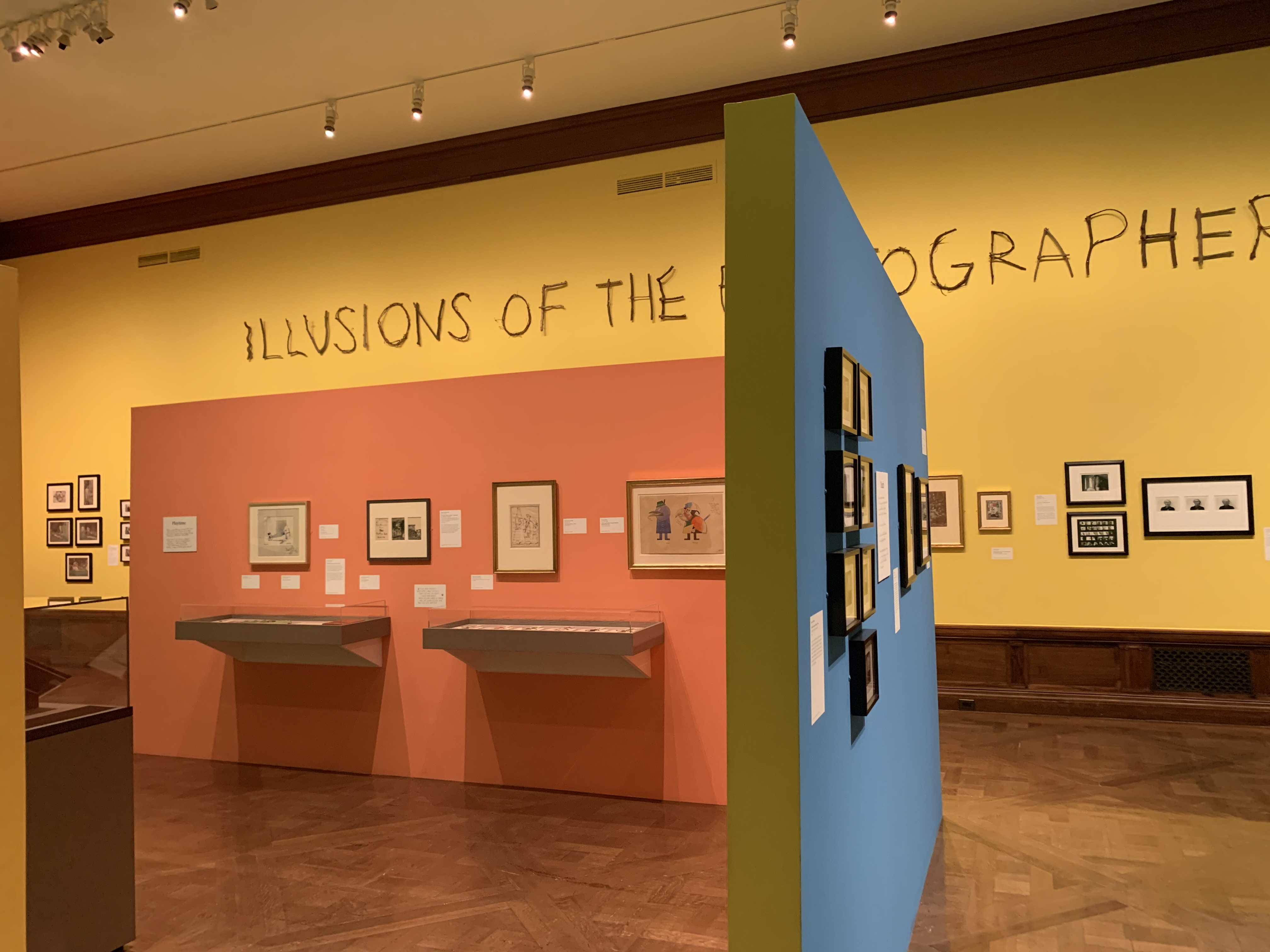
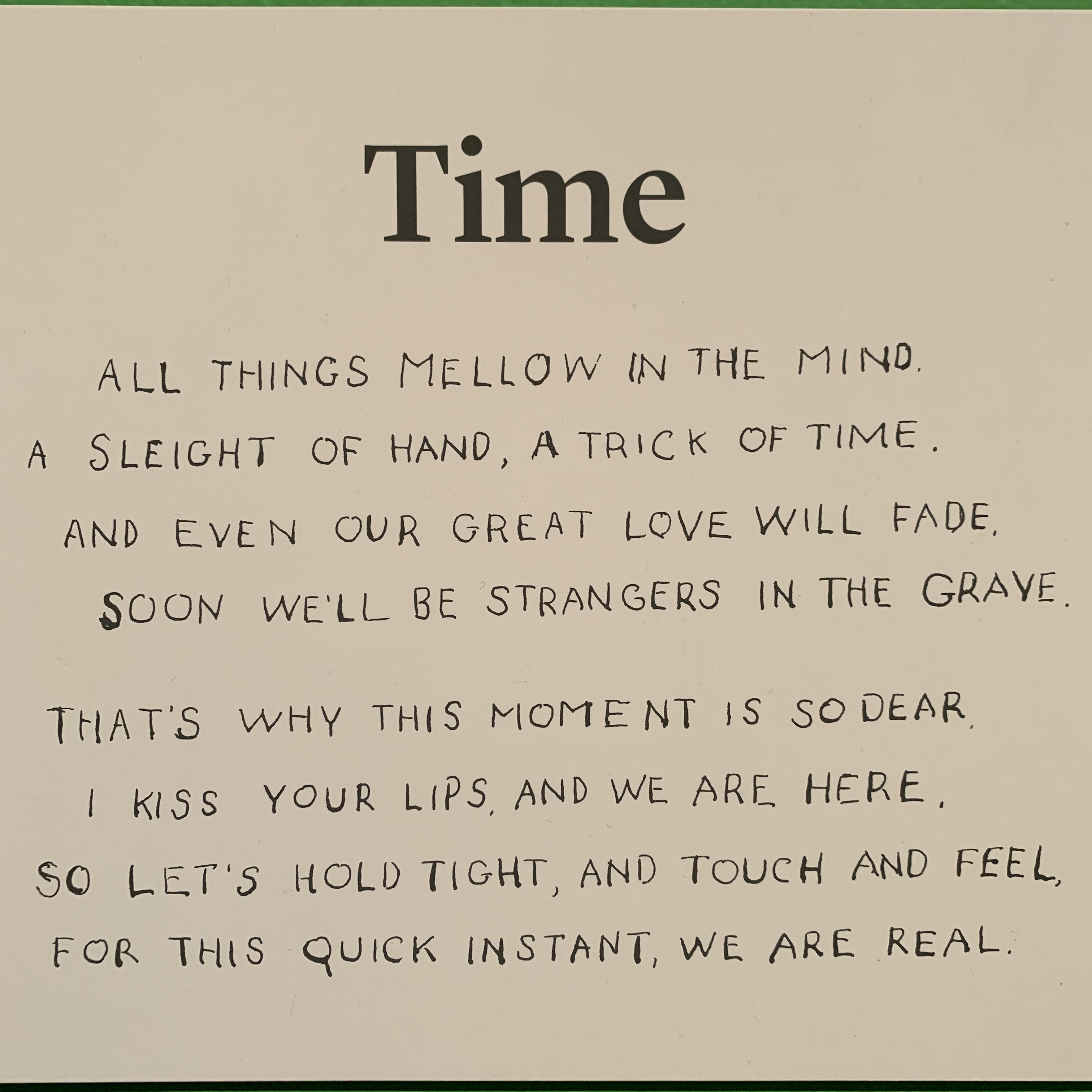
A few days later I met my friend Liam Cunningham at the Morgan Library to walk through the beautiful exhibition “Illusions of the Photographer: Duane Michals at the Morgan.” I’ve long admired Michals’s work, distinctive for the interplay of image and language, poems and sentences and stories handwritten in the margins around his usually black-and-white, often enigmatic photographs.
The show is partly a retrospective but also an “artist’s choice” event, meaning that Michals got to root around in the Morgan’s archives to pull out art works that struck his fancy or that resonate with his own work.
Liam (who is a legendary photographer in his own right) took this beautiful picture of me in front of Sol LeWitt’s giant Wall Drawing 552D.
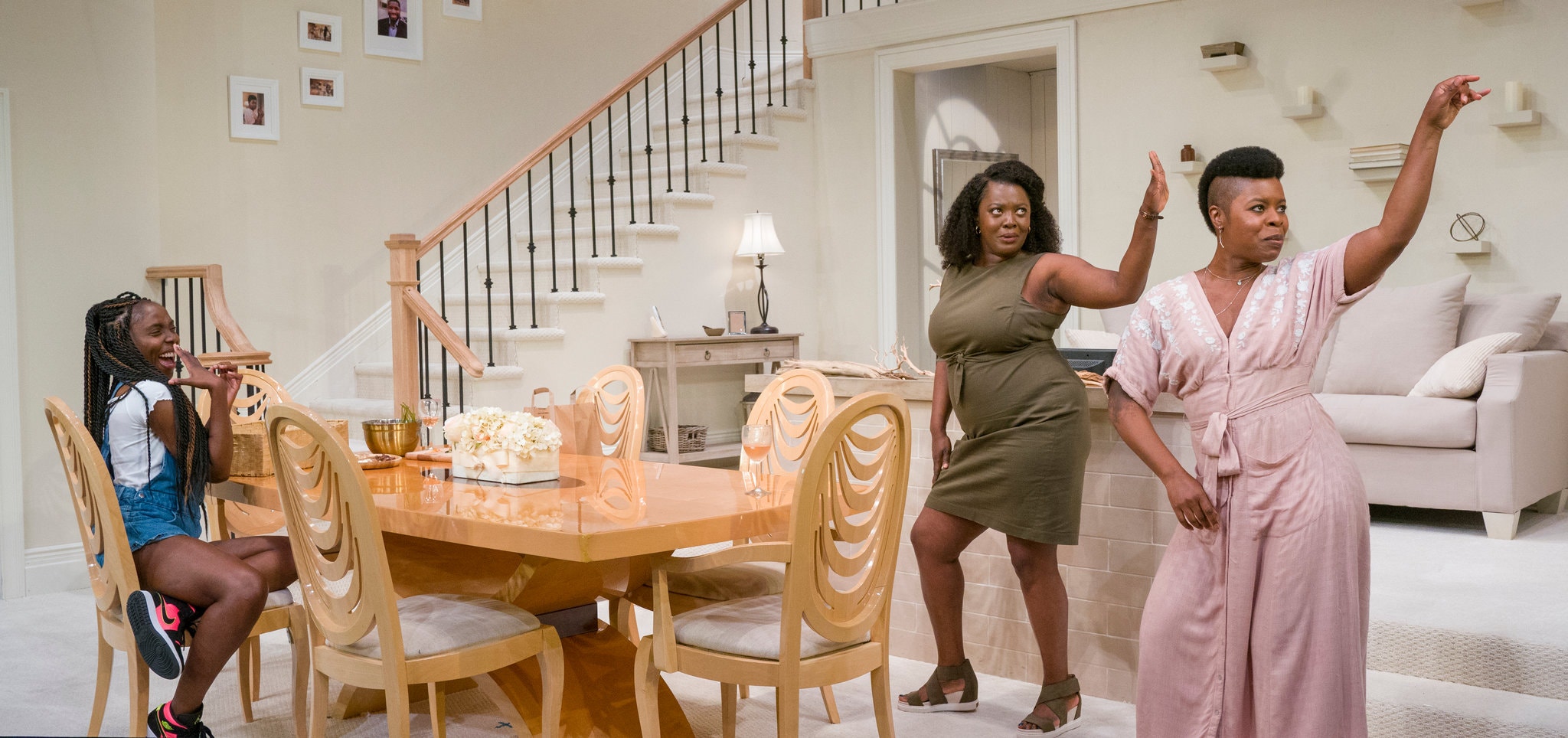
Fairview – I was a latecomer to Jackie Sibblies Drury’s Pulitzer Prize-winning play, having missed it at Soho Rep and caught up with it at Theater for a New Audience (in a bigger and I have to imagine more ideal space). The play, Sarah Benson’s production, Mimi Lien’s set, Raja Feather Kelly’s choreography, and the masterful ensemble (especially Mayaa Boateng, Heather Alicia Simms, and Roslyn Ruff, below, photo by Richard Termine) rocked my world with its canny employment of theatrical elements to dramatize how we perform race for each other.
2. Octet – Composer Dave Molloy continued to astonish with this a cappella musical about a 12-step group for internet addicts, with a superb cast directed by Annie Tippe with extraordinary music direction by Or Matias.
3. American Utopia – David Byrne turned his latest album tour into a Broadway spectacle with the help of choreographer Annie-B Parson, staging consultant Alex Timbers, lighting designer Rob Sinclair, and whoever devised the technology to allow the musicians to roam the stage as self-contained entities.
4. Hadestown – Pop songwriter Anaïs Mitchell’s adaptation of the Orpheus myth was a revelation to me, beautifully staged by the great Rachel Chavkin with a bunch of remarkable performances, including Amber Gray, Reeve Carney, and standout ensemble member Timothy Hughes.
5. To Kill a Mockingbird – Aaron Sorkin’s adaptation surpassed my expectations, thanks to Bartlett Sher’s tough production and Celia Keenan-Bolger’s indelible Scout.
6. Fefu and Her Friends – Lileana Blain-Cruz’s exquisite staging of Maria Irene Fornes’s famous, rarely seen 1977 theatrical groundbreaker, with excellent sets by Adam Rigg, costumes by Montana Levi Blanco, and top-notch performances by all, especially Amelia Workman and Brittany Bradford.
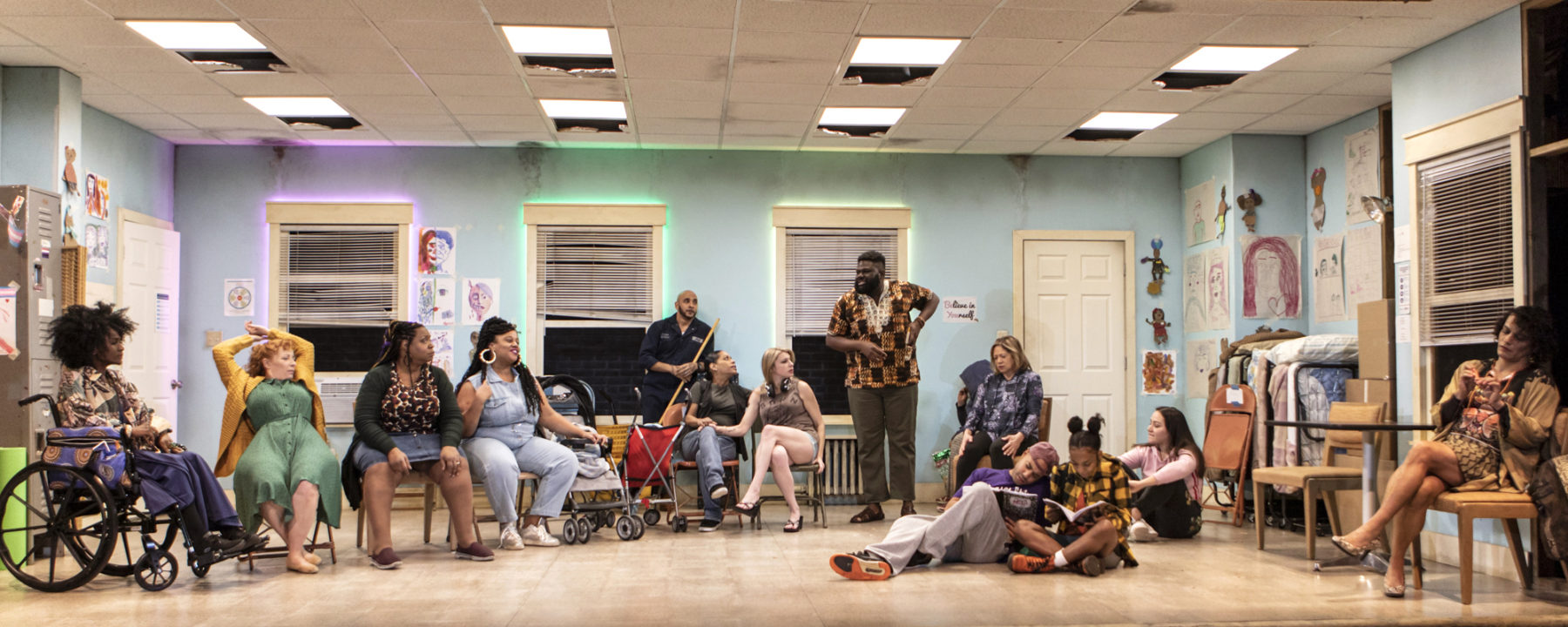
7. Halfway Bitches Go Straight to Heaven – another rich, messy, double-slice of life from Stephen Adly Giurgis with a crazy good ensemble (above, photo by Monique Carboni) directed by John Ortiz, especially Elizabeth Rodriguez, Kristina Poe, and the towering Liza Colón-Zayas.
“Daddy” A Melodrama – Jeremy O. Harris has unerring instincts for language, stories, and imagery that make theater electric. Like his Slave Play (currently on Broadway) and Black Exhibition (recently at Bushwick Starr, above, Miles Greenberg with Harris, photo by Sara Krulwich), Daddy made up for its imperfections with puppets, outrageous performances, and Alan Cumming suddenly grabbing a mic to sing George Michael’s “Father Figure” with a female gospel trio singing backup.
Adaku’s Revolt – MacArthur fellow Okwui Okpokwasili mounted this beautiful small piece for young audiences at the Abrons Arts Center.
Soft Power – David Henry Hwang and Jeanine Tesori collaborated on this curious, ambitious fun musical-within-a-play about reimagining The King and I from a Chinese point of view in order to heal the 2016 election results and Hwang’s experience of being stabbed.
Special Mention: Madonna’s Madame X show at the BAM Opera House was surprising, annoying, theatrical, and unforgettable.
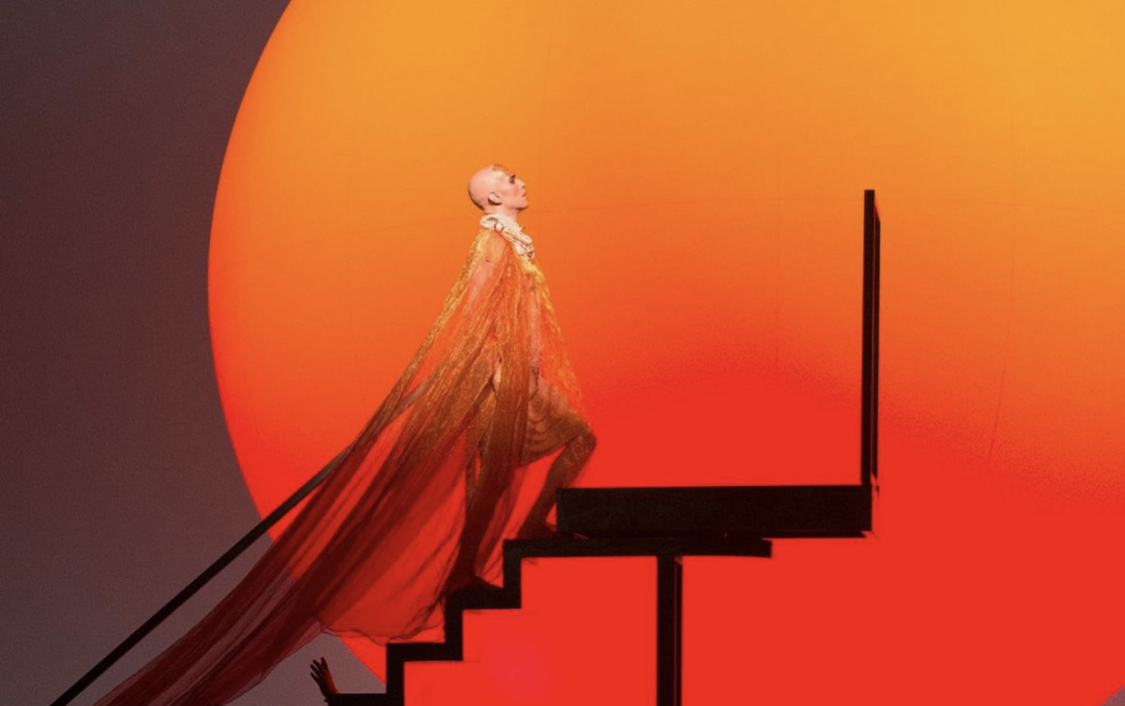
Other memorable performance highlights: Michael R. Jackson’s A Strange Loop, beautifully staged by Stephen Brackett with brave Larry Owen in the lead; Netta Yerushalmy’s epic Paramodernities at New York Live Arts; Becca Blackwell and Danielle Skraastad in Hurricane Diane; exquisite design and direction of Jackie Sibblies Drury’s Marys Seacole at LCT3 with Quincy Tyler Bernstine and Karen Kandel; Phelim McDermott’s beautiful campy production of Philip Glass’s Akhnaten at the Metropolitan Opera with a strong lead performance by counter-tenor Anthony Roth Costanzo (above); Lauren Patten in Jagged Little Pill; at least Part One of Matthew Lopez’s The Inheritance on Broadway; Jez Butterworth’s The Ferryman; Hannah Gadsby’s Douglas; Come Through, Bon Iver’s collaboration with TU Dance; and the Encores! Off-Center production of Al Carmines and Irene Fornes’s quirky, smart, devastating musical Promenade.


















 another eye opens