Archive for the 'Culture Vulture' Category

Culture Vulture: THE MILK OF SORROW and MASSIVE ATTACK VS. ADAM CURTIS

September 29, 2013

FILM

9-28 milk of sorrow

I’m headed to Peru for a three-week trip to Lima, Machu Picchu, the Sacred Valley, and the Amazonian jungle. To prepare, I thought I’d see what Netflix might have to offer me. It coughed up The Milk of Sorrow, a beautiful film directed by Claudia Llosa (niece of the famed writer Mario Vargas Llosa). The main character (played by Magaly Solier, above) was “born during terrorism” and so inherited the fears and traumas her mother experienced at the hands of extremists. In other words, she imbibed “the milk of sorrow” (the English translation of La teta asustada, “The Frightened Breast”). The film tracks her from her mother’s death, the watchful nurturing of her uncle, who lives nearby and whose family business is planning weddings, and her employment by a rich neurotic concert pianist who lives in The Big House in a very poor neighborhood in Lima. It’s no Chamber of Commerce piece — it’s like getting to know Portland by watching a Gus Van Sant film — but it’s gorgeous, poetic, elliptical, beautifully shot. Llosa is one of a growing batch of phenomenal female filmmakers in Latin America, definitely someone to watch. Speaking of translation, I was amused that whenever quinoa was mentioned, the subtitles would call it “quinine.”

MUSIC/PERFORMANCE

9-28 in the future

In the New York Times magazine Robert del Naja, a member of Massive Attack, describes the band’s collaboration with video artist Adam Curtis as a “drive-in movie on acid that’s completely mental.” Not a bad description of this unusual performance event at the Park Avenue Armory. Massive Attack vs. Adam Curtis marks the first time Massive Attack has played in NYC for many years, and it’s fitting for such a smart, cool band that it’s not your typical concert. They’re on a stage behind three of eleven giant screens onto which Curtis does his thing, which is splicing together unused found footage discarded from news broadcasts. The narrative is all over the place, starting with audio from the first rock concert in Afghanistan, bouncing back and forth from the U.S. to Russia, developing a kind of multimedia essay about the difficulties of revolutionary action, how the desire to change the world has morphed into managing data, and the political forces that want the masses to fall in step so that things happening “According to The Plan.” Curtis’s heart is in the right place, but his absorption with the visuals wreaks chaos with any sort of narrative. He throws in every possible calamity that’s happened in the last 50 years, and some of his points seem obvious and others have a spark of brilliance. One sequence shows frightened people looking up at the sky and running while a series of buildings explode, crumble, and burn — all scenes from Hollywood action films released before 2001. It’s easy in hindsight to see how the architects of the 9/11 attacks got some ideas about the damage they could cause.

9-28 how shitty i feel

Meanwhile, Massive Attack provides an almost constant musical score. They cover a wacky assortment of American pop oldies (“Baby, It’s You,” “The Twist”) and a few ’80s chestnuts (“Bela Lugosi’s Dead,” “The Sultans of Swing,” Nirvana’s arrangement of Leadbelly’s “In the Pines”) with snatches of their own songs and a few by little-known Russian punk bands. An ethereal-voiced female shows up to sing several songs, including “The Look of Love” and a sweet sad ballad in Russian whose chorus went “You don’t know how fucking shitty I feel all day long.” In the audience we were all buzzing — could that be Elizabeth Fraser from Cocteau Twins? It wasn’t but it was fun to imagine her on the premises. The sound was incredible, the band was amazing to hear live, the visuals were dazzling but the message was murky. I am curious to know more about Adam Curtis’s work and see more after reading the article about him in last week’s New York magazine.

9-28 horse shadow

Culture Vulture: LOVE’S LABOUR’S LOST, BLUE JASMINE, Amanda Palmer and Rosin Coven

August 11, 2013

THEATER

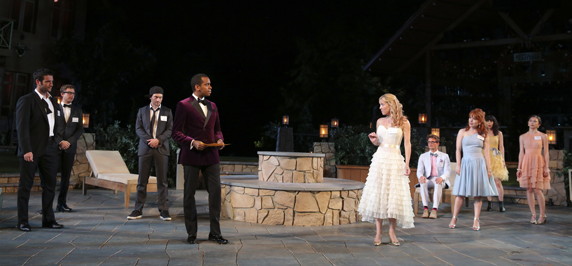
The musical adaptation of Love’s Labour’s Lost in Central Park reassembles the major dudes responsible for Bloody Bloody Andrew Jackson – writer/director Alex Timbers (who adapted Shakespeare’s early comedy), songwriter Michael Friedman, choreographer Danny Mefford, and some key players (Lucas Near-Verbrugghe and the hilarious Jeff Hiller). The show is even more fantastic than I could have dreamed it would be – a fast, funny, smart update of one of Shakespeare’s un-sacred texts. The four aristocrats renouncing pleasure are frat boys (they open the show ceremonially locking in a trunk a six-pack, a bong, and a string of condoms) who are as cute as a boy band. The four party girls who tease them out of their vows hit the stage like the cast of Bridesmaids crashing the set of Girls.

Love's Labour's Lost Public Theater/Delacorte Theater
The nutty secondary comic plot actually sizzles because of Caesar Samayoa’s brave and funny turn as Don Armado, with a lot of help from his Jacquenetta (Rebecca Naomi Jones, late of Murder Ballad) and the band (musical director Justin Levine jumps in and out of the action playing Moth). The cast is full of newly minted downtown stars – Daniel Breaker (Passing Strange), Colin Donnell (Anything Goes, the Encores! version of Merrily We Roll Along), Patti Murin (Lysistrata Jones), and, hello, Rachel Drach for good measure. I especially enjoyed Audrey Lynn Weston’s stoner-chick Katherine. Friedman’s songs are fiendishly witty (I think I heard the word “apothegms” fly by in one of the lyrics), and Timbers happily ladles in references to Hair, Passing Strange, and (for some reason) Einstein on the Beach. I would gladly see this show several more times. I can’t believe it’s not going to extend or move after its scheduled run in the park finishes next Sunday. It’s every bit as good as anything I’ve seen in Central Park.

MOVIES

I think I’d gotten a vague inkling that Woody Allen’s new movie Blue Jasmine somehow referenced A Streetcar Named Desire, but watching the movie I couldn’t believe how note-for-note the plot follows Tennessee Williams – one more instance of Woody Allen defying predictability. He’s been on a roll with his string of feel-good travelogue movies (Vicky Cristina Barcelona, Midnight in Paris, To Rome with Love), but Blue Jasmine breaks that cycle. Yes, it’s set in San Francisco (and the Hamptons) but it’s not a love letter to any location, and the story swerves dark. What makes the movie a must-see is Cate Blanchett, who has played Blanche DuBois onstage to rave reviews (wish I’d seen it) but here perfectly embodies Woody’s interpretation of Blanche (mixed in with Ruth Madoff) as a woman whose beauty allows her to deceive her way into powerful men’s hearts because her looks makes her vulnerability and desperation come across as strength. But the cast is full of yummy performances by terrific actors: Sally Hawkins in the Stella role, Bobby Cannavale and Andrew Dice Clay (!) as two versions of Stanley Kowalski, Louis C.K. as Karl Malden, plus Peter Saarsgard, Alec Baldwin, and Michael Stuhlbarg.

MUSIC

Amanda Palmer and the Grand Theft Orchestra headlined Friday night’s show at Lincoln Center Out of Doors in a light drizzle. AFP (as her legion of hardcore fans, including Andy, refer to Amanda Fucking Palmer) did a modified version of the concert she gave last fall at Webster Hall on the launch tour for her album Theater Is Evil – a couple of the major numbers from that release (including the hit-single-that-shoulda-been, “Do It With a Rock Star”); guest appearance by her former cohort from the Dresden Dolls, Brian Viglione; plenty of time spent off the stage moshing around with the folks standing in front of the stage; a couple of plaintive, emotional, inspiring solo numbers on ukulele; the odd cover (“Smells Like Teen Spirit”); encore of “Leeds United.” I confess that I dug the Webster Hall show a bit more, partly because the stomping crowd during the encore made the floorboards bounce, an effect not quite possible in Damrosch Park. For me the gift of the night was getting to hear the opening act, a quirky outfit known as Rosin Coven: a flame-tressed singer fronting a string trio, a vibes player, two horns, and a drummer. Andy called it “mystic Goth jazz,” not a bad summary – smart, ambitious, nutty and intriguing arrangements putting me in mind of Boston’s genius band of the mid-70s Orchestra Luna, with traces of Dan Hicks and his Hot Licks and Frank Zappa’s Mothers of Invention.

Culture Vulture: CRYSTAL FAIRY, THE ACT OF KILLING, James Turrell, MONKEY, and more

July 24, 2013

MOVIES

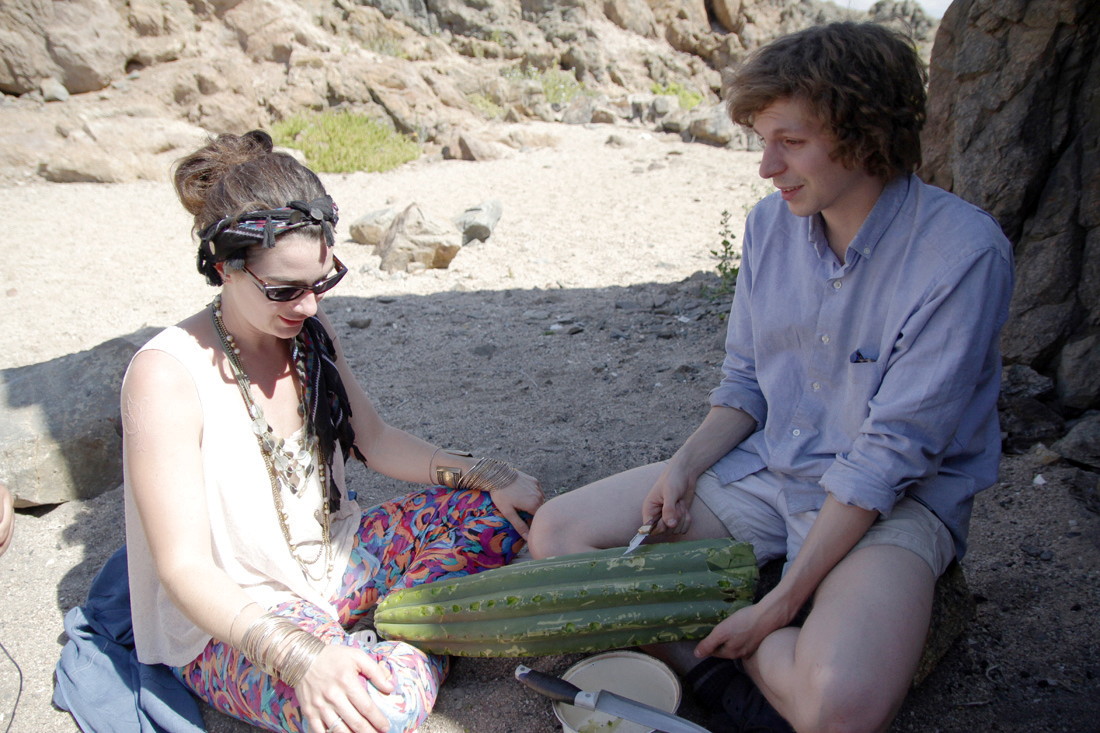
Crystal Fairy – Sebastian Silva’s feature debut stars Michael Cera (the adorable male ingénue from Juno and Superbad, though TV fans probably know him from Arrested Development) as Jamie, an American in Chile who has read Aldous Huxley’s essay on psychedelics, The Doors of Perception, and is intent on acquiring some San Pedro cactus, the native source of mescaline. He enlists his friend Champa in organizing a road trip with his two brothers (these three guys are played by the director’s actual brothers – Juan Andrés, José Miguel, and Agustin), and at a party the night before, loaded on too much booze and blow, he impulsively invites a wacky American girl who calls herself, yes, Crystal Fairy to join them. She is played by Gaby Hoffman, daughter of Warhol superstar Viva (of whom I’ve always been a big fan).

crystal fairy
The synopsis makes it sound like a charming and funny journey toward enlightenment, but it’s not that at all. The Michael Cera character could not be more disagreeable – in his single-minded quest for the holy grail, he is rude, obnoxious, and abusive to everyone in his path. Fascinating as drama, and big props to Cera for making the paradoxical casting really work, but quite unpleasant to sit through. Hoffman is pretty great, too, while playing a character who vacillates wildly from clueless exhibitionism to new-age wackadoodleness to quiet maturity

The Look of Love – Michael Winterbottom’s latest also sounds like a fun romp, a flashy cinematic biopic about Paul Raymond, whose earnings from strip clubs, girlie shows and lad mags, wisely invested in real estate, made him the richest man in London. It is a lot more fun-fun than Crystal Fairy, but at heart it’s a serious, nearly tragic depiction of Raymond’s relationship with his daughter, Debbie, whom he grooms as his business partner and presumed successor (neglecting several other children to do so) only to watch her spiral into drug addiction and an early death.

Although I don’t see everything and he’s very prolific, I’m pretty crazy about Winterbottom as a filmmaker. I love how he picks canny off-the-beaten-path subject matter, how he cycles restlessly through genres, and that he casts terrific actors (often Brits I’ve never heard of) and coaxes wonderful performances out of them. Steve Coogan is his go-to leading man, and he does a great job as Raymond, but the movie is full of yummy turns. I was most dazzled by Tamsin Egerton (below, with Winterbottom) as one of Raymond’s wives.

tamsin egerton michael winterbottom
The Act of Killing
– Joshua Oppenheimer’s mind-frying documentary concerns a gruesome chapter in living history. After the government of Indonesia was overthrown by the military in 1965, a genocide took place in which more than a million alleged communists, ethnic Chinese, union members, and intellectuals were exterminated in less than a year, killed by street gangs suddenly empowered to operate as death squads. Unlike Nazi Germany, Rwanda, Cambodia or Bosnia, Indonesia has never been called to confront or account for these events as war crimes, so the perpetrators remain in power. Oppenheimer somehow befriended a pocket of these killers in northern Sumatra and convinced them to take part in this film. The central figure, a reasonably well-spoken and seemingly dignified guy named Anwar Congo, repeatedly espouses the belief that “gangster” means “free man,” and he is perfectly happy to demonstrate the cheap and efficient manner he developed of strangling his victims with a length of wire attached to a post. You can’t believe the outrageous things Congo and his comrades allow the director to capture on film – and then the director plays the footage back to them and records their commentary. Sometimes the consequences of what they’ve done sink in and some flicker of remorse emerges, but not always. They not only reminisce boastfully about how ruthlessly and efficiently they slaughtered their victims, they also enthusiastically stage elaborate reenactments of key scenes, dramatizing them in the style of their favorite Hollywood movies – westerns, Bollywood musicals, and gangster films. (Congo’s hyper-aggressive sidekick, Herman Koto, seems to be a big John Waters fan – he never hesitates to appear in scary drag — see below.)

7-21 congo koto
Half the time you can’t believe the crazy things they’re saying and doing. It’s a harrowing and upsetting and extremely powerful film, really worth seeing and talking about. One of the most unnerving things about it is that when the credits roll, you notice that most of the production crew, for their own safety, are listed as “Anonymous,” including one of the co-producers. The website for the film provides some very interesting background information.

7-21 anonymous credits

ART

Last Friday morning Andy and I and Keith Hennessy’s boyfriend Adam Kuby (visiting from Portland for the day) made a pilgrimage to one of the blockbuster art shows of the moment, the James Turrell exhibit at the Guggenheim Museum. There was a long line to get in but it moved pretty quickly – we were in the door within 20 minutes, and shortly after that we were lying on our backs on the floor of the rotunda witnessing the main event of the show, a piece called Aten Reign. Turrell, a conceptual artist whose chief medium is light, has converted the Guggy’s famous spiral into a multi-tiered cone emanating concentric circles of gorgeous light continuously shifting color and intensity. Like everyone else, we had our smartphones out immediately to take pictures.

7-19 turrell blog1 7-19 turrell blog3 7-19 turrell blog2
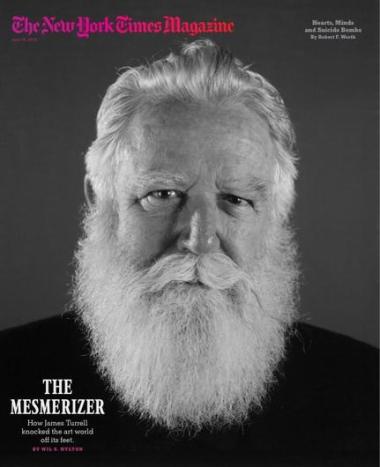
It’s savvy marketing for the Guggenheim to encourage picture-taking AND it’s a cosmic joke for several reasons. Turrell’s beautifully chosen lighting discombobulates your camera’s color-recognition capabilities. What you’re seeing never matches what your camera can capture. And even though you can get some gorgeous photos this way (check out my photodiary shots), it’s almost impossible to tell what you’re looking at because Turrell’s work toys so masterfully with dimension and flatness. It is, in a certain way, his one trick – making light simply projected onto flat surfaces look three-dimensional, or lighting depths in such a way as to make them look flat. (Is that two tricks or one?) The single example of the latter phenomenon on view at the Guggenheim, a piece called “Illtar,” is very very subtle and takes time to really perceive – and unfortunately it’s installed in a less than optimal  manner. Although the room is small and the number of viewers limited, I could never get a purchase on it (after waiting on yet another line for half an hour to see it). Nevertheless, the Guggenheim show is a great opportunity to tap into an artist who’s sustained a deep original vision for a very long time. For a good overview, check out the New York Times Magazine’s recent profile of him.

turrell times mag cover

MUSIC

That evening, Adam and Andy and I had the pleasure of encountering another artist with a highly individualized vision cultivated over the course of several decades. When Karlheinz Stockhausen died in 2007, he had completed a magnum opus called Licht, a cycle in seven parts that takes 29 hours to perform in full. It is an elaborate, quirky mythopoeic “opera” with no singers in which each day of the week has its own color – just to mention a few of its eccentricities. The Lincoln Center Festival wisely bit off just a chunk of this giant work, a one-hour selection from Act II of Donnerstag aus Licht (“Thursday”) called Michaels Reise um die Erde (Michael’s Journey Around the Earth). It was originally staged at Vienna’s Taschenoper by Carlus Padrissa, a member of the wildly adventurous Catalonian performance company La Fura dels Baus, featuring the Cologne-based Ensemble musikFabrik. Stockhausen’s score is characteristically modern, which is to say not especially melodic. Heavy on horns, it reminded me at times of some of Frank Zappa’s whimsical/lyrical classic compositions, and it was exquisitely played by the ensemble.

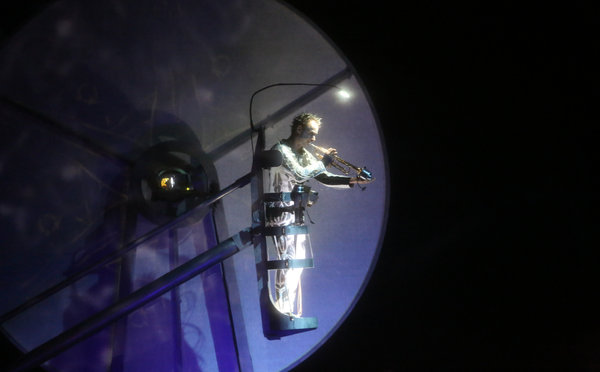
MICHAELS-articleLarge
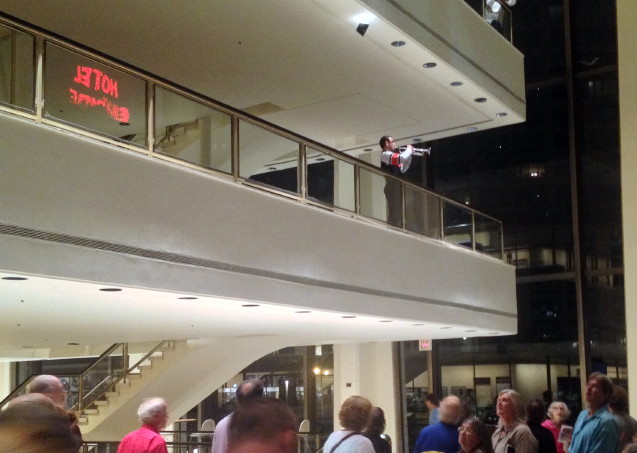
Just by itself, it might have been a little dry to sit through, but Padrissa came up with an elaborate visual production with striking and witty projections, colorful costumes, and an amazing contraption for the trumpeter who plays the Archangel Michael – a kind of cage he’s strapped into that revolves him through space so at times he’s playing upside down. In the piece, Michael flies around the world making stops in Cologne, New York, Japan, Bali, India, Central Africa, and Jerusalem. The program notes mention the musical motifs that Stockhausen used to refer to these locations but they’re laughably glancing. There’s a lot to make fun of about Stockhausen – in his vision, Thursday is associated with the color blue, so the audience at Avery Fisher Hall was encouraged to wear bright blue clothing (they stopped short of issuing uniform smocks the way Park Avenue Armory did for the staging of Oktaphonie earlier this year) – but I admire his mind and his effort. Adam and I enjoyed the concert more than Andy, who chafed at the lack of melody to follow. Departing the theater the audience was serenaded by five musicians playing a farewell piece from the balconies of Avery Fisher Hall (below) – a final lovely, quirky treat. The program notes, generous and informative, can be read online here.

7-19 post show trumpets

THEATER

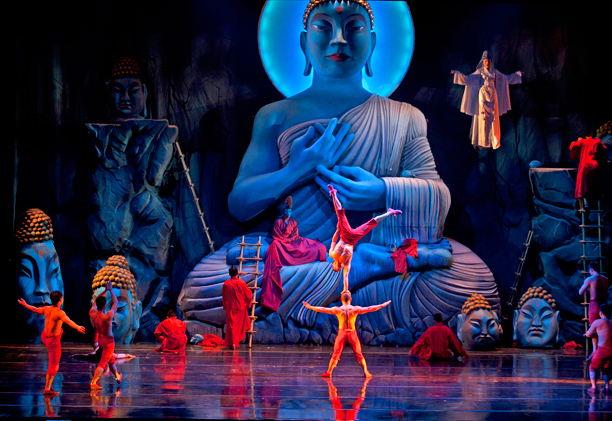
Lincoln Center Festival pitched Monkey: Journey to the West as a big deal, scheduling a whole month of performances. An adaptation of the classic Chinese novel Journey to the West, the show was directed by Chen Shi-Zheng, a youngish hotshot favorite of the festival, as a kind of rock and roll opera circus with music by Damon Albarn of the rock band Blur and visual design by Gorillaz (the virtual band Albarn co-created with Jamie Hewlett) and skills acts performed by the Jiangsu Yancheng Acrobatic Company. The still photos make it look amazing, but the show was unbelievably bad. Truly, one of the worst things I’ve seen in years. A smidgen of cool animation buried by lame staging, shallow spectacle, pathetically anemic acrobatics, underwhelming music — ugh. Festival kitsch.

monkey-journey-to-the-west

Culture Vulture: Steve Kazee, THE NANCE, THE DESIGNATED MOURNER, Edmund White on Rimbaud, and more

July 10, 2013

CULTURE VULTURE

MUSIC

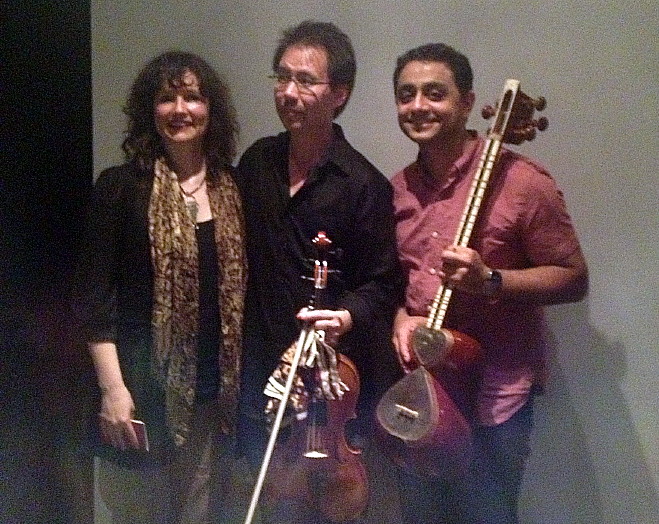
7/4/13 – Since I’m not a big fan of flag-waving, fireworks, and/or hot dogs, I was happy to spend part of my Fourth of July evening at the Stone, the tiny storefront music venue founded by John Zorn deep in the heart of the East Village at the corner of 2nd Street and Avenue C. The place is very basic and stripped-down – it sells no refreshments and no merchandise, just music, with a very cheap door charge ($15 tonight). Different musicians curate a whole series of performances each week. This week’s honcho was Eyvind Kang (below center), who has played violin and viola with the likes of Laurie Anderson and Bill Frisell. He lives in Vashon, WA, with his wife Jessika Kenney, a spectacularly talented singer who often appears as a guest for concerts of Javanese gamelan given by the group I play with, Gamelan Kusuma Laras.

7-4 jessika eyvind hidayat honari
For this occasion, the two of them were joined by tar and setar player Hidayat Honari for a program called “Rokh-e Khåk (رخ خاک),” an hour of classical Persian music – new, old, and improvised tunes with texts taken from the poetry of Hafiz, the 14th century Persian mystic. I know Hafiz’s work mostly from the sly, ecstatic English versions by Robert Bly. It was utterly transporting to hear this trio perform this music and to experience Jessika’s amazing, soulful voice communing with ancient Arabic. Apparently, the three of them all study with the same Persian master. It was a sweltering night, so Eyvind thoughtfully created an intermission after half an hour to turn the air conditioning and fan on for a while before resuming.

54 Below Press Preview - Barbara Cook, Steve Kazee & Jonathan Tunick With Rebecca Faulkenberry

7.8.13 — Handsome and talented Steve Kazee’s warm, expressive voice made him a star on Broadway and won him the Tony Award for Once, so I was excited to see his cabaret act at 54 Below. He appeared onstage with his four-piece rock band, the Shiny Liars, two guys (on bass and drums) and two gals (Elizabeth Davis, his fellow Once cast member who’s married to the bass player, and singer-songwriter Lora-Faye Whelan) and performed a set of all original material, which was okay but not especially memorable. He made it a point to tell the audience right away he wouldn’t be singing any songs from Once, and later he mentioned that any women he encountered on OK Cupid who mentioned seeing him in the show would instantly be blocked – which I thought was weirdly hostile. There is something strangely uneasy about his personality – he seemed surprisingly insecure, couldn’t believe how quiet and attentive the audience was, kept apologizing for using swear words, fretted about not having enough material to fill an hour-long show, and floated several negative comments he imagined audience members might be thinking, which came off as defensive, paranoid, not very attractive. Except for a tune about his mother (who died shortly after Once opened on Broadway), much of his material consisted of romantic break-up numbers or “Fuck you” songs, and a picture of him started to form as a bitter, arrogant dick. I’d prefer to believe that he was just very very nervous, and when I went online to check out his website I noted that he had to leave Once prematurely because of an injury to his vocal cords, which would make any rising star pretty unhappy, I should think. 

DVD

greenberg
Greenberg  — I’m fascinated by Noah Baumbach without feeling obliged to see every single one of his films. I caught up with Greenberg via Netflix mostly out of curiosity because it apparently brought about the end of his marriage to Jennifer Jason Leigh (whom I admire tremendously) and the beginning of his relationship with Greta Gerwig, about whom I have not formed a definitive opinion. She’s strange-looking, sort of pretty and sort of lumpy, a little like Lena Dunham, although more than anything else she reminds me of Aimee Mann. Gerwig is a brave soul, willing to throw herself into roles that require awkward and unpleasant self-exposure. Actually, that might be a perfect description of the Noah Baumbach School of Cinema: awkward and unpleasant self-exposure. Greenberg certainly demands plenty of that from Ben Stiller, who plays the eponym, a disagreeable chap who’s younger and better-looking yet even more neurotic than any Woody Allen character ever. The running joke of the movie is that he incessantly writes complaint letters. Interesting, quirky film. I liked it, didn’t love it.
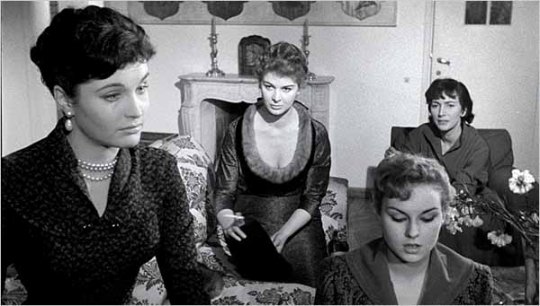
Yvonne Furneaux, Eleonora Rossi Drago, Valentina Cortese, and Anna Maria Pancani (from left to right) in a scene from Michelangelo Antonioni's LE AMICHE (1955)

Yvonne Furneaux, Eleonora Rossi Drago, Valentina Cortese, and Anna Maria Pancani (from left to right) in a scene from Michelangelo Antonioni’s LE AMICHE (1955)

Le Amiche – Whatever qualities you might associate with Antonioni (long, slow, taciturn, full of dry and not especially sensual shots of women’s naked backs) do not characterize this early (1955) black-and-white film (whose title in English is “The Girlfriends”). It’s screwball-comedy fast with people talking nonstop with the kind of peculiar, fleetly observed comic behavior more familiar from early Fellini and the visual luxuriousness of Max Ophuls, dominated with remarkably strong female characters, many of them modern businesswomen whose romantic interactions with hunky but emotionally immature men don’t follow predictable narrative contours. Some of the acting stays soap-opera shallow but mostly I found the movie riveting and bracing.

THEATER

the nance

7.5.13The Nance, Douglas Carter Beane’s newest play produced by Lincoln Center Theater at the Lyceum Theater on Broadway, honorably intends to convey two lessons about gay history to younger generations: 1) there was a time not so very long ago (the play is set in 1937) when the socially repressive policies we hear about in places like Uganda and Iraq pertained in New York City – gay guys could get arrested just for cruising other men in public; and 2) at the very same time, behavior that was deemed socially unacceptable and legally sanctioned played for laughs on burlesque stages, where the strippers, novelty acts, singers, and vaudevillean comics sometimes incorporated “queer doings,” skits and sketches featuring campy clownish depictions of effeminate men (fairies, pansies, or nances, in the parlance of the day). I’m familiar with the cinematic equivalents of these caricatures, played by the likes of Franklin Pangborn and Edward Everett Horton, but I don’t know much about this stage history. Beane apparently extrapolated the germ of his play from some pages in the classic history book Gay New York by George Chauncey; as a tip of the hat, he named the title character (played by Nathan Lane) Chauncey Miller. The play that contains these history lessons unfortunately comes across as a clumsy mixture of musical comedy, romance, and social commentary, with a lot of contemporary political attitudinizing retroactively laden onto a period piece. The politically conservative Chauncey proudly proclaims himself a Republican – but the term had a very different political meaning in the ‘30s and didn’t invite the same sort of badge-wearing it does today. And the romance between Chauncey and Ned, a young guy from the sticks he picks up at the Automat (played by Jonny Orsini), never feels authentic – Beane shoves them around to dramatize the conflict between monogamy-minded nesters (Ned) and intimacy-averse promiscuous guys (Chauncey).

7.6.13Wallace Shawn’s The Designated Mourner takes place in a world that looks similar to ours and yet scary and alien at the same time. The government and the military have started to merge, and intellectual life is coming under siege, at first with occasional and remote acts of repression that become more frequent, more brutal, and closer to home. Shawn himself plays Jack, the title character, the hapless narrator of this tale from his perspective – both intimate and envious — just outside a literary social circle that revolves around Howard (Larry Pine), a prominent poet and the father of Jack’s wife Judy (Deborah Eisenberg). It’s one of the most impressive plays I’ve ever encountered – dense, deep, dark, disturbing, and yet in Andre Gregory’s production at the Public Theater it’s also amazingly entertaining, funny, and theatrical. The same cast and crew did this show at a disused gentleman’s club in the financial district in 2000 for an audience of 30 every night. The production at the Public looks and feels quite different and yet equally intimate and impressive. It’s so easy to think of Wally Shawn as an enjoyable character actor in lots and lots of movies – with this production, it’s impossible not to be bowled over by the mastery of his performance, all the more spectacular because it’s not especially showy or dramatic. Yet his energy and focus and how he manages to surf the play’s mind-boggling swerves from domestic chitchat to philosophical exploration to reporting of horrendous events to smug self-blindness is utterly remarkable. Pine and Eisenberg do equally impressive, haunted performances under difficult circumstances — they are onstage, often silent, always implicated.

designated mourner playbill
I think anyone who cares about theater of substance will want to see this play. I’ve already bought tickets to see the show again. If you don’t live in New York so can’t see the play live, you might be interested to know that there is a radio version of the play available online here: http://www.wnyc.org/articles/arts/2006/jul/18/the-designated-mourner/. And there is a film version of the London premiere production, which is directed by the playwright David Hare and stars none other than Mike Nichols.

At the Public Theater, I was fascinated to observe how Wally makes himself available after the show. He’s just given a relentless and intense three-hour performance, and yet as the audience files out of the theater, there he stands, smiling and open to meeting and greeting anyone who cares to approach. I’ve known him for 30 years and was happy to chat and praise his performance, and he graciously introduced me to Andre Gregory, whom I’d never met and whose work I also cherish. But I also enjoyed observing the different ways that audience members interact with him – from the earnest young theater scholar who’s clearly composed an entire essay about the playwright’s work that he intently wants to share on the spot to the individual who stands 10 feet away and snaps a flash photo without asking. Andy was tickled to meet Wally and also a little weirded out that we’ve now seen three shows at the Public Theater that ended without curtain calls for the actors.

ART

I tried once again to check out Random International’s popular environmental piece Rain Room at MOMA, but even at 9:00, half an hour before the museum opened for Member Early Hours, there were already 50 people in line, which meant standing in the queue for at least an hour, and frankly I just don’t have the stamina to wait that long. That’s how I missed Christian Marclay’s The Clock and the Alexander McQueen show at the Met, and I never even got in line to lock eyes with Marina Abramovic. I’m delighted for the success of these cutting-edge art spectacles, but this waiting in line things seems geared to…whom? People who grew up standing in line for rides at Disney World? Apparently the James Turrell show at the Guggenheim is also massively popular and you pretty much have to build in at least half an hour of waiting time.

BOOKS

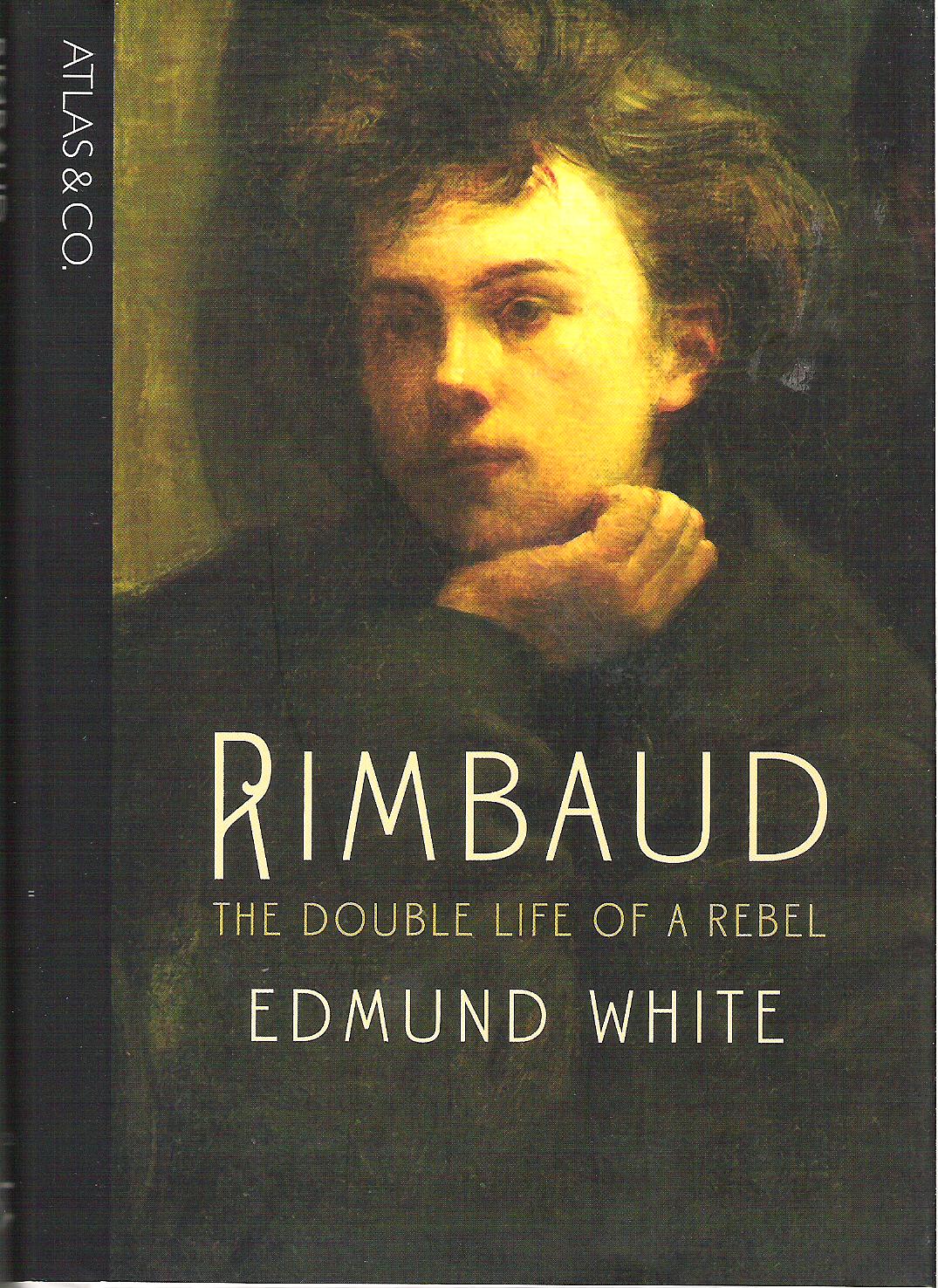
rimbaudcollection10.jpeg.jpeg
Edmund White’s Rimbaud – I love the whole concept of Brief Lives, the series of short biographies of important people crafted by distinguished contemporary writers that editor/author James Atlas has shuttled around to various major publishers. They are really extended biographical essays rather than definitive histories with footnotes and index – which makes them compulsively readable. I very much enjoyed Wayne Koestenbaum’s Andy Warhol and Edmund White’s Marcel Proust, which came out under Penguin’s imprint, and I just happily gobbled up White’s Rimbaud – The Double Life of a Rebel, another perfect pairing of biographer and subject. Certainly, Rimbaud’s short life lends itself to a succinct biography – he only wrote poetry for four years as a teenager, published in two slim volumes. White began his publishing career writing encyclopedia entries for Time-Life Books, a job that you could say developed and/or exploited his gift for synthesizing vast swatches of information into elegant, witty, erudite prose. Here he digests everything written by and about Rimbaud (doing all the French translations himself) in fewer than 200 small pages. Whether evaluating Rimbaud’s best poems, detailing his love affair with Paul Verlaine, or tracking his dizzyingly peripatetic post-poet life, White’s commentary is informed without being boringly academic or scholarly, and it frequently betrays his own personal touches and obsessions. He notes with amusement that, after his affair with Verlaine made him persona non grata among the culturati of Paris, Rimbaud befriended a diminutive poet named German Nouveau who in letters referred to Rimbaud not by name but simply as “Thing” (“Chose”), as in “Miss Thing.” And a discussion of Verlaine’s medical examination to determine whether he has had anal intercourse veers into this digression:

“If the reader imagines that such examinations belong to the era of pseudoscience in the nineteenth century, he or she should be reminded that in the English town of Cleveland, from January to June 1987, more than five hundred children were forcibly removed (sometimes during midnight raids) from their parents’ homes by social workers because two doctors had determined that they’d all been buggered by their fathers. The doctors were using the highly questionable ‘anal dilation test,’ a sort of inserted balloon. If the children couldn’t grip the balloon with enough force, the doctors determined that they’d been anally violated. Soon there were no more foster families or hospital rooms in the entire region for the ‘victims.’ Ultimately the tide of opinion shifted against the doctors and most of the cases were thrown out of court. The whole unsavory episode was seen as a modern instance of a Salem witch trial. Verlaine’s examination by ‘experts’ had no more validity and revealed the same sort of disgusting prurience. As a result of it, curiously enough, we know more about the condition of his penis and anus than we do about the intimate anatomy of any other major poet of the past.”

Culture Vulture: THE STRANGER’S CHILD, 5 BROKEN CAMERAS, Paul McCarthy, THE ASSEMBLED PARTIES, and 20 FEET FROM STARDOM

June 30, 2013

BOOKS

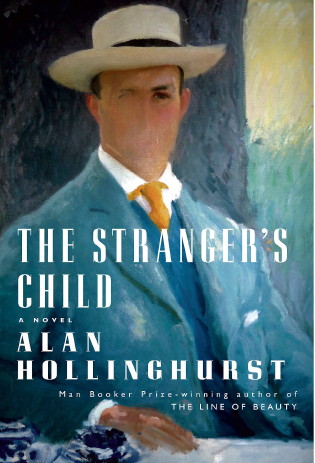
I’ve been a fan of prize-winning British novelist Alan Hollinghurst since I read his debut volume, The Swimming Pool Library, and admired its beautifully crafted sentences, its confident multiple narratives, and its homoerotic frankness. The Line of Beauty had all that and more – a remarkably intimate depiction of Thatcher’s England from inside the Iron Lady’s social circle. Hollinghurst’s latest, The Stranger’s Child, is exponentially more ambitious even, with all of the writer’s qualities burnished with an impressive Henry James-like mastery. Divided into five parts that unravel over the course of the entire 20th century, it revolves around an invented cast of literary characters: a young Wilfrid Owen-like poet whose death in World War I transforms him into a national legend, a Bloomsbury-like circle of aristocratic and self-mythologizing artists, and the industry of academic archivists, scholars, and biographers who feed on their remains.
The-Strangers-Child
From the very beginning, Hollinghurst sets up a skein of sexual secrets that the characters play cat-and-mouse with the full length of the novel, some of which never make the surface again. It’s dense, fiendishly clever, and emotionally absorbing. I am apparently not the only reader who recognized it as a fictional corollary to a non-fiction volume that came out the same year (2011), A Book of Secrets by the distinguished biographer Michael Holroyd, who is wittily name-checked or rather mis-name-checked in The Stranger’s Child – one of many delicious tidbits the author drops along the way. Not exactly light summer reading, but it kept me absorbed on two train trips across Italy and a long plane ride home.

VIDEO

It’s impossible to watch 5 Broken Cameras, the Oscar-nominated documentary by Emad Burnat and Guy Davidi, and not feel a mounting outrage at the situation it depicts. Burnat, a Palestinian farmer in the West Bank village of Bil’in, acquired a camera to film the birth of the youngest of his four songs, which coincided with the beginning of weekly protests against Israeli forces that seized land, bulldozed olive groves, and built a barricade to make room for a new Israeli settlement. Drawn to start filming everything that happened in the village, Burnat became an activist documenting the increasingly brutal and unjust behavior of the Israeli army, who attack the ragtag protestors (armed with nothing more than stones, drums, and pride) with tanks, gas grenades, and lethal bullets. It’s a crude but effective microcosmic portrait of the heart-sickening ongoing Israeli-Palestinian conflict. You can stream the whole film on YouTube here.

ART

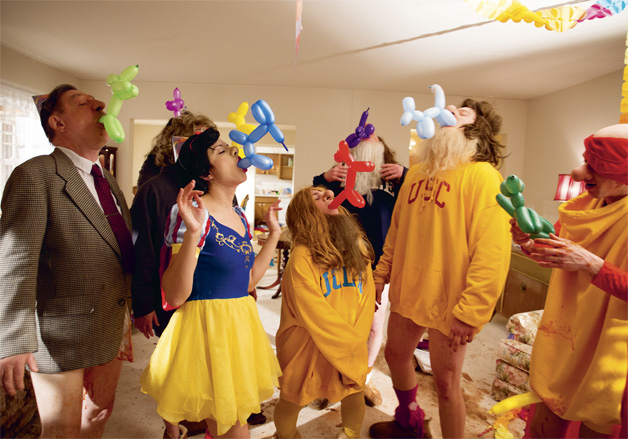
Paul McCarthy WS at the Park Avenue Armory is a big, expensive, puerile, idiotic conceptual art piece that I guess makes the case that most Hollywood movies are big, expensive, puerile, idiotic fairy tales. WS consists of eight hours of film in which McCarthy plays Walt Disney shooting a live action version of Snow White and the Seven Dwarves, with most of the characters sporting prosthetic noses, eating junky food, and cavorting orgiastically with toy-balloon genitals and cake-frosting jizz. The main film sequences are projected onto two banks of screens at either end of the Armory’s cavernous space. In the middle of the space stands a reconstruction of the sets used for the film – a plywood simulation of a suburban tract house and a plastic jungle for the forest sequences. Additional film sequences screen in a series of galleries off to the side.
ws-mccarthy
All the advertising and signs all over the place warn “This exhibition contains explicit imagery and mature content. Admission is restricted to audiences over 17 years of age.” So of course viewers can’t wait to find the naughty bits – I stumbled across one of the side galleries where a naked pomaded porn star was alternately stroking his hard cock and poking it into a mannequin lying on the fake-forest floor. McCarthy seems to be one of those artists whose work is more interesting to talk about and read about than actually to experience – see Holland Cotter’s thoughtful review in Friday’s New York Times.

MUSIC

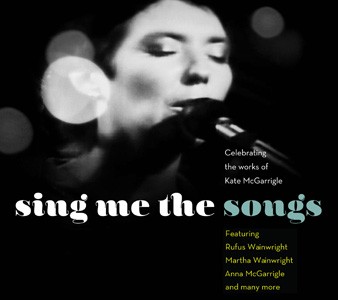
It’s a big week for remembering Kate McGarrigle – two memorial concerts at BAM coincided with the opening at the Film Forum of the documentary film Sing Me the Songs That Say I Love You, directed by Lian Lunson (who made the excellent concert film Leonard Cohen: I’m Your Man). And Nonesuch Records put out the 2-CD set Sing Me the Songs featuring a stellar crew singing songs by and associated with her: Kate’s kids, of course, Rufus and Martha Wainwright; her sisters Anna and Jane; the extended McGarrigle family (Anna’s partner Dane Lanken, their daughter Lily, old friend Chaim Tannenbaum); and a passel of guest stars including Emmylou Harris, Norah Jones, Richard, Linda, and Teddy Thompson, Justin Vivian Bond, Antony, and Broken Social Scene. The songs that Kate and Anna recorded together can’t really be topped by anyone else, so for my money the treasures of the album are the many previously unrecorded or unreleased songs. Best among them: “I Am a Diamond,” sung by Martha and Rufus.

sing-me-the-songs-kate-mcgarrigle

THEATER

Richard Greenberg has written many plays, but The Assembled Parties (produced by Manhattan Theatre Club at the Samuel Friedman Theatre) is a rare convergence for him: it’s a thoughtful, dramatically ambitious script that receives a perceptively detailed staging by director Lynne Meadow with the help of an excellent cast, all the artists involved doing things that are more difficult than they look. What looks like a pretty standard New York Jewish family play – the secrets! the matchmaking! the lovable alter kockers! the wayward children! the worried mothers! – turns out to be much more of an impressively novelistic enterprise that’s less about the story and more about creating intricate character studies. Many of the Henry Jamesian qualities I admired about Alan Hollinghurst’s novel show up here, including the willingness not to announce what it is about but to let the audience put some pieces together itself. Also the narrative confidence – the two acts take place in the same apartment 20 years apart, but the sets look entirely different for each act, two actors in major roles don’t return for act two, and Jake Silbermann plays one character in act one and his younger brother in act two.
assembled parties
Judith Light (above right) won lots of awards playing the loud and lovable Aunt Faye (a variation on the role she played last season in Other Desert Cities – both performances more than a little redolent of the great Linda Lavin), and Jessica Hecht (above left) deservedly drew critical praise for authentically inhabiting the complicated, deceptively cheerful former actress around whom the play’s activity revolves. But really I admired all the actors equally – Lauren Blumenfeld as the self-admittedly dim bulb Shelley, Jeremy Shamos as the outsider who works overtime to ingratiate himself with the family by serving as unofficial spy, Silbermann as elusive Scotty and socially awkward Tim, and Jonathan Walker and Mark Blum as the husbands who are sociable in company and adversaries in private.

FILM

As a film 20 Feet from Stardom, Morgan Neville’s documentary about rock and roll’s backup singers, is somewhat shapeless, repetitive, and meandering. But for diehard music fans like me who spent formative years studying the credits in fine print on record albums, it’s an enjoyable opportunity for face time with the people who, as someone in the film points out, sang the parts of hit songs that most listeners love singing along to. The movie showcases a selection of legendary backup singers – most notably Darlene Love (whose leather lungs sang the hell out of early ‘60s Phil Spector hits that came out with other artists’ names on them, like the Crystals’ “He’s a Rebel”) and Merry Clayton, who earned a spontaneous round of applause in the movie theater after we heard the track of her climactic performance in the Rolling Stone’s “Gimme Shelter” without the band. Almost worth the price of admission alone! Other singers featured include Claudia Lennear, Gloria Jones, the Waters Family, David Lasley, and two singers new to me, Judith Hill and the truly amazing Lisa Fischer. Aside from rummaging around inside rock ‘n’ roll nostalgic trivia, the movie does ponder the somewhat melancholy question: how come some incredibly talented singers never make it as solo performers, while many mediocrities become rich and famous?