Archive for the 'Culture Vulture' Category

CULTURE VULTURE, part 3: Zanele Muholi and Jean-Michel Basquiat at the Brooklyn Museum

August 17, 2015

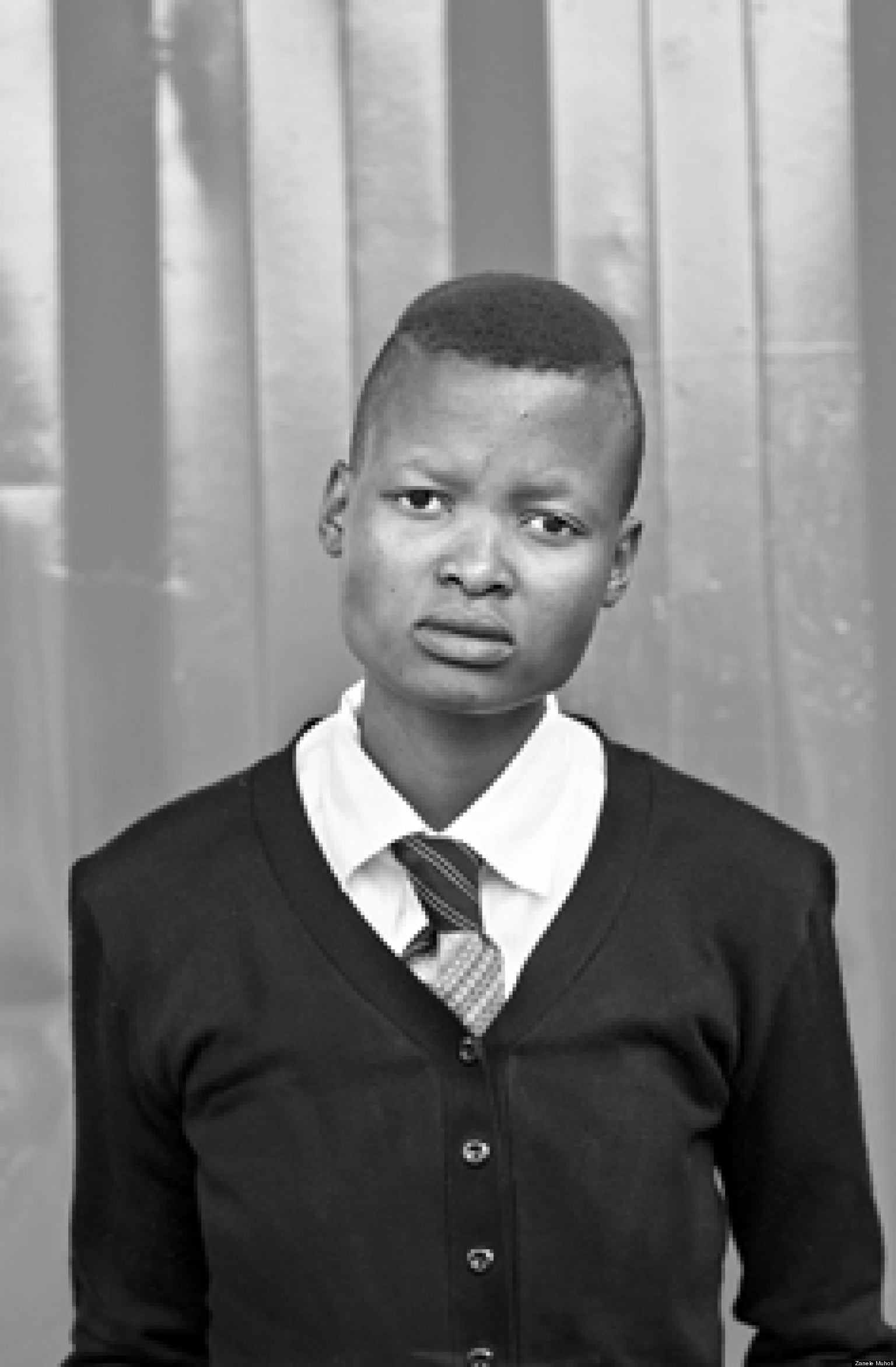
8.16.15 I never knew how hungry I was for images of African lesbians until I walked into South African photographer Zanele Muholi’s show Isibonelo/Evidence at the Brooklyn Museum and stood riveted for half an hour watching the digital slideshow of the 250+ portraits in her series Faces and Phases. Eighty-seven of the photos are framed and displayed along one wall of the gallery in the Elizabeth A. Sackler Center for Feminist Art (next-door to Judy Chicago’s The Dinner Party), along with one wall of testimonials by the subjects and another wall with a timeline of the violence (beatings, murders, and “corrective” rapes) committed against lesbians and trans persons in South Africa. But nothing beats the power of standing in front of the digital slideshow and drinking in these striking larger-than-life black-and-white projections of one unsmiling face after another, each of them making deep calm direct eye contact with…the camera, the artist, and the viewer.

muholi sisipho ndzuzo VUYELWA-MAKUBETSE-facebook Zanele-Muholi-selfie
Shot simply against often textured backgrounds, they nod with respect toward the late Malian photographer Seydou Keita’s famous and beautiful portraits of African men and women. But I was knocked out and grateful to Muholi (above) for undertaking the project of documenting her LGBTI community in South Africa, a project that is not only ambitious and politically valuable but dangerous. Three years ago, her apartment was burglarized. She lost her laptop and over 20 primary and back-up external hard drives containing five years’ worth of photos and video, including records of the funerals of three Black South African lesbians murdered in hate crimes. Nothing else was stolen. The Brooklyn Museum show is up until November 1. I encourage you not to miss it.

I made my pilgrimage specifically to see the Muholi show but I was also mildly curious to see Basquiat: The Unknown Notebooks. I’m a huge fan of Basquiat; his work excites me more than almost any other artist of the last half century. Hearing that this show basically consisted of eight Marble Composition Books taken apart and displayed page by page, I assumed this would be a minor little show of marginal dribs and drabs. Not at all.
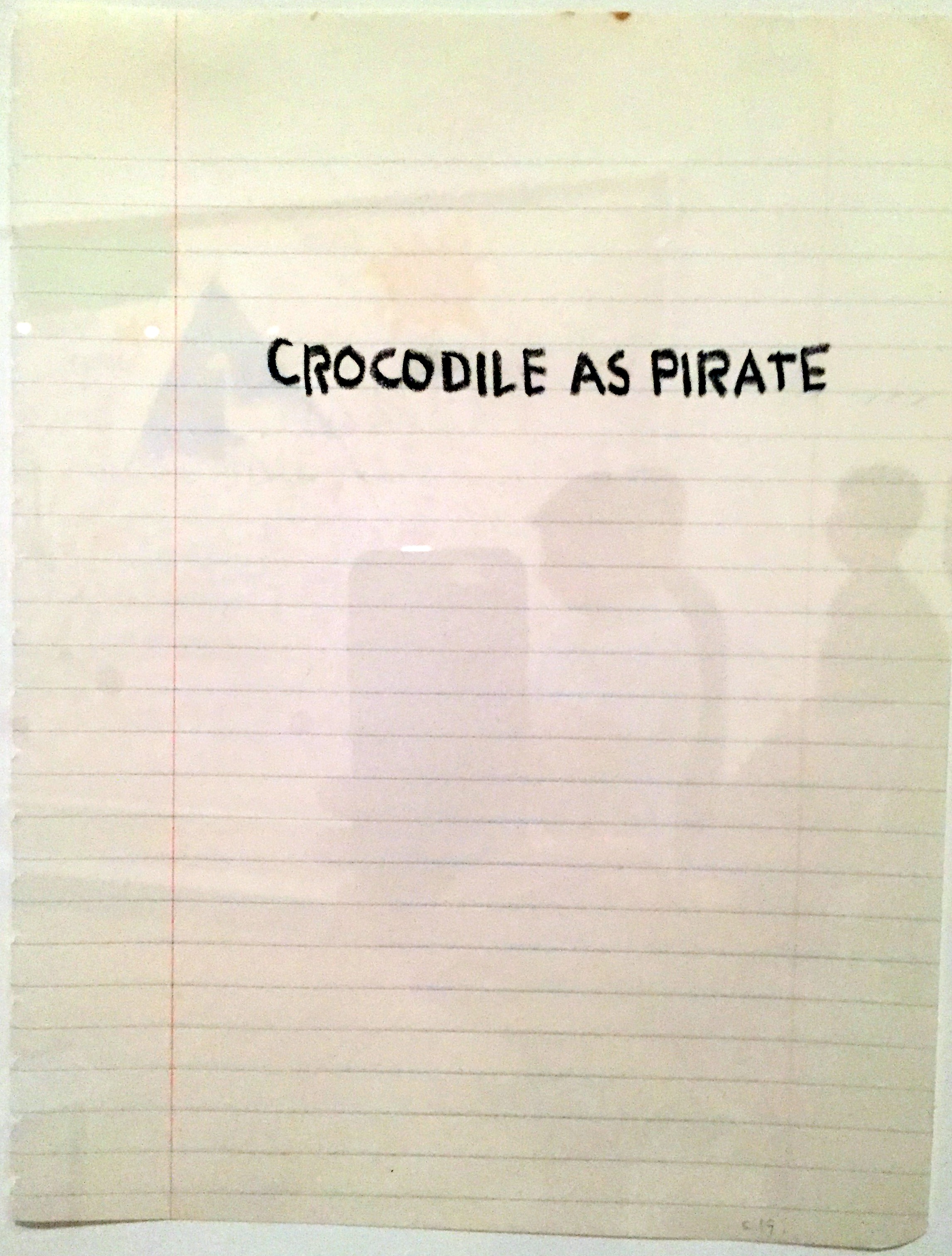
8-16 crocodile as pirateIt spotlights the prolific fertile young artist’s use of language – both words as a key element in his paintings (especially lists) but also the poetry that flowed from his deep immersion in literature and music. The individual pages from notebooks leap out as ideas for paintings or art projects but sometimes just as great images complete in themselves (above).
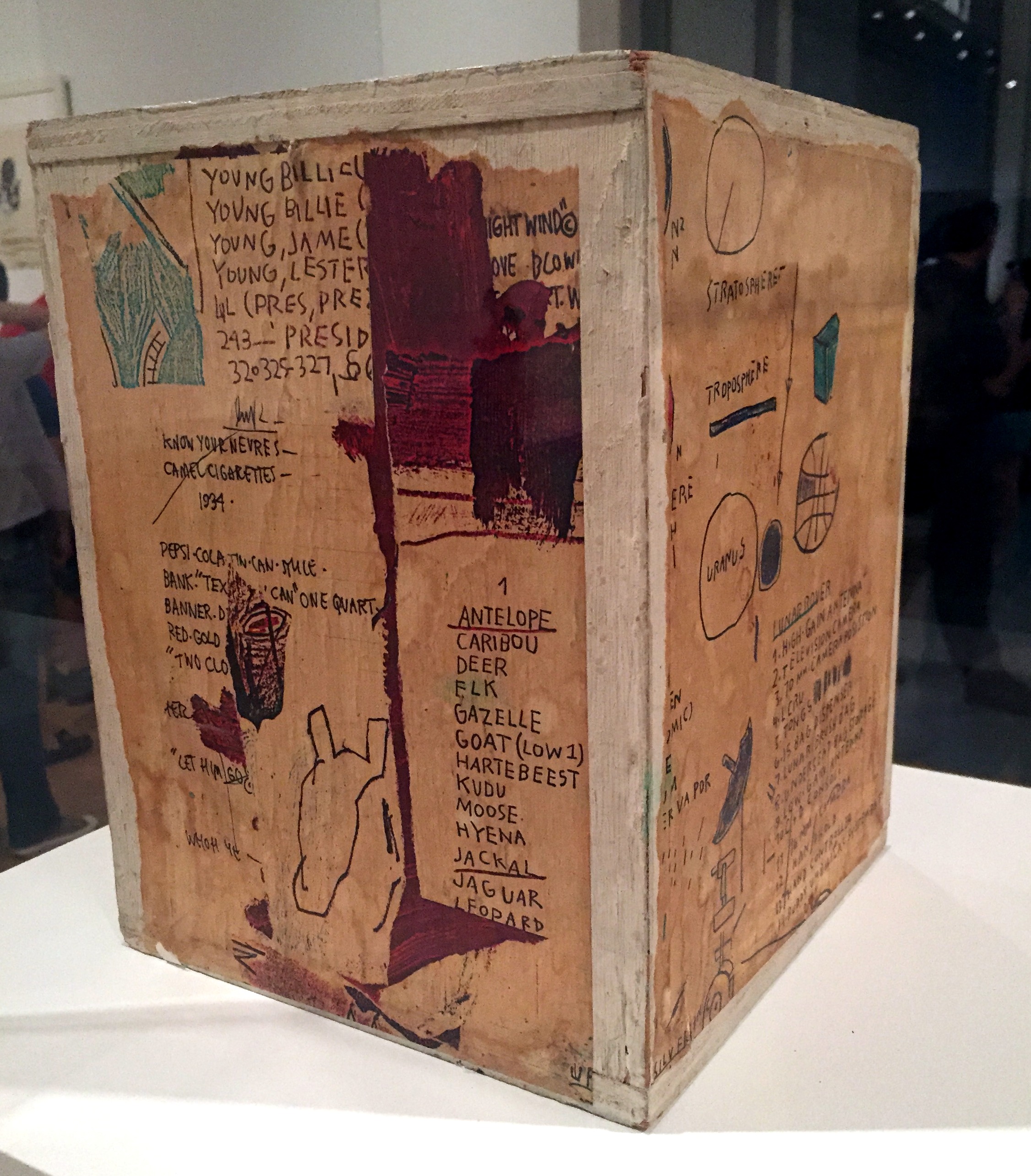
8-16 cube2 8-16 cube1
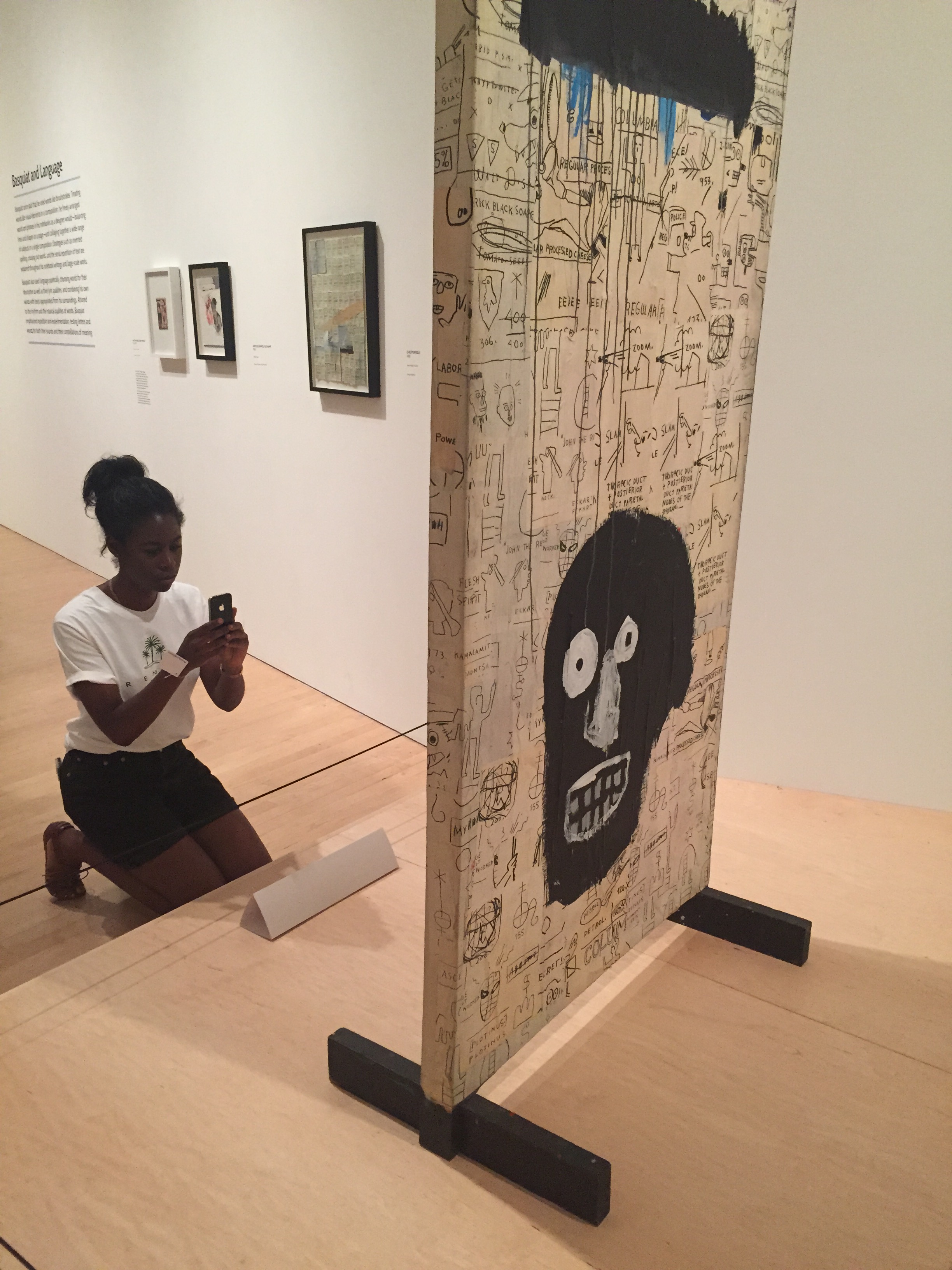
I also wasn’t expecting that the show would include so many big Basquiat works, including a bunch of dazzling stuff I hadn’t seen before – a beautiful little wooden cube painted on every side (above), a couple of free-standing double-sided wooden pieces that look like advertisements for restaurants or stores (below).
8-16 basquiat famous front 8-16 famous back 8-16 all beef
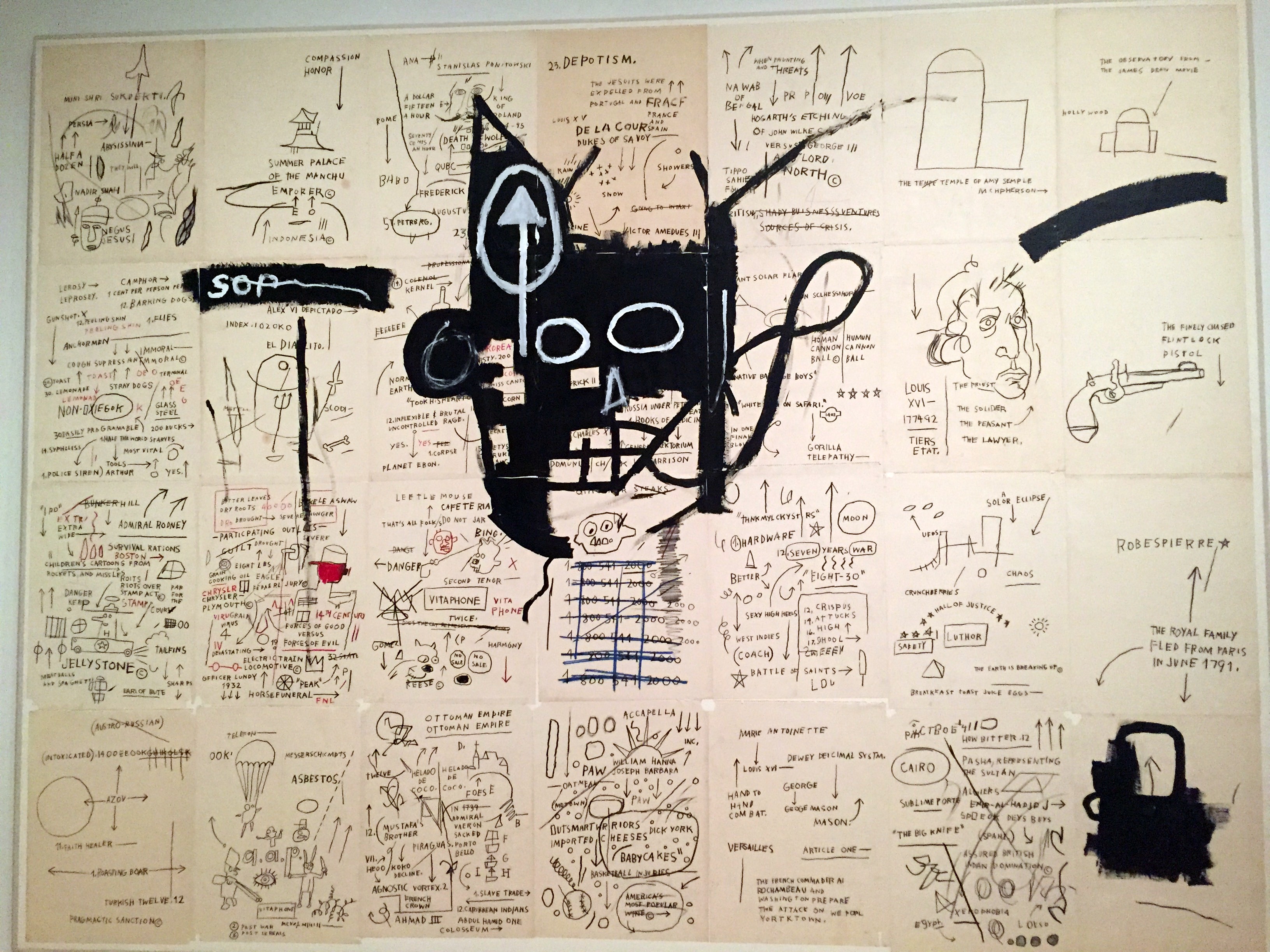
A major piece calls “Untitled 1982-83” pastes together 28 separate notebook pages into one giant canvas; every panel is its own intriguing abstract poem – my favorite is the list that includes: FAITH HEALER, ROASTING BOAR, TURKISH TWELVE, and PRAGMATIC SANCTION.

8-16 untitled full 8-16 untitled detail

CULTURE VULTURE, part 2: Sean Baker’s TANGERINE

August 17, 2015

8.15.15 Sean Baker’s film Tangerine is a pretty astonishing achievement. It’s a romantic comedy set entirely within the world of what some lowlife politically unconscious person would call “tranny hookers” in West Hollywood. Sin-Dee has just finished a month in jail, and she’s celebrating Christmas Eve over a jimmy-sprinkled doughnut with her BFF Alexandra when she finds out that her pimp boyfriend Chester has been cheating on her with a real woman, so she goes on a rampage until she locates the unfortunate gal and drags her all over town until she can confront Chester, who denies everything and proposes marriage in front of everybody, including the Armenian taxi driver whose wife and mother-in-law have only just now found out about his penchant for chicks with dicks.

It’s fast and funny as hell, a down and dirty portrait of LA you never see in Hollywood studio films, shot on location at Donut Time with side trips to a seedy motel-room brothel and an unforgettable trip through a car wash. The storytelling is comic book/fotonovela but nothing is softened or sweetened. The two transgender leads, Mya Taylor as Alexandra and Kitana Kiki Rodriguez as Sin-Dee (below), give fierce full-on performances, as does brave Karren Karagulian as Razmik, the cabbie. The kicker is when the final credits roll and you see that the entire film was shot on an iPhone 5s!

tangerine christmas

CULTURE VULTURE, part 1: Yoko Ono and the Plastic Ono Band at MOMA

August 17, 2015

8.14.15 I’d never seen Yoko Ono in person, so when the email arrived from the Museum of Modern Art announcing that the Plastic Ono Band would perform two live shows (in conjunction with the retrospective of her artwork currently on exhibition), I bought tickets immediately. I guess I thought she would play with a rock band led by her son, Sean Lennon, and they would play some of her well-known songs (“Walking on Thin Ice,” “Kiss Kiss Kiss”). But no, this was an art performance from beginning to end. The intimate show took place in the smaller of MOMA’s two movie theaters, and while waiting for the performance to begin Yoko’s film Bottoms played on screen. I don’t mind looking at asses for half an hour – I rather like it, in fact, especially if they’re hairy male asses — but my friend Anu got a kick out of noticing audience members squirming in their seats and studying their smartphones to avoid watching the film.
ono bottoms
When Yoko took the stage, she seemed quite frail – she is 82 and tiny – and, backed by a trio (drums, guitar, and cello), she proceeded to do the kind of singing you or I might do if we were doing our best Yoko Ono imitation: shrill, wordless witchy cackling. She did that for a while until she ran out of steam and said, “Okay, that’s an introduction.” She alternated between reading earnest awkward poetry (“Listen to your heart! Respect your intuition! Make your manifestation!”) and improvising with the band (she would turn to the musicians, whom she never introduced, and say “Do more jazz now”), occasionally doing some stiff dancing in front of random films from her early years in Japan of children playing and passersby bowing and smiling. After 50 minutes it was abruptly, awkwardly over.

8-14 yoko at moma
As I indicated in my blog post about the retrospective, I admire Yoko Ono tremendously as a conceptual artist and as a force for peace and justice in the world, but it was hard to think of this as good music.

yoko setlist

Culture Vulture: Annie Baker’s JOHN, Merrill Garbus’s tUnEyArDs, and CLOUDS OF SILS MARA

August 11, 2015

THEATER

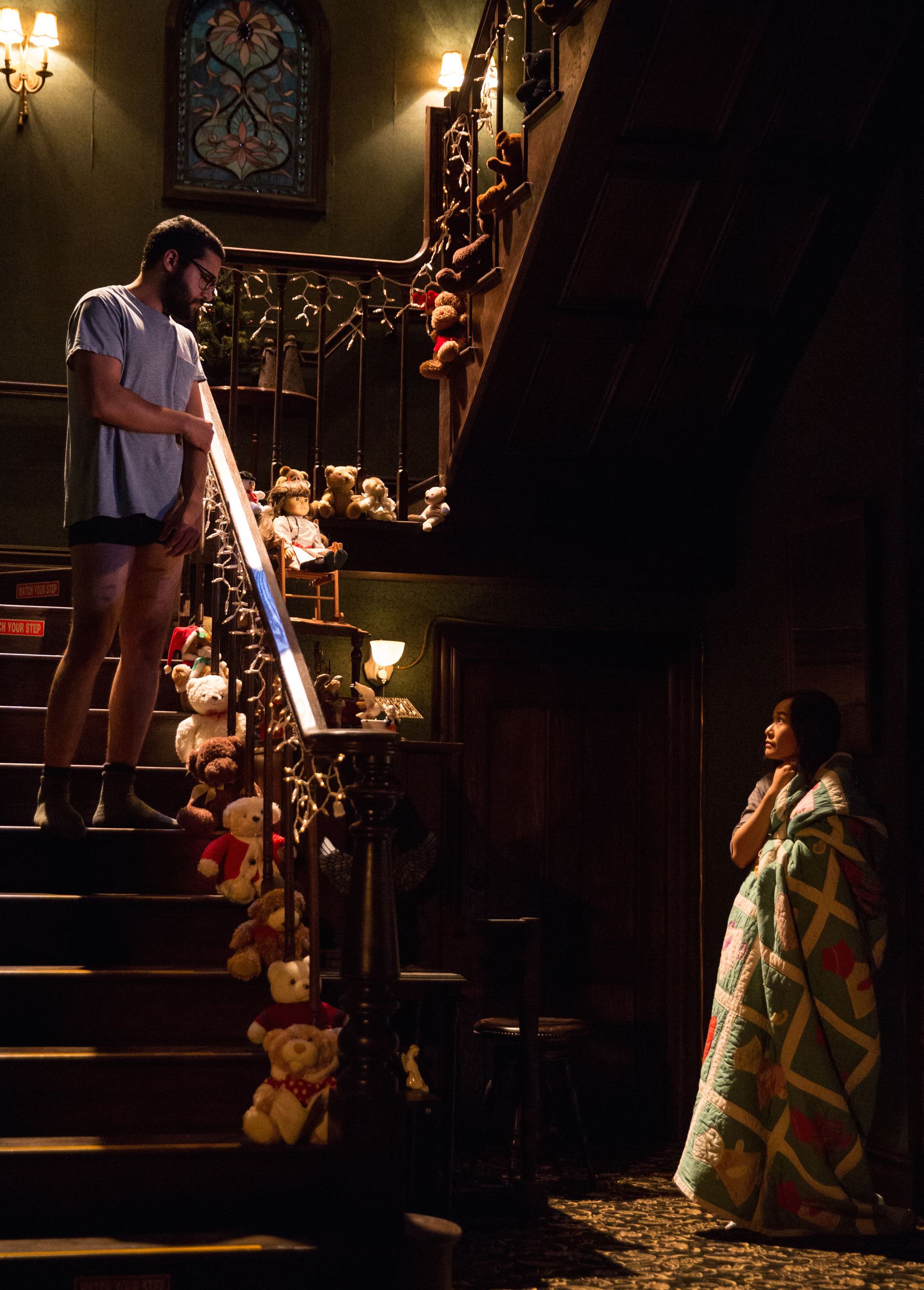
Annie Baker has done it again. On the heels of her Pulitzer Prize-winning The Flick, her new play John, which is having its world premiere at the Signature Theatre, is yet another long (three-and-a-half hours!) slow fascinating novelistic play with a deceptively slim plot — two young people in a stormy relationship spend a cold winter’s night at a bed and breakfast in Gettysburg, PA – and a lot to say about life. On a meticulously perfect set by Mimi Lien, the play is impeccably staged by Sam Gold with theatrical touches suited to the wide stage at the Signature. Georgia Engel, whose low-key comic performance as the servant Marina in Baker’s adaptation of Uncle Vanya inspired Baker to write this play for her, quietly dominates the stage as Mertis (aka Kitty), the endearing and enigmatic proprietor of the B&B. The director has her draw the stage curtain open and closed herself, and he has her manually turn the grandfather clock’s hands to indicate the passing of time between scenes. It’s not accidental that the clock stands right in the center of the set. Time is at the center of the play – time as the ticking of minutes going by but also time in the form of history. It’s not a character but more like an element of the play, the air that it breathes. The air is thick with big themes that are not exactly stated but conjured like clues to a mystery that is never solved. One theme has to do with craziness, mystical experience, and ghost stories – are those the same, or different? Also love – same as craziness, or different? Another theme is Being Watched Over. Mertis likes to ask each of her guests if they believe they’re being watched. She’s not talking about surveillance or paranoia, Big Brother or the NSA. She’s sort of asking “Do you believe in God?” but as she’s talking we’re being also watched by an innocent/creepy line of teddy bears snaking up the staircase to the second floor.

Signature Theatre presents “John” A New Play by Annie Baker; Directed by Sam Gold Pictured: Christopher Abbott as Elias Schreiber-Hoffman & Hong Chau as Jenny Chung

Signature Theatre presents “John”
A New Play by Annie Baker; Directed by Sam Gold
Pictured: Christopher Abbott as Elias Schreiber-Hoffman & Hong Chau as Jenny Chung

The great Lois Smith plays a very crazy character named Genevieve who’s blind and who believes that her ex-husband has been controlling her life. Jenny (played by Hong Chau, an excellent young actress I’ve never seen, with one of those high-pitched annoying baby voices) believes that her American Girl Samantha doll controls her. She is being heavily scrutinized by Elias (played spectacularly well by Christopher Abbott, looking and acting uncannily like Sam Gold), who hasn’t quite forgiven her for the affair she swears is over. Magic/spooky stories are told and magic/spooky things happen in the house — lights go on and off by themselves, the player piano plays on its own. Jenny turns into a statue at one point, so rigid that Eli can pick her up like a board and place her on the sofa. Kitty reads to Genevieve from a convoluted story that I recognized as H. P. Lovecraft (keyword: Cthulu). As for the title character: I don’t think I’m spoiling anything when I say that when Mertis speaks the last line of the play – “Who’s John?” – you both know and don’t know the answer, and that is simultaneously devastating, mystifying, and provocatively perfect all at once.

MUSIC

Andy and I went out to Prospect Park for the closing show of the Celebrate Brooklyn series, Shabazz Palaces opening for Tune-Yards. The gates officially opened at 6:30 – we got there shortly after that and there were thousands of people lined up at both entrances to the park. Nevertheless, we managed to get good seats, on chairs! I was afraid we’d be stuck sitting on the ground. I have enjoyed checking out the first two albums by Shabazz Palaces, a band I vaguely understood to be a spinoff of Digable Planets, whose fusion of jazz and hiphop caught my attention back in the day. Shabazz Palaces turns out to be two guys (Ishmael Butler and Tendai “Baba” Maraire) shouting into microphones over a somewhat interesting soundscape that got completely obliterated whenever Butler detonated the bass loop on his synthesizer. Could not understand a word they said. At least on record they’re more intimate and compelling. Still, it was worth trekking to Prospect Park to see Merrill Garbus, aka Tune-Yards.

tune-yards-23
She is really amazing to watch as she creates drum loops and then layers them with her (often double-tracked) vocals and sometimes ukelele. Her hot hot band included her right-hand man Nate Brenner on bass, a guy on keyboards, a guy on sax, another woman on percussion, and two female singers. The show hit an ecstatic peak two-thirds of the way in with a piece that turned into the most entertaining free jazz I’ve ever experienced. Garbus, Brenner, her keyboardist, and her sax player were all playing something wildly different, anarchic, chaotic, yet exciting, and then somehow precisely fell back into sync to finish the song. The high of that continued through her two biggest YouTube hits, “Water Fountain” and “The Bizness” (for both of which a line of young women behind us sang along at the top of their lungs – I love that Merrill Garbus is such a hero to them). The long-lined chants, the chugging polyrhythms, the high-pitched women’s voices made me think that Tune-Yards is the spot where Fela Kuti meets the B-52s. But really, her music is pretty unclassifiable – it’s not sufficient to say Laura Nyro meets Talking Heads in Nigeria. She’s really original, especially when it comes to rhythm.

MOVIES

Olivier Assayas’s film Clouds of Sils Mara is fascinating on many levels. First of all, I love a movie that doesn’t feel the need to (over)explain everything. Second, the relationship between the two main characters totally passes the Bechdel test. Valentine (a surprising Kristen Stewart) is the fast-talking smart American personal assistant to Maria Enders (glamorous and poignant Juliette Binoche), an internationally renowned movie star who made her splashy stage debut playing a teenager who seduces and abandons an older woman. Now she’s being asked by a hotshot European director (think Ivo van Hove) to play the older woman in a revival of the play opposite a hell-raising young starlet named Jo-Ann (think Jennifer Lawrence). The movie evokes and explores Maria’s complicated feelings about aging, the play, its recently deceased author, the characters in it, and the two young women (Valentine and Jo-Ann), not to mention the film industry and her place in it. Hollywood movies about movie people tend to either make fun of them or sentimentalize them. Assayas takes us inside the bubble that famous actors live inside, without commentary, viewing their concerns about publicity and making nice and avoiding photographers as matter-of-factly as they do. I also loved how the movie accurately depicted people’s casual but incessant dependence on their devices – mostly phones but especially iPads – in a way that no science fiction projecting into the 21st century ever accurately anticipated.

CLOUDS-OF-SILS-facebook


Culture Vulture: Dancenoise, Gymna Dalang Cilik, THE LAST FIVE YEARS, and CYMBELINE

August 4, 2015

7.24.15 I’m no expert on Dancenoise, the performance art duo Annie Iobst and Lucy Sexton (below), but they’re legendary to me nevertheless. In their heyday (late ‘80s/early ‘90s), they never did shows that had long runs. They were more likely to manifest in late-night club dates (at 8 B.C. or King Tut’s Wah Wah Hut) and one-off festival appearances while I was busy going to sit-down shows in theaters. I did glimpse them occasionally doing walk-ons at the Bessie Awards shows or group-show galas but never felt I’d really gotten the full whammy. So thank you, Whitney Museum, for “DANCENOISE/Don’t Look Back,” a mini-retrospective inaugurating the performance facilities at the new venue in the West Village. There was an installation, some film screenings, a variety show, and then a three-night full-length performance of new and old material.

7-24 dancenoise 2
It’s hard to describe what they do in their string of funny, savage, politically pointed vaudevillean sketches, except that they generally gravitate toward everything women are NOT supposed to do. The program notes at the Whitney quoted Tom Murrin the Alien Comic calling them “the premier practitioners of synchronized aggression,” which is a great succinct summation. After a brief funny freshly finished Charles Atlas film of them running through the museum on their way to the show, they made their usual famous entrance: completely naked except for high heels, flaunting their completely real now-aging unshaved untucked bodies with the fierceness of warriors. They ran through a multitude of costumes, pulled guns and shot each other repeatedly like tireless kids playing, they yielded the stage for scantily clad bump-and-grind boys (including the likes of hunky actor Jonathan Walker, drag clown Hapi Phace, monologuist Tony Stinkmetal, and Elevator Repair Service’s Mike Iveson), they flung fake blood everywhere. In my favorite section, the high-quality sound system blasted Fleetwood Mac’s “You Make Loving Fun” while Lucy and Annie did some partnered ballroom dancing with genderqueer partners (Richard Move and Connie Flemming), all them in black bras and panties, eventually joined by a whole stage-ful of folks in the same outfit bouncing up and down to the music. No big verbal commentary, just a lot of anarchic energy and sexual vitality, which was exhilarating. Coming right after the revival of And That’s How the Rent Gets Paid at the Kitchen, it felt like a fun and funny time-warp. A lot of the same faces showed up in the audience – Andy and I sat next to Nicky Paraiso and chatted afterwards with John Hagan, Yolanda Hawkins, and William Niederkorn. At home I dragged out Cindy Carr’s anthology On Edge: Performance at the End of the Twentieth Century and read out loud her observant piece on Dancenoise, which was published in April 1989 but pretty much described the show we’d just seen:

“These are terrorists wielding a shtick, and with it they attack power in its many disguises. Their shows are always teeming with pop culture junk, since that’s where power hides and where it emanates from – the evening sound bites, the advertising arias, the fashion forecasts, the top forty wool-gatherers. The Dancenoise way of knowledge is to see life as one ungentrified unregenerate 14th Street, just a ramshackle boulevard where everything from Shakespeare to the unwritten law on how to wear a leotard can finally be destroyed and displayed in a bin. The performances level everything in their path, turning slogans into mantras, banality into ritual, pearls into swine. As a rule, they’re a riot and a gas.”

7.29.15 For gamelan musicians, playing for a wayang kulit (shadow-puppet play) constitutes an unusual challenge – although there’s a basic score with familiar notation, the music has to go wherever the dalang (storyteller) goes, so the players have to be alert to split-second stop-and-start cues. I finally got my first crack at playing under those circumstances when Gamelan Kusuma Laras accompanied the performance of “The Story of Gatotkacha” at the Indonesian Consulate featuring a dalang named Gymna Cahyo Nugroho, an eleven-year-old prodigy from Yogyakarta, Java, who was in the U.S. for the first time for two shows (the night before he was in Washington, DC).

7-29 wayang title
He travels with his father, his teacher, and some key musicians (including the kendhang player, who essentially conducts the ensemble with his drum), none of whom spoke much English. The afternoon rehearsal was a little rough, and afterwards Gymna looked very tired and wrung out, probably jet-lagged. But he put on a pretty amazing show, manipulating the leather puppets, singing and voicing the various characters, and improvising jokes and reactions to the audience.

7-29 wayang setup7-29 wayang from shadow side
Most wayang kulit tell stories from the Mahabharata, and one thing you quickly learn is that there are tons and tons of battle scenes, which meant that a lot of our score required playing long sections of sampak — bang-bang-bang-bang loud and fast, kind of exciting and kind of monotonous.
7-29 notation last page
Sitting and playing for hours is pretty punishing on the body. But we had a full responsive house and a lot of fun. Gymna seemed shyly proud of himself and smiled a bit except when cameras pointed at him, in which case he snapped into a very solemn professional pose.

7-29 gymna kendhang carla leslie
7.30.15 I didn’t see the original stage production of The Last Five Years but I got a lot out of the original cast recording of Jason Robert Brown’s intimate musical, mainly because of the cast. Sherie Rene Scott and Norbert Leo Butz are arguably the finest musical theater performers of their generation, and the album displays them at their very best. The show runs on two conceptual elements. It portrays the arc of a relationship from  his-and-hers perspectives, proceedings backwards in time (from breakup to first meeting) by not-quite-making-it actress Cathy and forwards (from first date to walking out) by hot young best-selling novelist Jamie, and it tells the story entirely in songs, with very little dialogue. And Brown writes some strong solid songs: “Still Hurting” and “A Summer in Ohio” are highlights for her, “Shiksa Goddess” and “If I Didn’t Believe in You” for him.

last5years
I was happy to learn that it was made into a movie by Richard Lagravanese and curious to see how it played out. The movie was released in an unusual manner – pay-per-view before theatrical release, which is several cuts above direct-to-video and mainly aimed at the theater-geek audience that made the live broadcasts of The Sound of Music and Peter Pan such big hits. Anna Kendrick and Jeremy Jordan (above) are appealing actors with musical-theater cred, and their drama is touching at times. I confess I got a little tired of their voices, which were a little too nonstop theatrical for me, spoiled as I am by the warm, flexible, more singer-songwriter pop-oriented voices of Scott and Butz.

8.3.15 Daniel Sullivan’s production of Cymbeline is a triumph for Shakespeare in the Park. Especially given the play’s insanely complicated, even ludicrous plot, the show is unexpectedly entertaining. Sullivan smartly addresses head-on the absurdly dense exposition that happens at the top of the show and the equally dense final scene that has to wrap up every conceivable variety of plotline the playwright ever used (a program note mentions that “scholars have counted 27 revelations in the final scene alone”) with a sly attitude that makes merry of the play without trashing it altogether. And he’s assembled a terrific ensemble of solid veterans, all of whom get doubly or triply cast (usually with at least one surprise appearance.)

007
Lily Rabe and Hamish Linklater are very fine as the young lovers, though Rabe is never very convincing disguised as a boy and Linklater is more fun playing the buffoon Cloten than the quasi-hero Posthumus. Patrick Page is excellent in the title role, as is Steven Skybell as hard-working servant to the Queen, played by Kate Burton a little too timidly for my taste. Raul Esparza absolutely steals the show, though, as flashy, fast-talking bad guy Iachimo. The production makes great use of Esparza’s razzle-dazzle Broadway song-and-dance chops but he also nails both the sound and the sense of Shakespeare’s language. These folks are amply aided by top-notch sets by Riccardo Hernandez, costumes by David Zinn (loved the Queen’s costume, which looks like something out of a Tim Burton production at the Metropolitan Opera), lighting by David Lander, lovely original score by Tom Kitt, and the other actors I haven’t mentioned: Teagle Bougere, Jacob Ming-Trent, and David Furr.