Archive for December, 2013

From the deep archives: TWELFTH NIGHT at Lincoln Center Theater in 1998

December 2, 2013

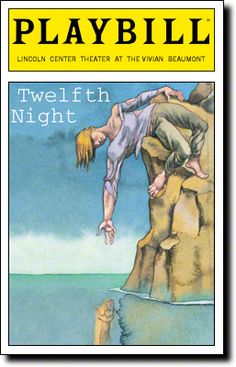
twelfth night lct playbill
Seeing Mark Rylance and Company’s take on Twelfth Night, currently on Broadway, conjured fond remembrance of Nicholas Hytner’s 1998 production at Lincoln Center Theater. Many snoots were cocked at Hytner’s casting the play with young movie stars not schooled in Shakespearean performance. But Hytner’s reading of the play struck me as deep and thoughtful, and Bob Crowley produced one of his most spectacular sets for the occasion. (The production was broadcast  on “Live from Lincoln Center” and you can see clips from it on YouTube starting here.)

My review begins:

Director Nicholas Hytner has said in interviews that his production of Shakespeare’s Twelfth Night at Lincoln Center Theater in New York continues the theme of unrequited love he explored in his film The Object of My Affection. What he was shyer about saying was that the production also investigates the same slipperiness of sexual identity that figured heavily in the film about a gay man’s affair with his female roommate. In any case, Hytner has mounted a physically ravishing production (with a show-stealing set by scenic genius Bob Crowley) that makes the case for Twelfth Night as Shakespeare’s most direct examination of homo love.

            The production, which runs through August 30, features Hytner’s Affection-ate leading man, Paul Rudd, who is practically unrecognizable here. Bearded, hairy-chested and with a scraggly rock-star mane, Rudd’s Duke Orsino is costumed by Catherine Zuber to resemble Prince in his New Power Generation period — all purple pajamas and brocade uniforms. As the audience enters, he and several serving boys are sprawled around an onstage pond passing a pipe and being serenaded by court musicians. He rouses himself to rhapsodize about Olivia (Kyra Sedgwick), the countess who spurns his advances while mourning her perhaps over-beloved brother. It becomes pretty clear, however, that this Orsino’s vision of women is a romantic spasm of compulsory heterosexuality. He seems quite content hanging with the homeboys. And when Viola (Helen Hunt) washes ashore from a shipwreck and disguises herself in trousers with just the right amount of gold piping to infiltrate his household as “Cesario,” she/he immediately becomes the Duke’s favorite, hand-picked to strip him down to his Princely purple trunks for a morning dip.

You can read the full review online here. Check it out and let me know what you think.
Performance diary: TWELFTH NIGHT on Broadway

December 1, 2013

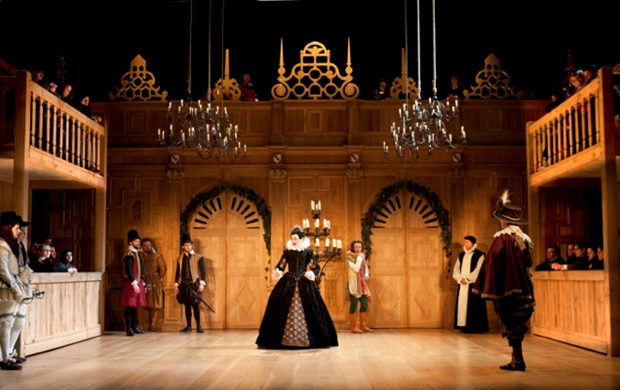
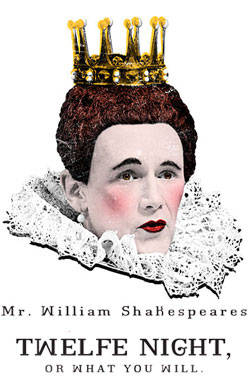
twelfth-night-poster-3092311.29.13 –  The production of Twelfth Night – or Twelfe Night, or What You Will, as the playbill officially calls it – at the Belasco Theater on Broadway in rep with The Tragedie of King Richard the Third is a fascinating and fun exercise in historical recreation. The production originated in London at Shakespeare’s Globe and is performed by an all-male cast led by Mark Rylance (who has blown Broadwaygoers’ minds in recent productions of Boeing Boeing, La Bête, and Jerusalem) in a bravura performance as the Countess Olivia. The audience is invited to arrive early to watch the actors onstage getting made up, dressed, and sewn into their costumes. The stage is lit with beeswax candles (and also modern lighting equipment). Meanwhile, a band of musicians entertains on instruments played in Shakespeare’s time but not so much nowadays: shawms, curtal, rauschpfeife, theorbo, cittern, sackbut, and hurdy gurdy. Yes, you get to watch a guy playing hurdy gurdy, an instrument I associate with the circus and Donovan’s hit song “Hurdy Gurdy Man” but had never laid eyes on. Sackbut, too – it’s a kind of Elizabethan trombone. The show is performed with some audience members in boxes onstage and the musicians perched in a gallery over the stage. The three actors who play the female roles pull them off handsomely – besides Rylance (below right), whose outrageous royal costumes and clown makeup suggest The White Queen out of Alice in Wonderland, that would be Samuel Barnett as Viola (below left, he was also wonderful a few seasons ago in The History Boys on Broadway) and Paul Chahidi as Maria. Liam Brennan makes for a sexy and amusing Orsino, and even with his curious Irish (?) accent he nicely pulls off the scene where the Duke finds himself strangely attracted to Cesario, the boy that Viola is pretending to be.

twelfe night 1

Much as I enjoyed these things, ultimately it’s not the best production of Twelfth Night I’ve ever seen. The director, Tim Carroll, worked hard to ground these characters in believable reality but several of the performances feel like missed opportunities. I’m so not a fan of broad comedy, but certain roles demand it or they either don’t make sense or just wind up boring the audience, both of which are true of Peter Hamilton Dyer’s Feste. I’ve seen productions where Sir Andrew Aguecheek stole every scene he was in. I’m thinking of a production I saw in 1978 at Brandeis University in which Robert Moberly’s Sir Andrew surpassed Jean Marsh’s Olivia and Ellis Rabb’s Malvolio. That doesn’t come close to happening with Angus Wright’s anemic performance. It’s great to see Stephen Fry, a masterful performer and witty writer, undertake Malvolio, but the scene where he confronts the trio who humiliated him has zero emotional weight, strange after the effort put into making him a flesh-and-blood character. Always one of the trickiest scenes to pull off is the recognition scene where Viola in boy-drag comes face-to-face with her twin brother Sebastian, whom she thought died in the shipwreck that washed her ashore. Here, it does not succeed.

In many productions the music comes close to stealing the show. I still remember some songs from my college theater department’s production, and Jeanine Tesori’s score for Nicholas Hytner’s 1998 staging at Lincoln Center (prime candidate for Best Twelfth Night I’ve Ever Seen) stands up to this day. The music for this production, chosen and arranged by Claire van Kampen (Mark Rylance’s wife and longtime Shakespearean collaborator), is scrupulously faithful to the historical record – and dull. Oops.

I know, picky-picky. Most people are loving the production and you’ll walk away mostly with images of Rylance’s performance in your head, his gliding walk and the way he moves that dress around the stage.

Twelfth-Night-on-stage-seating1

Quote of the day: PARENTING

December 1, 2013

PARENTING

You’ve said that couples focus too much on children in the United States, elevating their position in the family.

I’d say it’s an issue in the West in general, not just in the U.S. Never have children been so central to a marriage or so sentimentalized as they are today. Children used to provide us with their labor; now they give us meaning. They used to be an economic asset; now they’re an economic drain. Parents feel a need to participate in the child’s every activity, so there’s no space for the adults. Why can’t the children go to their sports practice alone? Does every parent have to stand on the sidelines and applaud each time the little Smurf touches the ball?

            I’m convinced this overwhelming focus on the children hurts the parents’ relationship. Fifteen years ago I wasn’t hearing couples say that they hadn’t gone out on a date in three years. This nonstop child-rearing sucks energy from the union. Women have long known that parental responsibilities decrease the erotic charge. Some couples can re-create that space for themselves when the kids leave home, but some cannot. So at this point we have three marriages: one before kids, one with kids, and one after kids. It’s not possible to have a model in which parents are available to their children to the degree we demand they be today and be emotionally available to each other in a romantic way. There needs to be a balance.

Moms and dads fear they’ll be bad parents if they don’t do every last thing they can for their children.

Yes, and God forbid my kid would feel bad or frustrated. What I’m seeing already in the younger generation of couples is that they are losing their desire for each other earlier and earlier – because if you haven’t known frustration, it’s harder to know desire. You need to not have in order to know what it’s like tow ant. We are raising a generation that has been protected from feeling bad. We used to believe frustration was part of growing up, that it built character. Now no one is left out of anything. Everybody gets a trophy at the end of the game.

            I’d be the last one to say that the previous generation was glorious, but we can see that certain child-rearing practices have their consequences – for the children and for the parents. Many couples with children aren’t closing the bedroom door. They’re expecting the kids to walk in. They have monitors so they can hear the little ones in their cribs at all times. Parents shouldn’t be afraid to say no to their kids; they shouldn’t be afraid of tantrums. Kids should be allowed to feel bad. it’s how children learn to be healthy adults. And parents shouldn’t feel guilty, thinking that every time kids feel bad it compromises their self-esteem.

— Esther Perel, interviewed by Mark Leviton in The Sun

perel2

Photo diary: Friday morning at MOMA

December 1, 2013

(click pictures to enlarge)

I stopped by the Museum of Modern Art on Friday to take advantage of their Black Friday special — six months extra when you buy a year’s membership. Such a deal! While I was there, since it was members’ early hour (9:30-10:30) and the place was surprisingly unthronged, I took the occasion to stroll through the current blockbuster show, “Magritte: The Mystery of the Ordinary, 1926-38.” I love Magritte’s work for its wit and its ability to peel strangeness out of everyday tableaux. It’s fascinating to notice how many of his images have become embedded in our cultural consciousness. It’s not that they look any less strange or striking — I would say that Magritte has contributed to how we accept surrealism as part of our landscape, literally and figuratively. There are many pictures in the show I’ve never seen before, and some favorites are not here, which reminded me that I must have seen a giant retrospective of his work before, possibly in London, because that show turned me on to what I think is my favorite of his paintings, “Homesickness.”

magritte homesickness
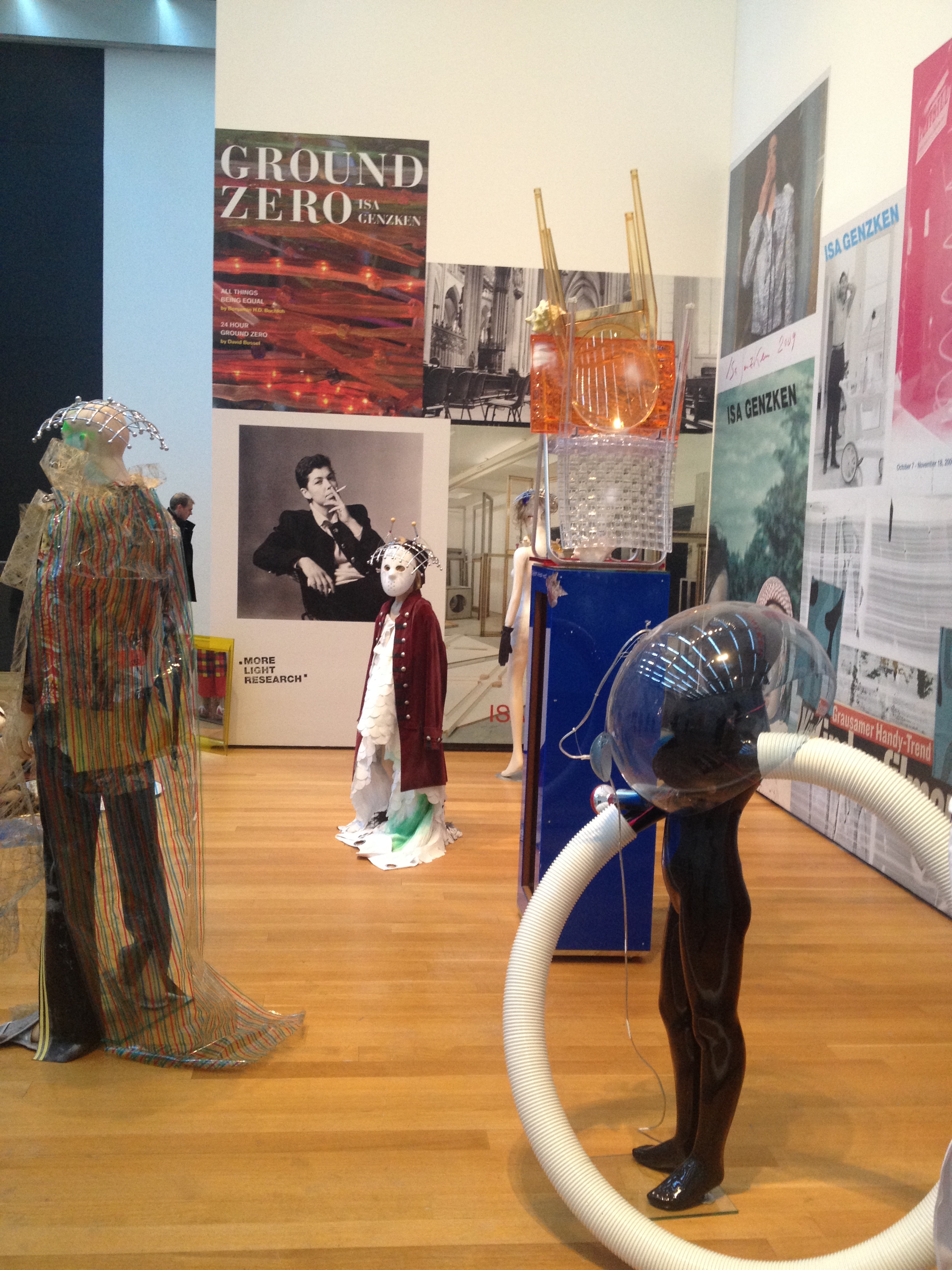
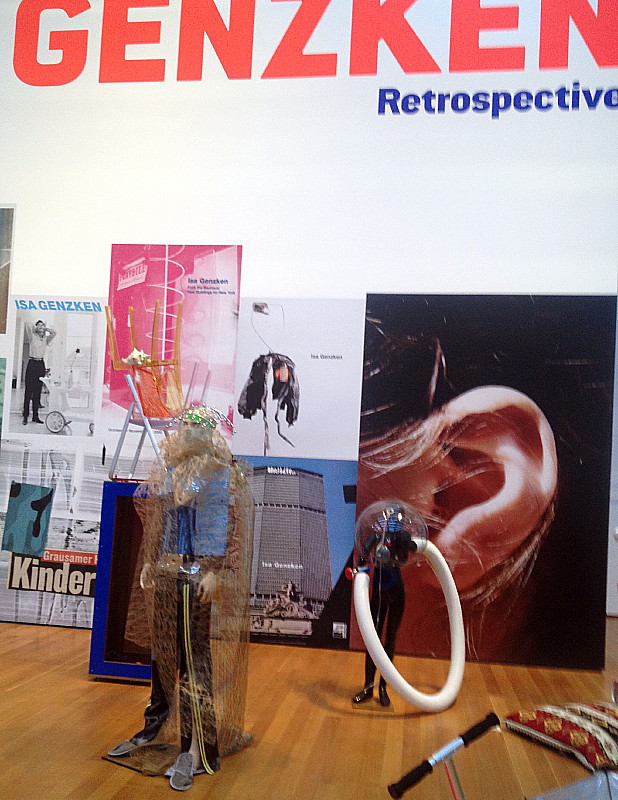
No photography is permitted in the Magritte galleries, but also on the sixth floor is the Isa Genzken retrospective, where pictures are encouraged. Before this week, I’d never heard of her, but I read Peter Schjeldahl’s glowing review in this week’s New Yorker, along with Nick Paumgarten’s profile of high-powered art dealer David Zwirner (who represents her) and Judith Thurman’s blog post about her aborted profile of the artist. So I felt sufficiently prepped to tour her array of sculptures, videos, collages, assemblages, paintings, photographs, and notebooks.
11-29 isa 411-29 isa 211-29 isa genzken 1
I was intrigued to read about and then to see evidence of her curious and strong identification with the gay male culture she encountered both in Berlin and in New York City.

11-29 isa and the gays
This piece, for instance, is called “Gay Babies” — a handful of suspended assemblages of net metal pans, chains, and other debris:

11-29 gay babies
She likes to use cruddy everyday objects for whimsical constructions, like this one, part of a piece called “Fuck the Bauhaus”:

11-29 fuck the bauhaus detail11-29 fuck the bauhaus
And there are a bunch of dioramas depicting vaguely sci-fi scenarios collectively called “Empire/Vampire,” an indirect response to the 9/11 attack on the World Trade Center (which apparently she witnessed firsthand):

11-29 empire vampire 1