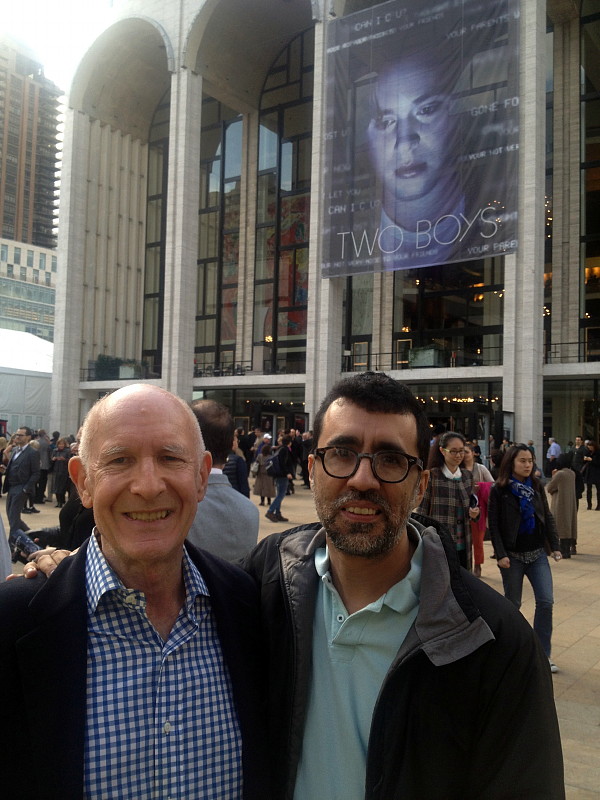
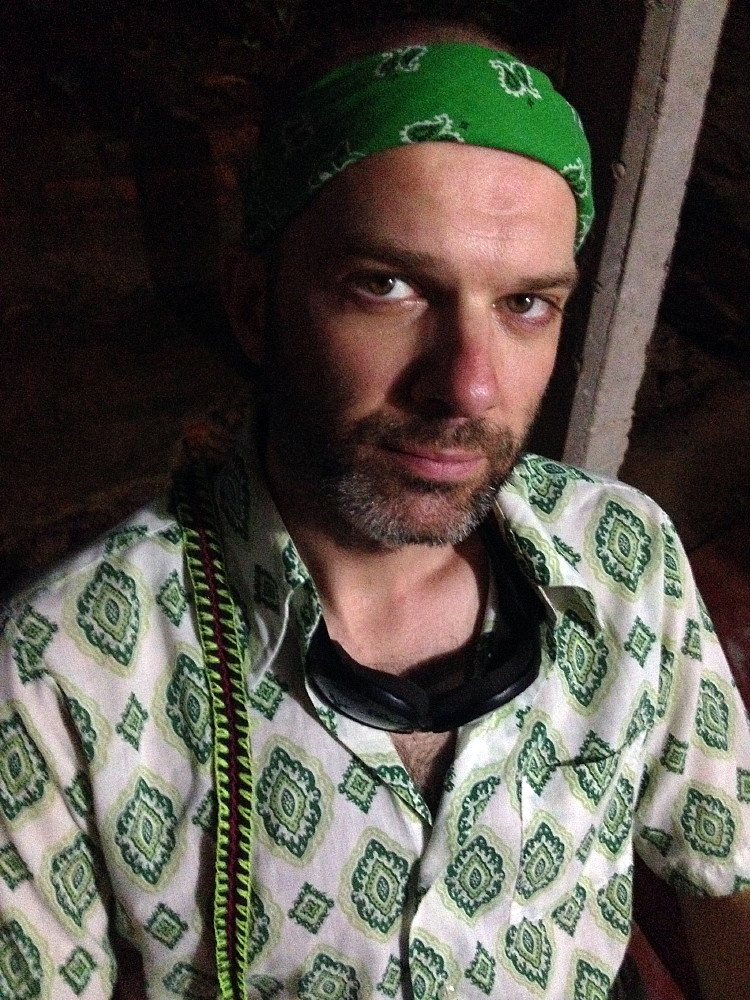
November 2 – I went with Stephen and Alvaro (above) to see Two Boys at the Metropolitan Opera. For me, the artistic merit in the production had less to do with Nico Muhly’s passable, unmemorable score than with Craig Lucas’s libretto. Based on a true story, the opera depicts the tragic consequences of an online friendship between a 13-year old, Jake, and a 16-year-old, Brian. Much of their interaction takes place in a chat room (the year is 2001 – nowadays chat rooms are passé but it’s interesting to have this technology captured in art). Lucas is a prolific playwright, I’m a big fan of his work, and I could immediately see that Lucas was returning to territory he’s mined before in his play (and film) The Dying Gaul, in which cyberspace becomes an eerie version of Orpheus’s underworld – a man finds his dead lover cruising him online. The chatroom dialogue between Jake and Brian (and other characters who get pulled into the action), misspellings and shorthand intact, shows up in the sung text but also on video screens in Bartlett Sher’s production and, at the Met, in titles on the back of the chair in front of you.

I loved how Lucas made theatrical poetry out of this language. It made me think of Gertrude Stein’s operas. I wish Nico Muhly’s score was as tuneful as Virgil Thomson’s. His vocal writing is lyrical, and his choral passages have a pleasant wash, but there’s nothing especially distinctive about his compositional voice. He’s getting a lot of attention and opportunity because of his youth (he’s 32) but he’s yet to create music that grabs me. Still, at the curtain call, I found myself unexpectedly moved to see a young living composer taking bows at the end of a piece that the Metropolitan Opera commissioned – must be quite a thrill for him.
11.16.13 – A weekend full of musicals, beginning with A Gentleman’s Guide to Love and Murder, a lavish and stylish exercise in pure fun. The Broadway debut of the journeyman team Robert L. Freeman (book and lyrics) and Steven Lutvak (music and lyrics), the show adapts to the stage the novel that inspired the 1949 film Kind Hearts and Coronets. Handsome but penniless striver Monty Navarro (Bryce Pinkham) discovers belatedly that he is descended from the rich and famous D’Ysquith clan. Determined to ascend to the family’s aristocratic title (Earl of Highhurst), he sets out to dispatch the eight individuals who stand in his way. All eight victims are played by the excellent Jefferson Mays (Tony Award winner for I Am My Own Wife), in the show-off role(s) legendarily played in the movie by Alec Guinness.
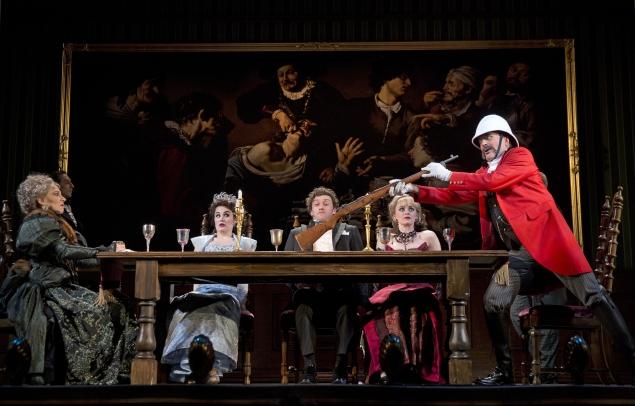
From the acclaim it received when it previously played in Hartford, I’d gotten the impression that the show revolved around Mays’ tour de force performance, but I was wrong. The show has a large cast full of excellent performers, and while Mays (above far right) gets to do all sorts of dazzling and daffy quick-changes, he is equally matched as leading man by Pinkham (above center, a crucial member of Alex Timbers’ teams for Bloody Bloody Andrew Jackson and the musical of Love’s Labour’s Lost last summer in Central Park). Lisa O’Hare (above in pink) and Lauren Worsham (above in white) are terrific as the women Monty courts; Joanne Glushak (above far left) is a riot as the current earl’s squabbling spouse. Beautifully designed from top to bottom, cleverly staged by Darko Tresnjak, superbly orchestrated by the great Jonathan Tunick, and entertaining as hell. Still, I left the theater with my heart untouched and my intellect unfed.
The same evening, I went back to the Public Theater to see Fun Home for the second time and liked it even better than I did the first time. In the interim I’d sat down and re-read Alison Bechdel’s original graphic memoir, which both deepened my understanding of the characters (especially the author and her father) and increased my appreciation for how creatively and ruthlessly the creators of the musical worked to turn it into a musical. I was much more aware this time of the understated importance to the story of the father’s mental illness. And where it bothered me the first time that the adult cartoonist Alison (Beth Malone) spends a lot of stage time standing around watching the younger versions of herself, it didn’t bother me at all this time. Every single performance has gotten sharper and stronger.

Each of the three Alisons gets a major aria. “Ring of Keys,” a song about a nine-year-old nascent lesbian (sung by Small Alison, the adorable Sydney Lucas, above left) spotting her first bull-dyke, is one for the ages, a moment that instantly enters gay-theater history.
With your swagger and your bearing
And the just-right clothes you’re wearing
Your short hair and your dungarees
And your lace-up boots and your keys
Your ring of keys…
Of all the people in this luncheonette
Why am I the only one who sees you’re beautiful…
I mean, handsome?
Medium Alison’s big number, sung with brave awkwardness by Alexandra Socha, is “Changing My Major” (from English to Joan — sex with Joan, minor in kissing Joan). And once again, I wept helplessly during “Telephone Wire,” the climactic song in which adult Alison pours out her desperate and unsuccessful clamoring for her father (a seriously impressive performance by Michael Cerveris, above right) to see her as a complete person, including her sexuality. I loved tracking the T-shirts that designer David Zinn gives to the three ages of Alison, and I appreciated how director Sam Gold let many awkward dramatic moments stay awkward. Kudos once more to Lisa Kron (book and intensely smart, characterful lyrics) and Jeanine Tesori (composer extraordinaire) – also choreographer Danny Mefford and lighting designer Ben Stanton.
11.17.13 – I tagged along as a posse of Andy’s choir-geek friends made an expedition to The Cloisters to experience Janet Cardiff’s sound installation “The Forty Part Motet” – an eleven-minute composition by 16th century composer Thomas Tallis recorded in 2000 by the Salisbury Cathedral Choir.

One voice comes out of each of 40 standing speakers arranged in an oval around the beautiful Fuentidueña Chapel – I thought of it as an invisible flash mob. The room was pretty crowded on a rainy Sunday afternoon, but it was one of those great New York interactive museum experiences, like lying on the floor of the Guggenheim’s rotunda looking up at the James Turrell light show.

The late twelfth-century apse of the chapel has been transported intact from the church of San Martín at Fuentidueña, near Segovia, Spain, on permanent loan from the Spanish Government. The art includes a striking Christ-on-the-cross and what looks for all the world like Tweedledee and Tweedledum proffering freshly baked pies (above).

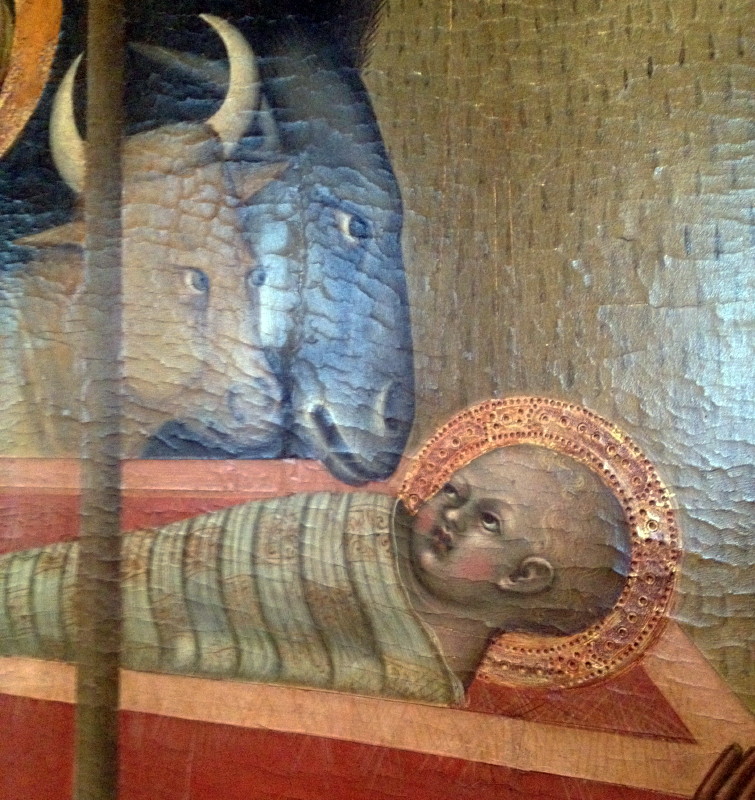
While we were at the Cloisters, we had a look at the famous room of Unicorn Tapesties and some of the other curiosities on display. I’d never seen a tableau like this one described as “Christ in Limbo.”

And it’s always fascinating to encounter these images of LBJ (the little baby Jesus) with strangely adult facial expressions. This one seems to be saying, “Bitch, get these animals out of my face.”
In the evening, my friend Misha Berson took me along to James Lapine and William Finn’s musical adaptation of Little Miss Sunshine, the feel-good dysfunctional family hit indie film. You can totally see why everyone would think that the guys who wrote March of the Falsettos and what everyone calls The Spelling Bee Musical would be perfect to make a musical out of this story. Yes, there are precocious children and furniture on wheels and quippy gay guys and a long-suffering wife (that would be Stephanie J. Block, very good). I wasn’t a fan of the movie – I thought all the characters were implausible cutesy stick figures. Lapine and Finn gave it their all, but they’re still stuck with mediocre source material.
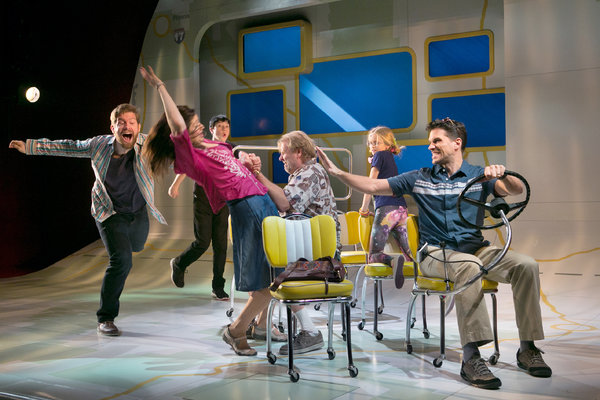
The musical is superbly, unpredictably cast – in the Steve Carell role, Rory O’Malley is an appealingly pudgy Jesse Tyler Ferguson type; I find Will Swenson charmless, which isn’t bad for the self-absorbed dad; I’ve always been a big fan of David Rasche, who couldn’t be more unlike the movie’s Alan Arkin; and all the nasty little girls are great, including Hannah Nordberg’s Olive. The wittiest thing about the show is Beowulf Boritt’s set, which snakes up from the floor onto the ceiling.











 another eye opens