Archive for September, 2013

Photo diary: weekend urban walkabout

September 23, 2013

(click on photos to enlarge)

The Apple Store is a madhouse the first day new products go on sale.

The Apple Store is a madhouse the first day new products go on sale.

I'd never noticed the gilt detail at the top of this building on W. 57th Street before.

I’d never noticed the gilt detail at the top of this building on W. 57th Street before.

I spun through MOMA's "American Modern: Hopper to O'Keefe" show, with easy reminders: I love Robert Rauschenberg ("Canyon," above), I don't love Jasper Johns.

I spun through MOMA’s “American Modern: Hopper to O’Keefe” show, with easy reminders: I love Robert Rauschenberg (“Canyon,” above), I don’t love Jasper Johns.

Richard Serra's "Delineator" invited viewers to step on it

Richard Serra’s “Delineator” invited viewers to step on it

so I did.

so I did.

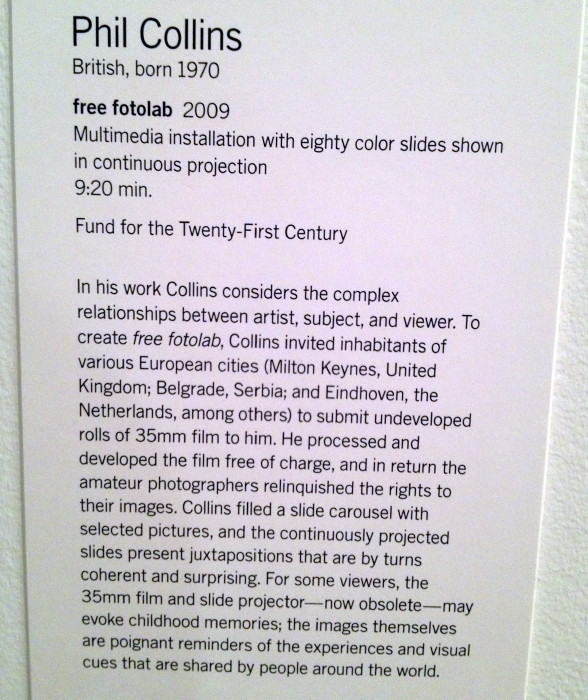
Some discoveries -- like this "Woman" by a painter unknown to me, Ivan le Lorraine Albright (above), and the slideshow by contemporary British artist Phil Collins (NOT the guy from Genesis)

Some discoveries — like this “Woman” by a painter unknown to me, Ivan Le Lorraine Albright (above), and the slideshow by contemporary British artist Phil Collins (NOT the guy from Genesis)

9-20 phil collins slide9-20 collins wall card

Andy pointed out that the giant eye on the billboard in the walkway at Columbus Circle follows you as you walk

Andy pointed out that the giant eye on the billboard in the walkway at Columbus Circle follows you as you walk

9-21 eye 29-21 random swirl

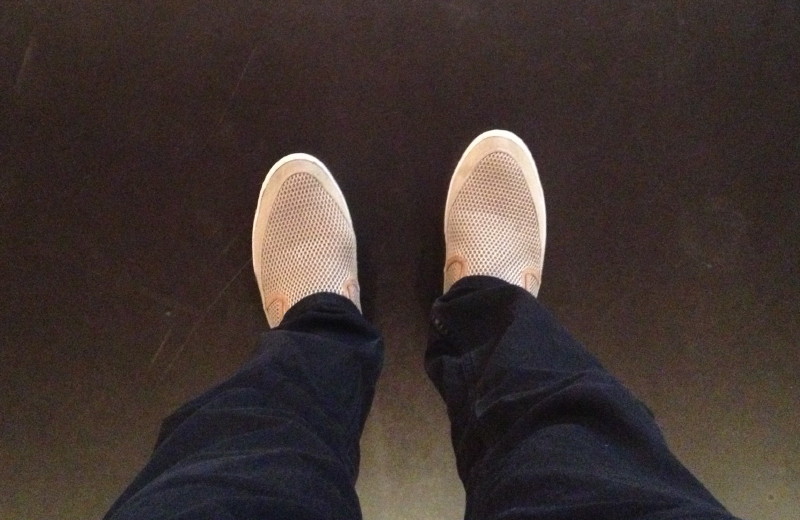
At Discount Shoe Warehouse I bought new rain boots to take to the Amazonian jungle

At Discount Shoe Warehouse I bought new rain boots to take to the Amazonian jungle


In this week’s New Yorker

September 22, 2013

new yorker goings on cover
The Style Issue contains a bunch of stories in a row that I found engrossing, often to my surprise:

bryan goldberg
Lizzie Widdicombe on Bryan Goldberg, a cocky young entrepreneur (above) who is launching an online magazine for women, Bustle.com, that he hopes becomes as popular and financially successful as his sports site, Bleacher Report, was with men;

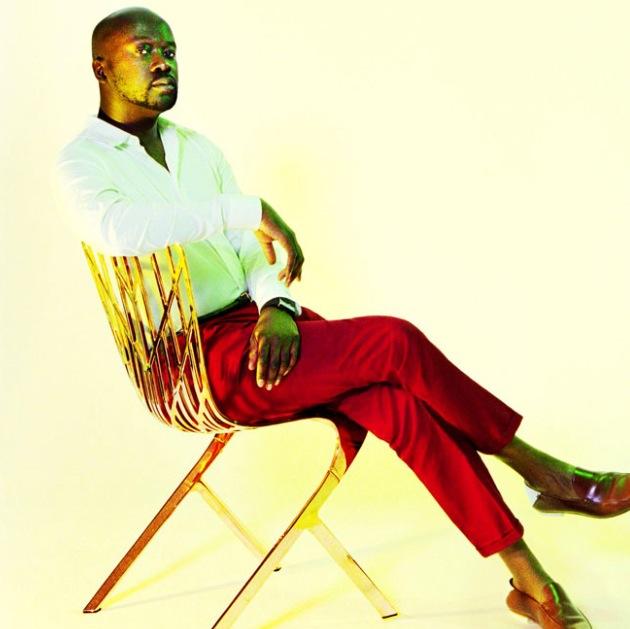
david adjaye
* Calvin Tomkins on David Adjaye, the Ghanaian-British architect (above) who is designing the National Museum of African American History and Culture in Washington, DC, which made him sound so appealing that I ordered his book of photographs of the architecture of African capitals;

* Rebecca Mead on Andrew Rosen, the schlubby founder of the fashion company Theory, a profile that doubles as a succinct history of the garment district;

eileen fisher
and a fascinating profile of modest but chic women’s clothing designer Eileen Fisher by Janet Malcolm. Fisher is a smart feminist who runs her company according to principles of non-hierarchical management and simple Buddhist kindness, and Malcolm plays a strange game with her of pretending not to understand the language she uses to describe how the business runs. Her language is slightly vague not not jargonistic, and it’s curious to watch Malcolm play dumb in print. But she is one of the New Yorker’s shrewdest veteran writers who is very open with her subjects about the duty of journalists to betray the people they write about, so I suppose it’s part of her strategy. On the New Yorker’s Page Turner blog, editor-in-chief David Remnick’s Letter from the Archive acknowledges that readers may be surprised to see Malcolm writing about a fashion designer. But Remnick also reminds us that she wrote the shopping column, On and off the Avenue, for a while. He steers Malcom fans to a couple of other surprising profiles from years past, “The Window Washer” and “A Girl of the Zeitgeist” (a memorable story about Ingrid Sischy, then-editor of Artforum, in which the august New Yorker published the word “asshole” for the first time, in a direct quote). Remnick also mentions Katie Roiphe’s Paris Review interview with Malcolm, which I have bookmarked to read very soon.

The New Yorker has done a major redesign, especially in the front of the book. I’m not sure I like it, and the iPad app is very buggy. But I’m prepared to wait and see how it shakes out over the next weeks and months.

twitter cartoon

Quote of the day: GARMENT DISTRICT

September 22, 2013

GARMENT DISTRICT

A century and a half ago, New Yorkers had a much more intimate connection with their clothes, because New Yorkers were making them. The garment industry was established in the mid-nineteenth century. Then, as now, immigrants supplied the labor, doing piecework at home or working in the small factories for which the term “sweatshop” was coined.

Initially, garment manufacture centered on the Lower East Side, where the labor pool was based. Around the turn of the century, with the arrival of department stores, the garment factories moved to the West Twenties and into the West Thirties, the better to supply Ladies’ Mile, the shopping corridor along Sixth Avenue between Fourteenth and Twenty-third Streets. The loft buildings there provided comparatively airy work environments. A hundred years or so ago, the first zoning laws were introduced, with the goal of preventing the manufacturing industry from encroaching on residential districts. By the nineteen-twenties, the West Thirties had become home to thousands of factories, showrooms, and offices dedicated to the garment trade. More than three-quarters of the nation’s clothing was made in New York City.

Today, only three per cent of the clothes we wear are made in America. New York’s garment district has undergone a parallel decline. Fifty years ago, there were two hundred thousand industry jobs in the neighborhood; now there are about twenty-one thousand, fewer than half of them in manufacturing.

— Rebecca Mead, “The Garmento King,” The New Yorker, September 23, 2013

Garment_District_NYWTS_crop

Quote of the day: COASTING

September 20, 2013

COASTING

New Yorkers have too much reverence for their institutions. A young banker absolutely worships Goldman Sachs. A young journalist is in complete awe of Condé Nast. In Silicon Valley, growing up, your parents approve of you saying, “Oh, I could do something way better than that.”

— Bryan Goldberg, founder of Bleacher Report and Bustle.com

bryan goldberg

Performance diary: THE GLASS MENAGERIE

September 20, 2013

glass m celia k-b
9.14.13 —  Everybody remembers the last five minutes of The Glass Menagerie, but I’ve never seen a production that placed such careful and meaningful emphasis on the first five minutes as John Tiffany’s revival currently on Broadway. I guess I’ve heard it a bunch of times, but I could never have told you that Tom Wingfield’s opening soliloquy describes economic conditions in the 1930s, “when the huge middle class of America was matriculating in a school for the blind. Their eyes had failed them or they had failed their eyes, and so they were having their fingers pressed forcibly down on the fiery Braille alphabet of a dissolving economy.” I wouldn’t have believed you if you told me that his mother Amanda would describe one of her suitors as “The Wolf of Wall Street” (the name of Martin Scorsese’s forthcoming film, starring Leonard DiCaprio and set in the contemporary world of securities fraud). Most of all, Tiffany and his key collaborators – choreographer/movement designer Steven Hoggett and set/costume designer Bob Crowley – combine the “memory play” aspect of Glass Menagerie with Tom’s mention of “tricks up his sleeve” to frame the naturalistic family scenes at the heart of the play with inventive, sometimes downright peculiar visual effects. As with Once and The Black Watch, the shows that put the team of Tiffany and Hoggett on the map in New York,  scene changes and transitions often involve the actors performing strange abstract gestural “dances”: Tom is drawn from the fire escape into the living room backwards as if memory exerted a literally magnetic pull; “setting the table” becomes a curious ethnographic tribal rite; and without giving away any spoilers, let’s just say Laura has never made an entrance before the way she does here.

glass m laura and jim
The production concept is strong and remarkable because it doesn’t get in the way of the actors but gives them something extra on their plate, so they go about their business (on a tiny island of tenement surrounded by Crowley’s lake of black goo) a little bit like naturalistic actors but also a little bit like performance artists. I think Tennessee Williams would have approved. His introductory stage directions explicitly state, “The scene is memory and is therefore non-realistic. Memory takes a lot of poetic license. It omits some details; others are exaggerated, according to the emotional value of the articles it touches, for memory is seated predominantly in the heart. The interior is therefore rather dim and poetic.”

glass m cherry jones
The actors are all terrific. Although Cherry Jones didn’t erase my memories of previous Amandas (Jessica Tandy, Jessica Lange, Judith Ivey), it didn’t remind me of any previous Cherry Jones performances, it’s completely created in the moment, and I don’t think I’ll ever forget her shattering delivery of the simple line “Betty who?” Amanda Plummer set a high-water mark for me playing Laura opposite Jessica Tandy, but I thought Celia Keenan-Bolger was awfully good – troubled and stubborn and a lot less fragile than we sometimes think of Laura as being. It’s always tough inhabiting a character so ostentatiously representing the playwright, but Zachary Quinto plays a lot of colors: claustrophobic, poet, proud member of the working class, resentful yet loyal son, loving brother. And there’s an attenuated moment on the fire escape with Jim, the Gentleman Caller (Brian J. Smith, suitably operating on a different frequency than the Wingfields), that suggests some history of physical intimacy the play never otherwise makes explicit.

glass m Jones-Smith-Quinto-wide-1024x682

The producers, by the way, have made available a thorough and informative study guide to the play – you can download the PDF here.