Archive for December, 2011

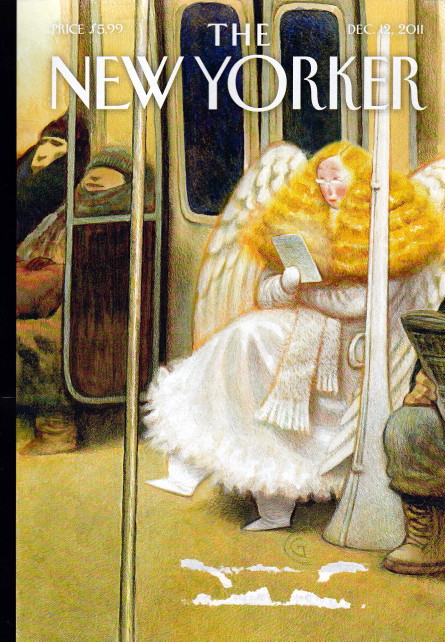
In last week’s New Yorker

December 12, 2011


Last week was a big one for brutal news stories. I was haunted all week by three in particular:

1) Family Guy screenwriter Patrick Meighan wrote a lengthy account of the reprehensible treatment of Occupy Los Angeles protestors by the LAPD. Meighan, who was cuffed with his hands behind his back and thrown face-first to the pavement before being made to kneel for seven hours in a parking garage, contrasts his treatment with that of Citigroup CEO Charles Prince, who after defrauding investors received $53 million in salary and an additional $94 million in stock holdings. Read the whole story here.

2) In New York Matthew Shaer wrote a detailed heart-sickeningly reconstruction of the abduction and murder of 10-year-old Leiby Kretzky by a mentally deficient member of his own Orthodox community in Borough Park. Ugh. It’s online here.

3) And in The New Yorker, Mattathias Schwartz contributed a long report on the massacre of citizens in Kingston, Jamaica, as part of a sweep to nab Christopher (Dudus) Coke, drug trafficker and community “don.”

Philip Gourevitch’s fascinating, informative “Letter from Paris” about French president Nicolas Sarkozy is another major downer. The only thing worse about Sarkozy’s decline from exciting and inspiring campaigner to corrupt politician is the scary rise of Marine Le Pen and the National Front.

And yet: the same week, Secretary of State Hillary Clinton gave an astonishing and eloquent speech to a United Nations gathering in Geneva specifically focused on the importance of including LGBT populations in human rights watch campaigns. She was clearly speaking to many countries with terrible records of harassing and ostracizing gay people, and the response in the room was apparently not so warm. But she spoke the truth, and no one can say they didn’t hear it. You can read the transcript here. The video also widely available online.

President Obama also gave a compelling and sensible address in Kansas giving a lot of clear history and good thinking about the economic crisis, who’s responsible, who’s working to fix it, and who’s intent on jamming up the works. If only he were as good at getting out front with his executive powers as he is with his speaking and teaching…… You can read the text here and also easily find it online if you prefer to watch it.

In this week’s New Yorker

December 4, 2011


A lot of terrific stuff in this issue, starting with the cover by the great comic-book artist Daniel Clowes, “Black Friday” — notice the amount of shelf space in the “bookstore” available for actual books…. The ever-excellent George Packer contributes a closely reported piece focusing on a representative Occupy Wall Street regular (“All the Angry People”). Calvin Tomkins, one of my all-time heroes as an arts journalist, profiles Carl Andre, a once-prominent visual artist whose work most American art followers haven’t kept up with largely because of the mystery surrounding the death in 1985 of his wife, Cuban-born artist Ana Mendieta. Andre was charged with her murder and acquitted, but many people harbor the belief that he was to blame. Tomkins, as usual, provides a clear-eyed 360-degree portrait of this artist.

I learned more about contemporary politics and economics from Nicholas Lemann’s Reporter at Large story on Brazil than I have from any other political reporting I’ve read this year. It is ostensibly a profile of Brazil’s current president, Dilma Rousseff, the incredibly smart protege who was hand-picked as successor by the hugely popular former president Luis Inacio Lula da Silva, known as Lula. Rousseff, raised in an affluent family, was radicalized in reaction to the 1964 coup that established Brazil’s military dictatorship. She and her former husband, Lemann writes, “are said to have planned the single most financially successful operation of the militant resistance: the 1969 theft of two and a half million dollars from a safe in the home of the mistress of a former governor of Sao Paolo. In early 1970, the military finally caught up with her. She spent three years in prison, where she was reportedly subjected to extensive torture with paddles, electric cattle prods, and other devices.” And now she’s President!

Lemann’s piece serves more generally as a survey of Brazil’s journey from being a low-functioning democracy with an enormous poverty-level population to a country that become a world economic power while increasing political freedom and income equality. Lemann spends some time with Fernando Henrique Cardoso, the two-term president who succeeded in turning the economy around. “Cardoso has spent his life analyzing Brazilian society. He has an ability, rare in a politician, to pull back emotionally from the field of play. In his memoirs, he says that he first discovered that poverty existed, as a child growing up in an overwhelmingly poor country, by reading John Steinbeck’s ‘The Grapes of Wrath.’ But distance isn’t the same as dispassion. Another anecdote has George W. Bush, in one of their talks, asking him, ‘Do you have blacks in Brazil?’ Cardoso was shocked. About half of Brazil’s population is made up of people of African descent.”

I was impressed with this unflinching observation about American politics from Governor Sergio Cabral, who may be a future president of Brazil: “The Republican opposition is different from the opposition here. I think the anger against a black man as President should not be enough to put the country in trouble. They disrespect Obama because of his race. It’s not just bad for Obama — it’s bad for the country. In Brazil, the opposition tried tricks against Lula, but the people made solidarity with Lula. The worker, the black man, the workingman, the woman. The world is changing. Thanks God.” But I was most impressed with Lemann’s fascinating conversation with Lula, a straight-talking man of the people. I wish I could provide a link to the whole article, but it’s worth buying the issue or, if you’re a subscriber, not skipping over it but sitting down with this article for 45 minutes.

Elsewhere in the issue: I don’t get fantasy fiction, but I get the truth of what Adam Gopnik says in his long essay about the genre. “Of all the unexpected things in contemporary literature, this is among the oddest: that kids have an inordinate appetite for very long, very tricky, very strange books about places that don’t exist, fights that never happened, all set against the sort of medieval background that Mark Twain thought he had discredited with A Connecticut Yankee in King Arthur’s Court.” I also don’t really get hip-hop’s new superstar, Drake, whose chorus of praisers is joined by Sasha Frere-Jones, but he sure is handsome.

Quote of the day: Q&A

December 4, 2011

Q&A

Q: I read that you donned a prosthesis for your one-woman show “Man to Man,” in which you played both husband and wife.

A: Actually it was a balled pair of socks, but the idea of it morphing in legend into a penis prosthetic is fantastic, and we should leave it right there.

— Tilda Swinton, interviewed by Andrew Goldman in the NY Times Magazine

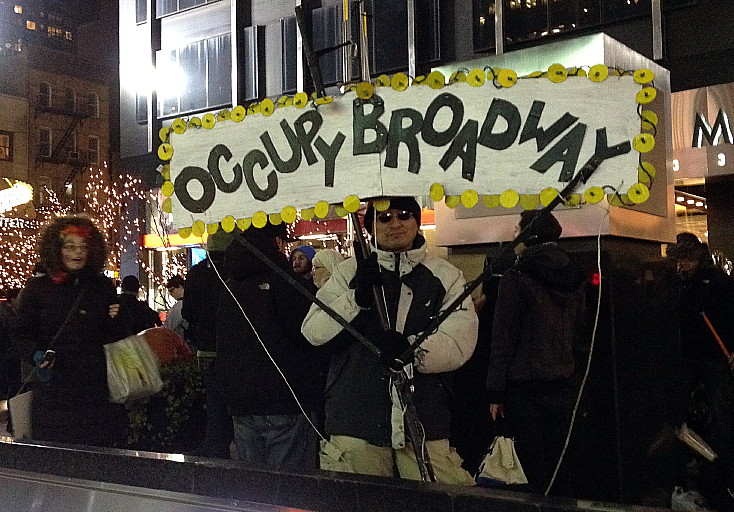
Photo diary: OCCUPY BROADWAY

December 4, 2011

Theater-world supporters of Occupy Wall Street conceived and executed a 24-hour performance/ action that began Friday December 2 at 6 pm and ran continuously until the same hour Saturday December 3.


The action took place in the open area between 50th and 51st Streets on Broadway, which had been dubbed the People’s Performance Plaza for the occasion I showed up in time to catch the last half-hour. When I arrived, an a cappella chorus of rather good singers was belting out a song on the theme of “We Are the 99 PerCent.” They were apparently the last in a long string of music, dance, and spoken-word performances that played to anywhere from a couple of dozen (in the middle of the chilly night) to a several hundred (during the day).


A well-spoken young woman in a long red dress seemed to be facilitating things at this point, and she invited the crowd to form a circle around the plaza holding hands. She said there had been a request for some chanting. Spontaneously, someone called out “All night, all day/Occupy Broadway!” We all chanted that for a while, and the tall guy next to me improvised a Rockette-style kick to go with it, which the entire circle adopted. Then there were a few minutes of “Our movement is unstoppable!/Another world is possible!”


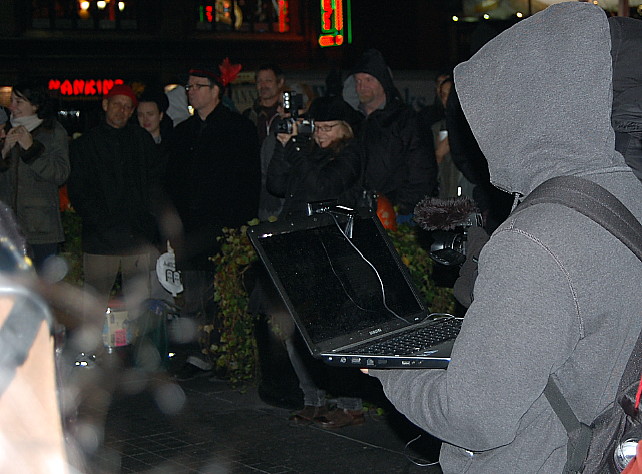
If you’ve ever tuned in to the OWS Livestream and wondered how it’s done, here’s how it works — this dude with his laptop and webcam strolling through the crowd.


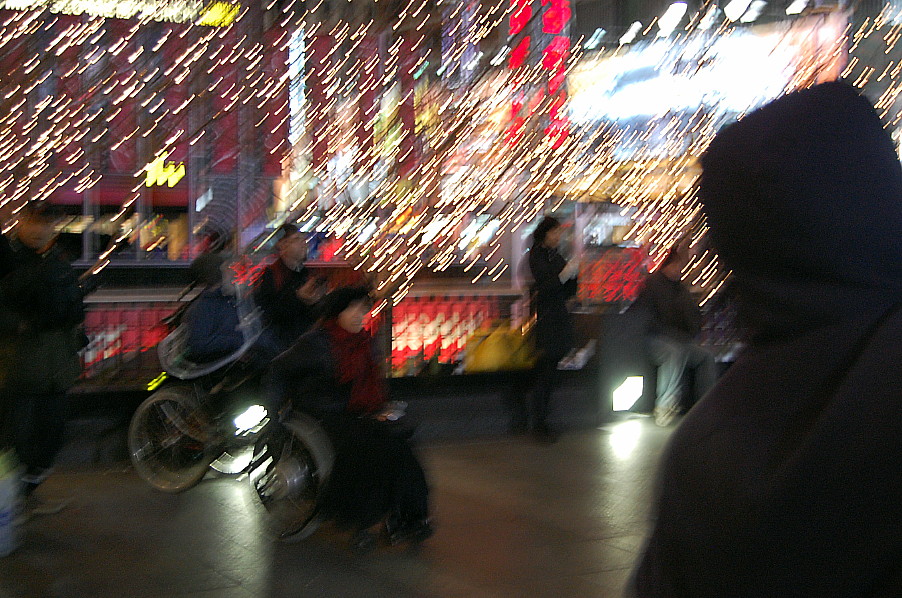
Next Red Dress Lady proposed that we break up into small groups and have a conversation about our experience with Occupy Broadway. My group consisted of Patrick, a longtime Occupier whose group Gravity performed at 1:00 AM; two Chinese-American brothers, Kevin and James; and a woman named Rebecca. People who only know of Occupy Wall Street from reading or watching news accounts of clashes with police might be surprised at how intimate and communal these actions are. Call it new age-y or call it civilized, it prompts strangers to talk to each other, on whatever shallow or deep level they choose. The diversity of OWS supporters delights me — from Radical Faeries (above) to multiple people in motorized wheelchairs (below).


And of course this is New York City, this is the theater district, so there is the cosmic absurdity of this action taking place across the street from the Winter Garden, with Mamma Mia! bestowing her Abba-fied blessing.

Theater review: BURNING

December 2, 2011

My review of Thomas Bradshaw’s mind-boggling new play Burning, directed by Scott Elliott at the New Group, has just been posted on CultureVulture.net. Check it out and let me know what you think.

The play is strong stuff but had a big impact on me. “The 30-year-old author of ten plays (including “Strom Thurmond Is Not a Racist”), Bradshaw does not, I think, set out primarily to shock, although shock he does…His remarkable accomplishment is to build a clear-eyed contemporary narrative that is as matter-of-fact about sex, drugs, and violence as it is about death, art, and politics. And he does so in a way that makes other playwrights look coy, cowardly, or faint-hearted.” You can read the full review online here.