
Archive for September, 2011

In this week’s New Yorker

September 3, 2011


After reading most of this week’s issue on my iPad, it finally showed up in my mailbox. But I’m glad it worked out that way because otherwise I wouldn’t have seen the coolest thing: the video that accompanies Ian Frazier’s piece about Theo Jansen’s mind-blowing wind-powered kinetic sculptures (he calls them Strandbeests), which I guess you can’t see unless you’re a subscriber. But you can see a bunch of other videos on YouTube, including this BMW commercial. (He’s also done a TED talk.) Very cool.

Then there’s the ever-droll Rebecca Mead’s profile of Timothy Ferriss, author of best-selling self-help books, most recently The Four-Hour Body. “The book, which is five hundred and forty-eight pages long, contains a lot of colorfully odd advice—he recommends increasing abdominal definition with an exercise he calls ‘cat vomiting’—but it also reassures readers that they need not go so far as to have Israeli stem-cell factor injected into the cervical spine, as Ferriss did in the name of inquiry. Nor need they necessarily incorporate into their regimen Ferriss’s method for determining the effectiveness of controlled binge eating: weighing his feces to find out exactly what kind of shit he was full of.”

I’m not sure why, but I read all of Larissa MacFarquhar’s piece on an Oxford philosopher named Derek Parfit and also Tad Friend’s heart-sinking report on how the town of Costa Mesa, California, has gone broke and alienated its working people. Like the best (read: most depressing) documentary films, Friend’s story gives you a new person to hate, a Costa Mesa city council member named Jim Righeimer.
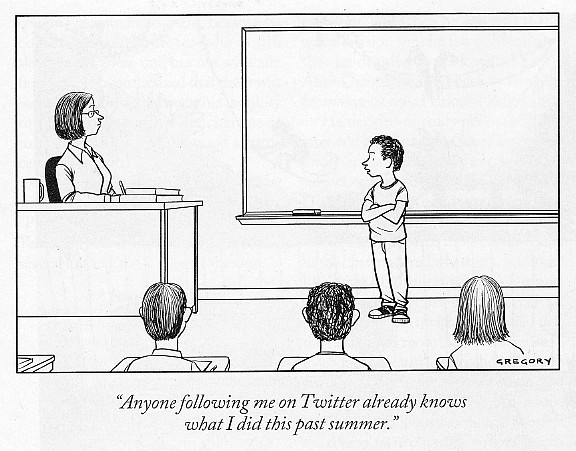
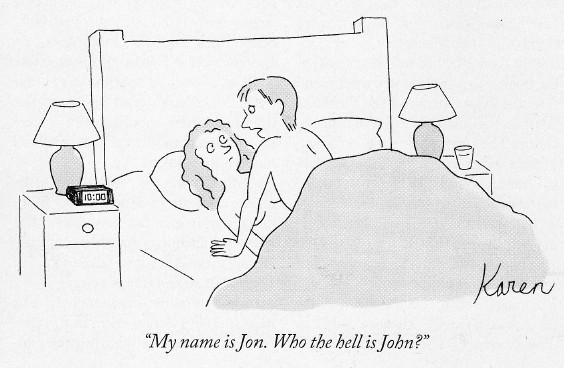
And then of course, as ever, the cartoons. Thank you, Alex Gregory (above) and Karen Sneider (below) .
Quote of the day: LANGUAGE

September 3, 2011

LANGUAGE

Street prostitution as practiced in Bonn, once the capital of West Germany and a town better known for sleepiness than sexiness, would be unfamiliar to many people outside Germany for its unusual degree of organization and institutionalization. The women wait for customers on a stretch of the Immenburgstrasse in a largely industrial part of the city. In addition to the Siemens-built meter machine, which cost $11,575 including installation, the city has built special wooden garages nearby where customers can park their cars and have sex.

“They are called, in fairest and finest administrative High German, ‘performance areas,’ but I believe the Italian prime minister would say ‘bunga bunga,’ ” said Monika Frömbgen, a spokeswoman for the city.

— Nicholas Kulish, “In Germany, Sex Workers Feed a Meter,” New York Times

In this week’s New Yorker

September 1, 2011

…there may be some good stuff, but I haven’t read it yet because it hasn’t arrived in my mailbox. (Hey! Irene ate my New Yorker!) I can read it on my iPad but somehow it’s not the same. Plus there’s a long takeout on Ry Cooder by Alec Wilkinson that’s ONLY available on the magazine’s website. I’m like Wilkinson: Cooder is a huge culture hero of mine (and was the first famous musician I ever interviewed, as an extremely callow college sophomore in Houston, at the time of his Paradise and Lunch album).

But instead of talking about The New Yorker, I want to give a shout out to New York magazine for this week’s 9/11 issue. I didn’t think anyone could come up with anything about 9/11 that a) hasn’t been done before and/or b) that I would want to read. But leave it to Adam Moss to come up with an ingenious concept, “The Encyclopedia of 9/11,” which manages to encompass some pockets of curiosity that managed to intrigue me and lure me into reading stuff I never would have otherwise. (Some entries that stand out: The Fake Widow, how Saturday Night Live handled that week, the weird story of Sneha Anne Philip.) It’s impressive journalism without straying too far into cheesy or cheap sentiment. I’ve known Adam since we were both kids (he edited my profiles of Phoebe Snow and Wally Shawn back when he was a junior editor at Esquire, and he hired me as arts editor for 7 Days), and I continue to admire his editorial restlessness, creativity, fearlessness, and insistence on quality.