



Archive for November, 2010
Photo diary
November 15, 2010
Performance diary: THE HOPEY CHANGEY THING
November 15, 2010November 9 – The Public Theater has been running an aggressively political season this year, starting with Bloody Bloody Andrew Jackson opening on Broadway, then Lisa Kron’s In the Wake and Lawrence Wright’s The Human Scale, and soon to come The Great Game — Afghanistan. A late addition to the schedule was Richard Nelson’s The Hopey Changey Thing, a play audaciously set on November 2, 2010 – that is, election day – which is also the same night the production (directed by the author) opened at the Public Theater. Talk about a high-wire act! I admire Nelson for being willing to write a play with a short shelf life in order to capture — for the theatrical record, as it were – some of the conversations and issues in the air right this minute without waiting to view from the cool distance of history. How current is it? The first line of the play is “Fuck you, Andrew Cuomo! Fuck you, Kirsten Gillibrand, and the horse you rode in on, whose name is Chuck!”
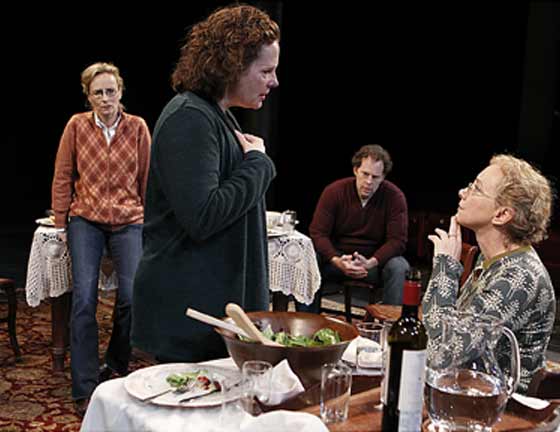
The speaker is Richard (Jay O. Sanders), a lawyer in the State Attorney General’s office, holding court in the kitchen of his sister Barbara’s house in Rhinebeck. Unmarried Barbara (Maryann Plunkett) teaches high school and looks after their Uncle Ben (Jon deVries), an actor who’s recently suffered a heart attack and has amnesia. They have two other sisters, Marian (Laila Robbins), an elementary school teacher in Rhinebeck who helps look after Ben, and Jane (J. Smith-Cameron), a recently divorced writer who lives in Manhattan with her new boyfriend Tim (Shuler Hensley) and does everything she can to avoid spending time in the depressing company of Barbara and Ben.
Three sisters, a brother, an elderly dotty uncle…Chekhov anyone? Nelson lays out this family dynamic in a blatantly schematic manner, assigning each character a single trait and having them always and only live out that role. Richard is the blowhard lawyer, Barbara is the long-suffering “old maid” who can’t stand conflict in her vicinity, Jane is the insecure one who sides with Richard in any family conflict, and Marian is the bossy unpleasant one who says whatever she thinks and is rabidly attached to the Democratic party line. I can’t help contrasting “Hopey Changey” with Lisa Kron’s play, which eschews obvious Republican-bashing and portrays characters thinking deeply and independently about political issues. Nelson’s up to something else, presenting characters who are not ostensibly mouthpieces for the author’s opinions but the semi-informed and semi-clueless, semi-smart and semi-defensive liberals whose opinions are formed by an attachment to the New York Times and the Huffington Post as middle-American households might be driven by Fox News. These New Yorkers see themselves as the center of American culture in a way that’s both patronizing and ignorant. Marian holds people in rigid party-line categories. Barbara claims never to have met anyone from Texas, and her sibs chime in with writing off that state as populated only by yahoos. Richard didn’t vote at all in the election – he admired his former boss, Eliot Spitzer, and despises Cuomo – and Jean did her me-too act.
As the characters talked about Sarah Palin, the election, the wars, campaign financing, Obama’s performance as president, I found myself going back and forth – outraged when I didn’t agree with them, absorbed when I did. Ultimately, I found the play thin and not especially illuminating. (For one thing, Uncle Sam, I mean Uncle Ben’s illness was so metaphorical, Susan Sontag must be spinning in her grave.) Nevertheless, I’m impressed that Nelson was able to get the play up and running at all. He certainly was able to amass a cast of excellent veteran actors, whom I was happy to see even if they were playing limited generic parts. And if the family aspect of the play is modeled on Chekhov, the political aspect is pure Brecht: if you don’t like the world, change it.
November 11 – Andy is a big fan of Radiolab, the WNYC-FM program and podcast whose hosts, Jad Abumrad and Robert Krulwich, weaving storytelling and science into sound and music-rich documentaries. So we went to a live show at Greene Space in the West Village, where the hosts were trying out material for a forthcoming show on the subject of symmetry. I found their approach disconcertingly random, more trivia-mongering than persuasive argument, but they had John Cameron Mitchell as a musical guest to sing “The Origin of Love” from Hedwig and the Angry Inch – a lovely song and lovely performance, even if I reject Aristophanes’ thesis that we are born with a longing for our “other half” that turns into love. We went out for dinner at Trattoria Toscana on Carmine Street with Andy’s friend Steve Kass, and David Hollander joined us after a concert at Lincoln Center.
Theater review: THE PEE-WEE HERMAN SHOW
November 14, 2010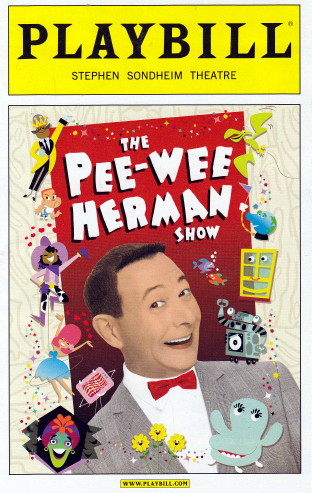
I wasn’t quite what to expect from the experience of seeing Pee-Wee Herman live onstage. Would it be an emotionally remote Xerox copy of the TV show? A cult event like Spamalot or Kiki and Herb on Broadway? In the event, I found myself helplessly swept up in its fiendish charms. You can read my review online at CultureVulture here.
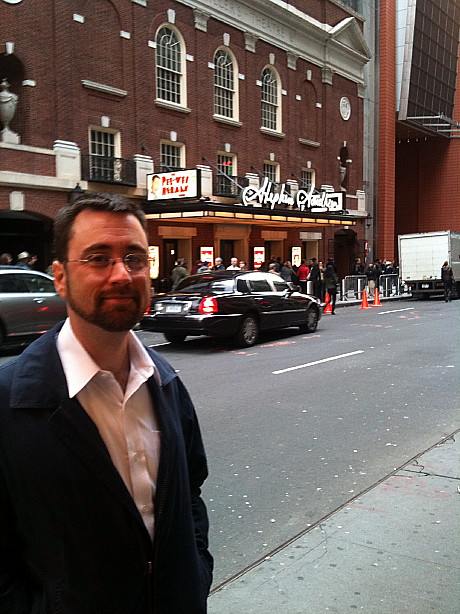
Andy also loved the show
Like Jesse Green in New York magazine, I found myself cackling at the idea of Pee-Wee Herman opening on Broadway at a theater originally named for Henry Miller and recently renamed in honor of Stephen Sondheim. I loved it, though, that when Green brought it up in his interview, Paul Reubens wouldn’t put up with any snickering:
Yours is the first show in the former Henry Miller’s Theater since it was renamed for Stephen Sondheim. Some people might find that ironic—do you?
I don’t know what you mean. I love Sondheim’s work.
In this week’s New Yorker
November 14, 2010
The best thing is this week’s issue is the very first thing: Hendrik Hertzberg’s editorial in Talk of the Town analyzing the results of this year’s midterm election.
As for “the American people” themselves, it seems clear enough that their rejection of the Democrats was, above all, an expression of angry anxiety about the ongoing economic firestorm. Though ignited and fanned by an out-of-control financial industry and its (mostly) conservative political and intellectual enablers, the fire has burned hottest since the 2008 Democratic sweep. By the time the flames reached their height, the arsonists had slunk off, and only the firemen were left for people to take out their ire on. The result is a kind of political cognitive dissonance. Frightened by joblessness, “the American people” rewarded the party that not only opposed the stimulus but also blocked the extension of unemployment benefits. Alarmed by a ballooning national debt, they rewarded the party that not only transformed budget surpluses into budget deficits but also proposes to inflate the debt by hundreds of billions with a permanent tax cut for the least needy two per cent. Frustrated by what they see as inaction, they rewarded the party that not only fought every effort to mitigate the crisis but also forced the watering down of whatever it couldn’t block.
Part of the Democrats’ political problem is that their defense, confusingly, depends on counterfactuals (without the actions they took in the face of fierce Republican opposition, the great slump would have metastasized into a Great Depression), deferred gratification (the health-care law’s benefits do not kick in fully until 2014), and counterintuitive propositions (the same hard times that force ordinary citizens to spend less money oblige the government—whose income, like theirs, is falling—to spend more). Another part of the problem, it must be said, is public ignorance. An illuminating Bloomberg poll, taken the week before the election, found that some two-thirds of likely voters believed that, under Obama and the Democrats, middle-class taxes have gone up, the economy has shrunk, and the billions lent to banks under the Troubled Asset Relief Program are gone, never to be recovered. One might add to that list the public’s apparent conviction that illegal immigration is skyrocketing and that the health-care law will drive the deficit higher. Reality tells a different story. For ninety-five per cent of us, taxes are actually lower, cut by around four hundred dollars a year for individuals and twice that for families. (The stimulus provided other tax cuts for people of modest means, including a break for college tuition.) The economy has been growing, however feebly, for five straight quarters. Most of the TARP loans have been repaid and the rest soon will be, plus a modest profit for the Treasury. And the number of illegal immigrants fell by close to a million last year, thanks in part to more energetic border enforcement. The health-care law, the nonpartisan Congressional Budget Office says, will bring the deficit down.
But why don’t “the American people” know these things? Could it be because the President and his party did not try, or try hard enough, to tell them?
Hmmm…are “the American people” ignorant because the President hasn’t properly educated them? Isn’t it much more likely that they’ve been successfully fear-mongered by Fox News into believing falsehoods and overlooking truths they don’t want to see? Fear creates more biochemical reaction in the body than appeals to calm and rationality do — that’s just survival, and that’s how demagogues and screamers get their way over the steady-speakers. Depressing.
Alec Wilkinson writes terrific profiles of musicians for the New Yorker. This week we read his report on Bettye Lavette, a minor soul singer overlooked for decades who’s had a resurgence of critical acclaim in recent years. I’m not a big fan of her singing, and the article makes her sound quite unpleasant to be around. But I had to chuckle at the frankness of this particular self-assessment: “I really don’t have a lot of talents. I can cook, and I can fuck, and I can sing. And I’m proud of all of them.”
I doubt if I would like Lena Dunham’s feature film debut as writer/director/star, Tiny Furniture, but I enjoyed reading Rebecca Mead’s profile of Dunham and her description of the movie. “In its merciless investigation of its creator’s character flaws, Tiny Furniture resembles Larry David’s Curb Your Enthusiasm mashed up with Whit Stillman’s Metropolitan, or Manhattan if it had been directed by Mariel Hemingway rather than by Woody Allen.”
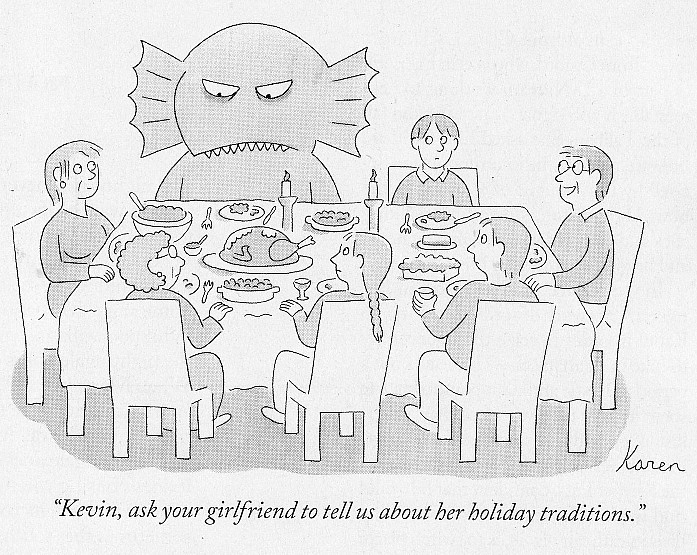
And then there’s this delightful cartoon by Karen Sneider:
Theater review: RAOUL
November 12, 2010My review of James Thiérrée’s Raoul at the BAM Next Wave Festival has been posted online at CultureVulture.net. I was a big fan of Thiérrée’s previous show at BAM, Au Revoir, Parapluie.
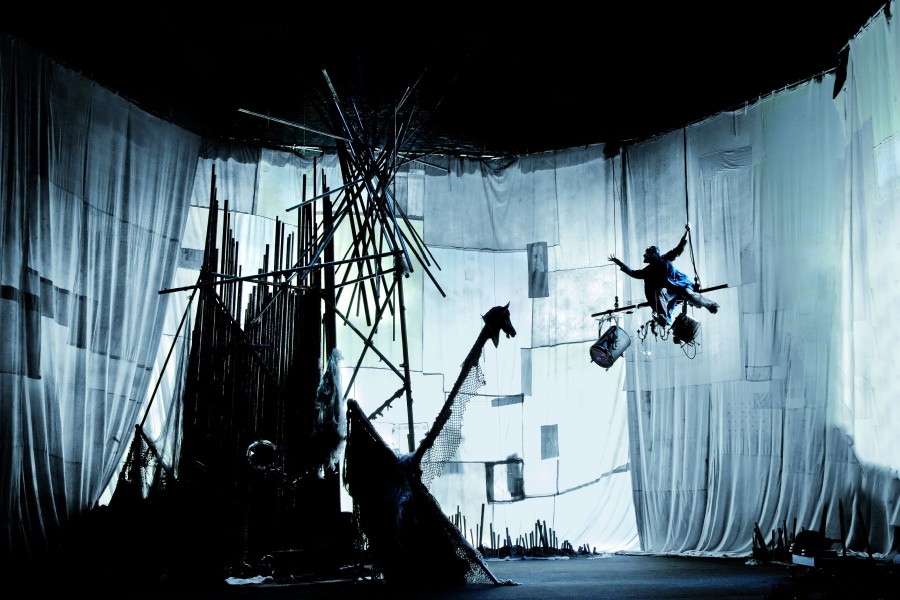
“As nonsensical as its title, that show was a completely delightful, non-narrative nouveau-circus piece in which five superb performers (including Thiérrée, who conceived, directed and designed the production) ceaselessly transformed the stage space, themselves, their costumes and props every minute of the show, going back and forth between silly and magical, literal and symbolic…[Raoul is] much smaller and less magical than its predecessor.”
You can read the whole review online here.
 another eye opens