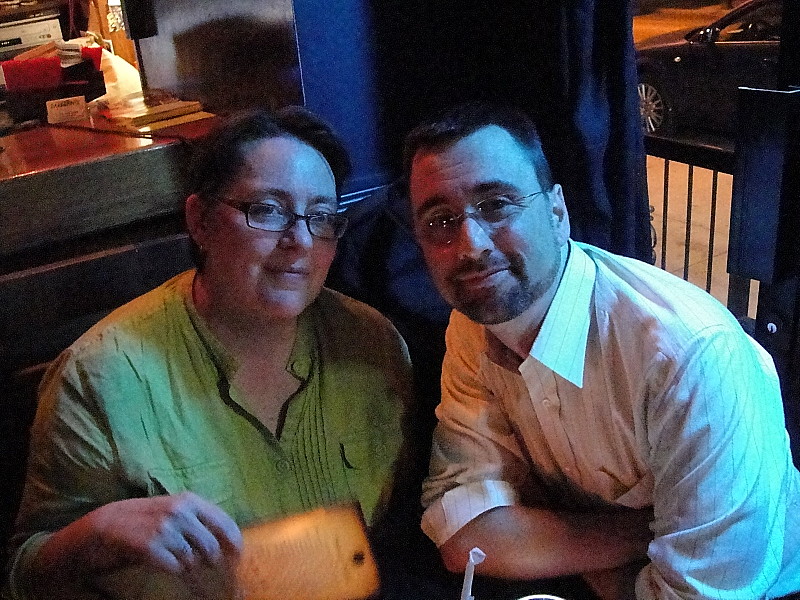
Darci and Andy gearing up for Brooklyn Pub Quiz

graffiti in the john at the Black Sheep Pub

geese at Sandy Hook

this has not been Photoshopped -- hibiscus is naturally psychedelic

there's a look...
cultural commentary from the desk of Don Shewey
Darci and Andy gearing up for Brooklyn Pub Quiz
graffiti in the john at the Black Sheep Pub
geese at Sandy Hook
this has not been Photoshopped -- hibiscus is naturally psychedelic
there's a look...
MUSIC
The musicians took the stage. The singer was wearing a dull green sari. She must have been sixty, was grand-looking, stern, hefty. She supervised the tuning of the tempura, sipped water without letting the bottle touch her lips, and waited….
Within minutes of starting to sing, she was transformed. It was like hearing a girl, dark-haired and lovely as the gopis Krishna had spied on from is tree-top hideaway. I had no idea what she was singing about, could not even tell when the words stopped being words and became just syllables, gliding sound. Her hands reached into the air above her as if the notes were growing there and, as long as they were picked endlessly, over and over, would always be there. Music people talk about perfect pitch, but what her voice made me think of was perfect posture: hair as long and straight as a supple back; bare feet moving so lightly they scarcely touched the ground. Her voice promised absolute devotion; but then the note was stretched further still, beyond this, until you wondered what you would have to do to be worthy of such devotion, such love. You would have to be that note, not the object of devotion, but the devotee. Her voice slid and swooped. It was like those perfect moments in life, moments when what you hope for most is fulfilled and, by being fulfilled, changed – changed, in this instance, into sound: when, in a public place, you glimpse the person you most want to see and there is nothing surprising about it; the pattern in the random, when accident slides into destiny. A note was stretched out as long as possible and then a little longer; it continued, somewhere, long after it was capable of being heard. It is still there, even now.
— Geoff Dyer, Jeff in Venice, Death in Varanasi

…by far the most interesting article is Atul Gawunde’s brave, honest piece called “Letting go: What should medicine do when it can’t save your life?” It tackles head-on a subject that is extremely pressing and yet hardly ever gets talked about: for medical patients who are known to be dying, known to be incurably ill, when do you stop the testing and the treatments. As Gawunde notes, “Twenty-five per cent of all Medicare spending is for the five per cent of patients who are in their final year of life, and most of that money goes for care in their last couple of months which is of little apparent benefit.”
Gawunde admits that he himself has found it almost impossible to acknowledge to patients when medical treatment has reached the end of the road. To discover a better way than avoiding the subject of deceiving his patients, he says,
I spoke to Dr. Susan Block, a palliative-care specialist at my hospital who has had thousands of these difficult conversations and is a nationally recognized pioneer in training doctors and others in managing end-of-life issues with patients and their families. “You have to understand,” Block told me. “A family meeting is a procedure, and it requires no less skill than performing an operation.”
One basic mistake is conceptual. For doctors, the primary purpose of a discussion about terminal illness is to determine what people want—whether they want chemo or not, whether they want to be resuscitated or not, whether they want hospice or not. They focus on laying out the facts and the options. But that’s a mistake, Block said.
“A large part of the task is helping people negotiate the overwhelming anxiety—anxiety about death, anxiety about suffering, anxiety about loved ones, anxiety about finances,” she explained. “There are many worries and real terrors.” No one conversation can address them all. Arriving at an acceptance of one’s mortality and a clear understanding of the limits and the possibilities of medicine is a process, not an epiphany.
There is no single way to take people with terminal illness through the process, but, according to Block, there are some rules. You sit down. You make time. You’re not determining whether they want treatment X versus Y. You’re trying to learn what’s most important to them under the circumstances—so that you can provide information and advice on the approach that gives them the best chance of achieving it. This requires as much listening as talking. If you are talking more than half of the time, Block says, you’re talking too much.
The words you use matter. According to experts, you shouldn’t say, “I’m sorry things turned out this way,” for example. It can sound like pity. You should say, “I wish things were different.” You don’t ask, “What do you want when you are dying?” You ask, “If time becomes short, what is most important to you?”
Block has a list of items that she aims to cover with terminal patients in the time before decisions have to be made: what they understand their prognosis to be; what their concerns are about what lies ahead; whom they want to make decisions when they can’t; how they want to spend their time as options become limited; what kinds of trade-offs they are willing to make.
Good to know.
 another eye opens