
July 2 – Seeing the revival of August Wilson’s Fences at the Cort Theatre – where the audience has to line up down the block, that traditional way of signifying “blockbuster hit” – reminded me that I was present for the very first public presentation of the play, at the O’Neill Conference in the summer of…1986? It’s still the same play as it was then: a somewhat long and rambling backyard play with lots of realistic two-black-guys-shooting-the-shit dialogue, chaotic-household action, a little too heavy leaning on the baseball metaphors, and the kind of choppy second-act wrapping-things-up sequence of events that bespeak “novice playwright.” Plus an awkward last-minute leap into non-naturalism, which would show up again in other plays (like Joe Turner’s Come and Gone). Wilson wrote much better, less derivative plays later. I didn’t love the first Broadway production, with Lloyd Richards’ leaden direction and James Earl Jones’ ponderous performance as Troy Maxson, the would-be ballplayer turned bitter garbageman, brightened by the spectacular Mary Alice as Rose. The new production directed by Kenny Leon is much better, partly thanks to the high-voltage cast: Denzel Washington of course, with Viola Davis, Stephen McKinley Henderson, and Russel Hornsby. (Chris Chalk was fine as Cory, the Biff Loman-like son, but Courtney Vance was better in the original production.)
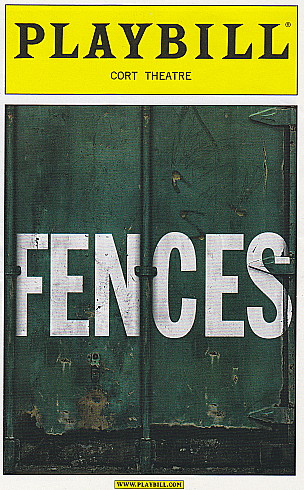
Having a star of Denzel’s magnitude in the role, though, does a wacky number on the audience. Throughout most of the play, the audience (I’d say a third to a half black, much much higher than average for a Broadway show) was primed to greet every utterance, move, and gesture of Denzel’s as an opportunity for riotous laughter and excited response, as if they’re watching an episode of The Jeffersons. It disrupts the play and kinda throws the actors off. It takes an awfully long time for it to sink in that Troy is not an especially likable character. Then when that becomes manifestly clear with the announcement that he’s fathered another child with someone other than Rose, the audience starts responding with gasps, as if they’re watching a Tyler Perry melodrama – which Leon’s direction, with what you could call realistic savvy, joins and exploits rather than trying to fight. I could help monitoring some of the play’s clunkiness, how two scenes in a row ended with the same tag line (“Don’t strike out!”), how Troy’s awkward soliloquies echoed a little too closely and a little too faintly the blazing monologue addressing God that made Roc Dutton a star in Wilson’s previous play Ma Rainey’s Black Bottom (“Don’t turn your back on me, muthafucka!”). Nevertheless, the last scene finally kicked me in the guts. I’m such a sucker for father-son dramas, and I totally related to the experience of a young man unable to mourn the father who he felt never really liked him, and his rage/grief at learning about the affection toward him that his father expressed to other people, never to him directly. The thirtysomething black man behind me, who belly-laughed a little too loudly throughout most of the play, was still limping out of the theater with tears running down his face after the show – guess that scene snagged him, too.





 another eye opens