The best cartoon:
cultural commentary from the desk of Don Shewey
The best cartoon:
UNITED STATES
Bill Beckley: You were born in France, but you have lived a long time in the United States. What is the difference between the aesthetics of the two countries?
Louise Bourgeois: I’ll tell you a story about my mother. When I was a little girl growing up in France, my mother worked sewing tapestries. Some of the tapestries were exported to America. The only problem was that many of the images on the tapestries were of naked people. My mother’s job was to cut out the — what do you call it?
Beckley: The genitals?
Bourgeois: Yes, the genitals of the men and women, and replace these parts with pictures of flowers so they could be sold to Americans. My mother saved all the pictures of the genitals over the years, and one day she sewed them together as a quilt, and then she gave the quilt to me. That’s the different between French and American aesthetics.
— from Beckley’s anthology, Uncontrollable Beauty: Toward a New Aesthetics
May 6 – I’ve been hearing about The Kid, the musical adaptation of Dan Savage’s book about adopting a child with his boyfriend, for several years. A friend of Stephen’s, Michael Zam, wrote the book, and with his partners lyricist Jack Lechner and composer Andy Monroe he has been chasing down producers until Scott Elliott agreed to mount the show at the New Group, directing it himself. And it’s terrific: funny, honest, entertaining, smart, and theatrical, not unlike, say, the musicals of Bill Finn. It tells a real and compelling story with a lot of humor but also a lot of heart, and it’s shockingly free of bogus moments that pander either to the audience or to some tradition of musical theater.

The real Dan Savage is a larger-than-life character already, an incredibly smart, sharp-tongued and potty-mouthed sex columnist and political commentator. I was amazed at how successfully the musical created a stage version of Dan that refers to the real-life guy and yet becomes a separate entity – a tribute to the writing and the directing but mostly to the performance of Christopher Sieber. I’ve never felt one way or another about Sieber, but he really puts out here. It’s a little shocking that he’s chubbed up for the part, which makes him NOT look like Dan Savage, but he stays wonderfully true to the character’s highly neurotic, rage-filled smartass and yet completely inhabits a very intimate vulnerability. Lucas Steele as his boyfriend Terry is fine but somewhat thinly drawn – it’s hard to know what Dan sees in him, other than his being “young and cute” (not my taste, but whatever). But their relationship is sexy and feisty and culturally plugged in (I love the role Bjork plays in their life). And the rest of the cast is absolutely terrific – minor superstars of contemporary New York theater including Ann Harada (Christmas Eve in Avenue Q), Tyler Maynard (Altar Boyz), the spectacularly pale and skinny Brooke Sunny Moriber (The Wild Party, The Dead, Parade), and especially Susan Blackwell (of [title of show] fame), who plays the woman from the adoption agency who serves as liaison to the birth mother whose baby the guys adopt. The story has plenty of potential for both zany comedy and dramatic tension, and the treatment of the birth mother – Melissa, a homeless alcoholic teenager – is handled with extraordinary respect and restraint. She’s very well played by Jeannine Frumess, and everything about her has a different tone than Life At Home with Dan and Terry. The score carefully walks a line between storytelling and show-biz. There’s a modesty about it that I really liked, and there are several moments that are genuinely touching. Melissa’s song, “Sparechangin’,” is a dramatic highpoint that shifts the show to an intriguing deeper layer. Many of the songs are chatty and fun, along the lines of, say, Falsettos or Baby, with the occasional change-of-pace blast (“Seize the Day”). But at key moments things drop into truer and realer in a way that feels really solid (the candidate for instant classic is “I Knew,” a PFLAG anthem if I ever heard one, nicely sung by Jill Eikenberry as Dan’s mother). Bravo to this team for pulling it off. I think The Kid is going to be a hit.
TELEPHONE
“Telephone Meditation”
Every time the telephone rings, or your beeper makes a sound, take it as the bell of mindfulness, a reminder to practice conscious breathing. When you hear the sound, stay where you are and practice breathing in and out. You can afford to do that because if the person calling you has something really important to tell, she will wait. She will not hang up before the second or third ring. “Breathing in, I am aware that I am breathing in. Breathing out, I am aware that I am breathing out.” That’s what you do while you listen to the bell. And when you go to the telephone during the third ring, still practice breathing in and out. Now when you pick up the telephone, you are fresh. You are calm. You are present. There is a gatha (teaching) that says, “Words can travel thousands of miles. They are to build up more mutual acceptance and understanding. I vow that my words will be like gems. I vow that my words will be fresh like flowers.” You may write down these lines and stick them to your telephone. Every time you go to make a call, touch the phone with your left hand and practice breathing in, reciting one line silently. Breathing out, recite the second line. After you finish the gatha, you have breathed in and out twice. Now you are qualified to make a telephone call.
— Thich Nhat Hanh
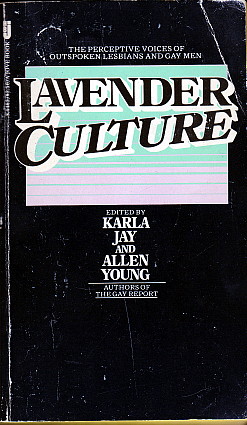
A response to a random post on Facebook led me to reconnecting with an old friend, Allen Young. From Allen, I learned that Lavender Culture, the anthology of essays about gay culture that he and Karla Jay edited and published in 1978, is still in print from NYU Press. Allen commissioned an article from me about gay theater, and it marked my first appearance in a book. I’ll never forget the thrill of walking into the Brattle Street Bookstore in Harvard Square and seeing the book on the shelf. It was a mass-market paperback from Jove Press (a division of Harcourt Brace Jovanovich) back then; the NYU Press edition is a trade paperback, with new introductions by the editors and by Cindy Patton.

I’m touched to re-read my author’s bio from the original edition: “Don Shewey, Cambridge, Mass. Twenty-four years old, formerly an actor and classics scholar, currently a freelance writer, theatre and music critic for the Boston Phoenix, and aspiring playwright. Intensely interested in theatre, literature and my lawyer-lover John. I would like to thank the previous generation of gay activists (whose struggles enabled me to grow up gay free of guilt, shame and despair) and the women’s movement, which changed my life.”
 another eye opens