May 7 – I’m not the kind of theatergoer who sees shows again and again. I have to really like a show to see it more than once. Aside from the Wooster Group, whose every production I have seen three or more times (because I love them so), it’s rare for me to repeat. Same with movies, same with books: I’d rather experience something than revisit something I’ve already encountered, even something I loved. I have seen Fela! three times, and I saw Spring Awakening 4 ½ times (once I employed the time-honored theater-geek tactic of second-acting the show, grabbing a seat in the balcony just to re-live the ecstasy of watching the number “Totally Fucked” rock the house). My friend Tom Dennison is the opposite of me – when he likes something, he likes to watch it over and over. He saw Spring Awakening seven times (and that was after the original cast left), and he’s seen David Cromer’s production of Our Town about a dozen times. I admire that kind of devotion.
My friend Misha Berson, the theater critic for the Seattle Times, was in town this week for her twice-a-year marathon catching up on new shows, and we were supposed to see Enron together. But once they posted their closing notice, it seemed no longer newsworthy to cover, so she switched gears and arranged to see Martin McDonagh’s A Behanding in Spokane. Of course, I had no problem switching gears with you, since I liked the show very much. Seeing it a second time yielded no big rewards, but it was interesting to experience the squeeing of the Christopher Walken maniacs in the audience. Zoe Kazan and Anthony Mackie were very consistent and energized. I got the sense that Walken and Sam Rockwell were laying back, now that the show has been running a while. Not that they were phoning it in, but there was a certain slackness to their energy. Nevertheless, I enjoyed noticing the trade-off: what was lost in a certain kind of Pinter-esque tension, there was a gain in wacky rock-and-roll assurance between those two guys. Walken is so so deadpan, dropping his voice for impact so you have to really lean in and pay attention, while Rockwell relishes playing fast and loose, as if he’s some guy who just wandered onto the set. I did look forward to his front-of-curtain monologue, which does have an explosive impact on the audience. When he says, “I keep waiting for something exciting to happen. Maybe a prostitute will get stabbed…” the audience responds with a combined gasp of horror and surprised laughter. A guy in the balcony got caught up in a bout of barking laughter so helpless that Misha found it creepy, understandably. Classic McDonagh moment.
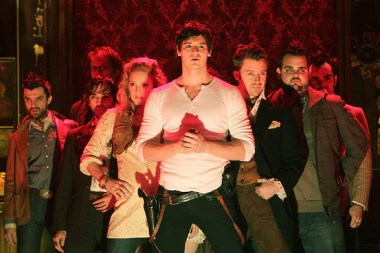
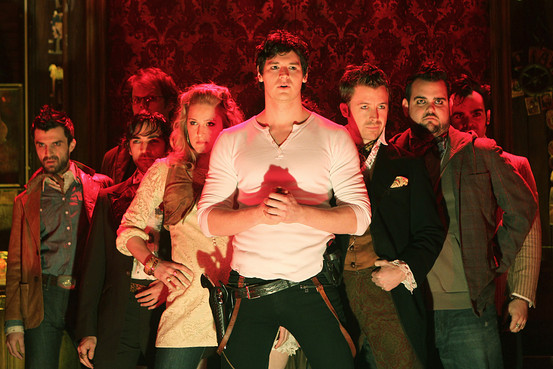
May 8 – Then Saturday afternoon we reconvened at the Public Theater for my second dose of Bloody Bloody Andrew Jackson, which I loved again. I really respect the incredible energy of each individual performer, including the musicians, but of course most of all the charismatic Benjamin Walker in the title role. The staging is tremendous, and the play itself continues to impress me with its daredevil juxtaposition of classic American contradictions – generosity and selfishness, smarts and stupidity, victim and bully. Populism, yeah yeah! I understand they’re putting out an original cast album. Can’t wait! Misha had seen an earlier version of the show in Los Angeles and hadn’t cared for it, thought it was sophomoric and shallow. She liked it much better this time, said they’d sharpened the script, and that the addition of Danny Mefford’s choreography made a huge difference. It is sensational. In the lobby, Misha met a ninth-grade girl who was seeing the show for the third time. I can understand that. There’s a heat and energy to the show that’s just delicious to have blasting at you again and again.
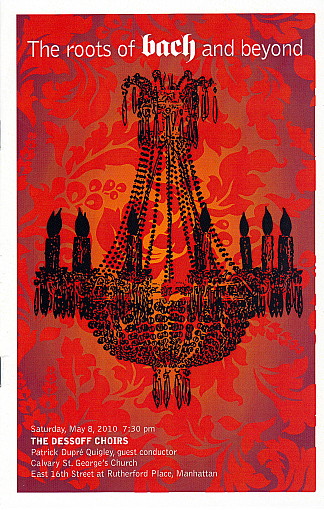
Afterwards, I grabbed a falafel and lemonade at Tahini and then made my way to my next gig, a concert called “The Roots of Bach and Beyond” by the Dessoff Choirs at Calvary St. George’s Church in Stuyvesant Square. Okay, I went because my boyfriend sings with the Dessoff, but I’m so glad I went. It was a beautiful concert, organized and conducted by Patrick Dupré Quigley. The centerpieces were two Bach motets (“Singet dem Herr nein neues Lied” and “Jesu, meine Freude”), one before intermission and one after, each preceded by pieces by composers who influenced Bach: Mendelssohn, Kuhnau, Pachelbel, Schutz, Frescobaldi, and Buxtehude. (I just love saying the name Buxtehude.) Actually, the second half began with “Immortal Bach,” a fascinating, slightly nutty 1988 piece by the Norwegian Knut Nystedt in which the sections hold notes for different intervals. The choir was in fine voice, the acoustics in the church are amazing, and Quigley’s conducting and introductory chats were exemplary. A fine time.



 another eye opens