Archive for April, 2010

R.I.P.: Corin Redgrave

April 7, 2010


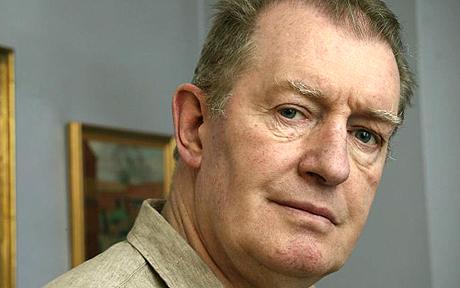
Corin Redgrave was a fine actor and, like his more famous sister, a political activist. I admired his performance in Tennessee Williams’ Not About Nightingales, and in 2003 I interviewed him for the New York Times. At the time, George W. Bush was president and had plunged the United States into war with Iraq under false pretenses. The article never ran at the time. Now, finally, here it is:

CORIN REDGRAVE

The country is at war. From state to state, vastly different values predominate, often driven by religious faith. The economy is perilously volatile. It’s hard to tell who’s running things, politicians or businessmen or the military. Charges of corruption abound, always met by protestations of innocence. We’re talking, of course, about the year 1779, which is the setting for The General from America, Richard Nelson’s play about Benedict Arnold that opened last Thursday at the Lucille Lortel Theatre.

Directed by the author, the production stars Corin Redgrave in the title role of the man whose name is synonymous with traitor and features Jon DeVries as George Washington, the iconic “father of our country.” In Mr. Nelson’s play, these figures from American history and the chaotic time they lived in are portrayed with considerably more complexity than high-school history books usually convey. Were General Arnold’s motives for defecting to the British side purely mercenary, a matter of wounded pride, a gambler’s leap of faith, a retreat from the barbaric colonial mentality to a civilized culture, or all of the above?

The New York production presented by Theatre for a New Audience, which came directly from four weeks of performances at the Alley Theater in Houston, was instigated by Mr. Redgrave. The 63-year-old actor appeared in the original production of The General from America in 1996 at the Royal Shakespeare Company, which commissioned the play. He recommended it to Gregory Boyd, the artistic director of the Alley Theater, where Mr. Redgrave had recently appeared in a Julius Caesar produced by the Moving Theatre, the company he founded with his famous sister Vanessa and his wife, actress Kika Markham. It took a few years to schedule the production — in the meantime, Mr. Boyd produced and Mr. Redgrave starred in Trevor Nunn’s premiere staging of the early Tennessee Williams play Not About Nightingales, which played to rave reviews in London, Houston, and New York. But the delay has served Mr. Nelson’s play well, Mr. Redgrave observed in an interview after the first preview of The General from America.

“In those six years, the play has gained resonance immensely,” said Mr. Redgrave, who is as soft-spoken offstage as he is fiery on. He was sitting in the balcony lounge at the Lortel wearing a black jacket with an anti-war button saying “Not in Our Name” pinned to the lapel. “In 1995 and ‘96, the author was looking at a certain tendency to view things in a Manichean light — black/white, good/evil — and how that can play absolute havoc with people’s sense of where they belong and what they belong to. This seems extraordinarily relevant to me now. You have a president in this country who actually says, ‘You’re either with us or against us.’ This is a dangerous thing to say because it polarizes the world into two opposing camps. The play makes you see how people who might be your intimate ally can be made, by that thinking, into your worst enemy. Benedict Arnold is publicly rebuked by the commander-in-chief for things that he did and didn’t do, but they’re minor compared to what he’s brought to the revolution up until then. So he switches sides. It’s a fantastic subject for a drama.”

Speaking of switching sides, Mr. Redgrave played the brief but dazzling role of Washington in the R.S.C. production, directed by Howard Davies. It was Mr. Nelson who suggested he play Benedict Arnold in the current staging. “I was very, very happy playing Washington,” the actor said. “After scene ten, you can go off to the green room and have a glass of wine and let the rest of your colleagues get on with the play. It’s absolutely wonderful. When Richard said, ‘You must play Arnold,’ I was not sure about it. I had once played Coriolanus, which turns on approximately the same theme, and I found it immensely difficult. Both plays are about men who can’t really account for what they do. They do it in the heat of the moment and figure out afterwards why. They never explain to themselves or others. Which is the way life happens, but it’s difficult to play. Fortunately, I trusted Richard as a director.”

Mr. Nelson, the prolific playwright (Goodnight Children Everywhere, Madame Melville) and Tony Award-winner for his acclaimed adaptation of James Joyce’s The Dead, considers Mr. Redgrave’s performance crucial to comprehending The General from America. In a phone interview, he said, “At the end of the day, the play is about how we should look at the world through the complexity of human lives rather than simple, easy ideas. So you need someone like Corin, who’s able to show the richness and texture of a human being. He can be warm, decent, principled, proud, selfish, blind, thoughtful — the contradictions all human beings have, Corin is able to convey and still be the same person.”
From the deep archives: Chay Yew

April 6, 2010

Seeing Chay Yew’s production of Kia Corthron’s play reminded me that I interviewed him for The Advocate in 1999. I’m re-posting that story here and on my website:

NOTHING COMPARES TO YEW

“Gay theater has become more diverse in terms of aesthetics and stories,” says playwright Chay Yew. “But let’s face it. How many gay plays are being done? Quite a few. Who are they about? Beautiful young white men. And they’re usually not deep. They affirm the image we want of ourselves, or they’re titillating. There’s a place for that, but it’s not my kind of gay theater.”

The 33-year-old playwright, who was born in Singapore but grew up in the U.S., got his first hit of gay theater from seeing Larry Kramer’s The Normal Heart. “I came out utterly moved, rejuvenated, and angry,” he recalls. Still a communications major at Boston University, he wrote his first play, Porcelain, about a young Asian man who kills the would-be lover he meets in a public toilet. His second play, A Language of Their Own (which received a stellar production at New York’s Public Theater in 1995), portrays a gay Asian-American couple who break up when one discovers he’s HIV-positive. Next August the La Jolla Playhouse in San Diego will mount Wonderland, a play in monologue form about an Asian-American couple and their gay son who gets kicked out of the house by his father and takes to drugs and hustling.

Currently on the boards at New York’s Manhattan Theatre Club is Red, in which a best-selling Asian-American novelist tracks down a former star of the Beijing Opera, a gay father famous for playing female roles.

Yew says he originally wanted Red to make a connection between the Cultural Revolution that destroyed a generation of Chinese artists and Newt Gingrich’s attempt to abolish the National Endowment for the Arts. But he also jokes that he wanted to write “a big chinky play” that would impress 60-year-old regional theatergoers. Inevitably, though, “it’s a very gay play,” he says, “because it’s about divas. All the characters are passionate about their art. Sort of like All About Eve.”

April 13, 1999

Performance diary: SONDHEIM ON SONDHEIM, A COOL DIP IN THE BARREN SAHARAN CRICK, and THE BOOK OF GRACE

April 6, 2010


March 31 –
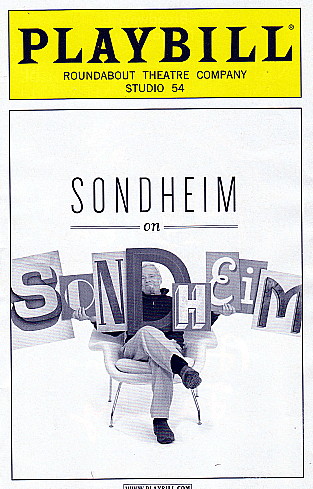
Somehow I thought Sondheim on Sondheim was going to be just a concert, a variation on Side by Side by Sondheim with a somewhat bizarre array of Broadway singers: veteran Barbara Cook, TV star turned trouper Tom Wopat, pop star Vanessa Williams, Taboo star Euan Morton, industry favorite Norm Lewis, and up-and-comers Leslie Kritzer, Erin Mackey, and Matthew Scott. I was shocked when suddenly there was video of Sondheim himself (beautifully shot in high-def) talking about his life, the shows, songwriting, theater, and his collaborators – a cross between a documentary and a master class. It’s a little slow and flat at first. The first act is basically and-then-he-wrote, somewhat generic, a lot of the information pretty familiar to Sondheim fanatics. The second act feels a little less predictable and more substantial. And there are revelations along the way – personal revelations, most notably the composer talking with astonishing intimacy about his relationship with his toxic narcissistic mother Foxy and how Oscar Hammerstein provided the parenting he needed to survive; but also revealing commentary about the shows and his retrospective thoughts about them. Merrily We Roll Along’s Franklin Shepard points directly to Hal Prince (I didn’t realize until intermission that it was a bespectacled and somewhat chubbed-up Euan Morton singing “Franklin Shepard, Inc.” – very well, by the way), and Sondheim says the only song he’s ever written that he would consider strictly autobiographical is “Opening Doors,” which is about his relationship with Mary Rodgers and a composite of Arthur Laurents and Burt Shevelove. He also says that Assassins is the only show of his he can look back on and not find anything he would change – the rendition of “Something Just Broke” delivered by this ensemble is one of several high points. This revue (conceived and directed by James Lapine, whom Sondheim obviously trusts to the nth degree) makes a good case for the underrated Passion in a long sequence featuring Cook as Fosca. She’s ever-so-slightly shaky at times – she is, after all, 82 years old! – but another high point of the evening is Sondheim’s succinct disquisition on the difference between a poem and a song lyric, followed by Cook singing “In Buddy’s Eyes,” which illustrates his points precisely. Vanessa Williams impressively understates “Losing My Mind” (and has the guts to sing it sitting a few feet away from Cook, who’s owned it for years) and does a great job with the song Sondheim wrote for Diana Rigg to sing in the London production of Follies, “Ah, But Underneath.” Andy and I both responded to its fiendishly clever lyric, especially this verse:

In the depths of her interior
Were fears she was inferior.
And something even eerier.
But no one dared to query her superior exterior.

The most emotionally involving portion of the show had to do with the creation of Company, an opportunity for Sondheim to talk about his own experience of relationships, briefly alluding to his conflicted experience of being gay and revealing that he sat Mary Rodgers down and took notes on a yellow legal pad while he interviewed her about her two marriages to collect ideas for the show. And then we get to hear the three different finales he wrote for Company (“Marry Me a Little,” “Happy Ever After,” and “Being Alive”) – something that numerous Sondheim revues have done but never more effectively. I was in tears by the end. For all the zillion times I’ve heard singers belt their way through “Being Alive,” no one has ever sung it better than Norm Lewis (a handsome, super-talented actor-singer who is just one key role away from being a superstar). The climax of the song almost always come across a little screechy, but not in this show – Lewis delivers it so creamily as if the high notes are right in the middle of his range.

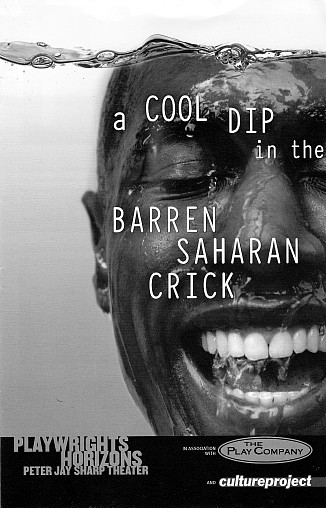
April 2 – Kia Corthron takes on one big sociopolitical issue with each of her plays, and with A Cool Dip in the Barren Saharan Crick it’s water, considered from 19 different points of view. A young theology student from a Ethiopian village with no indoor plumbing can’t stop flushing the toilet even though his host family in suburban West Virginia is trying to be super-conscientious during drought season….dams being built to siphon off and sell electricity after flooding towns and relocating whole populations…bottled water and its implications (the fallacy of safety, empties going to landfill rather than recycling, bottling plants creating jobs but also noise and air pollution)…the commodifying of natural resources…baptism and other spiritual uses for water…Dr. Emoto’s experiments with the impact of positive and negative statements on water samples…all this and more is crammed into the two and a half hour play. Not one of Corthron’s finer moments, sorry to say. The dialogue and exposition are unusually clunky, not helped by playwright-director Chay Yew’s clumsy staging. Cool Dip comes across as a somewhat tedious term paper – not scintillating theater, but I will say I got something out of the term paper. I’m definitely on the same page as Corthron about bottled water and have long been on the same campaign against it. New York City tap water is extraordinarily drinkable, and free! Corthron inevitably asserts influence on everybody’s conscience in her vicinity – the concession stand at Playwrights Horizons sells no bottled water but provides free drinking water and paper cups with a bin for not just recycling but composting the used cups. (see below) Who knows how long that system will continue, but I applaud the effort. I went with Marta, the Norwegian sex therapist, who is gratifyingly game to attend serious drama, even when it’s not great, like tonight. We met Andy afterwards at Marseille and polished off two bottles of a delicious white Bordeaux.

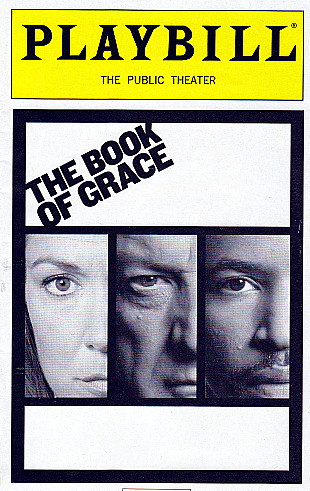
April 3 – Suzan-Lori Parks is another playwright I’m always interested to follow, to see what her quirky poetic theatrical mind is cooking up these days. In recent years she’s veered away from her early Gertrude-Stein-meets-Adrienne-Kennedy explosions toward more conventional drama. She won a Pulitzer for Topdog/Underdog, her most straightforward play, and with The Book of Grace at the Public Theater (formerly titled Snake) she’s strayed into pulpy B-movie territory, fiddling around with clichéd characters in soap-operatic situations with an overlay of less-than-convincing political commentary. I found the play pretty ludicrous and felt sorry for the actors playing Mean White Military Guy (John Doman), Perky Abused-in-Denial Sex-Starved Waitress Wife (Elizabeth Marvel, no less), and Angry Abused Sneaky Criminal Black Guy (Amari Cheatom).