Archive for April, 2010

Quote of the day: HEALING

April 13, 2010

HEALING

Healing is simple, but it is not easy. The steps are few, yet they demand great effort.

Step 1: Commit yourself to healing all the way to the source of the pain. This means turning inward and coming to know your wounds.

Step 2: Once “inside,” identify your wounds. Have they become a form of “wound-power” within your present life? If you have converted your wounds into power, confront why you might fear healing. As you identify your wounds, have someone “witness” them and their influence upon your development. You need at least one person, a therapist or a friend perhaps, who is capable of working with you in this way.

Step 3: Once you have verbalized your wounds, observe how you use them to influence or even control the people around you as well as yourself. Do you ever say you are not feeling well because of them in order to cancel an appointment, for instance, when in fact you are feeling fine? Do you ever control another person by saying that his or her actions remind you of your parents? Do you ever give yourself permission to quit something, or not try at all, by dwelling on your past and therefore encouraging depression? Are you afraid that in healing yourself you will lose your intimate connections to certain people in your life? Are you afraid choosing to heal yourself will require you to leave behind some or much of your familiar life? These are questions you need to address honestly, because they are the most significant cluster of reasons that people fear becoming healthy.

As you observe yourself throughout the day, note carefully your choice of vocabulary, your use of therapeutic language, your fluency in woundology. Then formulate new patterns of interaction with others that do not rely upon wound power. Change your vocabulary, including how you talk to yourself. Should changing these patterns prove difficult, recognize that it is often far more difficult to release the power you derive from your wound than it is to release the memory of the painful experience. A person who cannot let go of wound power is a wound addict, and like all addictions, wound addiction is not easy to break. Don’t be afraid to seek therapeutic help in getting through this step, or any of the others.

Step 4: Identify the good that can and has come from your wounds. Start living within the consciousness of appreciation and gratitude, and if you have to — “fake it until you make it.” Initiate a spiritual practice and stick to it. Do not be casual about your spiritual discipline.

Step 5: Once you have established a consciousness of appreciation, you can take on the challenge of forgiveness. As appealing as forgiveness is in theory, it is an extremely unattractive personal action for most people, mainly because the true nature of forgiveness remains misunderstood. Forgiveness is not the same as telling the person who harmed you, “It’s okay,” which is more or less the way most people view it. Rather, forgiveness is a complex act of consciousness, one that liberates the psyche and soul from the need for personal vengeance and the perception of oneself as a victim. More than releasing from blame the people who caused our wounds, forgiveness means releasing the control that the perception of victimhood has over our psyches. The liberation that forgiveness generates comes in the transition to a higher state of consciousness — not just in theory, but energetically and biologically. In fact, the consequence of a genuine act of forgiveness borders on the miraculous. It may, in my view, contain the energy that generates miracles themselves.

Evaluate what you need to do in order to forgive others — and yourself, if necessary. Should you need to contact anyone for a closure discussion, make sure that you are not carrying the message of blame as a private agenda. If you are, you are not genuinely ready to let go and move on. Should you need to share your closure thoughts in a letter to the person, do so, but again, make sure your intention is to retrieve your spirit from yesterday, not to send yet another message of anger.

Finally, create an official ceremony for yourself in which you call your spirit back from your past and release the negative influence of all your wounds. Whether your prefer a ritual or a private prayer service, enact your message of forgiveness in an “official” way in order to establish a new beginning.

Step 6: Think love. Live in appreciation and gratitude. Invite change into your life, if only through your attitude. And remind yourself continually of the message of all spiritual masters worth their salt: keep your spirit in the present time. In the language of Jesus, “Leave the dead and get on with your life.” And as Buddha taught, “There is only now.”

— Caroline Myss, Anatomy of the Spirit

Performance diary: Marina Abramovic and ANYONE CAN WHISTLE

April 12, 2010

April 8 – Marina Abramovic’s retrospective at MOMA, “The Artist Is Present,” includes many of her intense body-based performances recreated by a squadron of young recruits. There’s the one where two naked performers stand in a doorway so that those wishing to pass from one room to another have to brush against them. (Originally this was the only entrance to a gallery show, and the performers were a naked man and a naked woman. Watching the documentary film adjacent to the current installation, you can witness how most people enter without looking at either performer and most of them choose to face the woman rather than the man. The gender aspect was nullified the day I visited MOMA, when both performers were women. Plus, it’s not the only way into the room so anyone can avoid touching naked people.) There’s “Hair Piece,” in which a man and a woman sit back to back, their long hair tied together. My favorite body piece had a naked man lying on his back with a skeleton lying on top of him; in the same room is a series of films projected onto the wall, one of a dozen naked men humping a grassy field, another of women pulling up their skirts and exposing their crotches to the falling rain. I admire Abramovic’s commitment to the body as art, though the work is very very cerebral, not very erotic or even emotionally compelling. She likes durational pieces, and nothing she’s done before has been quite as demanding as her current residency at MOMA, where she sits in the big rotunda on the second floor at a table (below, in red dress) while visitors come and sit opposite her silently for as long as they want. I perceive it as a form of darshan (that’s when spiritual teachers give audience to their devotees one at a time, usually very briefly), an encounter with the artist or guru as a mirror of oneself. Spectators do seem to be taking it that seriously. When I walked by, two different young somber-looking women sat opposite Abramovic, the two of them staring at one another. The guard told me that some people have been sitting with her for hours at a time and if you don’t get in line by 10:30 am you’re not likely to get your chance that day. In addition to the spiritual presence aspect, there’s something very Warholian about this performance as well – it takes place surrounded by fancy lighting, in the atmosphere of media circus.

I was more taken with the performative aspects of the William Kentridge show, “Five Themes.” His animated films are very beautiful and worth taking the time to sit through. I especially admired “Ubu Tells the Truth,” a fascinating take on South Africa’s Truth and Reconciliation Committee hearings, in which perpetrators of horrendous crimes during the apartheid era were granted amnesty for telling their stories – a theoretically healing process for the country, but paradoxically also a public airing of outrageous brutalities (Ubu-esque is a terrific way of framing them – a reference to Alfred Jarry’s fictional tyrant-clown). There’s also an elaborate hour-long show featuring an adaptation of The Magic Flute on a scale model of an opera stage – something I want to go back and spend more time with another day.

April 11 – Anyone Can Whistle is the kind of show that the Encores! series at City Center was created to present: a flawed musical that flopped in its day, hasn’t been seen much, isn’t really worth a full-scale revival, but has a score that’s worth hearing under circumstances that aren’t too demanding. Most of the time when I go to Encores!, I assume I’m going to see a pretty dumb show with a lame book, but if there are a couple of fine musical numbers and a handful of delightful performances I count myself lucky. Anyone Can Whistle definitely had one of the better casts in my experience: Donna Murphy as Cora Hoover Hooper, the brassy, maniacal mayor of a small-town that needs some kind of miracle — no matter how phony — to survive economically (Angela Lansbury played her originally); Edward Hibbert as Comptroller Schub, her partner in crime; Sutton Foster as Fay Apple, the head nurse at the local psychiatric hospital, sensitively referred to as The Cookie Jar; and Raul Esparza as J. Bowden Hapgood, who arrives in town as a patient and gets mistaken for the doctor-savior whose job is to decide definitively who’s crazy and who’s not.

The premise for Arthur Laurents’ 1964 play (with songs, of course, by Stephen Sondheim) comes straight from the heart of the countercultural ‘60s, when the very notions of sanity and craziness, right and wrong were up for questioning. The play is a kind of fractured fairy tale out of a Nichols-and-May nightclub routine, with the kind of sweetly neurotic mental patients and caricatured crooked authority figures that populated Jean Anouilh’s The Madwoman of Chaillot and the long-running cult film King of Hearts. Simplistic and vaudevillean, and yet Laurents was getting at the arbitrariness of classifying mental illness (after all, he and Sondheim were both gay guys in psychoanalysis at a time when homosexuality was officially designated a mental illness). And the hilarious, crazy way that the townspeople unquestioningly go along with Hapgood’s dividing them up into two factions – the A team and the 1 team, both of whom consider themselves superior – speaks to the fierce us-against-them state of American politics today.

[Further thoughts: Anyone Can Whistle was written right in the midst of the tumultuous civil rights movement, when crazed white racists were bombing black churches and Southern white cops were setting attack dogs on non-violent freedom marchers. And the McCarthy era was fresh in the memory of politically alert New York Jewish artists like Arthur Laurents. Those events are part of the backdrop for songs like “Simple,” which cheerfully trots out a series of syllogism: the opposite of dark is bright, the opposite of bright is dumb, therefore dark = dumb; the opposite of left is right, the opposite of right is wrong, therefore left = wrong. That’s a lot of political content for a musical comedy circa 1964, plus it’s delivered in an edgy, Brechtian way — not by modelling Right Thinking for the audience but by espousing offensive sentiments as if they were acceptable, forcing the audience to actively object rather than sink into the warm bath of agreement. David Gursky, Rob Berman’s assistant musical director for the show, told Andy and me afterwards that Angela Lansbury told the company that at the curtain call for the original production, the actors could totally feel the hatred coming from the audience.]

There’s a lot going on, emotionally and psychologically, amidst the play’s crazy cartoon atmosphere. Certainly, the mayor is a dazzling and entertaining monster, and Donna Murphy had a ball playing some wacky mixture of Jackie Kennedy, Tammy Faye Bakker, Kay Thompson, Ethel Merman, and Barbara Streisand. The always-appealing Sutton Foster got to play both the buttoned-down Nurse Apple and her liberated faux-French alter-ego in red dress and wig. “I love a woman who comes with an accent” was my favorite smutty line, spoken by Raul Esparza, suitably genial and manic as Hapgood. Once considered an obscure Sondheim score, Anyone Can Whistle brims with songs we now call classics: in addition to the title song and “There Won’t Be Trumpets” (which Foster sang with her usual dazzling lucidity), there’s “Everybody Says Don’t” (Esparza) and the ballad I can’t get out of my head, “With So Little to Be Sure Of.”

Playlist: iPod shuffle 4/1/10

April 8, 2010

“Jailhouse Tears,” Lucinda Williams
“This Is How it Goes,” Aimee Mann
“Window Wide Open,” Scritti Politti
“I Don’t Know What to Do,” Pete Yorn & Scarlett Johnasson
“Bad Body Double,” Imogen Heap
“Love Is No Big Truth,” Kings of Convneience
“My Medea,” Vienna Teng
“The Cell,” Erykh Badu
“Snake Song,” Emmylou Harris
“I’ve Done Everything I Can,” Rodney Crowell
“Take What You Take,” Lily Allen
“Dance with Me,” the Sweet Remains
“Nothing Else Matters,” Aqualung
“Mary,” Patty Griffin
“Experiment Music Love,” Magnetic Fields
“Chelsea Hotel, No. 2,” Rufus Wainwright
“Young Girl,” Dawn Landes
“The Body Breaks,” Devendra Banhart
“Low Rising,” the Swell Season
“Blue Rose,” Lizz Wright
“Driving,” Patty Griffin
“What Becomes of the Brokenhearted,” Joan Osborne
“The Time has Come,” Michael Feinstein & Cheyenne Jackson
“King of Nails,” Sparklehorse
“Campfire (Hisham Bharoocha & Rusty Santos Remix),” Grizzly Bear
“Take Me to the Backseat,” the Donnas
“Random Acts of Senseless Violence,” David Sylvian
“A Nightingale Sang in Berkeley Square,” Manhattan Transfer
“Someday Soon,” KT Tunstall
“Heartbroken,” Meaghan Smith
“Clever Disguise,” Eliza Gilkyson

Quote of the day: DEPRESSION

April 8, 2010

DEPRESSION

The phrase “dark night of the soul”…was originally used by St. John of the Cross, a Carmelite monk who wrote in the sixteenth century…By John’s definition the dark night of the soul is not something that happens to spiritual beginners. He is fairly indulgent of novices, allowing for a spiritual honeymoon period in which you have glimpsed a goal – such as enlightenment or “union with God” in the Carmelite context – and you have focused your life more or less on the pursuit of it. There is a feeling that you’re improving and that, with enough hard work, you will achieve your goal. But then the dark night comes along and changes that.

John breaks down the dark night into two parts: the “dark night of the senses” and the “dark night of the spirit.” The dark night of the senses hits at the point where you have milked your initial enthusiasm for all it’s worth, and you’re starting to realize that reaching your goal is going to take a lot more work than you suspected. You’re going to have to renounce habitual ways of thinking and doing. The dark night of the senses is about living with the dryness of that, living without the traditional pleasures. Again, John of the Cross is assuming a level of austerity that’s daunting to any contemporary reader; it might even sound morbid and anti-life. But if you’ve ever wrestled with the issues of distraction, then you know what he’s talking about: how do you get your mind to stop running after meaningless desires and come home to what actually serves our ultimate happiness?

Tim Farrington, interviewed in The Sun

Photo diary: spring forward

April 8, 2010

the seder plate at Randall's

Mostafa

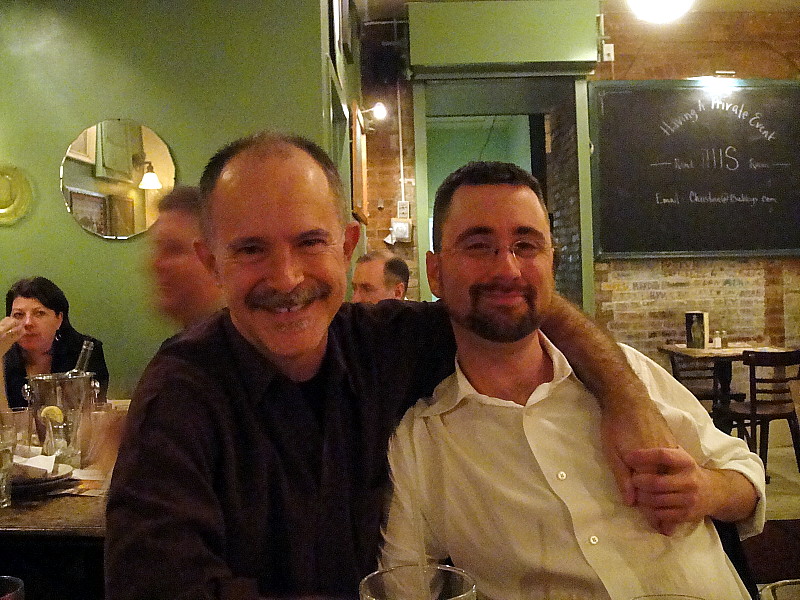
Don and Andy at Bubby's

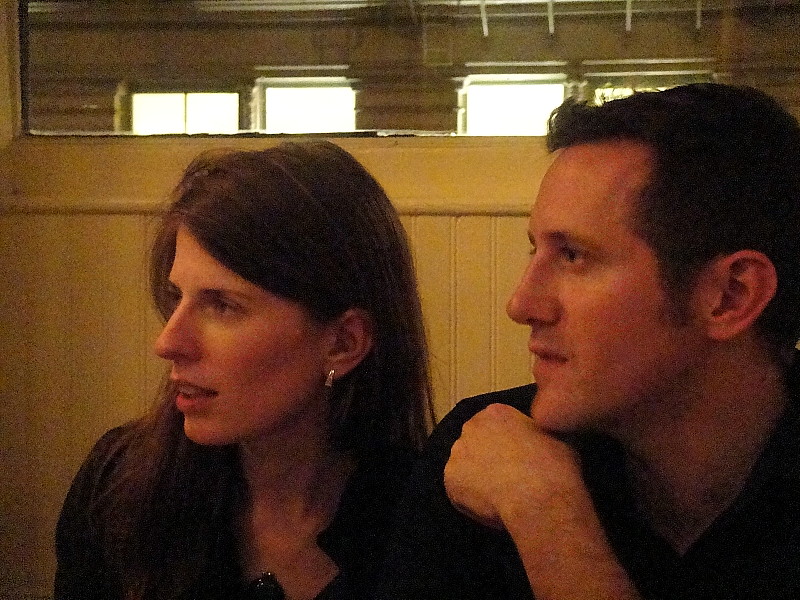
Morgan and Mike

my favorite cherry tree in Central Park, always the first to bloom