



Archive for April, 2010
Photo diary: 4/24/10
April 24, 2010
Quote of the day: LUST
April 24, 2010LUST
The man who arranges himself in a sling, awaiting anointing with Crisco, has come in perfect love and trust like a child to baptism. Lust can be a sacrament that washes us clean of envy, pride and anomie, and returns us to daily life with a satisfied heart, renewed hope and greater compassion. The mouth is not the only orifice that generates poetry; we must learn to listen to the hymns of our other openings, other lips. If “gay literature” did no more than rescue our genitals from revulsion, and celebrate them instead, it would be heroic.
— Pat Califia in POZ magazine, October 1998
Playlist: Laura Nyro, “Mercy on Broadway”
April 24, 2010I’m very happy with this little video I made in iMovie — a tribute to one of my favorite lesser-known Laura Nyro songs, from New York Tendaberry.

Performance diary: AMERICAN IDIOT
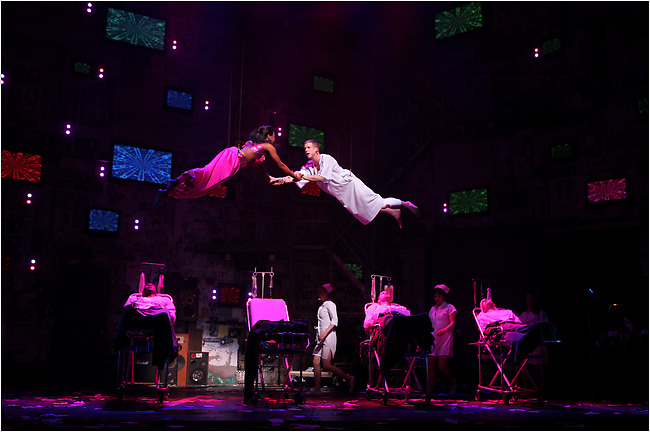
April 21, 2010April 16 – OK, American Idiot. Spectacular staging by Michael Mayer, who masterminded Spring Awakening, my favorite musical of the last 10 years and one of the most exciting and influential Broadway shows in recent memory. Mayer has his usual weaponry with him: dazzling set by Christine Jones, an art installation I’d be happy to visit on its own, pocked with 37 TV sets creating a Big Brother rec room from hell; state-of-the-art theatrical rock-concert lighting by Kevin Adams; smart original choreography by Steven Hoggett (who organized the memorable movement stuff in Black Watch); real rock ‘n’ roll played by an onstage band (with arrangements by Tom Kitt of Next to Normal fame); fantastically energetic performances by a young cast of all different sizes and shapes.
 That much was exciting to me for about half the show. But ultimately the Green Day songs just didn’t hold up as theatrical storytelling for me. I don’t know the album, so the words weren’t familiar to me, and they don’t really read from the stage. The songs are peppy and melodic but eventually they start to run together – there’s one strand of angry white-boy blare and another strand of acoustic emo ballad. Mayer has taken Green Day’s catalogue and shaped a storyline to thread the songs together, focusing on three main characters: John Gallagher’s Johnny aka Jesus of Suburbia, who flees the suburbs for the big city to make it as a musician but has more success as a junkie and a half-hearted lover (his girlfriend, the impressive Rebecca Naomi Jones, is known only as Whatsername); Will, who would have joined that expedition but got his girlfriend pregnant so stays home planted on the sofa watching TV (the sadly underutilized Michael Esper); and Tunny, who (in a witty sequence) gets mesmerized by an Army recruitment video, goes to Iraq, gets his leg blown off, and comes home with a wheelchair and his nurse-wife. (Tunny is played by Stark Sands, for me the finest performance in the show and he gets to do an aerial ballet with his Extraordinary Girl that isn’t exactly like “Can You Feel the Love Tonight” — see below.) Unfortunately, these stories come off as too generic to be really interesting – they’re sort of generational archetypes, like the characters in Twyla Tharp’s Billy Joel show Movin’ Out. Recognizable and forgettable at the same time.
I wanted to love this show but couldn’t quite get there. Still, I admire Michael Mayer’s fierce devotion to channeling the defiance, anger, confusion, and hormonal power of youth into an alive theatrical canvas. And I respect the conceptual arc of the show – the title starts off as a reference to George W. Bush and his misguided “redneck agenda” but winds up referring to Johnny himself, who has to face the consequences of his own idiotic actions and consider what else is possible now.

From the deep archives: Michael Mayer
April 20, 2010On the occasion of the Broadway opening of American Idiot, I resurrected an interview I did with director Michael Mayer in 1998 for The Advocate — back before Spring Awakening, when he’d just directed the fantastic revival of Arthur Miller’s A View from the Bridge starring Anthony LaPaglia and Alison Janney.

Michael Mayer is in a quandary. We’re sitting in a Chelsea diner near where he lives with his Jewish doctor boyfriend, and he’s brooding over the morning’s New York Times. On one hand, there’s an article announcing that Triumph of Love, the musical that he’d nurtured since its conception and that became his Broadway debut as director, would be closing after an all-too-brief run. On the other hand, there’s a two-column full-page ad for his revival of Arthur Miller’s A View from the Bridge quoting the rave reviews it had just received.
Sad as it is to watch a favorite show go down the tubes, just having two shows on Broadway at the same time is enough to establish 37-year-old Mayer as a director to watch. He’s been on a roll since 1993, when his former New York University classmate Tony Kushner invited him to direct a student production of Perestroika, the second part of Kushner’s Pulitzer-winning gay epic Angels in America, at their alma mater. The Broadway producers were sufficiently impressed to hire Mayer to direct the national touring company of Angels the following year, which put him on the map. Since then he’s worked almost nonstop, frequently with prominent gay writers such as Craig Lucas (Missing Persons) and the late Howard Ashman (the revue Hundreds of Hats).
Staging both an intimate vaudevillean musical and a Greek tragedy transposed to ‘50s Brooklyn would be a fun challenge for any director, and Mayer feels his secure gay identity has been an asset to both projects. What interested him about James Magruder’s translation of Triumph of Love, Pierre Marivaux’s gender-bending 18th-century comedy about a female Don Juan who woos both men and women in pursuit of her true love, was “the cultural flypaper aspect of camp sensibility.” Throwing in Tin Pan Alley references and openly acknowledging the diva worship that surrounds a star like Betty Buckley, Mayer and Magruder were “amusing ourselves, which is what gay people have always done, because who else will do it?”
Meanwhile, Mayer brought a ‘90s bluntness to View, whose main character, consumed by an illicit passion for his niece, projects his sexual confusion onto his wife’s Italian immigrant cousin, whom he brands as queer. “In the ‘50s the audience had no distance from Eddie’s psychological problems,” says Mayer. “You couldn’t acknowledge homophobia because there wasn’t anything else going on in the culture. The difference now is that we’re more visible.”
Growing up in Bethesda, Md., Mayer experienced his share of “typical suburban homophobia: being called faggot, being shoved every day in the hall, things written on my locker.” Luckily, his parents were supportive. “I mean, hello — when I was 8, I woke up one morning to find the double-album Judy at Carnegie Hall on my pillow.”
Those memories of gay adolescence will come in handy next spring when Mayer directs John C. Russell’s Stupid Kids, “a queer re-telling of Rebel without a Cause featuring two gay teenagers, a boy and a girl, who form a union that is their safe haven in a world that is at best indifferent and at worst really hostile.” Lest anyone pigeonhole him as one kind of director, though, Mayer’s also working with lesbian playwright Paula Vogel (How I Learned to Drive) on a revival of On a Clear Day You Can See Forever.
 another eye opens